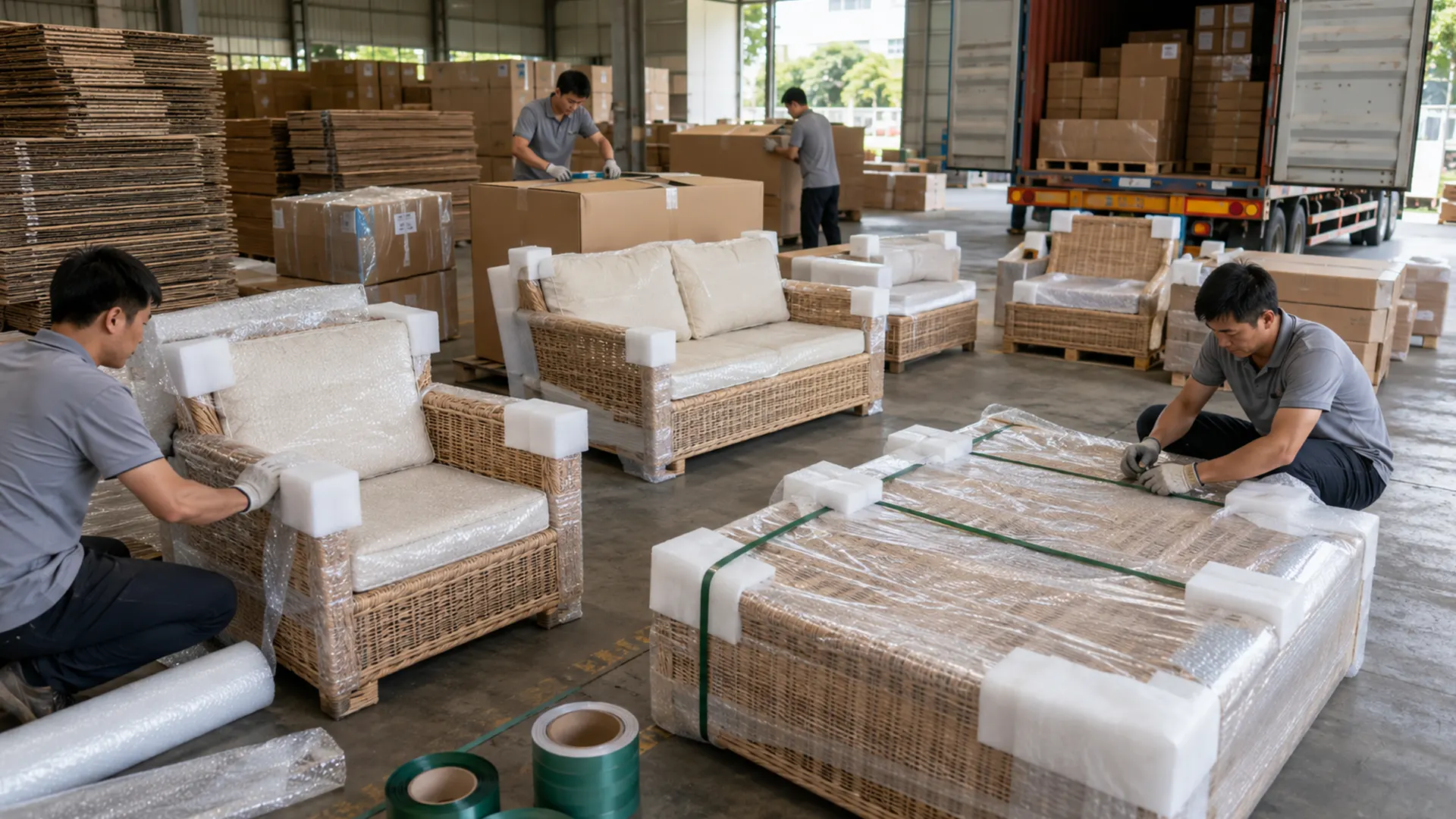
 Guía para compradores de Rattan Export: Embalaje De Exportación Para Muebles De Ratán: Cajas, Envoltura Y Protección.
El embalaje de exportación para muebles de ratán debe proteger el producto durante la manipulación en fábrica, carga del container, transporte marítimo, operaciones portuarias, transporte interior, recepción en almacén y posteriores movimientos de distribución. Para importadores, mayoristas, distribuidores, cadenas retail, hospitality buyers y equipos de project procurement, el packaging forma parte del product engineering y del control del landed cost.
Un buen precio FOB puede perder su ventaja si un embalaje insuficiente genera arañazos, tejido comprimido, patas rotas o daños por humedad. Al mismo tiempo, un embalaje excesivo aumenta packed CBM, reduce container utilization y eleva freight por unidad.
El objetivo no es usar la mayor cantidad posible de material. El objetivo es crear el paquete export más compacto que proteja el producto de forma fiable.
Los buyers que trabajan dentro del entorno vietnamita de producción de ratán y fibras naturales deberían definir las especificaciones de packaging durante product development y quotation.
Por Qué El Rattan Necesita Packaging Específico
- Rayaduras en el acabado
- Marcas de presión en el tejido
- Grietas en curvas o joints
- Patas o partes salientes rotas
- Binding damage
- Armrests deformados
- Moisture y mold
- Cushion contamination
- Carton crushing
- Missing KD hardware
Comenzar Con Risk Assessment
Antes de seleccionar carton o wrapping, identificar puntos de contacto, piezas salientes, superficies sensibles, joints estructurales y componentes desmontables.
Primary Y Secondary Protection
La protección primaria está en contacto con el product. La secundaria es el outer transport package.
Surface Wrapping
- Soft protective sheets
- Foam sheets
- Non-abrasive wrapping
- Paper protection
- Plastic film cuando corresponda
- Fabric sleeves
El material no debe manchar, marcar o rayar el finish.
No Embalar Material Natural Húmedo
El packaging no resuelve un problema de moisture. Si rattan o bamboo se cierran húmedos, puede aumentar mold risk.
Moisture condition y packaging approval deberían integrarse en el proceso de control de calidad y pre-shipment inspection.
Proteger Primero Los Contact Points
- Chair legs
- Armrest edges
- Top rails
- Table corners
- Cabinet corners
- Bindings
- Feet
- Nesting contact points
Leg Protection
Sleeves, foam, cardboard guards o reinforced bottom corners pueden proteger las patas.
Corner Protection
Tables, cabinets y muebles de marco cuadrado pueden necesitar protectores rígidos.
Weaving No Debe Soportar Stacking Load
Heavy cartons no deberían presionar directamente sobre woven seats o decorative panels. Las cargas deberían transferirse por el frame.
Binding Protection
Las ligaduras expuestas deben protegerse en puntos de roce.
Carton Design Alrededor Del Product
- Length
- Width
- Height
- Gross weight
- Units/carton
- CBM/carton
- Orientation
- Required carton strength
Un oversized carton desperdicia volumen y uno demasiado ajustado transmite impactos.
Single-Unit Cartons
Pueden ser adecuados para lounge chairs grandes, accent furniture, cabinets o productos con limited nesting.
Multi-Unit Cartons
- Fewer cartons
- Better nesting
- Lower CBM/unit
- Fewer handling units
Nested Chair Cartons
El carton debe seguir la protected nesting geometry y proteger real contact points.
KD Packaging
- Main frame
- Legs
- Tabletop
- Supports
- Hardware pack
- Assembly instructions
- Cushions
Hardware Control
Hardware debe contarse, embolsarse, identificarse y fijarse dentro del carton.
Assembly Instructions
Deben corresponder a la final production version y al destination market.
Cushion Packaging
Los cushions deben protegerse contra dust, moisture y abrasion. Su volumen forma parte del final CBM.
No Usar Cushions Como Structural Buffer
La compresión prolongada puede dañar foam y upholstery.
Glass, Stone Y Fragile Components
- Rigid support
- Edge guards
- Separators
- Dedicated cartons
- Orientation marks
Retail Packaging vs Export Packaging
Retail packaging prioriza marca, barcode e información. Export packaging prioriza protección, stacking, CBM e identificación logística.
Carton Marking
- Product name
- SKU
- PO number
- Colour/finish
- Quantity
- Carton number
- Gross weight
- Net weight cuando corresponda
- Carton dimensions
- Origin marking cuando corresponda
- Handling symbols
- Barcode
Orientation Y Stacking Marks
Los cartons con requisitos de orientación o stacking limits deben estar claramente identificados.
Carton Strength
La especificación depende de product weight, dimensions, stack height, transit duration, humidity y handling. No existe un carton grade universal.
Oversized Cartons Elevan Freight
Unos pocos centímetros adicionales multiplicados por cientos de cartons pueden aumentar mucho el CBM. Packaging design debe integrarse en el proceso de container, freight y export planning.
Under-Packing También Puede Costar Más
Reducir demasiado el material puede aumentar damage, replacement y claims.
Moisture Protection
- Dry cartons
- Clean packing area
- No packing inmediatamente después de wet finishing
- Appropriate moisture checks
- Container inspection
- Desiccants cuando sean apropiados
Los desiccants no sustituyen un product correctamente acondicionado.
Plastic Wrapping Con Cuidado
La película plástica protege contra dust pero puede atrapar moisture.
Los Cartons También Deben Estar Secos
Un product seco puede absorber moisture de un corrugated carton húmedo.
Container Condition
- Clean
- Dry floor
- No holes
- No water ingress
- No abnormal odor
- Doors working
Protection During Loading
- No dragging innecesario
- No throwing
- Respect orientation
- No heavy loads sobre fragile cartons
- Control voids
- No forced loading
Palletized vs Floor-Loaded
Los pallets mejoran handling pero consumen volumen. Muchos furniture containers se floor-load para maximizar CBM.
Mixed Containers
El loading team debe saber qué cartons son strong, crushable, upright-only o fragile.
Packaging Y Loading Deben Diseñarse Juntos
La mejor solución equilibra protection, CBM efficiency, stacking, handling y destination unpacking.
Test Packaging Antes De Mass Production
- Fit de protective materials
- Contact points
- Carton dimensions
- Closure
- Internal movement
- Ease of unpacking
- Hardware location
- Final CBM
Verify Production Units
No basta el golden sample; deben comprobarse varias production units.
Handling Y Drop Tests
Cuando el buyer los requiera, deberían seguir protocolos definidos.
Document Packaging Approval
- Photos
- Wrapping sequence
- Protection locations
- Units/carton
- Hardware location
- Carton dimensions
- Carton weight
- Markings
- CBM
Packaging Changes Requieren Review
Más foam o cartons mayores requieren recalcular CBM, units/container y freight/unit.
Private Label
Branded cartons, labels, care instructions, barcodes y model codes deben definirse temprano porque afectan artwork, cost y lead time.
Sustainability
Recyclability y plastic reduction son objetivos válidos, pero no deberían aumentar damage.
Packaging Y Landed Cost
- Material cost
- Labor cost
- Packed CBM
- Units/container
- Damage rate
- Destination handling
- Waste disposal
Illustrative Comparison
| Option | Protection | Relative CBM | Risk |
|---|---|---|---|
| Minimal wrap + loose carton | Low | Low-medium | Higher damage |
| Targeted protection + fitted carton | High | Efficient | Balanced |
| Heavy protection + oversized carton | Very high | High | Higher freight |
RFQ Packaging Data
- Packing method
- Units/carton
- Final carton dimensions
- Gross/net weight
- CBM/carton
- CBM/unit
- Protective materials
- Nesting method
- KD component packing
- Hardware packing
- Cushion packing
- Carton marking options
- Private-label capability
- 20ft, 40ft y 40HC estimates
Errores Comunes
- Packing de furniture húmedo
- Abrasive wrapping
- No proteger nesting contact points
- Weaving bajo stacking pressure
- Oversized cartons
- Weak cartons
- Loose hardware
- No proteger legs y corners
- Ignorar cushion volume
- Wet cartons
- Cambiar packing después de loading calculation
- No documentar approved method
Export Packaging Checklist
| Area | Confirm |
|---|---|
| Product | Dry, clean, ready |
| Surface | Non-abrasive protection |
| Legs/corners | Impact protected |
| Weaving | No excessive compression |
| Bindings | Protected contact points |
| Carton | Correct dimensions and strength |
| KD hardware | Counted and secured |
| Cushions | Protected and included in CBM |
| Moisture | Product, carton and container checked |
| Marking | Correct SKU and PO |
| CBM | Final dimensions recorded |
| Approval | Packing method documented |
Preguntas Frecuentes
¿Cada mueble necesita individual carton?
No. Nested chairs y compatible products pueden usar multi-unit cartons o protected bundles.
¿Más packaging siempre es más seguro?
No. Puede aumentar CBM y freight sin mejorar proporcionalmente la protección.
¿Plastic wrapping previene mold?
No. Puede atrapar moisture si el product se embala húmedo.
¿Cómo proteger weaving?
Evitar rubbing y prolonged compression, transfiriendo cargas por el frame.
¿Cuándo finalizzare packaging?
Debe definirse temprano y confirmar final packed dimensions después de sample approval.
¿Cuál es el best carton size?
El que se ajusta al protected product de forma compacta y segura.
¿Cuándo inspect packaging?
Durante sample approval, production y pre-shipment inspection.
Good Export Packaging Protects Product And Margin
El packaging influye directamente en quality, container utilization, freight por unidad, claims y landed cost.
Si está comprando rattan, bamboo o natural-fibre furniture para shipments de 20ft, 40ft o 40HC y quiere incluir packaging specs en la quotation, puede enviar su wholesale RFQ, product specifications y target quantities para evaluar packing, CBM y container-loading requirements antes de production.