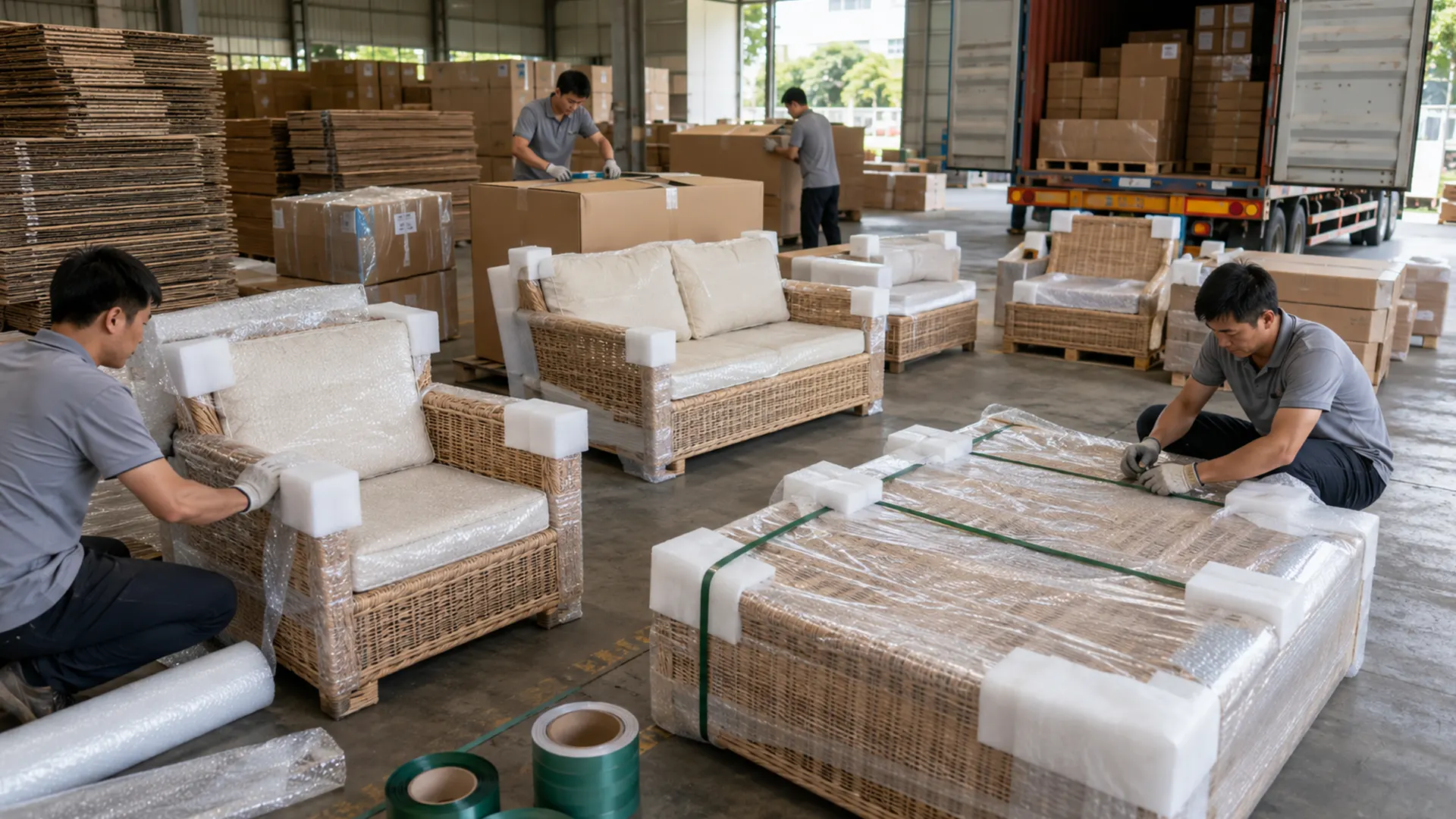
 Rattan Export buyer guide: Export Packaging For Rattan Furniture: Cartons, Wrapping And Protection.
Export packaging for rattan furniture has to do much more than make a product look ready for shipment. It must protect the furniture through factory handling, container stuffing, ocean transport, port operations, inland trucking, warehouse receiving and sometimes several additional distribution movements before the product reaches a store, hotel, project site or final customer.
For importers, wholesalers, distributors, retail chains, hospitality buyers and project procurement teams, packaging is therefore part of product engineering and landed-cost control. A chair with an attractive FOB price can become commercially expensive if insufficient packaging creates scratched finishes, crushed weaving, broken legs or moisture damage. At the same time, excessive packaging can increase packed CBM, reduce container utilization and raise freight cost per unit.
The objective is not maximum packaging. The objective is the smallest practical export package that protects the product reliably without creating unnecessary volume, weight, labor or waste.
Buyers working with suppliers in the Vietnam rattan and natural-fibre manufacturing environment should therefore define packaging requirements during product development and quotation, rather than leaving them until the container is ready to load.
Why Rattan Furniture Needs Product-Specific Packaging
Rattan furniture differs from many rigid industrial products because it combines structural frames with woven surfaces, bindings, natural fibres, curved elements and decorative finishes. Different parts of the same product may require different protection.
Typical risks include:
- Scratches and rubbing on finished frames
- Compression marks on woven surfaces
- Cracks at bends or joints
- Broken chair legs or projecting elements
- Damaged bindings
- Deformed armrests or backrests
- Moisture absorption and mold development
- Cushion contamination
- Carton crushing during stacking
- Hardware loss in KD products
A single generic wrapping method is therefore rarely suitable for every SKU.
Packaging Should Begin With A Risk Assessment
Before selecting carton thickness or wrapping material, classify how the product can be damaged.
Ask:
- Which parts touch the floor during handling?
- Which surfaces contact another unit during nesting?
- Which edges project outside the main frame?
- Which areas are decorative and visually sensitive?
- Which joints carry structural loads?
- Which components are detachable?
- Will cartons be stacked?
- Will the product be manually handled or moved with equipment?
This allows protection to be placed where it is actually required.
Primary Protection vs Secondary Protection
Export packaging can be considered in two layers.
Primary protection touches or closely surrounds the furniture and protects the finish, weaving and individual components.
Secondary protection forms the transport package, such as the outer carton, multi-unit carton or protected bundle.
A good export package combines both layers without allowing one to substitute for the other.
Surface Wrapping
Surface wrapping protects furniture from rubbing, dust and minor handling marks.
Depending on the product and buyer specification, protection may include:
- Soft protective sheets
- Foam sheets
- Non-abrasive wrapping
- Paper-based protective material
- Plastic film where appropriate
- Fabric sleeves for selected components
The material touching a finished surface should not create staining, imprinting or abrasion during prolonged contact.
Do Not Wrap Natural Materials While They Are Still Damp
Wrapping does not solve a moisture problem. If rattan, bamboo, wood or other natural fibres are packed before they have been appropriately conditioned, tightly enclosed packaging can trap moisture and increase mold risk.
Products should be dry and suitable for packing before protective layers are applied.
Moisture condition, finished-product inspection and packaging approval should be integrated into the buyer's wider quality-control and pre-shipment inspection process.
Protect High-Contact Areas First
Not every surface needs the same amount of material. High-contact areas often include:
- Chair legs
- Armrest edges
- Top rails
- Table corners
- Cabinet corners
- Exposed bindings
- Feet and glides
- Nested frame contact points
Targeted protection can reduce both damage and unnecessary packed volume.
Leg Protection
Furniture legs are vulnerable because they may be exposed to impact during factory movement, carton handling and container loading.
Protection may include:
- Individual sleeves
- Foam wrapping
- Cardboard guards
- Reinforced bottom corners
Leg protection should remain secure during transit and should not create excessive pressure on the finish.
Corner Protection
Dining tables, coffee tables, cabinets, headboards and square-frame furniture often require reinforced corners.
Corner protection can help distribute impact and prevent the outer carton from directly transferring force to the product.
The size and rigidity of the protector should match the weight and vulnerability of the item.
Protect Woven Surfaces Differently From Structural Frames
Woven rattan panels should not be treated like structural beams. Heavy pressure against woven seats, cabinet doors or decorative panels can cause permanent distortion.
Packaging should prevent:
- Heavy cartons pressing directly onto weaving
- Frame edges cutting into woven surfaces
- Nested units rubbing against the weave
- Tight wrapping compressing decorative patterns
When possible, compression loads should be transferred through stronger frame areas.
Binding Protection
Rattan bindings may cover joints and also form part of the visual design. Repeated rubbing can loosen or fray them.
Protective material should be added to exposed binding zones when those areas contact cartons or adjacent products.
Carton Design Should Follow The Product
The carton should be designed around the final protected product configuration. A generic oversized carton wastes container volume, while a carton that is too tight can transfer impact directly to the furniture.
Buyers should confirm:
- Carton length
- Carton width
- Carton height
- Gross weight
- Units per carton
- CBM per carton
- Stacking orientation
- Carton strength specification where relevant
Single-Unit Cartons
A single-unit carton can provide good individual protection and simpler warehouse receiving.
It may be suitable for:
- Large lounge chairs
- Delicate accent furniture
- Cabinets
- High-value finished items
- Products with limited nesting potential
The disadvantage is that individual cartons may create more packaging material and higher CBM.
Multi-Unit Cartons
Several chairs, stools or smaller products can sometimes be packed in one carton.
Potential advantages include:
- Lower carton count
- Better nesting efficiency
- Lower packed CBM per unit
- Fewer warehouse handling units
However, the buyer should monitor carton weight, internal pressure and manual-handling practicality.
Nested Chair Cartons
Dining chairs and stools may be nested and then protected as one multi-unit pack. The carton should follow the final nested geometry closely.
Protection should be placed between actual frame contact points so that freight efficiency is not achieved at the cost of scratched finishes or compressed weaving.
Knock-Down Packaging
KD furniture requires a different packaging system because multiple components and hardware must arrive together and remain protected.
A KD carton may contain:
- Main frame
- Legs
- Tabletop
- Cross supports
- Hardware pack
- Assembly instructions
- Cushions
Components should not move freely inside the carton.
Hardware Packs Must Be Controlled
Missing screws, bolts or fittings can make an otherwise perfect product unsaleable.
Hardware should therefore be:
- Counted
- Bagged securely
- Labeled where necessary
- Fixed to a controlled position inside the carton
- Protected from scratching visible furniture surfaces
For complex OEM products, buyers may also require hardware checklists.
Assembly Instructions
KD furniture should include instructions appropriate for the destination market and buyer program.
Instructions should match the approved production version. A packing change that moves hardware or changes assembly sequence may require updated instructions.
Cushion Packaging
Cushions and textile components should be protected from dust, moisture and abrasion.
Depending on the design, cushions may be:
- Packed inside the chair frame
- Packed within the same carton
- Compressed where the material specification allows it
- Packed separately and cross-referenced to the furniture SKU
Cushion placement can materially affect CBM and should be included in the final container calculation.
Avoid Using The Cushion As Structural Packaging
Cushions should not be used as the only protective buffer between heavy frame components unless the design has been validated. Prolonged compression can damage foam or upholstery.
Glass, Stone And Other Fragile Components
Some rattan furniture combines natural fibres with glass, mirrors, ceramic, stone or other fragile materials.
These components require separate protection logic and may need:
- Rigid support
- Edge guards
- Internal separators
- Dedicated component cartons
- Orientation markings
Heavy fragile parts should not move within the carton.
Retail Packaging vs Export Packaging
Retail packaging and export packaging are not always the same.
A retail carton may prioritize:
- Brand presentation
- Barcodes
- Product information
- Consumer handling
- Store-ready appearance
An export carton prioritizes:
- Transit protection
- Stacking performance
- Container efficiency
- Warehouse identification
- International handling
Many private-label programs require both objectives in one package.
Carton Marking
Export cartons should contain the identification required by the buyer and shipment program.
Typical data may include:
- Product name
- SKU
- Purchase order number
- Colour or finish
- Quantity
- Carton number
- Gross weight
- Net weight where required
- Carton dimensions
- Country-of-origin marking where required
- Handling symbols
- Barcode where applicable
Actual legal marking requirements depend on the destination market and product.
Orientation Marks
Products that must remain upright should carry clear orientation instructions.
This is particularly important for:
- Cabinets
- Glass-top furniture
- Furniture with loose internal parts
- Large decorative panels
Stacking Marks And Limits
If a carton has a stacking limit, the warehouse and container-loading team should be able to identify it clearly.
Do not rely on carton appearance alone to determine whether it is safe to place another carton above it.
Carton Strength Matters
Outer cartons must withstand the handling and stacking conditions expected in the logistics chain.
The correct carton specification depends on:
- Product weight
- Carton dimensions
- Stack height
- Transit duration
- Humidity exposure
- Handling method
There is no single carton grade suitable for every rattan product.
Reinforced Cartons
Large or heavy products may require reinforced areas, stronger board construction or additional internal support.
Reinforcement should be positioned where the load actually transfers through the carton.
Oversized Cartons Increase Freight Cost
A carton that is only a few centimeters larger than necessary can appear insignificant. Repeated across hundreds of units, the additional volume can materially increase total CBM and reduce container utilization.
Packaging design should therefore be connected to the wider container, freight and export-planning process.
Under-Packing Can Cost More Than Extra Packaging
Reducing carton dimensions aggressively can lower CBM, but insufficient protection can produce higher damage rates.
The commercial comparison should include:
- Packaging cost
- Freight cost
- Expected damage rate
- Replacement cost
- Claims administration
- Customer dissatisfaction
The lowest-cost package is the one with the best total economic outcome, not necessarily the one using the least material.
Moisture Protection
Natural rattan and other plant-based materials are sensitive to moisture conditions. Export packaging should therefore be applied only after the product has reached an appropriate condition for packing.
Possible controls can include:
- Dry cartons
- Clean packing area
- Avoiding packaging directly after wet finishing processes
- Appropriate moisture checks
- Container inspection before loading
- Desiccants or container moisture-control products where appropriate
Moisture-control products should be considered supplementary protection, not a cure for damp furniture.
Plastic Wrapping Must Be Used Carefully
Plastic film can protect against dust and surface contamination, but tightly wrapping damp natural-material furniture can trap moisture.
The buyer should define when plastic is appropriate and whether ventilation or alternative protection is needed.
Cartons Must Also Be Dry
Even dry furniture can absorb moisture from damp corrugated cartons. Carton storage before packing therefore matters.
Container Condition Is Part Of Packaging Protection
A perfectly packed product can still be damaged if loaded into a wet or unsuitable container.
Before stuffing, check:
- Interior cleanliness
- Floor dryness
- Visible holes
- Signs of water ingress
- Strong abnormal odor
- Door condition
Protection During Container Loading
Packaging cannot compensate for poor loading practices.
During stuffing:
- Do not drag cartons unnecessarily
- Do not throw furniture cartons
- Respect orientation
- Protect fragile cartons from heavy loads
- Control empty spaces
- Do not force oversized cartons into gaps
Void Management
Large gaps between cartons can allow movement during transport. The loading plan should minimize uncontrolled voids while avoiding dangerous compression.
Palletized vs Floor-Loaded Furniture
Some buyers may use pallets, while many container-based furniture programs are floor-loaded to maximize cube utilization.
Pallets can improve handling but consume additional container volume. The preferred method depends on buyer requirements, destination warehouse systems and product risk.
Packaging For Mixed Containers
Mixed containers may include chairs, tables, cabinets, baskets and decorative products with very different carton strengths.
The loading team should understand:
- Which cartons are structurally strong
- Which are crushable
- Which must remain upright
- Which can be used as top-load cartons
- Which contain fragile materials
Packaging Should Support The Loading Plan
Packaging design and container loading should not be developed independently.
A package can be strong in isolation but inefficient in a container. Another can have excellent CBM but poor stacking strength.
The best solution balances:
- Protection
- CBM efficiency
- Stackability
- Handling
- Destination unpacking
Test Packaging Before Mass Production
For new OEM or ODM products, buyers should approve the packing method during sampling or pre-production whenever practical.
The test should review:
- Fit of protective materials
- Contact points
- Carton dimensions
- Carton closure
- Product movement inside carton
- Ease of unpacking
- Hardware location
- Final CBM
Use Production Units For Verification
A golden sample may fit perfectly inside a carton while mass-production units show dimensional variation. Packaging should therefore be verified with several production units when possible.
Packaging Drop And Handling Tests
Depending on buyer requirements, product type and distribution channel, packaging may be subjected to defined handling or drop-test protocols.
The required test method should be specified by the buyer or applicable program rather than assumed universally.
Packaging Approval Should Be Documented
The approved specification can include:
- Photos of each protection layer
- Wrapping sequence
- Protection locations
- Units per carton
- Hardware location
- Carton dimensions
- Carton weight
- Carton markings
- CBM
This prevents uncontrolled packaging changes after quotation.
Packaging Changes Require Commercial Review
If the supplier adds thicker foam, a larger carton or additional internal protection, the product may become safer but also more expensive to ship.
Any material change should therefore trigger a review of:
- CBM per carton
- CBM per unit
- Units per container
- Freight allocation per unit
Private-Label Packaging
Private-label buyers may require branded cartons, labels, care instructions, barcodes, model codes and retail information.
These requirements should be supplied early because they affect:
- Artwork approval
- Printing lead time
- Carton cost
- Production schedule
- Packing workflow
Sustainability Considerations
Buyers may choose packaging materials based on recyclability, plastic reduction or corporate sustainability requirements.
However, reducing material should not increase product damage. Replacing one protective system with another should be validated through practical testing.
Packaging And Landed Cost
Packaging affects landed cost in several ways:
- Direct material cost
- Labor cost
- Packed CBM
- Units per container
- Damage rate
- Destination handling
- Waste disposal or recycling
A slightly more expensive packaging design can create lower total landed cost if it reduces damage without increasing CBM excessively.
Illustrative Packaging Comparison
| Packaging Option | Protection | Relative CBM | Commercial Risk |
|---|---|---|---|
| Minimal wrap, loose carton | Low | Low to medium | Higher damage risk |
| Targeted wrap + fitted carton | High | Efficient | Balanced |
| Heavy protection + oversized carton | Very high | High | Higher freight cost |
This table illustrates planning logic only. Actual packaging should be product-specific.
What Importers Should Request In An RFQ
Packaging information should be part of the quotation request.
Ask for:
- Packing method
- Units per carton
- Final carton dimensions
- Gross and net weight
- CBM per carton
- CBM per unit
- Protective material description
- Nesting method where relevant
- KD component packing
- Hardware packing
- Cushion packing
- Carton marking options
- Private-label packaging capability
- Estimated 20ft, 40ft and 40HC loading quantities
Common Export Packaging Mistakes
- Packing furniture before it is adequately dry
- Using abrasive wrapping on finished surfaces
- Failing to protect nesting contact points
- Allowing weaving to carry stacking pressure
- Using oversized cartons
- Using cartons that are too weak for stacking
- Leaving hardware loose inside KD cartons
- Failing to protect projecting legs and corners
- Ignoring cushion volume
- Using wet or damaged cartons
- Changing packaging after loading quantities were calculated
- Failing to document the approved packing method
Export Packaging Checklist
| Area | Buyer Should Confirm |
|---|---|
| Product condition | Dry, clean and ready for packing |
| Surface protection | Non-abrasive material on sensitive areas |
| Legs and corners | Protected against handling impact |
| Weaving | No excessive compression |
| Bindings | Protected at contact points |
| Carton | Appropriate dimensions and strength |
| KD hardware | Counted, secured and identified |
| Cushions | Clean, protected and included in CBM |
| Moisture | Product, carton and container condition checked |
| Marking | Correct SKU, PO and handling information |
| CBM | Final packed dimensions recorded |
| Approval | Packaging method documented before shipment |
Frequently Asked Questions
Should every rattan furniture item have an individual carton?
No. Some products benefit from individual cartons, while nested chairs, stools or compatible items may use multi-unit cartons or protected bundles. The correct method depends on product risk and buyer requirements.
Is more packaging always safer?
No. Additional material can improve protection but may also increase CBM, freight cost and pressure on the product. Packaging should be targeted and tested.
Can plastic wrapping prevent mold?
No. Plastic can protect against dirt and surface contamination, but it can trap moisture if the furniture is packed damp. Moisture condition must be controlled before packing.
How should woven surfaces be protected?
They should be protected from rubbing and prolonged compression. Structural stacking loads should preferably transfer through stronger frame sections.
Should packaging be finalized before the quotation?
At least the intended packing method should be defined early. Final packed dimensions may be confirmed after sample approval, but any change can affect CBM and container quantity.
What is the best carton size?
There is no universal size. The best carton fits the final protected product closely while allowing safe handling and adequate protection.
When should packaging be inspected?
During sample or pre-production approval when possible, again during production for consistency, and during pre-shipment inspection before container loading.
Good Export Packaging Protects Both Product And Margin
Export packaging for rattan furniture is not merely a final warehouse activity. It affects quality, container utilization, freight allocation, customer claims, warehouse handling and final landed cost.
The strongest packaging systems are engineered around the actual product. They protect exposed legs, corners, finishes, bindings and woven surfaces; secure KD hardware and cushions; control moisture risk; use cartons with appropriate strength; and avoid unnecessary empty volume.
For container-based buyers, packaging should always be considered together with loading efficiency. The commercial objective is not to use the least material or the most material. It is to deliver the maximum practical number of saleable products per container in the required condition.
If you are sourcing rattan, bamboo or natural-fibre furniture for 20ft, 40ft or 40HC shipments and need packaging specifications included in your quotation, send your wholesale RFQ, product specifications and target quantities so packing, CBM and container-loading requirements can be evaluated before production is finalized.