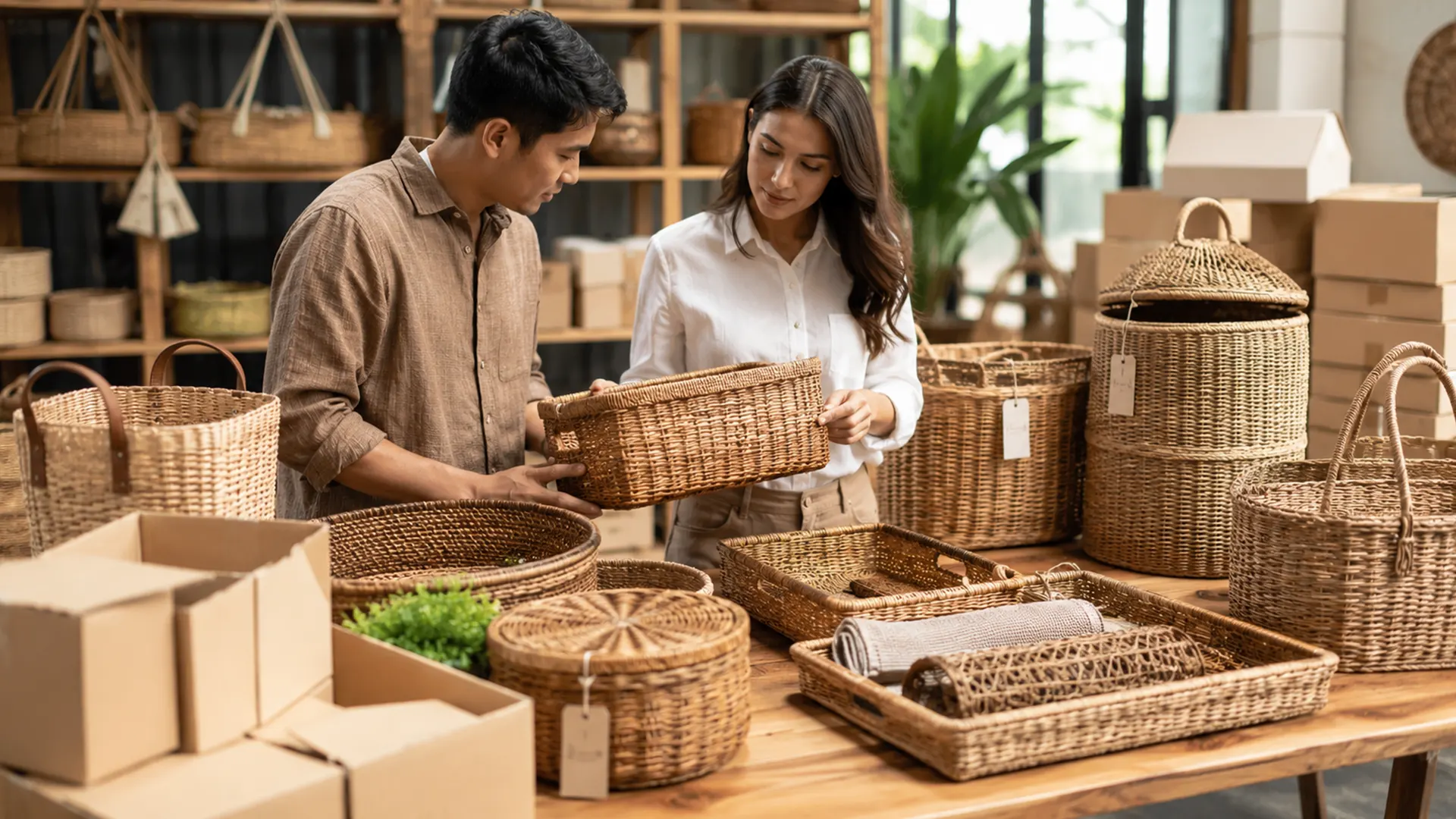
 Rattan Export buyer guide: Wholesale Rattan Baskets And Storage Products: Buyer Guide.
Wholesale rattan baskets and storage products can be highly efficient commercial products when they are designed, packed and loaded correctly. Unlike large furniture, many baskets are lightweight, hollow and capable of nesting inside one another, which creates significant opportunities to reduce CBM and improve container utilization. At the same time, poor nesting, weak handles, distorted rims, excessive compression, unstable shapes, uncontrolled moisture or inefficient retail packaging can quickly remove that advantage. For importers, wholesalers, distributors, retail chains, hospitality buyers and private-label programs, basket sourcing should therefore connect product design, dimensional control, quality standards, packaging and container planning from the beginning.
Within the Vietnam rattan, bamboo and natural-fibre production ecosystem, wholesale baskets may be produced from natural rattan, bamboo, seagrass, water hyacinth or combinations of fibres with timber, metal, fabric and other components. The correct material depends on the product's intended use, appearance, strength requirements and target market. Buyers should define the actual construction rather than using broad terms such as “natural basket” without technical detail.
Wholesale Basket And Storage Categories
A commercial collection may include:
- Storage baskets
- Laundry hampers
- Lidded baskets
- Open storage bins
- Shelf baskets
- Under-bed storage baskets
- Planter baskets
- Market baskets
- Handled baskets
- Tray baskets
- Bathroom storage
- Kitchen storage
- Toy-storage baskets
- Hotel and resort amenity baskets
- Retail display baskets
- Nested decorative basket sets
The sourcing criteria change according to whether the product is primarily decorative, load-bearing, frequently handled or expected to fit a specific shelf, cabinet or retail fixture.
1. Start With Intended Use
A buyer should first define what the basket is expected to do. A decorative planter cover does not need the same handle performance as a market basket carrying weight. A laundry hamper may require a lid and removable liner, while a shelf basket may need highly controlled dimensions so multiple pieces align neatly within furniture.
The RFQ should therefore identify:
- Intended use
- Approximate load where relevant
- Indoor or covered-use environment
- Need for handles
- Need for lid
- Need for liner
- Target shelf or cabinet dimensions where relevant
2. Material Choice Changes Appearance And Performance
Natural rattan can offer structural strength and relatively defined shapes. Seagrass can provide softer woven texture. Water hyacinth can create thicker, more substantial surfaces. Bamboo may be used for frames, slats or woven elements. Some products combine a rigid internal metal frame with natural-fibre weaving.
Buyers should confirm which material is:
- Structural
- Decorative
- Used for handles
- Used for rims
- Used for the base
A visually similar basket can have very different durability depending on the hidden frame and base construction.
3. The Internal Frame May Be More Important Than The Visible Weave
Some storage baskets rely on:
- Thick rattan stakes
- Bamboo supports
- Metal wire frames
- Timber bases
- Reinforced rim structures
The frame controls whether the basket remains square, round or rectangular during use and transport. Buyers should not evaluate only the exterior weaving.
4. Basket Dimensions Must Be Defined Clearly
For wholesale programs, specify:
- Overall length
- Overall width
- Overall height
- Inside usable dimensions where important
- Handle height
- Lid height
- Base dimensions
For tapered baskets, both top and bottom dimensions may be necessary.
5. Handmade Production Still Requires Dimensional Tolerances
Natural-fibre baskets are handmade or partly handmade, so minor variation is normal. However, uncontrolled dimensions can create serious commercial problems when products must:
- Fit shelving
- Fit furniture compartments
- Stack or nest
- Use standard liners
- Fit individual retail cartons
The approved sample should define realistic tolerances for critical measurements.
6. Tapered Geometry Can Improve Nesting
A basket with a slightly narrower base than top may allow one unit to fit partially inside another. This can substantially reduce packed volume.
However, the taper should not compromise:
- Usable internal storage
- Stability
- Visual proportions
- Retail function
Product design and logistics should be optimized together.
7. Nesting Is The Main Container Advantage Of Many Basket Programs
Because baskets are hollow, shipping them completely separated can waste significant volume. Nesting allows multiple saleable units to occupy less space than the same number packed individually.
The buyer should request:
- Number of units per nested group
- Height of the nested group
- Protective material between units
- CBM per group
- CBM per saleable unit
8. Maximum Nesting Is Not Always The Best Nesting
Pushing too many baskets tightly together can cause:
- Rim distortion
- Compressed weaving
- Broken fibres
- Handle damage
- Difficulty separating products at destination
The best nesting ratio is the maximum quantity that can be packed safely while preserving saleable condition.
9. Use Separators At Contact Points
Nested products may rub against each other during transport. Depending on the finish and material, suppliers may need protective paper, tissue, sleeves or other suitable separators.
Protection should focus on:
- Rims
- Handles
- Painted surfaces
- Decorative bindings
- Metal components
10. Set Packing Can Be Extremely Efficient
Small, medium and large baskets are often sold as coordinated sets. When designed properly, the smaller pieces can fit inside the larger basket.
A buyer should calculate:
- CBM per packed set
- Number of saleable baskets per set
- CBM per individual saleable basket
- Retail value of the full set
This can produce strong container efficiency when the retail assortment also benefits from graduated sizes.
11. Nested Sets Need Size Differences That Actually Work
A three-piece set should not be created simply by reducing dimensions randomly. Each smaller basket needs sufficient clearance to fit inside the next size after:
- Weaving variation
- Protective material
- Liners
- Handles
- Lids where relevant
The entire production set should be physically tested before mass production.
12. Handles Are A Major Quality Point
Handles may be:
- Integrated woven handles
- Wrapped rattan handles
- Timber handles
- Leather or synthetic straps
- Metal handles
The handle attachment should match the intended use. A decorative handle does not automatically qualify as a load-bearing handle.
13. Handle Attachment Needs Structural Review
Check:
- Attachment depth
- Reinforcement
- Binding quality
- Symmetry
- Movement under load
- Sharp edges or exposed fasteners
If the basket is intended to carry meaningful weight, an appropriate product-specific load assessment should be defined.
14. Rim Construction Controls Shape
The upper rim is often one of the most visible and structurally important parts of a basket. A weak or uneven rim can cause the product to appear distorted even if the weaving itself is acceptable.
Inspect:
- Roundness or squareness
- Rim thickness
- Joint quality
- Binding consistency
- Symmetry
15. The Base Must Match The Intended Load
Bases may be woven, reinforced with rattan, bamboo, timber, board or metal. Storage products carrying books, toiletries, toys or laundry may require more support than lightweight decorative baskets.
The buyer should inspect the basket both empty and under intended use conditions where relevant.
16. Square And Rectangular Baskets Need Strong Dimensional Control
Rectangular storage products often need to align with:
- Shelving systems
- Cube-storage furniture
- Cabinet openings
- Retail displays
If the side walls bow outward, the basket may no longer fit even though the base dimensions are correct.
17. Round Baskets Need Consistent Diameter
Round baskets may be more forgiving visually, but inconsistent diameter affects nesting, lids and liners.
Top diameter, base diameter and overall height should be checked when these dimensions are commercially important.
18. Lids Need Their Own Fit Standard
A lid should:
- Sit evenly
- Align with the basket
- Open and close without excessive resistance
- Remain stable during handling
Natural variation should not result in lids that interchange poorly across production units unless the product is specifically made as matched individual sets.
19. Hinged Lids Add More Components And Risk
Hampers with hinged lids may use:
- Textile hinges
- Natural-fibre bindings
- Metal hinges
- Leather-type straps
Opening angle, fastener security and repeated-use durability should be reviewed during sample approval.
20. Liners Can Add Commercial Value
Fabric liners are common in laundry, nursery, bathroom and storage baskets.
The buyer should define:
- Fabric composition
- Colour
- Weight or construction where required
- Removable or fixed design
- Closure method
- Care label
- Fit allowance
21. Liner Dimensions Must Match Production Baskets
A liner developed only from one hand-made sample may fit poorly if production basket dimensions drift.
Critical basket and liner dimensions should therefore be controlled together.
22. Planter Baskets Need Special Attention
Decorative planter baskets are often used around an inner pot. The buyer should confirm whether the basket itself is intended to contact water.
Unless specifically engineered otherwise, a natural-fibre planter basket should not automatically be treated as waterproof.
Requirements may include:
- Removable internal liner
- Plastic insert
- Raised base
- Protected floor contact
23. Storage Baskets With Metal Frames Can Hold Shape Well
Hidden metal frames can improve consistency in rectangular or tall baskets.
Inspect:
- Welds
- Coating
- Sharp ends
- Frame position
- Rust-related requirements where relevant
24. Mixed-Material Products Need Clear Specifications
A basket may combine natural fibre with:
- Timber
- Metal
- Fabric
- Leather-type components
- Synthetic liners
Each additional material creates its own quality, sourcing and compliance questions.
25. Weaving Density Affects Both Cost And Appearance
Denser weaving generally requires more material and labour. Open weaving may reduce material use but can change strength, visibility of stored contents and visual style.
Buyers should specify:
- Pattern
- Spacing
- Strand type
- Desired density
26. Weaving Tension Should Be Consistent
Loose weaving can make walls appear uneven and may reduce durability. Excessively tight weaving can distort a flexible frame.
The approved sample should establish the desired appearance.
27. Natural Colour Variation Should Be Defined
Natural-fibre baskets can vary in tone. Buyers should separate acceptable natural character from defects.
Potentially unacceptable conditions may include:
- Mold
- Severe uncontrolled discoloration
- Large stains
- Contamination
- Burnt fibres
- Broken structural strands
28. Moisture Management Is Critical
Natural-fibre storage products can be vulnerable to mold, odour and dimensional change when stored or packed under unsuitable conditions.
Drying, storage, material condition, finish curing and packaging readiness should be included in the quality-control and pre-shipment inspection process.
29. Do Not Pack Damp Products To Meet A Shipping Date
Production schedules should leave enough time for the material and any finish to reach suitable packing condition. A vessel booking should not override moisture and curing controls.
30. Finished Surface Quality Matters On High-Touch Products
Storage baskets are frequently handled. Inspect for:
- Sharp fibre ends
- Splinters
- Rough bindings
- Exposed wires
- Loose handles
- Finish transfer
Customer-contact areas need particular attention.
31. Final Packed Dimensions Matter More Than Product Dimensions For Freight
Request:
- Carton or pack length
- Width
- Height
- Units or sets per carton
- Gross weight
- CBM per carton
- CBM per saleable unit
These numbers should be based on the final approved packing method.
32. CBM Per Saleable Unit Is The Best Comparison Metric
When baskets are nested, CBM per carton alone can be misleading. A large carton holding many nested units may be extremely efficient.
Comparing CBM per saleable unit helps buyers evaluate different:
- Designs
- Suppliers
- Set configurations
- Packaging systems
33. Product Geometry Matters More Than Simple CBM Arithmetic
Two cartons with equal CBM can use container space very differently because of their proportions.
Practical loading is affected by:
- Carton length and width
- Container door clearance
- Stacking strength
- Void space
- Mixed-SKU arrangement
34. 20ft Containers Can Suit Focused Basket Programs
A 20ft container may work for a controlled assortment or an initial order. However, because baskets are frequently cube-limited, buyers should compare freight cost per saleable unit against larger container options.
35. 40ft Containers Offer More Assortment Flexibility
A larger container may make it easier to combine:
- Different basket sizes
- Multiple colours
- Laundry hampers
- Planter baskets
- Storage bins
- Other natural-fibre products
36. 40HC Can Be Useful For Lightweight Volumetric Products
Additional internal height can be valuable when cartons can be safely stacked to use it. However, basket cartons and nested sets still have compression limits.
Theoretical height is not useful if lower cartons become crushed or products deform.
37. Bulk Packing Can Reduce CBM
Wholesale programs may use:
- Nested groups
- Master cartons
- Protective sleeves
- Minimal outer cartons where commercially acceptable
This can improve freight efficiency, but destination handling and retail requirements must be considered.
38. Retail Packaging Can Increase CBM Significantly
Retail chains may require individual cartons, belly bands, hangtags, labels, inserts or protective bags.
These can improve:
- SKU control
- Shelf presentation
- Barcode handling
- Customer protection
but may reduce nesting efficiency and increase packaging volume.
39. Decide Retail Packaging Before Final Container Planning
A loading plan based on bulk nested baskets may become invalid if individual retail cartons are added later.
Product development, packaging development and container planning should therefore be connected.
40. Mixed-SKU Containers Work Well For Baskets
Because basket collections usually include multiple sizes and functions, mixed containers can support a broad commercial assortment.
However, the loading plan should identify:
- SKU
- Colour
- Size
- Sets per carton
- Total cartons
- CBM
41. Similar Sizes Need Clear Identification
A medium and large basket may look nearly identical after packing. Cartons and product labels should clearly distinguish size and SKU.
42. Colour Variants Need Separate Control
Natural, washed, stained, painted or mixed-colour products should have:
- Distinct SKU codes
- Carton markings
- Approved colour references
- Correct loading quantities
43. Private-Label Programs Need Artwork And Revision Control
Private-label basket programs may require:
- Brand labels
- Hangtags
- Care labels
- Barcode labels
- Printed cartons
- Packaging inserts
The buyer should control artwork versions and ensure obsolete labels are not used on repeat orders.
44. Barcode Placement Should Be Practical
Labels should remain readable without damaging the natural surface or being placed where they are easily removed during handling.
For nested sets, confirm whether each individual unit or only the set requires separate identification.
45. Hospitality Buyers May Need Special Dimensions
Hotel and resort storage baskets may need to fit:
- Wardrobes
- Bathroom shelves
- Minibar areas
- Amenity stations
- Laundry spaces
Project dimensions should be confirmed using technical drawings rather than approximate photographs.
46. Retail Buyers Need Repeatability Across Reorders
Repeated programs should maintain:
- SKU dimensions
- Nesting relationship
- Colour range
- Handle design
- Liner specification
- Packaging format
A physical approved sample and written specification are useful controls.
47. Storage Capacity Should Be Considered Alongside External Size
A thick rim or strongly tapered wall can reduce usable internal space even when external dimensions look large.
For functional storage products, the buyer may want to verify internal usable dimensions or volume.
48. Do Not Optimize Shipping Until The Product Stops Working
Making a basket narrower, more tapered or more flexible may improve nesting but reduce storage capacity, stability or retail appeal.
The best solution balances:
- Function
- Appearance
- Durability
- CBM
- Retail value
49. FOB Prices Should Be Compared On Equal Construction
A cheaper basket may use:
- Thinner material
- Less reinforcement
- Lower weaving density
- Simpler handles
- No liner
- Weaker packaging
Buyers should normalize the specification before comparing suppliers.
50. Compare Total Commercial Cost
Important elements include:
- FOB per unit
- CBM per unit
- Freight allocation
- Packaging cost
- Expected damage risk
- Retail preparation
- Replacement risk
A basket with slightly higher FOB can create lower landed cost if it nests more efficiently and arrives in better condition.
51. Sample Approval Should Include The Complete Packing System
Do not approve only one attractive basket. Review:
- Production dimensions
- Nesting
- Handles
- Liner
- Lid
- Labels
- Protection
- Carton dimensions
For sets, approve the entire nested combination.
52. Pre-Shipment Inspection Should Measure Critical Dimensions
Inspectors may check:
- Top dimensions
- Base dimensions
- Height
- Handle position
- Lid fit
- Nesting compatibility
The inspection criteria should use the agreed commercial tolerances.
53. Inspection Should Include Functional Checks
Depending on the product:
- Lift handled baskets
- Open and close lids
- Install liners
- Check flatness and stability
- Verify nesting and separation
54. Carton Counts And Set Ratios Must Be Reconciled
For nested sets and mixed SKUs, final inspection should confirm:
- Correct number of small, medium and large units
- Correct colour combinations
- Correct labels
- Correct cartons
A missing component can make an entire retail set unsaleable.
55. Empty Container Condition Matters
Before loading natural-fibre goods, the container should be checked for obvious problems such as visible water ingress, strong odours, serious contamination or major structural damage.
56. Loading Should Respect Compression Limits
Nested baskets may look robust but can still distort under heavy vertical pressure.
The container-loading and export plan should consider carton strength, stacking height, weight distribution and the position of heavier mixed products.
57. Heavy Furniture Should Not Crush Basket Cartons
In mixed containers, baskets can sometimes use residual space around larger furniture. This can be efficient, but lightweight basket cartons should not be placed where furniture loads can deform them.
58. Loading Evidence Helps Receiving Control
Records can include:
- Container number
- Seal number
- Loading photographs
- Final carton quantity
- SKU distribution
Wholesale Basket And Storage Buyer Checklist
| Area | Buyer Should Confirm |
|---|---|
| Intended use | Storage, laundry, planter, retail display or decorative use |
| Material | Rattan, bamboo, seagrass, water hyacinth or mixed construction |
| Frame | Hidden supports, rim construction and base reinforcement |
| Dimensions | Top, base, height, internal size and agreed tolerances |
| Handles | Design, attachment and intended load |
| Lid | Fit, alignment and hinge system where applicable |
| Liner | Fabric, fit, removability and care information |
| Nesting | Units per group, protection and ease of separation |
| Set packing | Correct relationship between graduated sizes |
| Quality | Weaving, moisture, mold, sharp ends, shape and workmanship |
| Packaging | Bulk, master-carton or retail-carton method |
| CBM | Per carton, set and saleable unit |
| Identification | SKU, size, colour, barcode and private-label requirements |
| Loading | 20ft, 40ft or 40HC plan using final packed dimensions |
Common Buyer Mistakes
- Buying by appearance without defining intended use
- Ignoring hidden frame construction
- Not defining critical dimensions
- Assuming handmade means any dimensional variation is acceptable
- Maximizing nesting until products distort
- Ignoring handle strength
- Approving lids without checking production fit
- Developing liners before controlling basket dimensions
- Treating planter baskets as automatically waterproof
- Ignoring moisture and mold risk
- Comparing FOB without comparing material and weaving density
- Using product dimensions instead of packed dimensions for container planning
- Adding retail packaging after the loading calculation
- Mixing similar sizes without strong SKU marking
- Failing to inspect complete nested sets before shipment
Frequently Asked Questions
Which material is best for wholesale storage baskets?
There is no single best material. Natural rattan, bamboo, seagrass and water hyacinth provide different appearance, rigidity, texture and cost characteristics. Selection should follow the product's intended use and approved specification.
Can wholesale baskets be nested for shipping?
Yes, many basket designs can be nested very efficiently. Taper, handles, rims, liners and protective materials determine how deeply and safely products can nest.
How many baskets fit in a container?
There is no universal number. Final packed dimensions, nesting ratio, set configuration, carton strength, mixed-SKU plan and actual loading geometry determine capacity.
Is 40HC good for basket shipments?
It can be useful for lightweight cube-limited products when cartons can safely use the additional internal height. Stacking strength and deformation risk must still be considered.
Should baskets be shipped in individual cartons?
Not always. Bulk nesting or master cartons may provide better container efficiency, while retail programs may require individual packaging. The correct method depends on the buyer's distribution model.
Can baskets be made to custom dimensions?
Yes, subject to material behaviour and production feasibility. Critical dimensions and tolerances should be agreed before sampling and mass production.
Can rattan planter baskets hold water?
Natural-fibre baskets should not automatically be considered waterproof. If water containment is required, an appropriate inner pot, liner or insert should be specified and tested.
What should be included in a basket RFQ?
Include product drawings or references, dimensions, material, weave, handles, lid, liner, colour, quantity, nesting expectations, packaging requirements and target container type.
The Best Basket Programs Treat Empty Space As A Logistics Asset
Wholesale rattan baskets and storage products offer a logistics advantage that many furniture categories do not: their internal empty volume can often be used for nesting. When the product geometry, handles, rims, liners, lids and protection are designed together, that empty space can materially reduce CBM per saleable unit and improve container economics.
That advantage disappears when products are over-compressed, dimensions are uncontrolled, retail packaging is added too late or weak frames distort under stacking pressure. The strongest buying programs therefore optimize the complete system rather than only the basket itself.
Before confirming container production, buyers should work from approved samples, controlled dimensions, tested nesting, final packaging, SKU-level CBM and a realistic loading plan.
If you are developing wholesale, retail, hospitality, OEM, ODM or private-label rattan baskets and storage products in Vietnam, send your product references or drawings, dimensions, material preferences, target quantities, nesting requirements and preferred container type so construction, packing and container utilization can be evaluated before quotation and production.