 Rattan Export buyer guide: How Nesting And Stackable Design Reduce Rattan Furniture Shipping Costs.
Nesting and stackable design can materially reduce the shipping cost of rattan furniture because they improve one of the most important variables in container-based sourcing: how much saleable product can be loaded into a fixed amount of container space. For importers, wholesalers, distributors, retail chains, hospitality buyers and project procurement teams, this means product geometry can influence landed cost almost as much as the quoted FOB price.
Rattan furniture is often lightweight relative to its physical volume. Chairs, stools, lounge furniture and occasional tables may reach the practical volume limit of a 20ft, 40ft or 40HC container long before the maximum payload is reached. When a design can nest inside another unit or stack efficiently without damaging the frame, finish or weaving, the packed CBM per saleable unit can fall substantially. More units can then travel in the same container, reducing freight allocation per unit.
This guide explains how nesting and stackable design work, how they differ, how they affect packed CBM and container utilization, what buyers should evaluate during OEM development, and how to avoid reducing shipping cost at the expense of product quality.
Why Rattan Furniture Shipping Cost Is Often Driven By Volume
Many rattan products are relatively light but occupy a large three-dimensional envelope. A chair may have four legs, a wide seat, curved arms and a high back. Much of the space inside that shape is air, but if another chair cannot safely occupy part of the same envelope, the importer effectively pays ocean freight to transport unused space.
This is why professional buyers should look beyond the product's bare dimensions and examine how the furniture behaves when packed. A supplier may offer an attractive FOB price, but if the product uses container space inefficiently, its landed cost can be higher than a more expensive alternative with better nesting or stacking geometry.
Buyers sourcing from Vietnam should therefore evaluate product design, manufacturing capability and packing logic together within the broader Vietnam furniture sourcing and production process.
What Is Nesting?
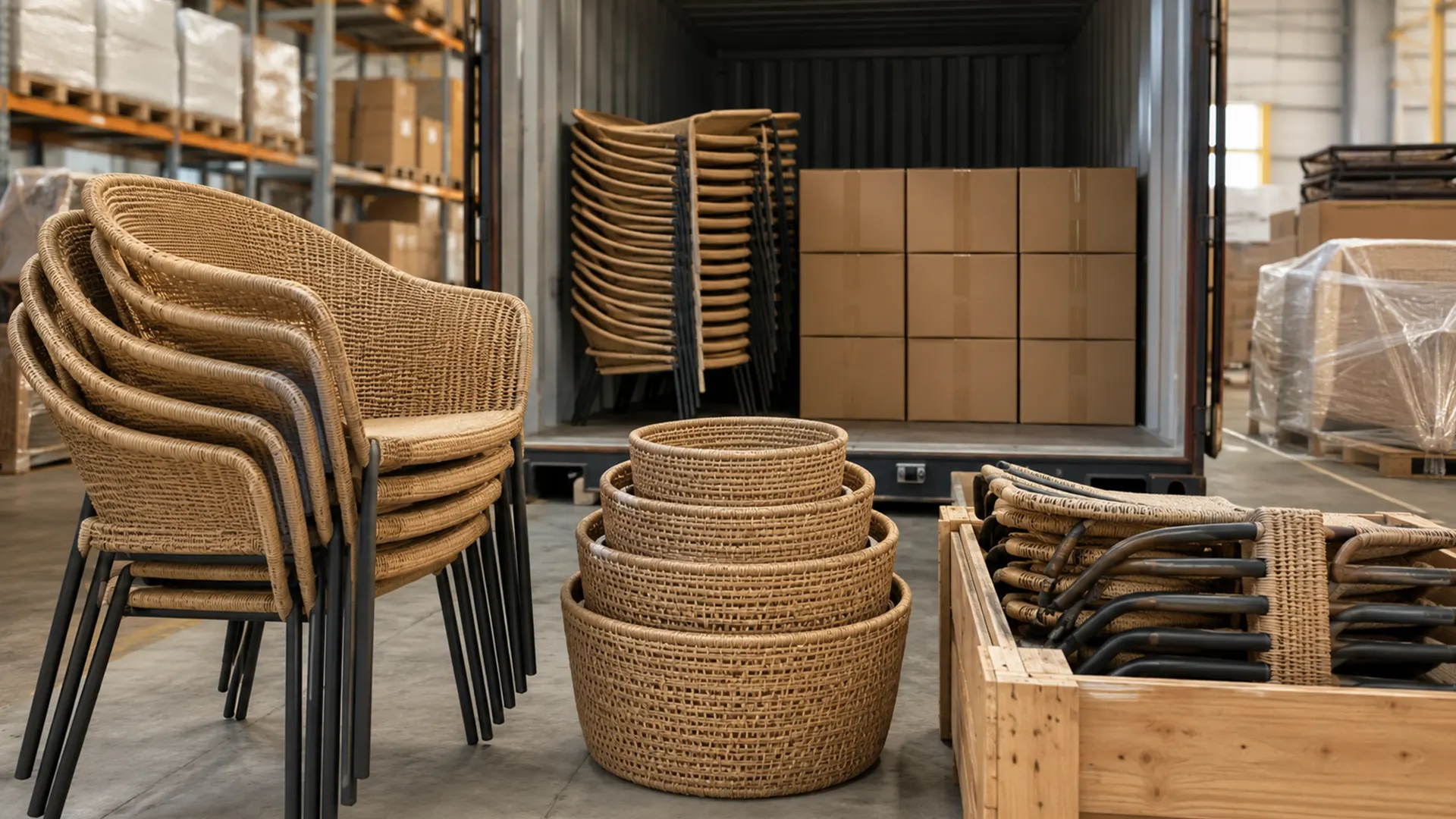
Nesting means that one furniture unit fits partially inside another unit of the same or compatible design. The products overlap in three-dimensional space rather than sitting completely separately.
Common examples include:
- Dining chairs that slide partially inside one another
- Stools that nest in a vertical stack
- Side tables designed in graduated dimensions
- Lounge chairs with open frame geometry allowing controlled overlap
- Baskets or natural-fibre accessories that fit inside one another
For shipping purposes, the key advantage is that the second, third or fourth unit does not require the same full additional volume as the first.
What Is Stackable Design?
Stackable furniture is designed so that one unit can be placed on top of another in a stable and repeatable configuration. The products may not overlap deeply like nested units, but the vertical stack uses space efficiently and safely.
A stackable chair may have:
- Leg geometry that avoids collision with the chair below
- Frame contact points that transfer weight safely
- Backrest angles that allow repeatable stacking
- Protective gaps between woven surfaces
- A stable center of gravity when several units are stacked
Stacking can improve warehouse handling as well as container utilization, but the maximum safe stack height must be tested rather than assumed.
Nesting vs Stackable Design
| Feature | Nesting | Stackable Design |
|---|---|---|
| Space reduction method | Units overlap inside each other | Units are arranged vertically in a repeatable stack |
| Typical CBM benefit | Can be substantial where overlap is deep | Depends on stack geometry and carton configuration |
| Primary engineering issue | Prevent rubbing and pressure at contact points | Transfer vertical load through safe structural areas |
| Common products | Chairs, stools, tables, accessories | Dining chairs, event chairs, stools, some side tables |
| Buyer concern | Finish and weaving damage during overlap | Compression and instability during stacking |
Some designs are both nestable and stackable. The important issue is not the label used in the catalogue but the measured packed CBM and the proven safe configuration.
How Nesting Reduces Packed CBM
Consider an illustrative example. Suppose one fully separated chair requires 0.20 m³ of packed volume. Four separate units would theoretically require 0.80 m³. If the same design can nest so that four protected chairs occupy an illustrative 0.48 m³, the packed CBM per chair falls from 0.20 m³ to 0.12 m³.
This example is purely illustrative, but it demonstrates the mechanism: each additional nested unit adds less incremental volume than a completely separate unit.
The financial effect can be significant because freight allocation per unit is closely related to how many saleable units fit into the container.
How Stacking Reduces Shipping Cost
Stacking reduces wasted vertical space and can allow more products to be organized into a stable loading block. Even when units do not nest deeply, well-designed stacking may improve carton efficiency, reduce voids and make better use of container height.
For example, a chair with outward-projecting legs may prevent the next chair from sitting close above it. A redesigned leg angle or frame position may allow the upper chair to sit lower, reducing the total stack height.
Repeated across hundreds of units, a small reduction in stack height can materially change the container loading quantity.
The Freight-Per-Unit Effect
The basic logic is:
Freight Cost Per Unit = Relevant Container Freight Cost ÷ Number Of Saleable Units Loaded
If an illustrative container freight cost is USD 4,500 and 300 fully assembled chairs fit, freight allocation is USD 15 per chair. If improved nesting allows 450 chairs to fit safely under otherwise comparable assumptions, the illustrative freight allocation falls to USD 10 per chair.
The USD figures and loading quantities are examples only. Actual freight and capacity vary by route, season, carrier, container, product dimensions, final packed dimensions and loading plan.
Nesting Can Make A Higher-FOB Product More Competitive
A buyer should not automatically choose the cheapest unit at origin. Consider two illustrative chair designs:
| Metric | Chair A | Chair B |
|---|---|---|
| FOB price | USD 68 | USD 72 |
| Packing | Limited nesting | Efficient nesting |
| Illustrative packed CBM/unit | 0.19 m³ | 0.12 m³ |
| Freight efficiency | Lower | Higher |
Chair B is more expensive at FOB level, but if it allows substantially more units per container, the freight saving may reduce or even reverse the landed-cost difference.
Nesting Must Be Designed Into The Product
It is difficult to create efficient nesting after the product design is already fixed. The best opportunity exists during concept development, sampling and OEM engineering.
Designers and suppliers can evaluate:
- Seat width
- Seat taper
- Leg angle
- Distance between front and rear legs
- Armrest position
- Backrest angle
- Frame projection
- Binding thickness
- Maximum safe overlap depth
Small changes in these dimensions can substantially improve nesting without changing the visual identity of the chair.
Seat Taper Is Often Important
A seat that becomes slightly narrower toward the rear or has appropriate frame clearance can allow the next chair to slide further into the first one. A completely parallel frame may limit nesting depth.
However, design changes should not reduce sitting comfort or structural stability merely to save CBM.
Leg Geometry Matters
Leg position is one of the most important constraints in stackable and nestable chairs. Legs can collide with the frame of the next unit and limit overlap.
During development, buyers should ask the supplier to demonstrate:
- Maximum nesting depth
- Number of units per safe stack
- Where legs contact adjacent units
- Whether protective material is required
- Whether repeated stacking changes frame alignment
Armchairs Are More Difficult To Nest
Armrests often create a wider envelope and can prevent deep nesting. This is one reason armchairs may have significantly worse container utilization than armless dining chairs.
OEM development can sometimes improve this by adjusting:
- Arm height
- Arm width
- Arm angle
- Connection point to the frame
- Clearance around the seat
Again, freight optimization should not compromise comfort or appearance.
Curved Rattan Frames Create Opportunities And Constraints
Natural rattan is often used to create curved frames. These curves can sometimes support elegant nesting geometry, but they may also create protrusions that prevent efficient stacking.
Design should consider both aesthetics and the three-dimensional envelope of a nested stack.
Do Not Let Nested Products Rub Directly
The biggest quality risk in nesting is contact damage. If one chair slides directly against another, ocean vibration and handling can create:
- Finish scratches
- Polishing marks
- Stain transfer
- Compressed weaving
- Damaged bindings
- Pressure marks on cushions
Protective separators should be placed at actual contact points rather than wrapping the entire product unnecessarily.
Identify The Real Contact Points
During trial nesting, mark every place where one unit touches another. These may include:
- Front legs
- Back legs
- Seat rails
- Armrests
- Backrest frames
- Binding areas
Protection can then be engineered around those points while maintaining low packed CBM.
Weaving Should Not Carry Stack Weight
Handwoven natural-fibre panels are often decorative or supportive surfaces, not primary structural load paths. A stackable design should ideally transfer vertical pressure through the frame.
If the upper chair rests directly on the woven seat or back of the lower chair, prolonged compression may cause deformation even if no immediate damage is visible during packing.
Stack Height Must Be Tested
A chair may stack safely three units high but become unstable or damaging at six units. Maximum stack quantity should therefore be determined through physical testing.
Evaluate:
- Stack stability
- Frame pressure
- Weaving compression
- Finish contact
- Ease of manual handling
- Carton strength
Carton Design Must Match The Nested Stack
Efficient nesting can be wasted if the final carton is much larger than the actual stack. The carton should be engineered around the protected nested unit configuration.
The supplier should confirm:
- Units per carton
- Final carton dimensions
- Gross weight
- CBM per carton
- CBM per saleable unit
- Safe carton stacking height
More Units Per Carton Can Reduce Handling
If several nested chairs can be packed in one carton, the number of individual cartons may fall. This can reduce handling points, labeling work and warehouse movements.
However, cartons should not become so heavy or large that manual handling, carton strength or unloading becomes problematic.
Nesting Without Cartons
Some export programs may use protected nesting bundles rather than full individual cartons for certain products, depending on buyer requirements, destination handling and risk profile.
This can reduce packaging volume, but the approach must be carefully evaluated because surfaces can be more exposed during handling and unloading.
The correct method should be determined within the wider quality-control, packaging and pre-shipment inspection framework.
Stackability Can Reduce Warehouse Cost Too
Stackable furniture may provide logistics benefits after the container is unloaded. Importers, distributors, event suppliers and hospitality operators may be able to store more units in a given warehouse area.
Potential downstream benefits include:
- Reduced warehouse footprint
- Easier inventory organization
- Faster movement of repeat SKUs
- Better storage for seasonal products
These benefits should be considered alongside shipping savings.
Retail Distribution Can Benefit From Better Nesting
Products that move through regional distribution centers may be handled several times before reaching the final store. Compact cartons can reduce truck and warehouse volume throughout the distribution chain, not only during ocean freight.
Hospitality Projects Can Use Stackability Differently
Hotels, resorts, restaurants and event venues may value stackability for operational reasons even after installation. Stackable dining or event chairs can be moved and stored when spaces are reconfigured.
In such cases, the design creates both freight savings and long-term operational value.
Nesting Is Not The Same As Knock-Down
Nesting keeps the product substantially assembled while overlapping multiple units. Knock-down design removes components to reduce volume.
Both can reduce CBM, but they have different trade-offs:
| Factor | Nesting | KD |
|---|---|---|
| Destination assembly | Usually minimal | Required |
| Hardware risk | Lower | Higher |
| Potential CBM reduction | High for suitable designs | Potentially very high |
| Customer convenience | High | Depends on assembly |
| Engineering focus | Geometry and contact protection | Connections, hardware and assembly reliability |
A Hybrid Approach Can Work Best
Some furniture may use both limited KD and nesting. For example, removable cushions or legs may allow the remaining frame to nest more deeply.
The best solution is the one that gives the lowest total landed cost while preserving structural quality and customer usability.
Container Utilization Should Be Measured After Final Packing
Do not approve a design based only on a supplier statement such as “stackable” or “nesting.” Request actual packing data.
At minimum ask for:
- Number of units per nested stack
- Units per carton
- Final carton dimensions
- CBM per carton
- CBM per unit
- Estimated units in 20ft
- Estimated units in 40ft
- Estimated units in 40HC
Container estimates should remain provisional until final packaging and a practical loading configuration are validated.
Nesting Can Improve 20ft Container Economics
For first orders or smaller buyers, improved nesting can make a 20ft container commercially more viable by increasing the number of units carried and lowering freight allocation per unit.
However, the buyer should still compare the freight economics of 20ft with larger equipment rather than assuming the smaller container is automatically cheaper.
Nesting Can Make 40HC Particularly Effective
For lightweight bulky furniture, 40HC can be highly useful when nested stacks also make good use of the additional internal height.
The total benefit depends on final carton dimensions, safe stack height and real loading geometry.
Container choice should therefore be evaluated as part of the wider export, freight and container-planning process.
Mixed Containers Require SKU-Level Nesting Data
In a mixed container, different SKUs may have very different cube efficiency. One lounge chair may consume the same volume as several nested dining chairs.
Buyers should therefore calculate:
- CBM per unit by SKU
- Margin by SKU
- Demand priority
- MOQ
- Relative freight allocation
This helps avoid allowing one poorly nesting SKU to consume disproportionate container space.
Use Low-CBM SKUs Strategically
Compact nested stools, side tables or accessories can sometimes help optimize remaining container volume. However, they should only be added when there is genuine commercial demand.
A physically full container filled with slow-moving inventory is not necessarily commercially efficient.
Illustrative Freight Comparison
Assume, illustratively, that a 40HC shipment has a relevant freight cost of USD 6,000.
| Scenario | Units Loaded | Illustrative Freight/Unit |
|---|---|---|
| Limited stacking | 400 units | USD 15.00 |
| Improved stacking | 500 units | USD 12.00 |
| Efficient nesting | 600 units | USD 10.00 |
These figures are illustrative only. They show how the same total freight cost can produce very different freight-per-unit outcomes when container utilization changes.
A Small CBM Improvement Can Be Significant At Scale
Suppose an OEM design reduces packed CBM by only 0.02 m³ per chair. That may appear small. Across hundreds of chairs, however, the cumulative volume saving can become several cubic meters.
This is why professional buyers should evaluate logistics efficiency during product development rather than after the design is frozen.
Do Not Optimize Only For Ocean Freight
A design that nests very tightly may create problems elsewhere:
- Difficult factory packing
- Slow destination unpacking
- Finish damage
- Excessively heavy cartons
- Higher labor cost
- Customer frustration
The best solution minimizes total supply-chain cost, not only ocean freight.
Quality Risks From Excessive Nesting
Trying to force too many units into a stack can cause:
- Frame distortion
- Cracking at bends
- Compressed weaving
- Binding damage
- Finish abrasion
- Leg misalignment
Maximum nesting depth should be a tested specification, not an instruction improvised by the loading team.
Moisture Must Still Be Controlled
Tightly nested natural-material furniture can reduce airflow around surfaces. If products are packed before they are appropriately stabilized, moisture risk may increase.
Nesting and moisture control should therefore be considered together during final packing.
Protective Material Can Change Nesting Geometry
A design may nest perfectly without packaging but become much less efficient after foam, wrapping and separators are added.
For this reason, CBM calculations should be based on the protected final packing configuration rather than an unwrapped showroom demonstration.
OEM Buyers Should Ask For Alternative Packing Scenarios
During development, request multiple options where practical:
- Fully assembled
- Standard stack
- Deep nesting
- Limited KD
- Full KD
Then compare FOB, packaging cost, CBM, units per container, assembly requirements and damage risk.
Supplier Capability Matters
A design may look nestable in CAD but perform poorly in mass production if frame dimensions vary excessively. Consistent manufacturing is necessary so one chair reliably fits another.
Supplier evaluation should therefore include:
- Dimensional consistency
- Frame jig quality
- Bending repeatability
- Weaving consistency
- Final QC
Tolerances Affect Nesting
If the gap between nested frames is too small, normal production variation may cause units to jam or rub. OEM drawings should therefore include realistic tolerances.
Test Mass-Production Units, Not Only The Golden Sample
A perfect development sample does not prove that all production units will nest equally well. Trial the packing with multiple randomly selected production pieces.
Record The Approved Packing Configuration
Once the buyer approves the nesting method, document it with:
- Photos
- Units per stack
- Protection locations
- Carton dimensions
- Carton weight
- Stack orientation
- Maximum stack height
This prevents the factory from changing the packing method without commercial review.
Common Importer Mistakes
- Comparing FOB price without comparing packed CBM
- Accepting the word “stackable” without actual loading data
- Calculating CBM from bare product dimensions
- Forcing deep nesting that damages the finish
- Allowing woven surfaces to carry stack pressure
- Ignoring production tolerances
- Failing to test multiple mass-production pieces
- Using cartons larger than the protected stack requires
- Ignoring carton weight when adding more units per carton
- Optimizing ocean freight while increasing destination labor cost
- Failing to recalculate container loading after packaging changes
Nesting And Stackability Evaluation Checklist
| Area | Buyer Should Confirm |
|---|---|
| Nesting depth | Maximum safe overlap |
| Stack quantity | Safe units per stack |
| Contact points | Protected frame-to-frame areas |
| Weaving | No load transferred through fragile woven surfaces |
| Finish | No rubbing or imprinting |
| Dimensions | Production tolerances support repeatable nesting |
| Carton | Final size matches protected stack |
| CBM | Per carton and per saleable unit |
| Container quantity | 20ft, 40ft and 40HC estimates |
| Handling | Safe factory and destination movement |
Frequently Asked Questions
Is nesting always better than stackable design?
No. The best method depends on product geometry, structural design, customer use, packaging and damage risk. Some products benefit more from controlled stacking than deep nesting.
How much can nesting reduce shipping cost?
There is no universal percentage. The saving depends on the reduction in packed CBM, the number of additional saleable units loaded and the actual freight cost for the selected route and container.
Can armchairs be nested?
Some can, but armrests often restrict overlap. The final geometry must be tested physically.
Does stackable furniture need individual cartons?
Not always. The correct packaging depends on buyer requirements, distribution route and risk. Some products use multi-unit cartons or protected bundles.
Can nesting damage rattan weaving?
Yes, if pressure is transferred through woven areas or if frames rub against the weave. Proper contact-point protection is essential.
Is KD better than nesting?
Not automatically. KD may achieve greater cube reduction, but it adds assembly, hardware and customer-use considerations. Nesting can preserve a more assembled product experience.
When should nesting be finalized?
Ideally during product and packaging development, before mass production and before final container loading estimates are approved.
Better Geometry Creates Better Freight Economics
Nesting and stackable design are not simply convenient product features. In container-based rattan furniture sourcing, they can directly change packed CBM, units per container, freight allocation per unit and final landed cost.
The strongest designs balance three objectives: commercial appearance, structural quality and logistics efficiency. A chair that nests deeply but arrives scratched is not efficient. A chair that never touches another unit but wastes large amounts of container space may also be commercially weak.
Professional importers should therefore treat nesting and stackability as measurable design criteria. Test the actual production geometry, protect real contact points, measure final packed dimensions and calculate freight economics from the approved export package.
If you are developing or sourcing nestable, stackable, KD or container-optimized rattan, bamboo or natural-fibre furniture, send your wholesale RFQ, product drawings and container requirements so product geometry, packed CBM and loading efficiency can be evaluated before production is finalized.