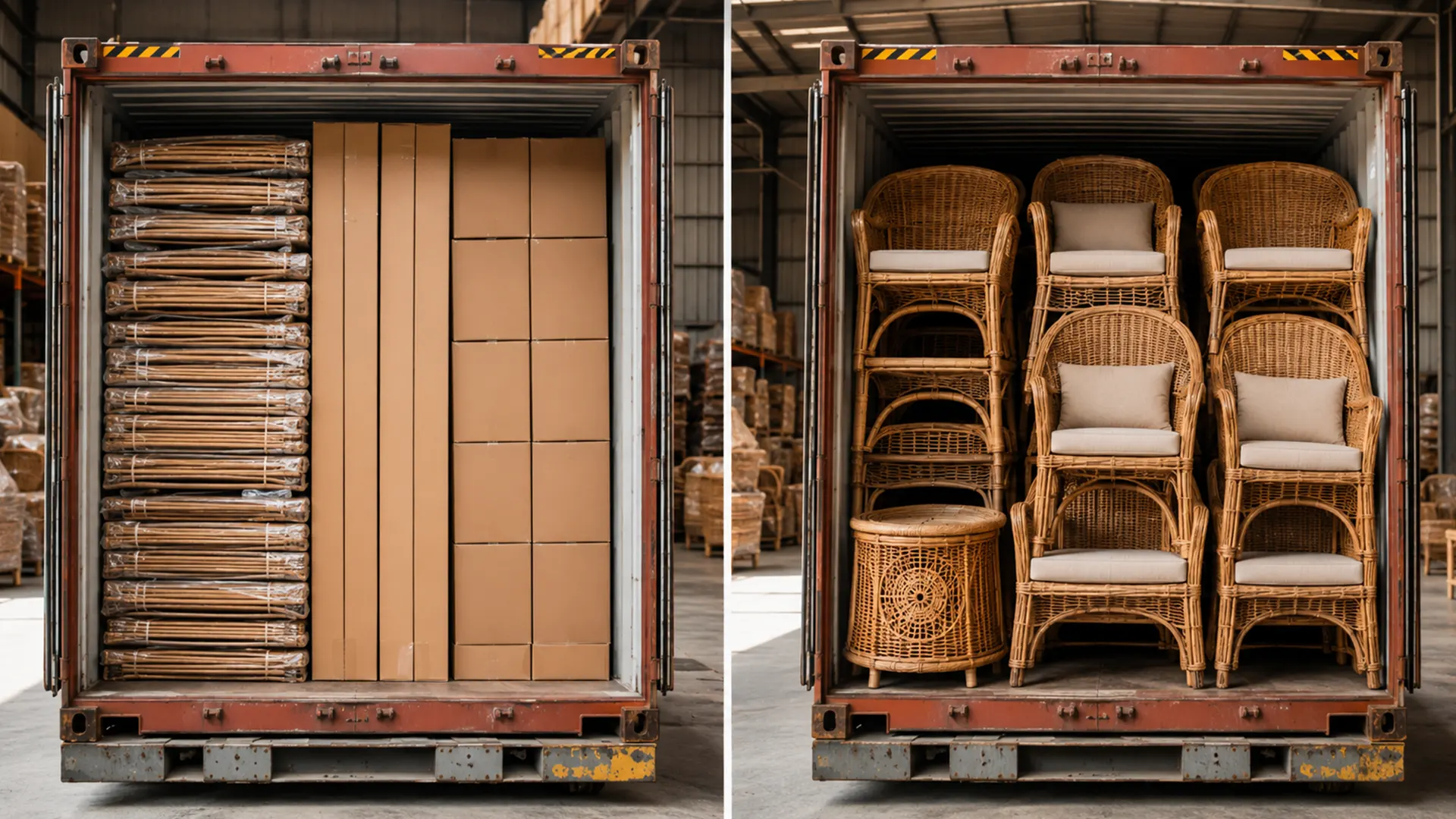
 Rattan Export buyer guide: Knock-Down vs Fully Assembled Rattan Furniture: Which Is Better For Container Shipping.
For importers buying rattan furniture by full container, the choice between knock-down and fully assembled construction can have a major impact on shipping efficiency, packed CBM, container quantity, handling, assembly requirements and landed cost. Knock-down furniture is designed so that selected components can be removed or separated for transport and assembled at destination. Fully assembled furniture leaves the factory in its final usable form. Neither model is automatically better for every order. Knock-down construction can reduce shipping volume and improve container utilization, while fully assembled furniture can simplify receiving and eliminate destination assembly. The correct choice depends on product design, structural requirements, packing method, labour costs, customer expectations and the economics of the entire container shipment.
What Is Knock-Down Rattan Furniture?
Knock-down, often abbreviated as KD, describes furniture that is partially or fully disassembled for packing and shipping. Components such as table legs, bases, arm sections, shelves or frames may be separated from the main structure and packed together in a flatter configuration.
Some products are completely knock-down, while others are better described as semi-knock-down. Semi-KD furniture may remain mostly assembled but use removable components where shipping volume can be reduced without making destination assembly unnecessarily complex.
Common examples may include:
- dining tables with removable legs;
- coffee tables with detachable bases;
- selected shelving or storage frames;
- bed or daybed structures with removable sections;
- some hospitality furniture;
- certain chairs or benches designed around detachable components.
For natural rattan furniture, the suitability of KD construction depends heavily on the structural design. Not every woven frame should be modified simply to reduce shipping volume.
What Is Fully Assembled Rattan Furniture?
Fully assembled furniture is shipped in substantially the same form in which the buyer or end customer will use it. The main frame, legs, arms and structural components remain permanently connected.
This can be common with:
- rattan dining chairs;
- lounge chairs;
- small stools;
- woven benches;
- certain cabinets;
- decorative furniture with complex handwoven structures.
Fully assembled construction can offer a simpler customer experience because no structural assembly is required after delivery. However, it may also transport a significant amount of empty space inside or around the frame.
The Main Container-Shipping Difference
The biggest logistics difference between KD and fully assembled furniture is usually shipping volume. A fully assembled table may occupy the cubic space defined by its complete height, even though much of the space beneath the tabletop is empty. If the legs can be removed and packed against the tabletop, the package may become substantially flatter.
This directly affects packed CBM, which is one of the most important metrics in container planning and export logistics.
For example, imagine two versions of the same table. The fully assembled version may require a tall carton because the legs remain attached. A KD version may fit into a much flatter rectangular package. Even if the FOB price of the KD version is slightly higher because additional hardware or manufacturing steps are required, the lower packed CBM may allow more saleable units into the same container.
Why Packed CBM Matters
Container shipping for rattan furniture is commonly constrained by volume before weight. Many rattan products are relatively light compared with the amount of space they occupy.
The standard CBM formula is:
Length × Width × Height = CBM Per Package
If one fully assembled table is packed in a carton measuring 1.40 × 0.90 × 0.78 metres:
1.40 × 0.90 × 0.78 = 0.983 CBM
If an equivalent knock-down version can be packed at 1.40 × 0.90 × 0.25 metres:
1.40 × 0.90 × 0.25 = 0.315 CBM
This is only an illustrative example, not a universal packing specification, but it shows why product construction can materially change container economics.
Knock-Down Furniture Can Improve Container Utilization
The primary shipping advantage of KD furniture is the opportunity to reduce unused cubic space. Flatter packages can often be stacked more predictably and combined more efficiently with other cartons.
Potential benefits include:
- lower packed CBM per unit;
- more units per container;
- better use of vertical container space;
- more regular carton dimensions;
- improved mixed-container flexibility;
- potentially lower freight allocation per saleable unit.
These benefits can be especially meaningful for 40ft and 40HC shipments where efficient cubic utilization affects a large number of units.
Fully Assembled Furniture Can Also Be Efficient
Fully assembled does not automatically mean inefficient. Some rattan products are naturally suitable for nesting, which can reduce effective CBM without requiring disassembly.
Dining chairs are a good example. If several chairs can nest securely into one protected stack, the effective volume per chair may be competitive with a KD alternative.
Baskets, stools and certain open-frame furniture may also use space efficiently when nested or stacked correctly.
Therefore, buyers should compare actual export packing rather than assuming that KD construction is always superior.
Nesting vs Knock-Down
Nesting and knock-down are different strategies, but both aim to reduce shipping volume.
| Method | How It Saves Space | Typical Consideration |
|---|---|---|
| Nesting | One assembled product fits partially inside another | Works well for selected chairs, stools and baskets |
| Knock-Down | Components are removed and packed flatter | Useful for tables, frames and selected furniture structures |
| Semi-KD | Only selected components are removed | Balances shipping efficiency with simple assembly |
| Fully Assembled | No assembly required at destination | May be preferable where labour or customer convenience dominates |
In some cases, the strongest logistics solution may combine both strategies. A semi-KD table may be packed beside nested chairs in the same container.
Assembly Labour Must Be Included In The Cost Comparison
Lower CBM does not automatically mean lower total cost. KD furniture creates an assembly requirement at destination.
Depending on the buyer's business model, assembly may be performed by:
- warehouse staff;
- retail employees;
- professional installers;
- hotel project contractors;
- the final consumer.
Each model creates different labour and customer-service costs. A product that saves freight but requires difficult assembly may not be commercially attractive.
The buyer should therefore compare:
- freight savings;
- assembly time;
- labour cost;
- hardware cost;
- instruction development;
- risk of incorrect assembly;
- after-sales support requirements.
Hardware Quality Becomes More Important With KD Furniture
Fully assembled furniture may rely primarily on permanent joints created during manufacturing. KD furniture often introduces bolts, threaded inserts, brackets or other hardware that must maintain structural performance after assembly.
The buyer should evaluate:
- hardware material;
- corrosion resistance where relevant;
- thread quality;
- insert strength;
- hole alignment;
- assembly tolerances;
- availability of replacement hardware;
- whether tools are included or required.
Hardware should not be treated as a minor packaging accessory. It becomes part of the structural system of the product.
Repeated Assembly Can Create Problems
Some KD furniture is assembled once and remains assembled for its useful life. Other products may be repeatedly assembled and disassembled for exhibitions, events, temporary projects or seasonal storage.
Repeated assembly can place additional stress on threaded inserts, screws and natural-material frames. If repeated disassembly is expected, the product should be engineered specifically for that use case.
A system that works well for one-time home assembly may not be suitable for commercial environments requiring frequent handling.
Natural Rattan Creates Special Design Considerations
Natural rattan is not identical to engineered metal or molded plastic. It has natural variation in diameter, curvature, density and surface characteristics.
For this reason, creating removable joints in a rattan structure requires thoughtful engineering. A design should not introduce detachable points where permanent joining would provide better structural stability.
When reviewing rattan sourcing and production in Vietnam, buyers should ask whether the supplier has previous experience producing the relevant KD construction rather than assuming any existing assembled design can easily be converted.
Fully Assembled Furniture Can Reduce Product Risk
One advantage of fully assembled construction is that the factory completes the structural assembly under controlled production conditions. The buyer receives a product whose major joints have already been assembled, checked and finished.
This can reduce:
- incorrect customer assembly;
- missing-hardware complaints;
- misaligned components;
- installation labour;
- variation caused by different assemblers.
For premium retail, hospitality or contract projects, this simplicity may be more valuable than maximum shipping efficiency.
Knock-Down Can Reduce Freight Allocation Per Unit
In a full-container shipment, many freight costs are associated with the container rather than directly with each individual furniture piece. If KD construction allows substantially more units into the same container, the freight cost allocated to each unit can fall.
For example, if two comparable products have different packing efficiency, the correct commercial comparison is not simply:
Which product has the lower FOB price?
It should also include:
Which product produces the better landed cost after realistic container utilization and destination assembly costs?
This distinction is particularly important for high-volume wholesale programs.
Packaging Requirements Differ
KD furniture can sometimes use flatter cartons, but additional internal protection may be required to prevent components from rubbing against one another.
Packaging may need:
- separators between parts;
- hardware bags or boxes;
- corner protection;
- foam or protective sheets;
- component labeling;
- assembly instructions;
- carton diagrams.
Fully assembled furniture may require larger cartons or protective wrapping around the complete structure.
In both cases, packaging should be integrated into the wider quality and pre-shipment control process.
Missing Hardware Is A Real Operational Risk
KD products introduce a risk that fully assembled products largely avoid: missing assembly components.
A shipment may become commercially problematic if hardware bags are incomplete or packed incorrectly. Buyers should consider controls such as:
- standardized hardware kits;
- piece-count verification;
- sealed component bags;
- clear labeling;
- spare hardware allowances where appropriate;
- assembly-kit inspection before carton sealing.
This is especially important for large orders where a small packing error can affect many products.
Assembly Instructions Matter
If furniture requires destination assembly, instructions should be treated as part of the product experience.
Good assembly instructions should make clear:
- which components are included;
- which hardware belongs to each connection;
- the correct assembly sequence;
- tools required;
- orientation of parts;
- safety or tightening notes where appropriate.
For retail or e-commerce channels, confusing instructions can generate returns and customer-service costs even when the furniture itself is well made.
Which Model Is Better For Mixed Containers?
KD furniture often creates more regular packages, which can make mixed-container planning easier. Flat table cartons can potentially be positioned beside nested chair stacks, basket cartons or other products.
Fully assembled furniture can also work well in mixed loads when package geometry is understood. Smaller cartons may sometimes fill spaces around assembled frames.
The correct mix should be planned using actual packed dimensions rather than theoretical product dimensions.
Which Model Is Better For Hotels And Resorts?
Hospitality projects create a special decision. A hotel may purchase hundreds of pieces but also face tight installation schedules.
KD furniture may reduce shipping volume and support larger project quantities per container, but destination assembly requires labour, tools, supervision and installation time.
Fully assembled furniture may arrive closer to installation-ready condition but consume more shipping space.
Project buyers should therefore evaluate:
- number of units;
- installation deadline;
- local labour availability;
- assembly complexity;
- room-by-room delivery plan;
- freight savings;
- risk of hardware loss.
Which Model Is Better For Retailers?
Retailers need to consider how the product reaches the final customer.
Fully assembled furniture may be attractive for physical stores, premium furniture outlets or customers expecting ready-to-use products.
KD furniture may be attractive where:
- warehouse space is expensive;
- parcel dimensions matter;
- home delivery is common;
- the customer accepts assembly;
- flat-pack storage offers an advantage.
The right decision depends on the retail business model, not shipping alone.
Quality Control Priorities For KD Furniture
Inspection of KD furniture should cover both the finished appearance and the assembly system.
Important checks can include:
- component count;
- hardware count;
- hole and insert alignment;
- test assembly;
- joint stability after assembly;
- fit between components;
- finish consistency on hidden and visible areas;
- carton organization;
- instruction accuracy.
A sample that looks correct before disassembly is not enough if bulk-production components do not assemble consistently.
Quality Control Priorities For Fully Assembled Furniture
Fully assembled furniture shifts more of the quality focus toward structural workmanship and packing protection.
Inspection may include:
- frame stability;
- joint workmanship;
- weaving consistency;
- surface finish;
- dimensions;
- level and balance;
- visible cracks or defects;
- carton or wrapping protection;
- nesting protection where applicable.
The absence of destination assembly does not eliminate quality risk; it simply changes where that risk is concentrated.
Illustrative Commercial Comparison
| Factor | Knock-Down | Fully Assembled |
|---|---|---|
| Packed CBM | Often lower | Often higher, depending on nesting |
| Container Quantity | Potentially higher | Potentially lower for bulky products |
| Destination Assembly | Required | Usually minimal or none |
| Hardware Dependency | Higher | Lower |
| Customer Convenience | Depends on assembly simplicity | Usually higher |
| Packing Complexity | Component organization required | Large-frame protection required |
| Mixed Container Flexibility | Often good with flat cartons | Depends strongly on geometry and nesting |
| Structural Risk | Depends on joint engineering and assembly | Depends on permanent factory workmanship |
This comparison is directional rather than universal. Actual performance depends on the specific product design.
Questions Buyers Should Ask The Supplier
- What is the packed CBM in fully assembled form?
- What would the packed CBM be in KD or semi-KD form?
- How many units are estimated per container under each option?
- Which parts would be removable?
- What hardware system would be used?
- Has the supplier produced this KD structure before?
- How long does assembly take?
- Which tools are required?
- Can the product be assembled correctly without specialist labour?
- Has the packing method been tested?
- Can a complete assembly sample be approved before bulk production?
Frequently Asked Questions
Is Knock-Down Rattan Furniture Always Cheaper To Ship?
No. It often reduces CBM, but the total commercial result also depends on hardware, packaging, assembly labour, freight rates and realistic container utilization.
Can Every Rattan Product Be Converted To Knock-Down?
No. Some designs rely on permanent structural relationships that should not be changed simply for shipping efficiency. The construction must remain safe and stable.
Are Fully Assembled Rattan Chairs Inefficient?
Not necessarily. Many chair designs can nest efficiently, which may create a low effective CBM per chair without requiring disassembly.
Is Semi-Knock-Down A Good Compromise?
It can be. Removing only the components that create major shipping volume can improve container efficiency while keeping assembly simple.
Should Hotels Choose Knock-Down Furniture?
It depends on project volume, installation schedule, labour availability and assembly complexity. Freight savings should be compared with the real cost of destination installation.
What Should Be Approved Before Ordering KD Furniture?
The buyer should approve the assembled sample, disassembled component set, hardware, assembly process, instructions and final export packing configuration.
Which Is Better For Container Shipping?
For pure cubic efficiency, well-engineered knock-down or semi-knock-down furniture can often provide an advantage because it reduces empty shipping volume and creates more regular packages. For operational simplicity, fully assembled furniture can be better because it eliminates destination assembly and reduces dependence on hardware and instructions.
The strongest decision is therefore not based on construction type alone. Buyers should compare packed CBM, realistic units per container, FOB cost, assembly labour, hardware risk, product quality, customer expectations and landed cost.
For some products, KD will clearly improve shipping economics. For others, nesting a fully assembled design may already provide excellent container utilization. The best solution is the one that delivers the required product quality and commercial experience at the lowest practical total cost.
Evaluating knock-down or fully assembled rattan furniture for a container order? Send your product list, target quantities, preferred construction and destination information through our wholesale inquiry so the proposed products can be considered from sourcing, packing and container-planning perspectives before commercial quantities are finalized.