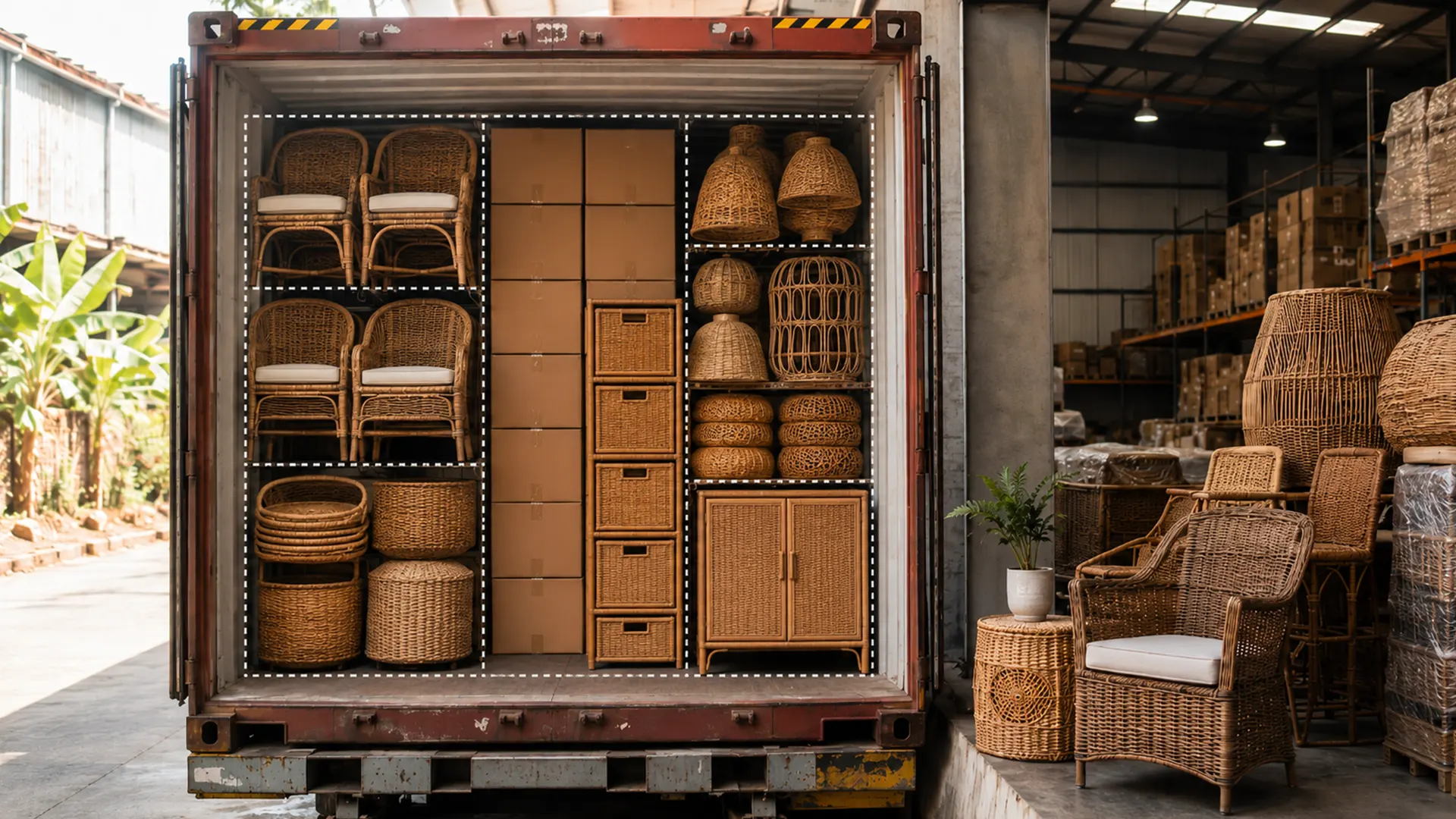
 Rattan Export buyer guide: Mixed Container Orders: How Importers Can Combine Different Rattan Products.
A mixed container order allows importers to combine different rattan furniture, baskets, lighting, storage products and home-decor items within the same 20ft, 40ft or 40HC shipment. For wholesalers, distributors, retail chains, hospitality buyers and project companies, this can be more commercially useful than filling an entire container with a single SKU. The objective is not simply to add as many different products as possible. A successful mixed container must balance packed CBM, SKU quantities, nesting, carton dimensions, product fragility, loading sequence, commercial priorities and destination inventory requirements. When these factors are coordinated early, mixed loading can improve product assortment and sometimes use container space more efficiently. When they are ignored, the same strategy can create excessive handling, unused gaps, damaged products and an unbalanced inventory mix.
What Is A Mixed Container Order?
A mixed container combines multiple SKUs or product categories in one full-container shipment. Instead of ordering only rattan dining chairs, for example, an importer might combine dining chairs, tables, lounge chairs, baskets, lighting and storage products within the same container.
A typical mixed rattan order could include:
- rattan dining chairs;
- rattan dining and coffee tables;
- lounge chairs;
- stools and benches;
- nested baskets;
- storage products;
- rattan lighting;
- wall decor and accessories;
- hotel or resort furniture;
- selected bamboo or other natural-fibre products.
The container is still purchased and planned as one commercial shipment, but its internal capacity is allocated between different SKUs according to the buyer's purchasing strategy and the physical characteristics of each package.
Why Importers Use Mixed Containers
For many buyers, a single-SKU container creates too much inventory concentration. A distributor may not want hundreds of identical lounge chairs while running out of dining chairs, tables or baskets. A mixed shipment allows inventory to be distributed across several products.
The main commercial advantages can include:
- broader product assortment from one shipment;
- lower inventory concentration per SKU;
- ability to test several products within a full-container buying model;
- better support for coordinated furniture collections;
- more flexible stock for retail or wholesale customers;
- potentially better use of spaces around large furniture packages.
Mixed loading should be integrated into the wider export and container planning process. It is not simply a final warehouse decision made when production is complete.
Start With Packed CBM For Every SKU
The foundation of a mixed container plan is the final packed CBM of every product. Buyers should not use showroom dimensions or bare product dimensions because export packaging changes the actual volume loaded into the container.
The basic calculation remains:
Package Length × Package Width × Package Height × Number Of Packages = Total CBM
For every SKU, the buyer should know:
- final packed dimensions;
- units per carton, bundle or nested stack;
- CBM per package;
- effective CBM per saleable unit;
- gross weight;
- whether the product is nestable;
- whether it is knock-down, semi-knock-down or assembled.
Once this information is available, different product combinations can be modeled before quantities are finalized.
Do Not Plan A Mixed Container Only By Total CBM
Total CBM is essential, but a spreadsheet cannot fully represent the physical geometry of container loading. Two different mixed orders can show exactly the same total CBM and produce very different loading results.
For example, an order containing mostly rectangular knock-down table cartons may use space efficiently. Another order with the same total CBM but dominated by fully assembled lounge chairs and irregular lighting packages may create much larger unused gaps.
Practical loading is affected by:
- carton length, width and height;
- stacking strength;
- irregular frames;
- nesting depth;
- fragility;
- orientation restrictions;
- door dimensions;
- weight distribution;
- loading and unloading sequence.
Therefore, the final mixed-container quantity should be confirmed only after the packing configuration of all important SKUs is known.
Use Large Products As The Structural Base Of The Load
Large furniture generally determines the overall loading geometry. Dining tables, sofas, lounge chairs, cabinets and larger seating pieces often occupy the biggest continuous areas inside the container.
A practical planning method is to begin with these large products and then examine the remaining spaces. Smaller cartons can sometimes be used around or between larger packages, provided this does not create damage risk.
For example, a buyer may first allocate space for:
- dining-chair stacks;
- knock-down table cartons;
- large lounge-chair packages.
The remaining spaces can then potentially accommodate:
- nested basket sets;
- small stools;
- compact decor cartons;
- small lighting products;
- accessory boxes.
This does not mean every empty gap should be filled. Products must remain protected and removable during unloading.
Nested Products Can Be Valuable Space Fillers
Rattan baskets, storage items, stools and some chair designs can be particularly useful in mixed-container planning because they may nest efficiently. A set of several baskets can sometimes occupy only slightly more space than the largest basket in the set.
This makes nested products commercially useful when balancing the remaining CBM of a mixed order. If a furniture-heavy container has several cubic metres of unallocated capacity, nested home-decor products may help use part of that volume without requiring large individual packages.
However, the buyer should verify the actual nested packing configuration. The theoretical finished dimensions of several baskets do not represent their real shipping CBM.
Knock-Down Products Give Buyers More Flexibility
Knock-down and semi-knock-down products often create flatter and more regular packages. This can make them easier to combine with other SKUs than fully assembled furniture.
Tables with removable legs, shelving with detachable frames and selected furniture components may be packed into rectangular cartons that can fit beside or beneath other products.
The commercial benefit can include:
- lower CBM per unit;
- more predictable carton geometry;
- better stacking potential;
- more flexibility in mixed-container planning.
The product should still remain structurally reliable and practical for assembly at destination. Shipping efficiency should never be achieved by creating assembly problems for the buyer's customers.
Protect Fragile Products From Heavy Furniture
A mixed container often contains products with very different strength levels. A heavy table carton and a delicate woven lampshade should not be treated as equivalent cargo.
Fragile items may include:
- rattan lighting;
- open-weave decorative pieces;
- thin cane-webbing panels;
- fine basket products;
- items with glass components;
- products with easily deformable frames.
These should not be placed beneath packages that can crush or distort them. Packaging and loading decisions should be part of the broader quality and pre-shipment control process, especially when multiple product types share one container.
Think About Unloading Before Loading
A container may be loaded efficiently at origin but become difficult to unload if the sequence was not considered. This matters particularly when the buyer needs certain products first or when different products will be delivered to different warehouse sections or project areas.
Before loading, consider:
- which products should be unloaded first;
- whether fragile items need immediate access;
- whether cartons can be removed without shifting large furniture;
- how heavy pieces will be handled;
- whether destination unloading equipment is available.
A few additional percentage points of theoretical utilization are not valuable if the destination warehouse must spend excessive labour dismantling the load.
How To Build A Commercial SKU Mix
A good mixed container is not only physically balanced; it should also match the buyer's sales plan. Quantities should reflect expected demand rather than being chosen only because a product fits neatly into an empty space.
For example, a wholesaler might classify products into:
| SKU Role | Commercial Function | Possible Quantity Strategy |
|---|---|---|
| Core Seller | High-demand recurring product | Allocate a larger share of container capacity |
| Collection Support | Complements core furniture | Moderate quantities |
| New Product Test | Unproven demand | Smaller commercial quantity |
| Space-Efficient Add-On | Nested or compact product | Use where commercially justified |
| Project-Specific Item | Required for hotel, resort or contract order | Quantity based on project requirement |
This approach prevents container optimization from becoming disconnected from the actual sales strategy.
Illustrative Mixed Container Example
The following numbers are purely illustrative. They demonstrate the planning method and are not guaranteed loading quantities.
| Product | Illustrative Quantity | Illustrative CBM Per Unit | Illustrative Total CBM |
|---|---|---|---|
| Nested Dining Chairs | 80 | 0.20 | 16.00 |
| Knock-Down Dining Tables | 20 | 0.25 | 5.00 |
| Lounge Chairs | 20 | 0.45 | 9.00 |
| Nested Basket Sets | 50 | 0.08 | 4.00 |
| Lighting Products | 30 | 0.10 | 3.00 |
| Total | - | - | 37.00 CBM |
On paper, a 37 CBM mixed order exceeds the nominal capacity of a 20ft container but sits well below the nominal volume of a 40ft or 40HC container. That does not determine the final equipment choice by itself. The buyer must still examine the geometry of the lounge chairs, the length of the table cartons, stacking limitations and the commercial possibility of increasing selected SKUs.
If the order is too small for efficient use of the chosen container, it may be better to increase quantities of proven sellers rather than adding random products simply to fill space.
20ft, 40ft Or 40HC For A Mixed Order?
The correct equipment depends on total packed CBM and product geometry.
| Container | Mixed-Order Characteristics |
|---|---|
| 20ft | Useful for focused first orders with a controlled number of SKUs and lower inventory commitment |
| 40ft | Useful for established mixed orders where products pack efficiently and extra height is not essential |
| 40HC | Often attractive for broad collections, bulky furniture and high-volume mixed wholesale shipments |
For bulky rattan products, a 40HC can offer valuable additional cubic capacity, but it should not be selected automatically. A poorly utilized 40HC can produce a worse cost per unit than a well-planned smaller container.
Mixed Containers From Multiple Suppliers Require More Coordination
Combining products from one production partner is generally simpler than consolidating goods from several independent suppliers. When multiple suppliers are involved, additional coordination may be required for production timing, delivery to the consolidation point, packing standards, labeling, documents and final loading.
Potential issues include:
- one supplier finishing production later than the others;
- different carton labeling systems;
- incompatible packing quality;
- additional inland transportation;
- consolidation warehouse charges;
- more complicated inspection scheduling;
- different commercial documentation.
Buyers sourcing across Vietnam's rattan and natural-material production network should therefore determine early whether one supplier, several suppliers or a coordinated sourcing model will be used.
Standardize Carton Labels And Packing Lists
A mixed container can contain dozens of visually similar cartons. Clear identification is essential for receiving, inventory control and destination warehouse operations.
Each package should normally identify the relevant information required by the buyer, which may include:
- SKU or item code;
- product description;
- quantity;
- carton number;
- purchase-order reference;
- destination marking where required;
- gross and net weight where appropriate;
- package dimensions.
The packing list should correspond accurately to the physical shipment so warehouse teams can reconcile the received quantities.
Do Not Mix Products That Create Unnecessary Risk
Not every combination is commercially sensible. A mixed container should avoid pairings that create excessive contamination, pressure, moisture or handling risk.
For example, buyers should carefully evaluate combinations where one product:
- is unusually heavy;
- has sharp metal components;
- requires special moisture conditions;
- is extremely fragile;
- cannot be stacked;
- requires a loading orientation that blocks other products.
Sometimes separating incompatible products into different loading zones or even different shipments is more economical than maximizing nominal container utilization.
How Mixed Containers Affect Landed Cost
Mixed loading can improve commercial flexibility, but each SKU still needs a realistic landed-cost calculation. A small product occupying an awkward area may consume more effective container capacity than its spreadsheet CBM suggests.
For each SKU, buyers should consider:
- FOB unit price;
- packed CBM per unit;
- effective freight allocation;
- packaging cost;
- handling requirements;
- customs classification where applicable;
- expected sales margin;
- inventory turnover.
A product should not be included merely because it fills space. It should contribute commercially to the shipment.
Buyer Checklist For A Mixed Rattan Container
- Confirm final SKU list.
- Confirm commercial quantities for every SKU.
- Obtain final packed dimensions.
- Calculate total CBM by SKU.
- Confirm nesting and knock-down configurations.
- Identify fragile and non-stackable products.
- Confirm gross weights.
- Review carton labeling.
- Prepare a preliminary loading plan.
- Check container type and dimensions.
- Coordinate production completion dates.
- Plan pre-shipment inspection.
- Confirm packing list before loading.
- Review destination unloading requirements.
Frequently Asked Questions
Can Different Rattan Products Be Loaded In The Same Container?
Yes. Dining furniture, lounge furniture, baskets, lighting and other products can be combined when packing dimensions, fragility, stacking and loading sequence are compatible.
Is A Mixed Container Less Efficient Than A Single-SKU Container?
Not necessarily. A well-designed mixed order can sometimes use space effectively because smaller packages can complement larger furniture. Poorly planned mixes, however, can create significant unused space.
How Many SKUs Should Be Included In A Mixed Container?
There is no universal maximum. The correct number depends on minimum production quantities, packed CBM, commercial demand and operational complexity. Adding more SKUs is not automatically better.
Can Products From Different Suppliers Be Combined?
Yes, but consolidation requires additional coordination of production schedules, transportation, labeling, inspection, documents and loading. The cost and operational complexity should be evaluated before confirming the sourcing structure.
Should I Use A 40HC For A Mixed Rattan Order?
A 40HC can be attractive for bulky mixed collections because of its additional cubic capacity, but the decision should be based on actual packed CBM, loading geometry, freight rate and inventory requirements.
Build The Product Mix Before Production Begins
The strongest mixed container orders are planned before production, not assembled from leftover space at the last moment. Buyers should combine commercial demand with packing data to determine how much capacity each SKU deserves.
A well-designed mix can provide broader inventory, reduce concentration in individual products and improve the economics of a full-container sourcing program. The key is to treat CBM, packing, product compatibility, quality control and sales strategy as one integrated planning process.
Planning a mixed container of rattan furniture, baskets, lighting or natural-material products? Send your intended product list, quantities, preferred materials and destination details through our wholesale inquiry so the proposed mix can be evaluated before commercial quantities are finalized.