
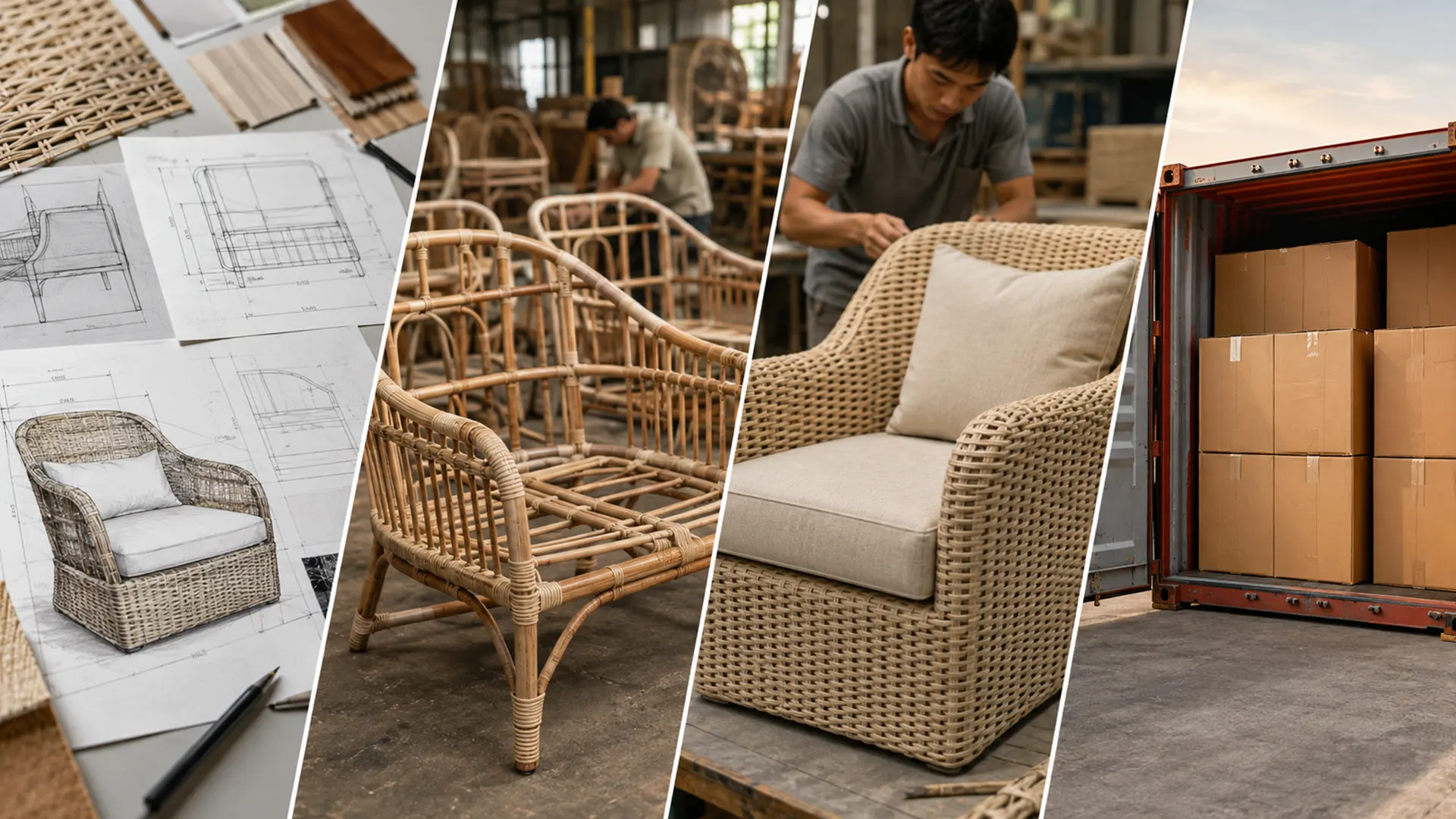
 Rattan Export buyer guide: OEM Rattan Furniture: From Buyer Drawing To Container Production.
OEM rattan furniture production is not simply a process in which an international buyer sends a drawing to a factory and waits for finished furniture to appear. A successful OEM program is a controlled development process that converts a buyer concept into a repeatable commercial product, an approved production specification, an export-packaging system and finally a container-ready order. Every stage matters because decisions made during drawing review, material selection, frame engineering, weaving, finishing and packaging can change product quality, FOB price, packed CBM, container utilization and landed cost.
For importers, wholesalers, distributors, retail chains, hospitality companies and project buyers, the central question is therefore not only whether a supplier can make one attractive prototype. The more important question is whether the supplier can reproduce the approved product consistently across hundreds of units while maintaining dimensions, structure, appearance, packing efficiency and delivery timing.
When developing products through the Vietnam rattan, bamboo and natural-fibre manufacturing ecosystem, buyers should treat OEM development as a sequence of documented approvals rather than an informal exchange of photographs and messages. The drawing starts the conversation, but it does not by itself define the complete product.
What Does OEM Rattan Furniture Mean?
OEM generally means that a supplier manufactures a product according to a buyer's design, specification, technical requirements or proprietary commercial concept.
The buyer may provide:
- A technical drawing
- A hand sketch
- A 3D rendering
- A physical reference sample
- Photographs
- Material references
- Dimensions
- Colour references
- Packaging requirements
The factory then develops a manufacturable version that can be produced repeatedly and economically.
OEM should not be confused with simply selecting an existing catalogue item and changing the colour. A genuine OEM program may require engineering, tooling or jigs, material trials, repeated samples, packaging development and production controls.
Step 1: Start With A Clear Buyer Brief
The strongest OEM projects begin with a structured product brief.
Before contacting suppliers, the buyer should define as much as possible about:
- Product type
- Target dimensions
- Intended use
- Indoor or covered-outdoor application where relevant
- Target market
- Target FOB range
- Target order quantity
- Expected container program
- Required materials
- Preferred finish
- Assembly concept
- Packaging expectations
The buyer does not need to solve every engineering question, but the commercial objective should be clear enough for suppliers to propose realistic solutions.
Step 2: Prepare The Drawing Package
A drawing should contain more than a product silhouette.
For furniture, useful information can include:
- Overall width
- Overall depth
- Overall height
- Seat height
- Seat width and depth
- Arm height
- Back angle
- Tabletop dimensions
- Leg dimensions
- Important radii and curves
- Connection points
- Material callouts
The more important a dimension is to comfort, assembly or project installation, the more clearly it should be identified.
Step 3: Identify Which Details Are Fixed And Which Are Flexible
Not every element of a buyer drawing needs to be frozen.
A buyer may specify:
- Overall appearance must remain unchanged
- Seat height is fixed
- Frame diameter may be optimized
- Internal reinforcement may be proposed by the supplier
- Packaging may be redesigned to improve CBM
This distinction helps the factory perform useful value engineering without accidentally changing the commercial identity of the product.
Step 4: Conduct A Manufacturability Review
The supplier should review whether the drawing can be produced reliably using natural rattan, bamboo, timber, metal or other intended materials.
Questions may include:
- Can the specified curve be bent repeatedly?
- Is the requested rattan diameter realistic?
- Will the frame remain stable?
- Can the weaving be executed consistently?
- Will the product nest or stack?
- Can the design be assembled as KD?
- Are the requested tolerances practical?
A good supplier does not simply say “yes” to every drawing. It identifies production risks before sampling begins.
Step 5: Confirm The Material Architecture
Many OEM rattan products use more than one material.
A chair, for example, may include:
- Natural rattan structural frame
- Rattan peel or natural-fibre weaving
- Timber reinforcement
- Metal hardware
- Plastic or nylon glides
- Foam cushions
- Textile upholstery
Every material should be identified because material substitutions can change cost, appearance, performance and compliance requirements.
Step 6: Define Structural Versus Decorative Material
Buyers should distinguish structural members from decorative elements.
A decorative rattan strip does not need the same selection standard as a load-bearing chair leg or frame rail.
Structural components may require tighter control for:
- Diameter
- Cracks
- Straightness
- Joint quality
- Moisture condition
Step 7: Review Frame Engineering
Frame construction is one of the most important hidden parts of an OEM product.
The buyer should understand:
- Main load paths
- Cross-bracing
- Seat support
- Joint methods
- Reinforcement locations
- How curved components are connected
If structural details will become hidden after weaving, they should be documented before the prototype is fully covered.
Step 8: Evaluate Comfort And Ergonomics
Drawings can look excellent while producing uncomfortable furniture.
For seating, evaluate:
- Seat height
- Seat depth
- Seat angle
- Back angle
- Lumbar relationship
- Arm position
- Cushion thickness
Comfort changes are much cheaper during prototype development than after mass production begins.
Step 9: Define The Weaving Specification
“Natural rattan weaving” is not a complete production instruction.
The OEM specification should identify:
- Weaving material
- Material width or diameter
- Pattern
- Direction
- Spacing
- Density
- Edge termination
- Transition around frames and corners
Weaving strongly influences both appearance and labour cost.
Step 10: Review Whether The Design Can Be Nested Or Stacked
Container economics should be considered during design development, not after the product is finished.
Small changes to:
- Leg angle
- Rear-frame geometry
- Arm projection
- Seat taper
- Back angle
may allow safer nesting or stacking without materially changing the design.
However, maximum physical nesting is not the objective. The goal is safe nesting that does not cause finish rubbing, weave compression, frame distortion or difficult unpacking.
Step 11: Evaluate Fully Assembled Versus KD Construction
The buyer and supplier should compare both product and logistics consequences.
Fully assembled construction may offer:
- No destination assembly
- Lower risk of missing hardware
- Faster retail or project deployment
KD construction may offer:
- Lower packed CBM
- More units per carton
- More units per container
- Potentially lower freight allocation per unit
But KD requires accurate drilling, good hardware, reliable joints, clear instructions and assembly testing.
Step 12: Develop An Initial Costing
The first price should be treated as an estimate until the product specification is stable.
FOB cost may depend on:
- Material consumption
- Material grade
- Frame complexity
- Manual bending
- Weaving hours
- Finishing process
- Hardware
- Cushions
- Packaging
- Expected production quantity
A drawing revision that appears visually minor can materially change labour or material consumption.
Step 13: Develop The First Prototype
The first prototype is a learning tool, not necessarily the final production standard.
During prototype review, inspect:
- Overall proportions
- Dimensions
- Comfort
- Frame construction
- Weaving
- Curves
- Symmetry
- Finish
- Hardware
- Assembly
Buyers should provide specific revision comments rather than vague feedback such as “make it more premium.”
Step 14: Control Sample Revisions
Every revision should have an identifiable version.
For example:
- Sample Rev. A
- Sample Rev. B
- Final Approved Rev. C
The drawing, sample photographs and specification should all refer to the same revision.
This prevents the frame department from following one version while the finishing or packaging department follows another.
Step 15: Approve Dimensions And Tolerances
Natural materials and handwork create some normal variation, but key dimensions should be controlled.
The buyer should define tolerances for critical measurements.
Functional dimensions such as seat height, table height, KD-hole location and overall footprint may require tighter control than decorative details.
Step 16: Approve Natural Material Variation
The buyer should clarify which variations are acceptable in commercial production.
These may include controlled differences in:
- Natural tone
- Surface texture
- Diameter
- Node appearance
- Minor handcrafted weaving variation
But structural cracks, mold, unstable frames, loose weaving and dimensions outside tolerance should not be hidden behind the phrase “natural material.”
Step 17: Approve Colour And Finish
Colour should ideally be approved using a physical reference.
The finishing specification may define:
- Preparation method
- Stain
- Sealer
- Topcoat
- Gloss level
- Acceptable colour range
- Curing requirements
A product packed before the finish has cured sufficiently can develop impressions, sticking, colour transfer or surface damage.
Step 18: Approve Cushions And Upholstery
For upholstered products, approve:
- Fabric code
- Fabric composition
- Colour
- Foam type
- Foam density
- Foam thickness
- Stitching
- Piping
- Zippers
- Attachment method
Two cushions can look identical while having very different comfort and cost.
Step 19: Approve Hardware
Confirm:
- Fastener type
- Material
- Dimensions
- Surface treatment
- Quantity
- Spare hardware where specified
For KD furniture, hardware is part of the product engineering, not a minor accessory.
Step 20: Test Assembly
Random people who did not develop the product should ideally be able to assemble it using the intended instructions.
Check:
- Hole alignment
- Part identification
- Required tools
- Assembly sequence
- Final stability
- Visible gaps
- Risk of incorrect assembly
Step 21: Convert The Approved Sample Into A Production Specification
This is one of the most important stages in the entire OEM process.
The final production package may include:
- Approved physical sample
- Final drawing
- Revision number
- Material specification
- Dimensional tolerances
- Frame construction photographs
- Weaving reference
- Colour reference
- Hardware list
- Cushion specification
- Packaging instruction
- Label specification
The sample should become a repeatable production standard, not remain only an attractive showroom object.
Step 22: Freeze The Specification Before Mass Production
Once production begins, uncontrolled changes become expensive.
Any later change can affect:
- Material purchasing
- Jigs
- Labour planning
- FOB cost
- Lead time
- Packaging
- CBM
Necessary changes should be formally documented and approved.
Step 23: Confirm Final Commercial Terms
Before mass production, confirm:
- Final FOB price
- Named FOB point
- MOQ
- SKU quantities
- Colour quantities
- Payment terms
- Production lead time
- Inspection requirements
- Packaging requirements
The final quotation should match the final approved specification.
Step 24: Plan Raw-Material Procurement
OEM orders may require material selection or procurement specifically for the project.
Lead time can therefore include:
- Rattan preparation
- Bamboo preparation
- Timber procurement
- Hardware sourcing
- Fabric procurement
- Foam procurement
Long-lead components should be identified early.
Step 25: Use Jigs And Production References
Jigs and templates improve repeatability in manual production.
They can control:
- Overall frame size
- Leg angle
- Back curvature
- Arm position
- Drilling points
- Symmetry
Handmade production can remain handcrafted while still using disciplined geometry controls.
Step 26: Check First Production Units
Do not wait until the full order is finished.
The first production units should be compared with the approved sample for:
- Dimensions
- Frame
- Weaving
- Colour
- Finish
- Hardware
- Assembly
Correcting a problem after the first twenty units is much easier than correcting it after several hundred.
Step 27: Manage Quality During Production
Quality should be checked throughout production rather than only at the end.
A structured quality-control and pre-shipment verification process may cover:
- Incoming materials
- Frame construction
- Bending
- Weaving
- Finish
- Moisture condition
- Assembly
- Packaging
Step 28: Engineer The Export Packaging
Packaging should be developed around the actual production product.
Review:
- Surface protection
- Corner protection
- Leg protection
- Weave contact points
- Nesting separators
- Cushion protection
- Hardware placement
- Carton strength
Packaging must protect the product without creating unnecessary volume.
Step 29: Measure Final Packed Dimensions
Container planning should use the final protected package.
Record for every SKU:
- Units per carton
- Carton length
- Carton width
- Carton height
- Gross weight
- CBM per carton
- CBM per saleable unit
Early estimates should be replaced with verified final data.
Step 30: Calculate Container Efficiency
For a rectangular carton:
CBM = length × width × height in metres.
For illustration only, a carton measuring 1.10 × 0.70 × 1.20 metres has a volume of 0.924 m³. If six chairs are packed inside, the illustrative CBM is 0.154 m³ per saleable chair. Actual OEM results depend on the final product and packaging.
Buyers should compare not only FOB per unit but also packed CBM per unit.
Step 31: Build The Container Loading Plan
The actual order may include several SKUs with different carton geometries.
The loading sheet should include:
- SKU
- Quantity
- Units per carton
- Carton dimensions
- CBM per carton
- Total CBM
- Gross weight
- Stacking restrictions
Theoretical container volume should not be treated as fully usable cargo volume. Door clearance, carton geometry, stacking restrictions and mixed-SKU layout all affect practical loading.
This stage belongs to the wider container-loading and export-planning process.
Step 32: Prepare Packaging And Labels For The Buyer's Supply Chain
OEM programs may require:
- Buyer SKU labels
- Barcodes
- Country-of-origin marking where required
- Carton numbers
- Handling marks
- Private-label branding
- Assembly instructions
- Hardware identification
These requirements should be approved before cartons are printed in volume.
Step 33: Conduct Pre-Shipment Inspection
Before release, inspection should compare production against the approved specification.
Typical checks include:
- Quantity
- Dimensions
- Frame construction
- Stability
- Material quality
- Weaving
- Finish
- Hardware
- KD assembly
- Cushions
- Packaging
- Labels
Serious or repeated deviations should be corrected before shipment release.
Step 34: Verify Actual Production CBM Before Loading
If production cartons differ from the planned carton dimensions, the loading plan may need revision.
Even a small increase in packed dimensions can reduce units per container when multiplied across many cartons.
Step 35: Inspect The Empty Container
Before loading, basic container suitability should be checked.
Look for:
- Clean interior
- Dry floor
- No obvious holes
- No abnormal odour
- No major signs of water ingress
- Functional doors
Step 36: Supervise Container Loading
Loading should follow the approved loading plan as closely as practical.
Check:
- Correct SKU quantities
- Carton orientation
- Heavy cartons not crushing weaker furniture packs
- Fragile products protected
- Final rows stable near the doors
- Final carton count reconciled
Step 37: Record Container And Seal Information
The shipment record should include:
- Container number
- Seal number
- Loading date
- Final quantities
- Loading photographs
How OEM Decisions Affect FOB Price
| OEM Decision | Possible Cost Effect | Possible Logistics Effect |
|---|---|---|
| More complex frame | Higher labour and material cost | May increase packed volume |
| Denser weaving | Higher labour cost | Usually limited direct CBM effect |
| Premium finish | Higher finishing cost | May require more protection |
| KD design | May add hardware and engineering cost | Can reduce packed CBM |
| Nestable geometry | May require design development | Can improve container utilization |
| Stronger packaging | Higher packing cost | May increase CBM but reduce damage |
| Premium fabric and foam | Higher component cost | May affect carton volume |
Common OEM Development Mistakes
- Sending only a photograph and expecting an exact quotation
- Not identifying critical dimensions
- Changing the design repeatedly after costing
- Approving one sample without documenting it
- Ignoring hidden frame construction
- Leaving weaving specifications vague
- Approving colour only from photographs
- Not defining natural-material tolerances
- Ignoring KD assembly risk
- Developing packaging after production is finished
- Calculating container capacity from bare product dimensions
- Starting mass production before final sample approval
- Allowing undocumented production changes
- Waiting until pre-shipment inspection to identify specification problems
What Buyers Should Include In An OEM RFQ
- Product drawing or reference
- Dimensions
- Material preferences
- Target use
- Finish and colour
- Weaving requirements
- Cushion specification
- KD or assembled preference
- Target quantity by SKU
- Target container type
- Packaging requirements
- Target FOB range if available
- Required sample timing
- Expected production timing
Frequently Asked Questions
Can a rattan factory quote accurately from a drawing?
It can often provide an initial estimate if the drawing is detailed enough, but the final commercial price should be confirmed after material, construction, weaving, finish and packaging assumptions are sufficiently defined.
How many sample rounds are normally required?
There is no universal number. A simple modification may need only one development round, while a new structural design can require several revisions.
Should mass production start before the final sample is approved?
For critical OEM programs, starting too early creates significant risk. Major production should normally follow final approval of the product and key specifications.
Can the factory modify the buyer's drawing?
It can propose engineering changes, but commercially meaningful changes should be reviewed and approved by the buyer before production.
When should packaging be developed?
Packaging should be considered during product development and finalized once the production configuration is stable. It should not be left until the entire order is finished.
When can final container quantity be confirmed?
The most reliable loading quantity becomes available after the actual production design, nesting or KD configuration, protection system and final carton dimensions are confirmed.
Is the lowest OEM FOB price always the best offer?
No. Buyers should also compare specification compliance, packed CBM, damage risk, quality-control capability, MOQ, lead time and supplier reliability.
OEM Success Depends On Turning A Design Into A Repeatable Production System
The real challenge in OEM rattan furniture is not producing one attractive chair, table or cabinet. It is converting a buyer's design into a specification that can be repeated consistently across commercial quantities.
That requires disciplined work across drawing review, material selection, frame engineering, comfort, weaving, finish, hardware, sampling, revision control, production tolerances, quality control, packaging, CBM calculation and container planning.
When these stages are connected properly, OEM development can improve not only product uniqueness but also manufacturing consistency, container utilization and total import economics.
If you are developing an OEM or ODM rattan, bamboo or natural-fibre furniture collection from Vietnam, send your drawings, reference images, target dimensions, quantities, materials and container requirements so the project can be evaluated from initial development through sample approval, production, inspection and container loading.


