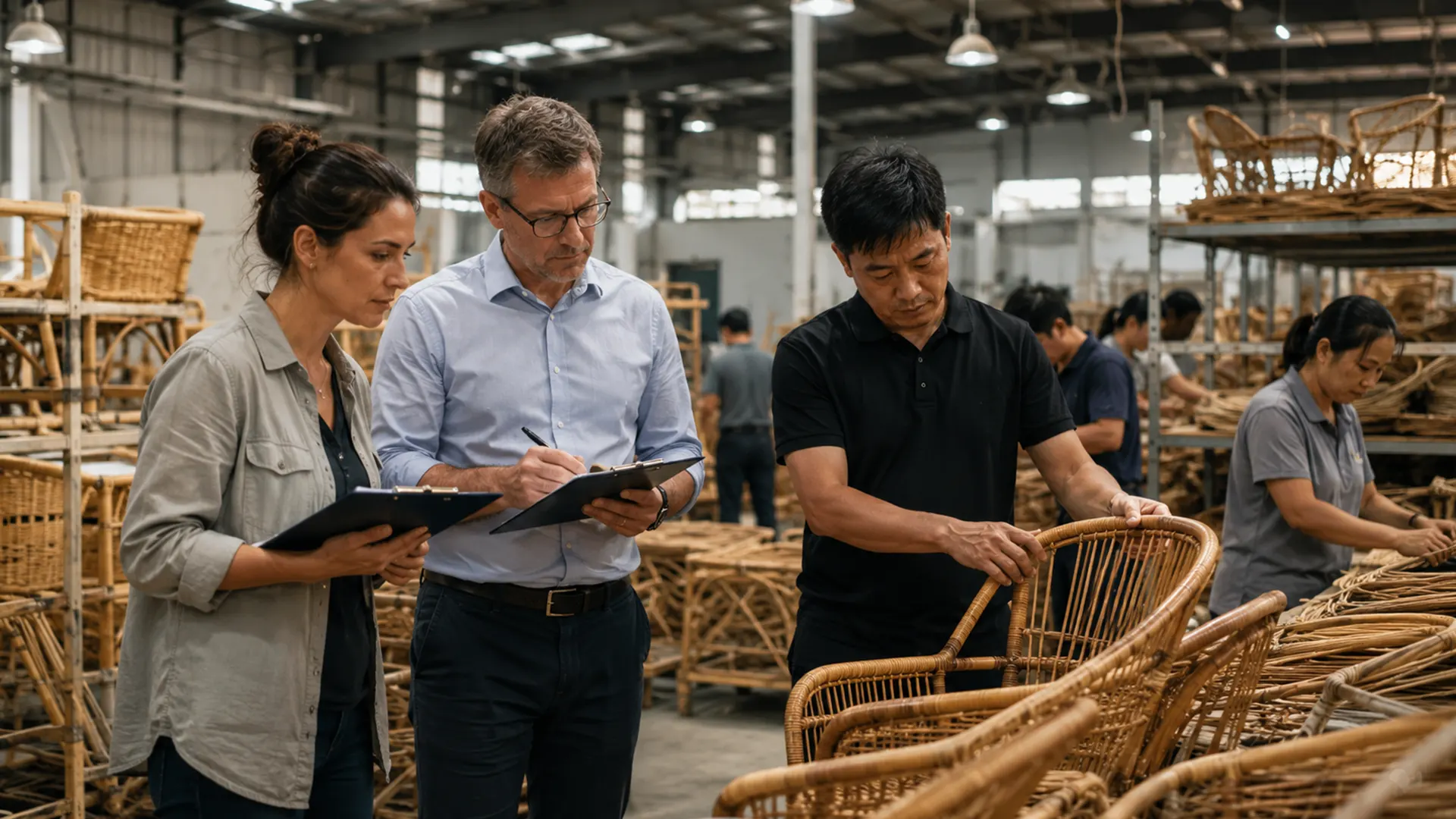
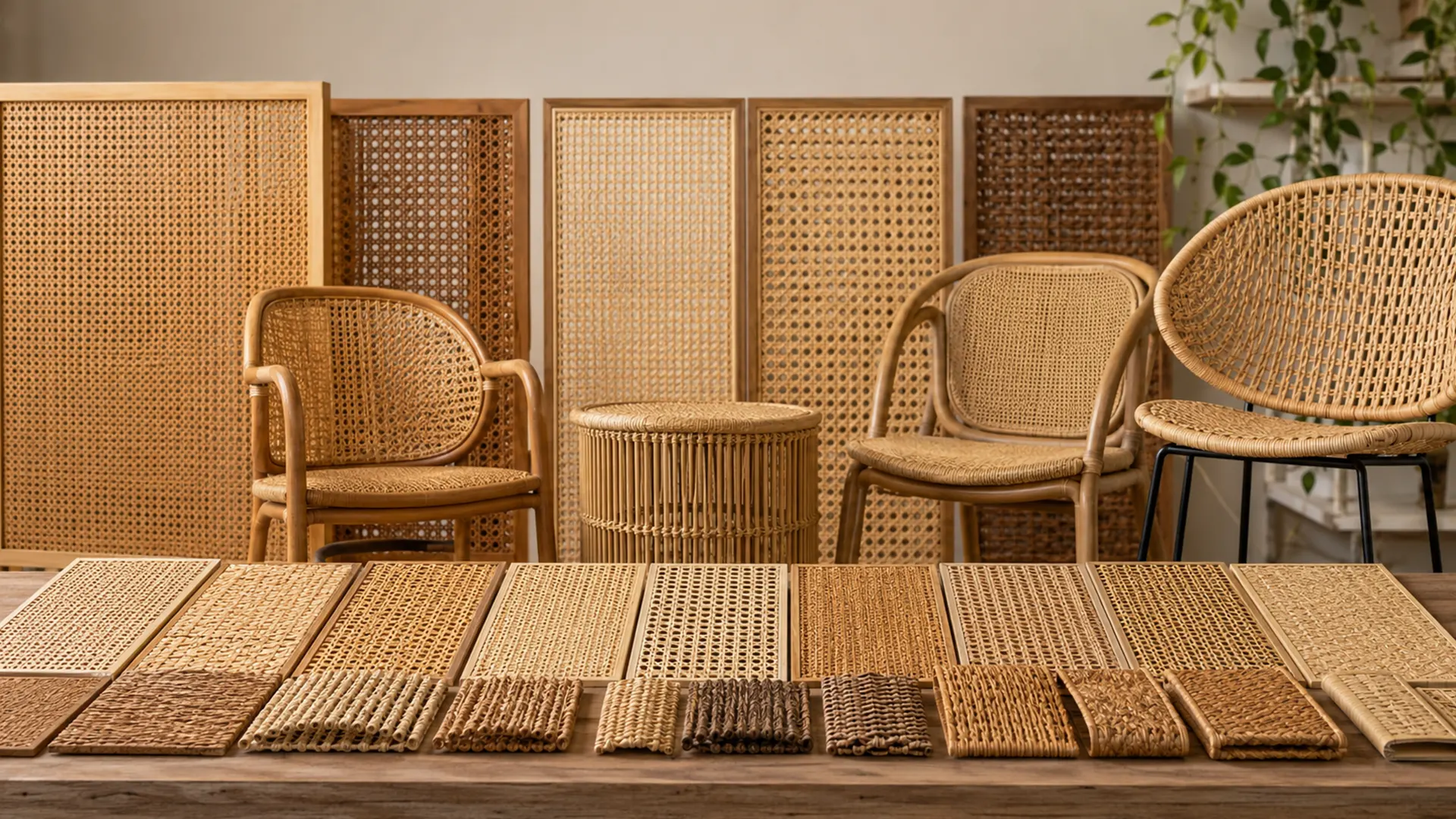
 Rattan Export buyer guide: Natural Material Variation: What Is Acceptable In Commercial Rattan Production.
Natural material variation is one of the defining characteristics of commercial rattan, bamboo and other natural-fibre products. It is also one of the most misunderstood areas in international furniture sourcing. Buyers sometimes expect handmade natural furniture to look as mechanically identical as injection-moulded plastic or machine-finished metal. Suppliers, on the other hand, may use the phrase “natural variation” too broadly to excuse inconsistency that should actually be controlled during production. The correct commercial approach lies between these two extremes.
Natural variation is normal. Uncontrolled variation is not. A professional buyer should expect reasonable differences in colour tone, surface character, diameter, node appearance, curvature and handwoven execution, but those differences must remain within an agreed visual, functional and structural standard.
This distinction becomes especially important when sourcing through the Vietnam rattan, bamboo and natural-fibre production ecosystem, where much of the value comes from natural materials and skilled manual work. The buyer therefore needs a specification that respects the nature of the material while still producing commercially consistent furniture across hundreds of units.
Natural Variation Is Not The Same As A Defect
A natural variation is a difference that arises from the normal characteristics of the raw material or the handcrafted production process without materially reducing function, durability, safety or agreed appearance.
A defect is a condition that falls outside the approved specification or creates unacceptable risk to:
- Structural integrity
- Function
- Durability
- Appearance
- Assembly
- Packaging
- Saleability
The challenge is that the boundary between variation and defect cannot always be described with one universal number. It must be defined by product type, design positioning, buyer expectations and approved references.
Why Rattan Naturally Varies
Rattan is a biological material. Individual canes do not grow with perfectly identical:
- Diameter
- Colour
- Surface texture
- Node spacing
- Density
- Straightness
- Flexibility
Even material from the same source can show visible differences. Drying, steaming, bending, sanding and finishing may reduce some variation, but they cannot and should not eliminate every natural characteristic.
Why Bamboo Also Varies
Bamboo has its own natural variables, including:
- Node position
- Wall thickness
- Diameter
- Colour
- Grain
- Surface marks
- Curvature
A product using split bamboo, laminated bamboo or whole bamboo sections may therefore show a different type of variation from natural rattan furniture.
1. Colour Variation: Usually Acceptable Within A Range
Natural rattan and bamboo rarely have completely uniform colour before finishing. One component may be slightly warmer, lighter or darker than another.
Reasonable tonal variation may be commercially acceptable when:
- The collection is intentionally natural or handcrafted
- The colour remains within the approved visual range
- No individual component looks dramatically unrelated to the product
- The variation does not create a patchy or accidental appearance
Colour becomes a defect when the difference is so strong that one unit or one component visibly falls outside the approved collection standard.
2. Do Not Approve Colour Only From Digital Photographs
Phone cameras, screens, lighting and automatic image processing can significantly change the appearance of natural tones.
Where colour consistency is commercially important, use:
- A physical approved sample
- An approved colour board
- Controlled reference photographs
- A documented acceptable colour range where appropriate
The approved reference should represent the realistic production target rather than one unusually perfect piece of material.
3. Natural Colour Variation And Finish Variation Are Different
A natural tonal difference within the material may be acceptable. Uneven stain application, missed coating, excessive dark patches, drip marks or inconsistent gloss are production defects rather than natural variation.
Buyers should not allow finishing problems to be reclassified as natural-material character.
4. Diameter Variation Can Be Acceptable
Rattan poles rarely have exactly the same diameter along their full length. Moderate differences may be visually appropriate, especially in rustic or artisan collections.
Diameter variation becomes problematic when it affects:
- Structural strength
- Symmetry
- Fit between components
- Seat or back geometry
- Nesting
- Assembly
- Overall visual balance
Critical structural members may therefore need a more controlled diameter range than purely decorative components.
5. Taper Is A Natural Characteristic
Natural canes often taper from one end to another. This can be visually acceptable and even desirable in handcrafted designs.
However, excessive taper in load-bearing parts can create:
- Weak connection points
- Uneven leg appearance
- Different joint geometry
- Inconsistent product dimensions
Material selection should therefore match the intended use of each component.
6. Nodes Are Normal, But Their Treatment Matters
Nodes are part of natural bamboo and may also be visually relevant in some rattan components.
Acceptable node-related variation may include:
- Different node spacing
- Natural tonal changes around nodes
- Minor surface contour differences
Potential defects include:
- Badly cut nodes
- Sharp projections
- Splintering
- Cracking extending from the node
- Poor sanding
7. Surface Marks Can Be Acceptable
Natural materials may contain light scars, growth marks, small colour streaks or subtle surface irregularities.
These may be acceptable if they support the natural aesthetic and do not compromise strength or finish quality.
They become problematic when the product appears dirty, damaged, poorly prepared or inconsistent with the approved market positioning.
8. Cracks Require More Careful Classification
Not every small surface check has the same significance, but cracking should never be dismissed automatically as natural.
Evaluate:
- Location
- Length
- Depth
- Whether the crack is structural
- Whether it is expanding
- Whether it affects a joint
- Whether it is visually prominent
A small superficial check on a non-structural hidden area may be treated differently from a deep crack through a chair leg, arm or load-bearing bend.
9. Splits In Structural Members Are More Serious
A split that reduces the effective section of a structural rattan component may affect durability and should not be accepted simply because the material is natural.
Structural defects require a stricter standard than decorative surface variation.
10. Curvature Variation Is Normal To A Point
Hand-bent natural rattan will not always reproduce a curve with the microscopic consistency of metal formed in a high-precision industrial process.
Small differences may be acceptable when the overall silhouette remains consistent.
Curvature becomes unacceptable when it creates:
- Visible left-right asymmetry
- Different seat or back dimensions
- Uneven arm height
- Instability
- Poor stacking or nesting
- Misalignment with other parts
11. Use Jigs To Control Repeatability
Handmade production does not mean production should rely only on the worker's eye.
Jigs, templates and dimensional checks can control:
- Frame width
- Leg angle
- Back curvature
- Arm position
- Seat height
- Symmetry
Natural material can remain visually natural while the functional geometry stays consistent.
12. Handmade Weaving Will Show Variation
Handwoven rattan naturally produces small differences in:
- Spacing
- Tension
- Material width
- Pattern alignment
- Edge termination
Reasonable variation can support the handcrafted character of the product.
13. Weaving Variation Must Still Be Controlled
Acceptable variation should not become:
- Large random gaps
- Loose strands
- Broken material
- Different pattern sections
- Visibly uneven density
- Poorly secured ends
- Bulging or sagging surfaces
These conditions are workmanship defects, not natural variation.
14. Pattern Consistency Is Different From Material Variation
The material may vary naturally, but the approved weaving pattern should remain consistent.
If one chair uses a different sequence or spacing concept from another, this should not be accepted merely because both products are handmade.
15. Binding Variation Can Be Acceptable Within Limits
Hand-applied bindings may show small differences in:
- Spacing
- Wrap position
- Tension
However, bindings should remain clean, secure and visually consistent.
Loose ends, irregular large gaps, insufficient wraps or bindings used to hide poor joints are defects.
16. Hand Sanding Creates Small Differences
Minor differences in hand-sanded surfaces may occur, particularly around curved joints and woven transitions.
Commercially acceptable variation should still feel properly finished and should not include:
- Sharp fibres
- Splinters
- Deep sanding marks
- Rough customer-contact areas
- Visible uncontrolled repairs
17. Natural Texture Should Not Become Poor Workmanship
A buyer ordering a rustic collection may intentionally accept visible natural texture. That does not mean accepting unsanded cuts, adhesive contamination or careless trimming.
The intended aesthetic should be documented clearly.
18. Dimensions Need Controlled Tolerances
Natural materials and manual processes make some dimensional variation unavoidable.
However, key dimensions should have documented tolerances.
Examples include:
- Overall width
- Seat height
- Seat depth
- Arm height
- Table height
- Cabinet opening size
- KD connection locations
The correct tolerance depends on product type and function. There is no single tolerance appropriate for all rattan furniture.
19. Functional Dimensions Need Tighter Control
A decorative curve may tolerate more variation than:
- Seat height
- Table height
- Door clearance
- Drawer opening
- Hardware hole position
- KD connection spacing
Where function depends on geometry, natural variation should not override dimensional control.
20. Symmetry Should Be Judged Commercially
Handcrafted furniture may not be mathematically perfect, but obvious asymmetry is usually unacceptable.
Check:
- Left and right arms
- Leg angles
- Back shape
- Seat alignment
- Decorative arches
The question is whether normal customers would perceive the difference as natural character or poor manufacturing.
21. Stability Is Never A Natural Variation
A chair or table that rocks excessively should not be excused as handmade character.
Functional stability must remain consistent across production.
22. Loose Joints Are Not Natural Variation
Joint movement, loose fasteners, weak connections and structural noise are production or construction issues.
They should be addressed through quality control, in-process inspection and pre-shipment verification.
23. Moisture-Related Distortion Requires Investigation
Natural materials respond to moisture, but visible distortion should not automatically be accepted.
Investigate:
- Drying
- Conditioning
- Storage
- Production humidity
- Finish curing
- Packaging timing
Natural responsiveness to humidity is real, but process failures remain the supplier's responsibility within the agreed specification.
24. Mold Is Not Acceptable Natural Variation
Visible mold, mildew or strong musty odour should never be classified as normal natural character.
These conditions indicate a moisture, storage, handling or contamination problem that requires corrective action.
25. Insect Damage Is Not Natural Character
Holes, active infestation, frass or other evidence of insect damage should be treated according to the buyer's quality and compliance requirements, not accepted as rustic appearance.
26. Finish Shade Variation Needs A Defined Range
Even when the same stain or coating is used, natural material absorbs colour differently.
Some variation may therefore remain after finishing.
Buyers should define whether the collection permits:
- Broad natural variation
- Moderate commercial variation
- Narrow premium-retail colour consistency
The tighter the range, the more selection and finishing control may be required.
27. Gloss Variation Is Usually More Controllable
Natural material may explain tonal differences, but large unexplained gloss differences often result from finishing-process inconsistency.
Uneven coating, poor spray control or different curing conditions should not automatically be accepted.
28. Retail Programs Usually Need A Narrower Visual Range
A premium retail chain may require stronger consistency between units displayed next to each other.
That may require:
- Tighter raw-material selection
- More controlled colour matching
- Greater finish consistency
- Stricter final inspection
This higher consistency normally increases production effort and potentially cost.
29. Rustic And Artisan Collections Can Allow More Variation
A deliberately rustic collection may accept:
- Wider tonal range
- More visible nodes
- Natural surface marks
- Minor irregularity in shape
But structural, functional and safety requirements should remain controlled.
30. Hospitality Projects Need Functional Consistency
Hotels, resorts and restaurants often place many units in the same visual environment.
Buyers may accept natural surface character while requiring tighter consistency in:
- Seat height
- Table height
- Chair stability
- Overall footprint
- Finish family
Furniture that looks individually attractive can still create an inconsistent project installation if dimensions vary too widely.
31. E-Commerce Can Increase Sensitivity To Variation
Consumers buying from product photography may expect the delivered item to resemble the online image closely.
If the collection contains wide natural variation, product descriptions and photography should communicate that characteristic accurately.
32. Matching Sets Require Special Control
Dining sets, chair pairs, nesting tables and multi-piece collections should be evaluated both individually and as a group.
Variation that is acceptable between unrelated units may be too strong within one matched set.
33. Colour Matching Within A Set Matters
A dining table and six chairs do not need to be scientifically identical in tone, but they should usually appear visually related unless the design intentionally uses mixed tones.
34. Replacement Units Need A Practical Standard
Natural materials make perfect colour matching across production periods difficult.
For replacement furniture, buyers should understand that later production may not match an older shipment exactly.
The goal should be commercially compatible appearance rather than impossible absolute identity.
35. Production Batch Variation Should Be Monitored
One batch of raw material may differ from another. Large orders should therefore monitor consistency across production time, not only within one day's output.
Potential controls include:
- Approved reference samples
- Batch colour boards
- Production photographs
- Regular in-process inspections
36. Do Not Use One Perfect “Golden Sample” As An Unrealistic Standard
If the approved sample was made from exceptionally selected material and unusually intensive finishing, normal production may struggle to reproduce it.
The approved reference should represent the intended commercial production standard, not an unattainable showroom prototype.
37. But Do Not Allow The Golden Sample To Become Irrelevant
The opposite problem is also common: suppliers may argue that every difference is natural even when mass production has clearly drifted away from the approved sample.
The reference must still remain meaningful.
38. Create An Approved Range Instead Of One Visual Point
For products with meaningful natural variation, buyers can sometimes approve:
- A light-end reference
- A medium reference
- A dark-end reference
or comparable visual examples showing the acceptable range.
This can be more practical than expecting every piece to match one exact colour.
39. Use Limit Samples For Common Defects
Limit samples or detailed photographs can show the boundary between:
- Acceptable and excessive cracks
- Acceptable and excessive colour variation
- Acceptable and poor weaving
- Acceptable and excessive curvature differences
Visual references often communicate handcrafted tolerances more effectively than vague written language alone.
40. Document The Standard In The RFQ And Purchase Order
The acceptable level of natural variation should not appear for the first time during final inspection.
Where relevant, documents should define:
- Material standard
- Colour range
- Dimensional tolerances
- Weaving expectations
- Surface appearance
- Crack limits
- Structural requirements
41. Train The Factory Before Mass Production
Sales staff may understand the approved sample while frame makers, weavers and finish workers interpret it differently.
The approved standard should be communicated to:
- Material selectors
- Frame teams
- Weavers
- Finishing teams
- QC staff
- Packaging teams
42. Inspect Early Production Units
Early production checks help determine whether natural variation is remaining within the approved commercial range.
Correcting drift after 20 units is easier than correcting it after 500 units.
43. Sample Across Different Parts Of Production
Do not inspect only the best units prepared near the showroom or QC area.
Random samples should reflect:
- Different production days
- Different workers
- Different raw-material batches
- Different carton locations
This helps reveal the true production range.
44. Separate Appearance Defects From Structural Defects
A small colour streak and a weak chair leg should never carry the same significance.
A practical inspection system distinguishes:
- Cosmetic variation
- Workmanship defects
- Functional defects
- Structural defects
- Safety-related defects
45. Consider The Normal Viewing Distance
Some tiny natural marks visible only at very close inspection may have little commercial relevance.
Other defects are obvious from several metres away.
Buyer specifications can therefore distinguish between normal viewing areas and hidden or low-visibility zones while maintaining safety and structural standards everywhere.
46. Customer-Contact Areas Need More Control
Areas touched by hands, legs or clothing should normally have stricter standards for:
- Smoothness
- Splinters
- Sharp fibres
- Rough bindings
- Coating quality
A rough hidden underside and a rough front armrest do not have the same commercial impact, although both should remain within the agreed workmanship standard.
47. Packaging Must Account For Natural Product Geometry
Slight dimensional variation can influence nesting and carton fit.
The packaging plan should therefore allow safe manufacturing tolerance without creating:
- Excessive compression
- Finish rubbing
- Weave deformation
- Carton bulging
Final packed dimensions should still be controlled because they affect the wider container-loading and export-planning process.
48. Natural Variation Can Affect CBM If It Is Not Controlled
If production dimensions gradually increase because “handmade variation” is not monitored, carton dimensions may also increase.
This can reduce units per container and raise freight allocation per saleable unit.
Dimensional discipline therefore has both quality and landed-cost implications.
49. Buyer And Supplier Should Agree Before Inspection
The worst time to debate acceptable natural variation is during the final pre-shipment inspection.
The buyer and supplier should agree before production on:
- What is intentionally natural
- What can vary
- How much it can vary
- Which characteristics cannot vary
- How borderline cases will be judged
50. Avoid Vague Language Such As “Handmade Variation Is Normal”
This statement is technically true but commercially incomplete.
A stronger specification might say that natural tonal and minor handwoven variation are accepted within approved reference samples, while structural cracks, unstable frames, loose weaving, mold, sharp fibres and dimensional deviations beyond tolerance are not acceptable.
Practical Natural-Variation Matrix
| Characteristic | Potentially Acceptable Variation | Usually Unacceptable |
|---|---|---|
| Colour | Moderate natural tonal difference within approved range | Strong patching or unit outside approved range |
| Diameter | Minor natural difference | Variation affecting strength, fit or symmetry |
| Nodes | Natural spacing and appearance | Sharp, cracked or poorly finished nodes |
| Surface marks | Light natural growth character | Severe damage, contamination or poor preparation |
| Cracks | Small non-structural surface checks where approved | Deep, expanding or structural cracks |
| Curves | Minor handcrafted difference | Obvious asymmetry or functional distortion |
| Weaving | Small spacing variation | Loose, broken, sagging or wrong pattern |
| Bindings | Minor wrap-position difference | Loose ends or structurally weak binding |
| Dimensions | Within documented tolerance | Outside functional tolerance |
| Finish | Natural tone variation | Runs, poor coating, large gloss inconsistency |
| Stability | None beyond agreed functional tolerance | Rocking or unstable furniture |
| Mold | None | Visible mold, mildew or musty contamination |
Questions Buyers Should Ask Suppliers
- Which natural variations do you consider normal for this material?
- Which characteristics do you sort during raw-material selection?
- What diameter range is used for structural components?
- How do you control left-right symmetry?
- How do you maintain weaving consistency?
- How is colour range controlled?
- What cracks are rejected?
- How do you control moisture-related distortion?
- Do you use jigs or templates?
- Can we approve limit samples for colour and workmanship?
- How are early production units compared with the approved sample?
Common Buyer Mistakes
- Expecting every natural product to be visually identical
- Accepting every inconsistency as “handmade”
- Not defining acceptable colour range
- Using phone photographs as the only colour standard
- Failing to define dimensional tolerances
- Ignoring structural cracks because the material is natural
- Allowing mold to be described as natural character
- Accepting loose weaving as handmade variation
- Using an unrealistic perfect prototype as the only reference
- Waiting until final inspection to define acceptance standards
Frequently Asked Questions
Should every rattan chair look exactly the same?
No. Natural rattan and handwork create normal variation. The chairs should nevertheless remain consistent in design, dimensions, structure, function and agreed visual range.
Is colour variation normal in natural rattan?
Yes, within limits. The buyer should approve a realistic colour range rather than expect exact uniformity.
Are cracks always acceptable because rattan is natural?
No. Cracks must be evaluated by depth, location and structural significance. Deep or structural cracks are not simply natural variation.
Is uneven weaving acceptable?
Minor handcrafted variation may be acceptable. Loose strands, large random gaps, broken material, sagging or wrong patterns are workmanship defects.
Can handmade furniture have dimensional variation?
Yes, but important dimensions should remain within documented tolerances.
Is mold ever acceptable as natural variation?
No. Mold and mildew indicate a moisture, handling or storage problem.
How can buyers reduce disputes about natural variation?
Use realistic approved samples, written tolerances, colour-range references, limit samples and clear defect classifications before mass production starts.
The Goal Is Controlled Natural Character
Commercial rattan production should not remove everything that makes natural furniture look natural. Small differences in tone, texture, diameter, curvature and handwoven execution are part of the product's identity and can add value when they are controlled.
At the same time, natural material should never become a blanket excuse for unstable frames, deep cracks, loose weaving, mold, poor finishing, uncontrolled dimensions or inconsistent production.
The buyer's goal is controlled natural character: enough variation to remain authentic, but enough process discipline to ensure that every saleable unit belongs to the same approved collection.
If you are developing an OEM, ODM or wholesale rattan, bamboo or natural-fibre collection from Vietnam, send your product references, specifications, target quantities and quality expectations so acceptable natural variation, production tolerances and inspection criteria can be defined before mass production begins.