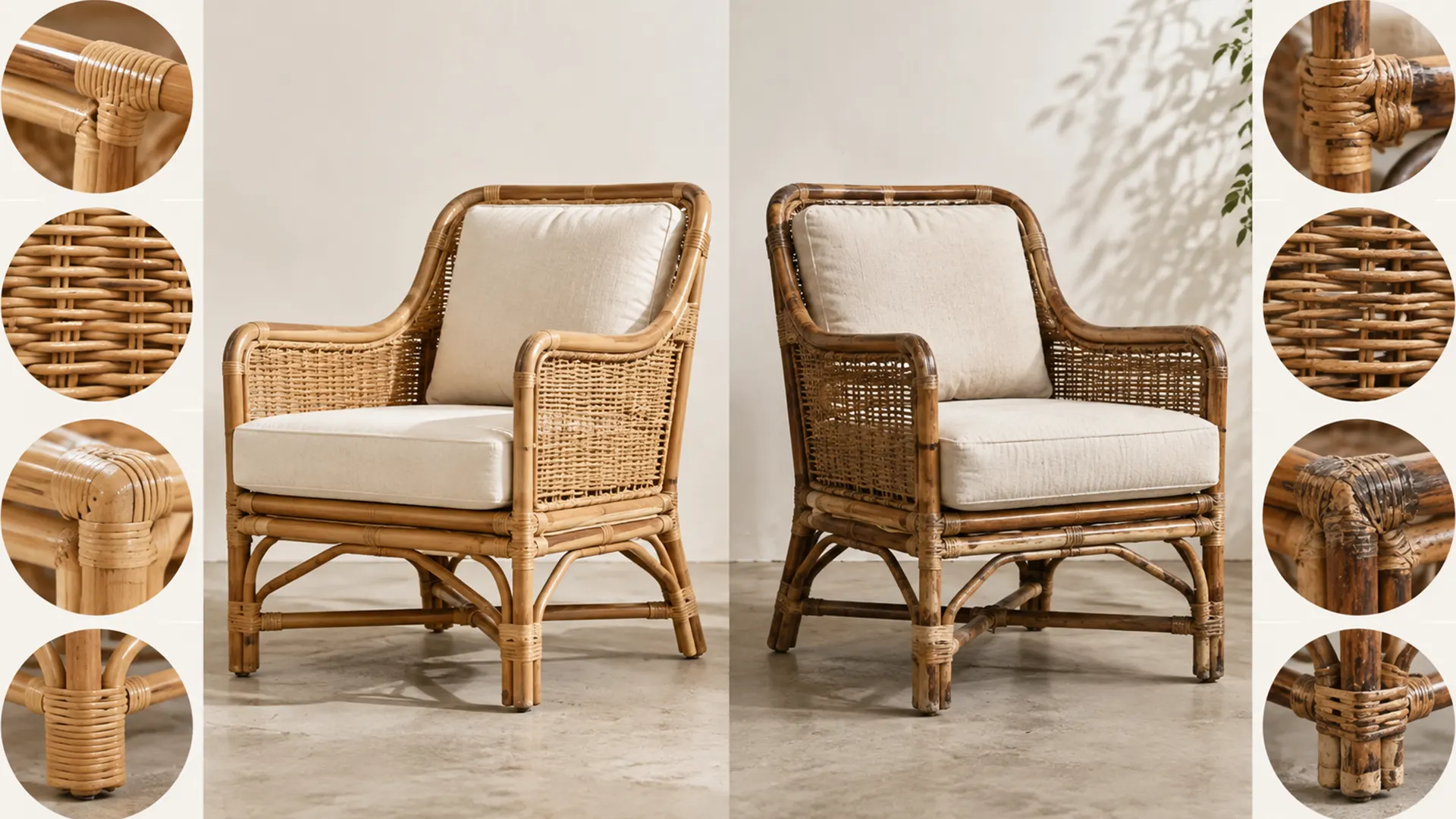
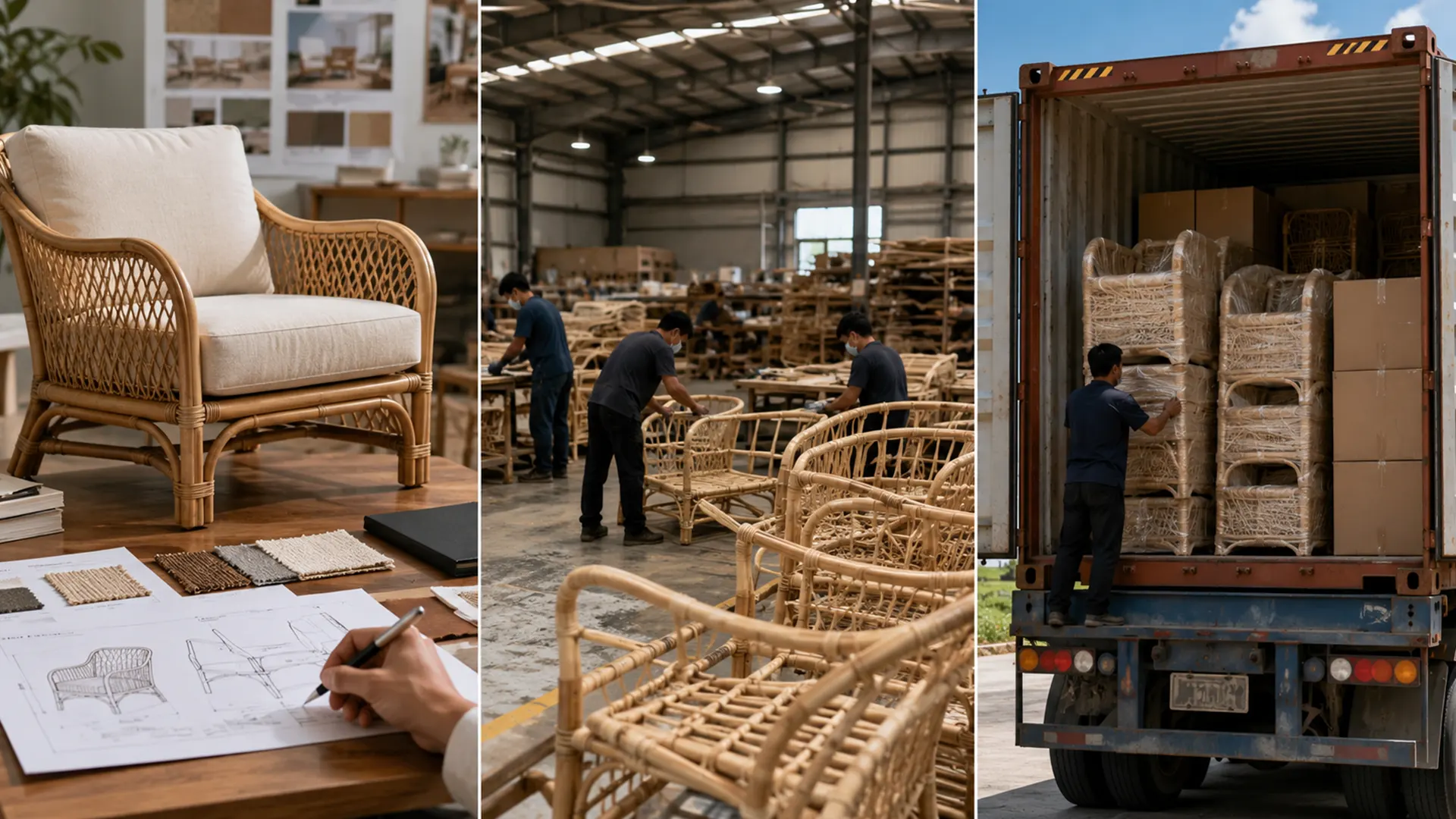
Rattan Export buyer guide: Sample Approval Before A Container Order: What Buyers Should Check.
Sample approval is one of the most important control points before a rattan furniture container order enters mass production. A sample is not simply a piece used to confirm whether the chair, table, basket or cabinet looks attractive. For a professional importer, the approved sample should become a physical production reference connecting the design, dimensions, materials, construction, weaving, finish, hardware, upholstery, packaging and expected workmanship standard.
If the sample is approved too casually, problems that appear minor on one prototype can be multiplied across hundreds of units inside a 20ft, 40ft or 40HC container. A slightly incorrect seat height becomes hundreds of incorrectly sized chairs. A weak joint becomes a structural problem across the production batch. A colour difference becomes a retail consistency issue. A packaging mistake can change container capacity or create widespread transport damage.
The purpose of sample approval is therefore not to decide whether the buyer “likes” the product. It is to establish what the factory is authorized to reproduce during mass production and which characteristics must remain within an agreed range.
When sourcing through the Vietnam rattan, bamboo and natural-fibre manufacturing ecosystem, buyers should also remember that handcrafted products naturally contain some variation. The objective is not mechanical identity between every unit. The objective is controlled consistency within an agreed commercial and technical standard.
What Is An Approved Sample?
An approved sample is the physical or documented reference against which mass-production units are evaluated.
Depending on the product program, the approval package may include:
- The physical sample
- Technical drawing
- Dimensions and tolerances
- Material specification
- Approved colour reference
- Weaving pattern
- Hardware specification
- Cushion or upholstery specification
- Packaging specification
- Photographs
- Revision number and approval date
The strongest system uses the physical sample together with written specifications. A sample alone cannot communicate every tolerance or hidden construction requirement, while a drawing alone may not fully communicate handcrafted appearance and feel.
The Sample Should Be Production-Representative
A beautiful prototype is not useful if it was produced using methods that cannot be repeated during normal production.
Before approving the sample, ask whether it was made using:
- The intended production material
- The intended frame construction
- The intended weaving material
- The planned finishing system
- The planned hardware
- The intended packaging concept
If the sample uses premium material specially selected for one prototype while mass production will use a different grade, the sample is not a reliable production reference.
1. Confirm The Correct SKU And Revision
Before checking quality, confirm that everyone is reviewing the same version.
The sample should be identified by:
- SKU or model number
- Product name
- Revision number
- Colour code
- Approval date
This becomes especially important when several sample rounds have been produced. Factories and buyers should avoid vague statements such as “produce according to the last sample” without clearly documenting which sample is the authorized version.
2. Measure The Overall Dimensions
Do not approve dimensions only by visual impression.
For furniture, measure all commercially important dimensions such as:
- Overall width
- Overall depth
- Overall height
- Seat width
- Seat depth
- Seat height
- Arm height
- Table height
- Clearance dimensions
Dimensions influence comfort, ergonomics, retail specifications, project installation and packaging.
3. Define Reasonable Tolerances
Handmade furniture should not be managed with the assumption that every unit will measure exactly the same to the millimetre.
However, “handmade” should not mean uncontrolled variation.
The buyer and factory should define reasonable tolerances for important dimensions. The correct tolerance depends on product type, construction, function and production method.
Critical functional dimensions may require tighter control than purely decorative dimensions.
4. Inspect Frame Construction
The frame is one of the most important parts of the sample because much of it may become hidden after weaving and finishing.
Check:
- Number of structural members
- Position of rails and braces
- Joint design
- Reinforcement
- Symmetry
- Leg alignment
- Frame squareness where relevant
- Visible cracks or splitting
If structural details are important, document them with photographs before the sample is fully covered.
5. Check Stability
A chair that looks attractive but rocks on a flat floor is not ready for approval.
Check that:
- All legs contact the floor properly
- The product does not rock excessively
- The frame does not twist under normal handling
- Tables remain stable
- Stools and chairs feel balanced
For applicable furniture programs, additional performance or safety testing may also be required according to the buyer's market and product category.
6. Evaluate Structural Comfort, Not Just Appearance
A dining chair can match a photograph perfectly and still be uncomfortable.
Check:
- Seat angle
- Back angle
- Lumbar support
- Arm position
- Seat depth
- Front-seat pressure
- Relationship between table and chair height where relevant
Changes to comfort dimensions should be completed during sample development, not after mass production begins.
7. Inspect Rattan And Bamboo Material Quality
Natural material should be evaluated according to the intended commercial grade and design style.
Check for:
- Excessive cracking
- Major surface defects
- Inappropriate diameter variation
- Unacceptable colour variation
- Poorly prepared nodes
- Splintering
- Damaged or crushed material
Some natural variation is normal and can be part of the product character. The important issue is defining where acceptable natural variation ends and a quality defect begins.
8. Check Bent Components Carefully
Bent rattan is a major visual and structural element in many chairs, lounge furniture and decorative frames.
Check:
- Curve consistency
- Left-right symmetry
- Flattening
- Cracks at high-stress bends
- Distortion
- Alignment between related parts
If the design depends heavily on symmetrical curves, photographs and key dimensional references should be added to the approval package.
9. Inspect Joints And Bindings
Bindings may be structural, decorative or both.
Check:
- Tightness
- Position
- Number of wraps
- Clean finishing
- Loose ends
- Consistency between repeated joints
Bindings should not merely hide poor structural connections underneath.
10. Approve The Exact Weaving Pattern
“Woven rattan” is not a sufficient production instruction.
The approved sample should define:
- Pattern
- Direction
- Material size
- Spacing
- Density
- Edge treatment
- Transition between woven and structural areas
Even small differences in spacing can materially change appearance and labour content.
11. Check Weaving Tension
Weaving should neither be excessively loose nor forced so tightly that it distorts the frame or creates later cracking.
Check for:
- Uneven tension
- Large inconsistent gaps
- Loose ends
- Bulging surfaces
- Distorted frame members
- Weak edge termination
12. Define Acceptable Handmade Variation
This is one of the most important discussions before mass production.
Handwoven furniture naturally varies more than injection-moulded plastic or CNC-machined metal components. The buyer should therefore distinguish between acceptable craftsmanship variation and defects.
For example, small natural differences in weave spacing may be acceptable, while visibly different patterns, loose material or major asymmetry may not be.
13. Approve Colour Under Appropriate Lighting
Colour evaluation should not depend only on mobile-phone photographs.
Camera processing, screen brightness and lighting conditions can dramatically change the appearance of natural materials and stains.
Where colour is commercially important, use:
- A physical approved sample
- An approved colour panel
- A documented colour reference
The factory should understand how much natural colour variation is acceptable.
14. Inspect The Finishing System
Check:
- Surface smoothness
- Colour uniformity
- Coverage
- Runs or drips
- Dust contamination
- Visible sanding marks
- Unfinished hidden areas where relevant
- Excessive gloss variation
Ask whether the sample uses the same finishing process planned for mass production.
15. Confirm The Finish Is Properly Cured
A sample photographed immediately after finishing may look excellent while the coating is still soft.
Before final approval, confirm that the surface behaves correctly after sufficient curing.
Watch for:
- Sticky surfaces
- Fingerprint marking
- Wrapping impressions
- Colour transfer
- Strong residual odour
16. Review Moisture Condition And Material Stability
Natural rattan and bamboo respond to moisture.
No universal moisture percentage should be applied blindly to every product. Appropriate control depends on material type, section size, process, factory method and destination requirements.
The important point is that the approved sample should represent material that has been appropriately dried or conditioned and that the production supplier follows a documented quality, moisture and pre-shipment control process.
17. Check Hardware
For furniture containing screws, bolts, brackets, hinges, glides or connectors, confirm:
- Material
- Dimensions
- Finish or plating
- Quantity
- Location
- Function
Do not allow the sample to use temporary workshop hardware if mass production will use another specification.
18. Test KD Assembly
For knock-down products, the sample should be assembled using the same process expected at destination.
Check:
- Parts align correctly
- Holes align
- Hardware is sufficient
- Tools are practical
- Assembly sequence is understandable
- Finished product is stable after assembly
The buyer should ideally test assembly without relying on a factory technician who already knows the product.
19. Check Disassembly And Reassembly Where Relevant
If the product may need to be disassembled during retail handling, installation or replacement, verify that repeated assembly does not easily damage the joints or threads.
20. Approve Cushion Dimensions
Cushions can materially change comfort and appearance.
Check:
- Length
- Width
- Thickness
- Fit within the frame
- Corner shape
- Attachment method
21. Confirm Foam Specification
Two cushions that look identical can feel completely different because of internal foam specification.
Confirm the intended:
- Foam type
- Density
- Thickness
- Layer structure where applicable
22. Approve Fabric And Upholstery Details
Check:
- Fabric code
- Colour
- Direction
- Seam placement
- Piping
- Zipper
- Stitch quality
- Pattern alignment where applicable
Keep an approved fabric reference where practical.
23. Verify Product Function
Depending on the product, test:
- Doors
- Drawers
- Hinges
- Lids
- Adjustable components
- Folding mechanisms
- Swivel or moving components
Function should be tested repeatedly rather than only once.
24. Check Floor Contact And Protective Feet
Glides, foot caps or protective pads may appear minor but strongly affect customer experience.
Check their:
- Position
- Attachment
- Material
- Height consistency
25. Check Visible Workmanship From Normal Viewing Distance
After technical inspection, evaluate the sample as a customer would see it.
Look for:
- Asymmetry
- Visible glue
- Exposed fasteners
- Rough bindings
- Uneven weaving
- Poor touch-up
- Surface marks
- Untrimmed material
26. Also Inspect Hidden Areas
Turn the product upside down and inspect underneath.
Low-visibility areas often reveal:
- Weak joints
- Poor sanding
- Incomplete finish
- Loose fasteners
- Untidy bindings
- Uncontrolled repair work
A premium product should not depend on the assumption that the customer will never inspect the underside.
27. Compare The Sample With The Drawing
If the drawing and physical sample disagree, resolve the conflict before production.
Do not allow one factory team to follow the sample while another follows an outdated drawing.
The approved documentation should clearly state which revision controls production.
28. Record All Approved Deviations
Sometimes a prototype cannot follow the original drawing exactly and the buyer intentionally approves a change.
That change should be documented.
For example:
- Seat height changed by 10 mm
- Binding width increased
- Leg angle adjusted
- Weaving pattern modified
- Hardware changed
Undocumented verbal approvals are a major source of disputes.
29. Approve The Packaging Before Mass Production Is Finished
The furniture sample and packaging sample should be treated as part of the same commercial product.
Check:
- Wrapping materials
- Surface protection
- Corner protection
- Leg protection
- Internal movement
- Carton strength
- Carton closure
- Units per carton
30. Test Nesting And Stacking With Protection Installed
If the product is designed to nest or stack, test the actual protected configuration.
Bare showroom products may fit together beautifully, while protective materials increase the required spacing.
Check:
- Maximum safe units per stack
- Actual contact points
- Finish rubbing
- Weaving pressure
- Frame load transfer
- Ease of unpacking
31. Verify Final Packed Dimensions
Container planning should use final packed dimensions, not bare furniture dimensions.
Record:
- Carton length
- Carton width
- Carton height
- Units per carton
- Gross weight
- CBM per carton
- CBM per saleable unit
32. Packaging Approval Can Change The Landed Cost
If the final package is larger than expected, fewer units may fit in the container.
A small increase in CBM per unit multiplied across hundreds of pieces can materially change freight allocation per chair or table.
Packaging therefore belongs in both the product-development process and the wider container and export-planning process.
33. Check Carton Markings And Labels
Before the first production cartons are printed, approve:
- SKU
- Product name
- Quantity
- Country-of-origin wording where required
- Handling marks
- Barcode where applicable
- Buyer reference
- Carton number format
34. Confirm Assembly Instructions
For KD furniture, assembly instructions are part of the product.
Test whether a person unfamiliar with the design can understand:
- Part identification
- Hardware identification
- Assembly sequence
- Orientation
- Required tools
35. Check The Hardware Pack
The sample hardware pack should represent the production pack.
Verify:
- Correct quantity
- Spare pieces if specified
- Individual separation where necessary
- Identification
- Secure placement inside the carton
A missing bolt can make an otherwise perfect KD product unusable.
36. Consider Retail And Warehouse Handling
The package should survive more than the ocean journey.
It may also pass through:
- Destination warehouse
- Distribution centre
- Retail store
- Project site
- Last-mile delivery
The sample-approval process should consider the entire intended distribution chain.
37. Decide Whether Testing Is Required
Depending on product type, buyer program and destination market, the buyer may require structural, performance, material or other testing.
Testing requirements should be defined before production rather than discovered after goods are complete.
38. Do Not Assume A Sample Is A Compliance Certificate
A physically approved sample proves only that the reviewed unit met the buyer's approval criteria at that moment.
It does not by itself prove that the product complies with every legal, testing or market requirement.
Compliance documentation and testing must be managed separately where applicable.
39. Create A Written Sample-Approval Checklist
Verbal approval such as “looks good, proceed” is risky for a container order.
A stronger approval record lists:
- What was checked
- What was accepted
- What still requires correction
- Which tolerances apply
- Which documents control production
- Who approved the final version
- Approval date
40. Use Conditional Approval Carefully
Sometimes a buyer may approve a sample subject to minor corrections.
For example:
Approved for production provided that the rear binding is tightened, the seat height is reduced according to Drawing Rev. C and the final carton uses the approved corner protection.
Conditional approval should identify every required change clearly. The factory should confirm those corrections before mass production proceeds too far.
41. Keep An Approved Master Reference
Where practical, the factory should retain an approved reference sample or master sample during production.
It can be used to compare:
- Colour
- Weaving
- Shape
- Binding
- Hardware
- General workmanship
The buyer may also retain an equivalent sample or detailed approval record.
42. Protect The Master Sample From Damage
A production reference loses value if it is repeatedly handled, faded in sunlight, damaged or modified.
The factory should identify it clearly and prevent it from being accidentally shipped or altered.
43. Train Production Teams From The Approved Reference
The approved sample should not remain only in the office of the sales team.
Relevant information needs to reach:
- Frame production
- Weaving teams
- Finishing department
- Upholstery
- Quality control
- Packaging team
Each department should understand which characteristics are critical.
44. First Production Units Should Be Checked Against The Sample
Do not wait until the complete container order is finished.
Early mass-production units should be compared with the approved reference for:
- Dimensions
- Shape
- Frame
- Weaving
- Colour
- Workmanship
This is one of the best opportunities to stop a small deviation from becoming a full-order problem.
45. Do Not Rely Only On The Perfect “Golden Sample”
A supplier may be capable of producing one excellent prototype. The real commercial question is whether normal production can consistently reproduce the approved standard.
That is why in-process controls and random production checks remain important after sample approval.
46. Sample Approval Does Not Replace Final Inspection
The approved sample defines the target. Production inspection verifies whether the order followed it.
A proper inspection program may check:
- Random production units
- Quantity
- Dimensions
- Construction
- Workmanship
- Colour
- Function
- Packaging
47. Common Sample-Approval Mistakes
- Approving only from photographs
- Ignoring dimensions
- Not checking the underside or hidden construction
- Approving colour on an uncalibrated screen
- Not defining tolerances
- Ignoring weaving density
- Not testing KD assembly
- Ignoring hardware specification
- Approving the furniture but not the packaging
- Using bare dimensions instead of packed dimensions
- Allowing multiple uncontrolled sample revisions
- Failing to document approved changes
- Starting mass production before critical corrections are confirmed
A Practical Sample Approval Matrix
| Area | What To Approve | Main Risk If Missed |
|---|---|---|
| Dimensions | Critical sizes and tolerances | Incorrect fit, comfort or project dimensions |
| Frame | Construction, joints, reinforcement | Instability or structural weakness |
| Rattan/bamboo | Material grade, diameter and appearance | Inconsistent quality |
| Weaving | Pattern, density, spacing and tension | Visual and workmanship variation |
| Finish | Colour, coating, smoothness and curing | Colour mismatch or surface damage |
| Hardware | Type, quantity and placement | Assembly or durability problems |
| Cushion | Fabric, foam, dimensions and stitching | Comfort and appearance mismatch |
| KD | Assembly, instructions and hardware pack | Customer assembly failure |
| Packaging | Protection, carton and packed dimensions | Damage or poor container utilization |
| Documentation | SKU, revision and approval record | Wrong version produced |
Questions Buyers Should Ask Before Signing Off The Sample
- Is this the exact material planned for production?
- Is the frame identical to the production construction?
- Are all dimensions verified?
- Are tolerances documented?
- Is the weaving pattern final?
- Is acceptable handmade variation defined?
- Is the colour physically approved?
- Is the finish fully cured?
- Is the hardware final?
- Has KD assembly been tested?
- Are cushion specifications confirmed?
- Is packaging approved?
- Are final packed dimensions measured?
- Is CBM confirmed?
- Are all required corrections documented?
- Which revision controls mass production?
Frequently Asked Questions
Can I approve a rattan furniture sample from photos?
Photos can support the process, but they are weak for confirming dimensions, comfort, stability, surface feel, true colour, structural details and assembly. For significant container programs, physical review or a robust technical approval process is preferable.
Should handmade rattan furniture match the sample exactly?
It should match the approved design and quality standard while allowing agreed natural and handcrafted variation. The important issue is defining acceptable variation before production.
What happens if the sample and drawing are different?
The conflict should be resolved before production, and the controlling revision should be documented clearly.
Should packaging be approved at the sample stage?
Yes, ideally before mass production is complete. Packaging affects protection, CBM, container capacity and landed cost.
Is one approved sample enough for production?
It is a critical reference, but it does not replace in-process quality control or pre-shipment inspection. The factory must demonstrate that normal production consistently follows the approved standard.
Can the factory make small changes after approval?
Changes that affect construction, appearance, function, material, packaging or commercial performance should be communicated and approved rather than implemented informally.
What is the most important sample-approval mistake to avoid?
Approving the sample as a visual object without converting it into a documented production standard.
The Approved Sample Should Become The Production Standard
A successful container order begins long before the container arrives at the factory. It begins when the buyer and manufacturer agree exactly what the product is supposed to be.
For rattan furniture, that means more than colour and appearance. It means dimensions, tolerances, frame construction, natural-material standard, weaving, joints, finish, hardware, cushions, functionality, packaging, final packed dimensions and acceptable handcrafted variation.
The more precisely these items are approved before production, the less room remains for disputes, rework and shipment delays later.
An approved sample is therefore not simply a prototype. It is one of the central quality-control tools connecting product development to container-scale manufacturing.
If you are preparing an OEM, ODM or wholesale rattan furniture order from Vietnam, send your product drawings, reference images, specifications, target quantities and container requirements so the sample-development and approval process can be structured before mass production begins.