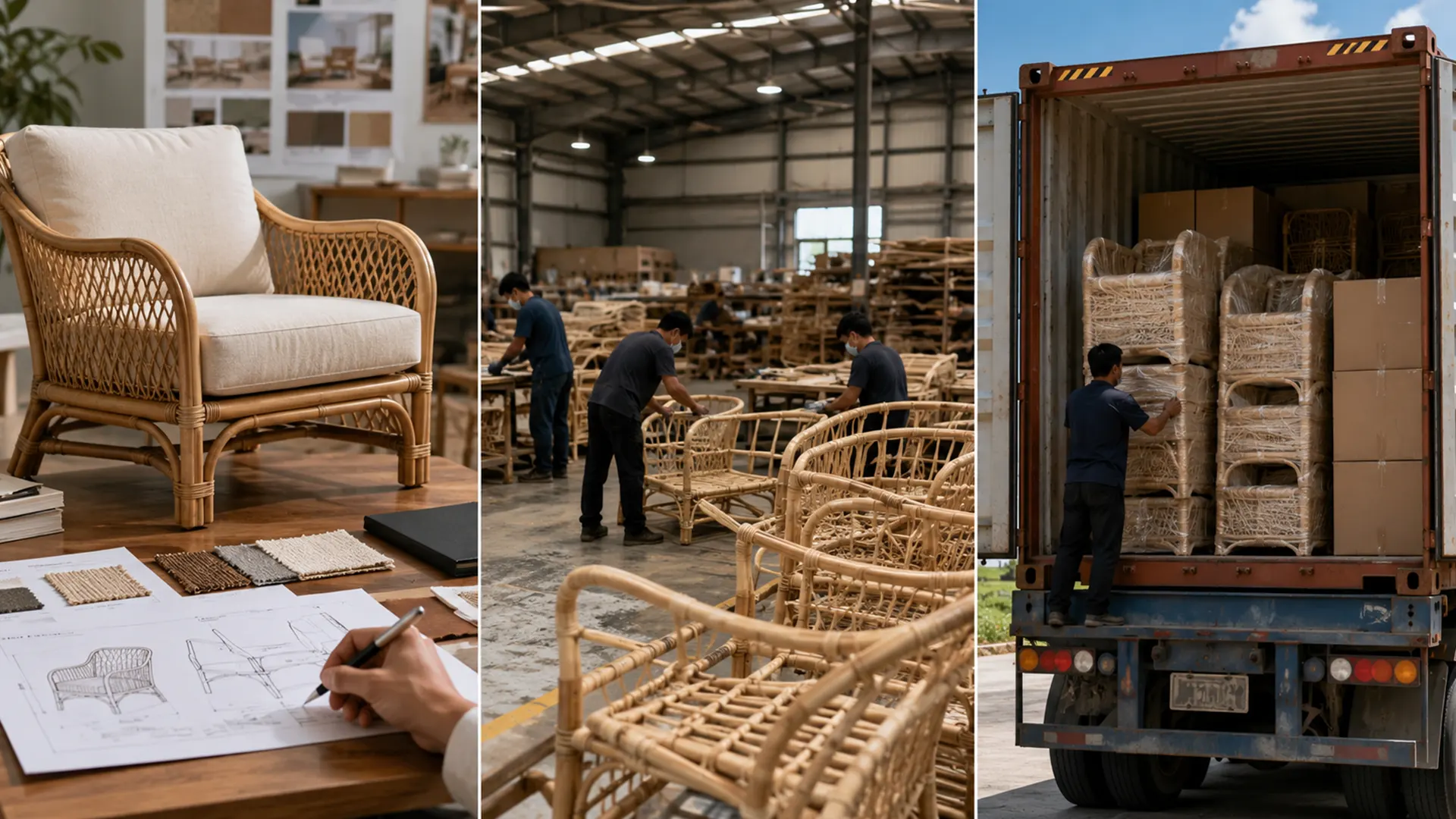
 Rattan Export buyer guide: Rattan Furniture Lead Times: From Sample Approval To Container Loading.
Rattan furniture lead time is not a single number. For an international importer, the time between sample approval and container loading is created by a chain of dependent activities: material preparation, frame production, bending, weaving, sanding, finishing, curing, assembly, quality control, packing, carton verification, container planning and final loading. If one stage starts late or has to be repeated, the entire shipment schedule can move.
This is particularly important for rattan, bamboo and natural-fibre furniture because much of the work is manual, natural materials require conditioning and stabilization, finishes need sufficient curing time, and bulky furniture must be packed around real container-loading constraints rather than only around factory production output.
Professional buyers should therefore treat lead time as a production plan rather than a promise such as “45 days.” The most useful question is not simply “How many days do you need?” but “What must happen between sample approval and container loading, and which approvals or dependencies can change that schedule?”
Buyers sourcing through the Vietnam rattan and bamboo manufacturing ecosystem should also remember that some programs involve more than one location. Materials, frames, woven components, upholstery or accessories may move between suppliers or specialist workshops before final inspection and export packing.
What Does Rattan Furniture Lead Time Actually Mean?
Different suppliers may use the term lead time differently. One factory may count from deposit receipt. Another may count from final sample approval. Another may count only actual production days and exclude waiting time for packaging approval, buyer comments or shipment booking.
Before comparing quotations, clarify exactly when the clock starts and when it stops.
A practical definition for international purchasing is:
Production lead time = the period from final commercial and technical release to finished, inspected and export-packed goods ready for container loading.
This is different from:
- Sample development time
- Transit time
- Port waiting time
- Ocean freight time
- Destination customs clearance
Lead Time Should Start Only After Critical Approvals Are Complete
A factory cannot reliably schedule production if essential information is still changing.
Before full production begins, buyers should ideally have confirmed:
- Final SKU list
- Approved sample or master reference
- Technical drawings
- Dimensions and tolerances
- Materials
- Weaving pattern
- Colour and finish
- Hardware
- Cushions or upholstery where applicable
- KD or fully assembled construction
- Packaging method
- Labels and carton marks
- Order quantities
- Commercial terms
If these items remain open, the supplier may reserve capacity but still be unable to start stable mass production.
Sample Approval Is The Real Production Gate
For OEM, ODM and custom furniture, sample approval is one of the most important milestones in the entire schedule.
An approved sample should confirm more than appearance. It should ideally establish:
- Overall dimensions
- Frame construction
- Rattan or bamboo size
- Weaving detail
- Colour
- Surface finish
- Stability
- Hardware
- Assembly method
- Packaging concept
A buyer who approves appearance but continues changing dimensions or construction afterward has not really frozen the product.
Sample Revision Cycles Can Add More Time Than Buyers Expect
One sample may be approved immediately. Another may require two, three or more revisions.
Each revision can involve:
- New material preparation
- New frame components
- Re-bending
- New weaving
- New finish application
- New curing time
- New photographs or physical shipment of the sample
For this reason, development time should be planned separately from mass-production lead time.
Do Not Place A Large Order On An Unstable Sample
Starting mass production before critical sample issues are resolved may appear to save time, but it can create much larger delays later if hundreds of units require rework.
Production speed is useful only when the specification is stable.
Stage 1: Raw-Material Preparation
Once the order is released, the supplier needs to secure and prepare the required materials.
Depending on the product, this may include:
- Natural rattan poles
- Rattan peel or weaving material
- Bamboo components
- Timber
- Metal parts
- Fabric
- Foam
- Hardware
- Packaging materials
Lead time can increase if the order uses unusual material sizes, custom finishes, special fabrics or imported components.
Material Availability Should Be Confirmed Before The Factory Commits To A Date
A supplier may have available labour but still lack the correct material.
Ask whether required materials are:
- Already in stock
- Regularly purchased
- Made to order
- Imported
- Subject to seasonal availability
This is especially important for custom upholstery, special hardware or unusual mixed-material designs.
Stage 2: Conditioning, Drying And Stabilization
Natural materials cannot always move directly from receiving to furniture production. Depending on their condition and the manufacturing process, they may need drying, conditioning, sorting or stabilization.
Rushing this stage can create later problems such as:
- Cracking
- Movement
- Distortion
- Mold risk
- Finish inconsistency
There is no universal number of days suitable for every rattan or bamboo product. The correct period depends on material condition, species, component size, process and factory controls.
Stage 3: Frame Production And Bending
For furniture such as dining chairs, lounge chairs, stools, beds and tables, the frame is one of the earliest major production stages.
Typical operations may include:
- Cutting
- Bending
- Drilling
- Joint preparation
- Assembly
- Reinforcement
- Dimensional checking
Complex curved frames usually require more labour and control than simple straight structures.
Jigs And Templates Improve Repeatability
When a design enters mass production, proper jigs and dimensional references can reduce variation and rework.
This becomes especially important when later stages depend on accurate frame dimensions, such as nesting, KD assembly, upholstery or woven panel fitting.
Stage 4: Weaving
Weaving is often one of the most labour-intensive parts of rattan furniture production.
The required time depends on:
- Surface area to be woven
- Pattern complexity
- Material thickness
- Number of colours or materials
- Skill level required
- Number of available artisans
- Whether weaving is internal or distributed to specialist workshops
A simple open weave can be much faster than a dense or decorative pattern. A large lounge chair can also require substantially more weaving hours than a small dining chair.
Manual Capacity Is Not The Same As Machine Capacity
Adding more orders does not automatically increase weaving output. Skilled artisans are a limited production resource.
During busy periods, a factory may have frame capacity available but insufficient weaving capacity. Professional production planning should therefore consider the actual bottleneck.
Distributed Weaving Networks Can Increase Capacity But Add Coordination
Some suppliers work with village artisans or specialist weaving groups. This can increase total production capability but also requires strong control of:
- Approved samples
- Dimensions
- Material distribution
- Pattern consistency
- Collection schedules
- Incoming inspection
Distributed production should not be treated as automatically slower or faster. Its performance depends on management quality.
Stage 5: Sanding And Surface Preparation
Before finishing, frames and woven structures may require sanding, cleaning, trimming and localized repair.
This stage can appear minor but has a major effect on final appearance.
If sanding quality is poor, later finishing may reveal:
- Rough surfaces
- Visible repair marks
- Uneven stain absorption
- Dust contamination
Stage 6: Staining, Painting And Finishing
Finish requirements can significantly change lead time.
A natural clear finish may follow a different process from:
- Dark stain
- Whitewash
- Painted finish
- Distressed finish
- Multi-step decorative finish
Each process may require preparation, application, drying and additional coats.
Curing Time Should Not Be Sacrificed To Recover A Late Schedule
One of the most dangerous ways to “save time” is packing furniture before the finish has sufficiently cured.
Premature packing can result in:
- Surface sticking
- Marks from protective wrapping
- Odor inside cartons
- Colour transfer
- Finish damage
- Increased moisture risk
When reviewing production schedules, buyers should distinguish between “finish completed” and “safe to pack.”
Stage 7: Upholstery, Cushions And Additional Components
If the collection includes cushions or upholstery, additional supply chains enter the schedule.
Potential dependencies include:
- Fabric availability
- Fabric approval
- Foam production
- Sewing capacity
- Labels
- Zippers
- Fire-performance or destination-specific requirements where applicable
A furniture frame can be finished while the cushion supplier is still late, preventing the complete SKU from being packed.
Stage 8: Final Assembly
Fully assembled furniture may require final joint checks, hardware installation, feet, glides, cushions and cleaning.
KD furniture may require:
- Part matching
- Hardware kit preparation
- Assembly testing
- Instruction verification
- Part labelling
KD designs can reduce packed volume but introduce additional production-control requirements.
Stage 9: Internal Quality Control
Quality control should happen throughout production, not only after the goods are complete.
Useful checkpoints may include:
- Incoming material inspection
- Frame check
- Post-weaving inspection
- Pre-finishing inspection
- Post-finishing inspection
- Final assembly inspection
- Pre-packing inspection
A stronger quality-control and pre-shipment inspection process can actually protect lead time by identifying problems before the entire order reaches the final stage.
Late Quality Detection Creates The Biggest Schedule Disruptions
If an issue is discovered when only ten frames are produced, correction may be manageable. If the same issue is discovered after five hundred finished chairs are packed, the impact can be severe.
Examples include:
- Incorrect dimensions
- Wrong finish colour
- Loose weaving
- Missing reinforcement
- Incorrect hardware
- Packaging that does not fit
Stage 10: Rework And Corrective Action
Factories should include realistic time for rework when necessary. Professional production planning does not assume that every unit will pass every stage without correction.
However, repeated rework should trigger root-cause analysis rather than simply extending the schedule.
Stage 11: Packaging Approval
Packaging should ideally be approved before the full order reaches completion.
The buyer and supplier should confirm:
- Protection method
- Carton construction
- Units per carton
- Nesting arrangement
- KD component arrangement
- Hardware placement
- Cushion placement
- Carton marks
- Final packed dimensions
Waiting until production is complete to design the carton can create unnecessary delay.
Packaging Changes Can Change The Container Plan
A seemingly small packaging change may change final CBM substantially.
Examples include:
- Thicker protection
- Larger corner blocks
- Different nesting depth
- Changing units per carton
- Separating cushions
- Retail packaging
Once final packed dimensions change, container-loading calculations should be updated.
Stage 12: Final Packing
After products are approved for packing, workers still need time to protect, carton, label and move the goods into finished-goods storage.
Packing capacity can become a bottleneck at the end of a large order, especially when several containers are being prepared at the same time.
Stage 13: Pre-Shipment Inspection
Many international buyers perform a pre-shipment inspection after the order is substantially complete and packed.
The inspection may verify:
- Quantity
- Workmanship
- Dimensions
- Colour
- Function
- Assembly
- Packaging
- Carton markings
If the inspection fails, the schedule should allow time for correction and reinspection.
Do Not Book An Unrealistically Tight Vessel Before Inspection
If the vessel cutoff occurs immediately after inspection, even a minor corrective action can cause a missed sailing.
A practical schedule should contain enough operational buffer to manage normal corrections without forcing the factory to load nonconforming goods.
Stage 14: Finished-Goods Release
After internal QC and buyer inspection requirements are satisfied, goods can be formally released for shipment.
At this point the supplier should have reliable final data for:
- Total cartons
- Total units
- SKU quantities
- Gross and net weight
- Final CBM
- Container requirement
Stage 15: Container Booking And Equipment Coordination
Factory completion and container availability are separate issues.
The export schedule also depends on:
- Shipping-line booking
- Container availability
- Empty-container release
- Trucking schedule
- Port cutoff
- Customs and documentation timing
These activities should be managed within the wider FOB, freight and container-shipping process.
Stage 16: Empty Container Inspection
Before loading natural-fibre furniture, the container should be checked for basic suitability.
Typical checks include:
- Clean interior
- Dry floor
- No obvious holes
- No significant water ingress
- No strong abnormal odor
- Doors functioning correctly
An unsuitable container should not be accepted simply to protect a vessel deadline.
Stage 17: Container Loading
Container loading is the final physical production milestone, but it still requires planning.
The factory should control:
- Loading sequence
- SKU quantities
- Carton strength
- Heavy versus crushable packages
- Void management
- Door clearance
- Final carton count
- Container number
- Seal number
- Loading photographs
Single-SKU Orders Are Usually Easier To Schedule
A container containing one chair model in one colour is generally easier to coordinate than a container containing twenty-five SKUs from several product categories.
A simple order reduces:
- Material combinations
- Finish changes
- Packaging variation
- SKU synchronization
- Loading complexity
Mixed Containers Need Synchronization Across SKUs
Mixed-container programs can be commercially attractive, but the entire shipment may be delayed by the slowest critical SKU.
For example, if twenty-four SKUs are complete and one important dining-chair model is still in finishing, the buyer must decide whether to:
- Wait for the SKU
- Replace it with another approved SKU
- Reduce its quantity
- Ship without it and accept lower container utilization
These decisions should be anticipated during production planning rather than made on loading day.
Multi-Factory Mixed Containers Need Even More Coordination
When goods come from several factories, each supplier has its own production schedule.
The consolidation plan should track:
- Completion date by supplier
- Inspection date
- Domestic transport to consolidation point
- Final carton quantity
- CBM
- Loading priority
One late supplier can delay the entire container.
OEM And ODM Orders Usually Need More Planning Time
Custom development adds uncertainty before mass production because product engineering may still be evolving.
OEM or ODM programs may require:
- Drawing review
- Prototype
- Structural modifications
- Finish development
- Packaging engineering
- Assembly testing
- Multiple sample rounds
Repeat orders of an already approved SKU should normally be easier to schedule than first-time development.
Repeat Orders Can Still Change Lead Time
A repeat SKU does not always mean the same schedule.
Lead time can change because of:
- Factory backlog
- Seasonal demand
- Material availability
- Labour availability
- Packaging changes
- Quantity changes
- Different colour mix
Peak Capacity Periods Matter
A factory quoting a short schedule during a quiet month may not be able to maintain the same schedule during a busy export period.
Buyers should ask not only for theoretical capacity but also:
- Current order backlog
- Available weaving capacity
- Current finishing load
- Existing container commitments
Large Orders Should Be Planned By Production Batches
For several-container programs, it can be more practical to divide production into controlled batches.
Advantages include:
- Earlier detection of problems
- Progressive inspection
- More predictable loading
- Better warehouse control
- Reduced risk of discovering one defect across the entire order
Illustrative Planning Timeline
The following example is only a planning illustration, not an industry standard or guaranteed schedule. Actual timing varies substantially by product, factory, quantity, season and approval status.
| Phase | Illustrative Planning Focus |
|---|---|
| Commercial and technical release | PO, deposit where applicable, approved sample, specification freeze |
| Material preparation | Secure and condition materials |
| Frame production | Cutting, bending, assembly and dimensional control |
| Weaving | Manual production according to approved pattern |
| Finishing | Sanding, staining/coating and curing |
| Assembly and internal QC | Functional checks, corrections and cleaning |
| Packing | Approved protection, cartons, labels and final CBM |
| Pre-shipment inspection | Buyer or third-party verification |
| Shipment release | Corrections closed, final quantities confirmed |
| Container loading | Equipment inspection, loading, carton reconciliation and sealing |
Why A Single Number Can Be Misleading
Suppose Supplier A says “40 days” and Supplier B says “50 days.” Supplier A may exclude sample release, packaging approval and inspection correction, while Supplier B may include them.
The quotations are not directly comparable until the timing definitions are aligned.
Ask For Milestones, Not Only A Final Date
A stronger production schedule contains milestone dates.
For example:
- Material ready
- Frames completed
- Weaving 50% complete
- Weaving 100% complete
- Finishing complete
- Packing starts
- Goods ready for inspection
- Correction deadline
- Container loading target
Milestones help buyers identify delays before the final shipping week.
Weekly Production Updates Can Reduce Surprises
For significant orders, the supplier should ideally report progress against agreed milestones.
Useful updates may include:
- Units completed by SKU
- Current production stage
- Known shortages
- Quality issues
- Rework status
- Expected inspection readiness
Progress percentages are useful only when based on real production data.
Photographs Should Support, Not Replace, Production Data
Production photographs can confirm that work is moving, but a few photographs do not prove that the complete order is on schedule.
Buyers should combine visual evidence with SKU-level quantity reporting.
What Causes Rattan Furniture Lead-Time Delays?
Common causes include:
- Late sample approval
- Buyer specification changes
- Material shortages
- Insufficient weaving capacity
- Complex finishes
- Slow curing
- Subcontractor delays
- Late upholstery components
- Quality rework
- Packaging changes
- Failed inspection
- Container shortages
- Late consolidation from another factory
Buyer Changes Are A Major Lead-Time Risk
Factories are often blamed for delays that actually begin with specification changes after production has started.
Changes to dimensions, colour, weaving, carton size or quantity can affect several stages simultaneously.
Professional buyers should maintain controlled revision approval and clearly identify which version is authorized for production.
Rush Orders Can Increase Quality Risk
Shortening a schedule is sometimes possible, but the buyer should understand which activities are being compressed.
Reducing waiting time between administrative steps is different from reducing:
- Material conditioning
- Finish curing
- Quality inspection
- Corrective action
These technical stages should not be sacrificed simply to meet an unrealistic departure date.
Lead Time And Landed Cost Are Connected
A late container can create commercial costs beyond freight.
Possible impacts include:
- Out-of-stock risk
- Missed retail launch
- Project delay
- Warehouse scheduling problems
- Expedited freight
- Lost seasonal sales
For this reason, a slightly higher FOB price from a supplier with reliable scheduling may sometimes be commercially better than the lowest-priced factory with unstable delivery performance.
Do Not Confuse Production Completion With Shipping Date
“Goods ready” does not necessarily mean “container loaded today.”
The shipment may still require:
- Inspection
- Correction
- Booking confirmation
- Empty-container release
- Trucking
- Customs preparation
Import planning should distinguish production-ready date, inspection-ready date, loading date and estimated vessel departure.
FOB Lead Time Should Be Defined Precisely
For FOB transactions, buyers should clarify whether the quoted lead time means:
- Goods ready at factory
- Goods packed and inspection-ready
- Container loaded
- Container delivered to port
The commercial Incoterm does not by itself define the factory's internal lead-time wording.
A Practical Buyer Lead-Time Checklist
| Question | What The Buyer Should Confirm |
|---|---|
| When does lead time start? | PO, deposit, sample approval or final specification release |
| Is material available? | Stock, procurement period and special components |
| Where is weaving done? | Internal factory or outside artisan network |
| What is the bottleneck? | Frames, weaving, finishing, upholstery or packing |
| Is packaging approved? | Protection, carton, units/carton and final dimensions |
| When is inspection? | Target readiness and correction allowance |
| Is the order mixed? | Synchronization across SKUs or factories |
| When is loading? | Target container date and operational buffer |
| What can change the date? | Buyer approvals, materials, rework, capacity or logistics |
Questions To Ask Your Supplier Before Confirming The Order
- What event starts the quoted production lead time?
- Is the sample fully approved?
- Are all materials available?
- Which production stage is the expected bottleneck?
- Is any process subcontracted?
- How many weaving teams are allocated?
- When will finishing begin?
- How much curing time is planned?
- When will packaging be approved?
- When will final cartons be measured?
- When will goods be ready for inspection?
- How much correction time is included?
- When is the target container-loading date?
Common Buyer Mistakes
- Comparing supplier lead times without defining the start date
- Starting production before the sample is truly frozen
- Changing specifications after production begins
- Ignoring material procurement time
- Assuming weaving capacity is unlimited
- Forcing finish curing to recover lost time
- Approving packaging too late
- Booking a vessel with no inspection buffer
- Assuming all SKUs in a mixed container finish together
- Confusing goods-ready date with vessel departure
- Ignoring peak-season factory loading
Frequently Asked Questions
How long does rattan furniture production normally take?
There is no universal number. Timing depends on product complexity, quantity, material availability, weaving intensity, finishing requirements, factory capacity, packaging and approval status. Buyers should request a milestone-based schedule rather than rely on a generic number of days.
Does lead time start when the deposit is paid?
Sometimes, but not always. It may start only after deposit, approved sample and final specifications are all complete. The quotation should define the trigger clearly.
Why can rattan furniture take longer than simple factory-made products?
Natural materials, manual bending and weaving, finish curing and quality stabilization can create more process dependencies than highly automated products.
Can a repeat order be produced faster?
Often yes because development and sample approval may already be complete, but actual timing still depends on material availability and factory capacity.
Does a mixed container increase lead time?
It can. Several SKUs or suppliers must reach readiness at approximately the same time, and the slowest critical item can affect the complete load.
Should inspection happen before all goods are packed?
The inspection structure depends on the buyer's program. Final pre-shipment inspections are commonly performed when a substantial proportion of the order is complete and sufficiently packed, while earlier in-process inspections can identify problems sooner.
Can a factory guarantee a loading date?
A factory can commit to a production plan, but actual loading can still depend on inspection release, container availability, trucking, shipping-line booking and port operations. The responsibilities should be clearly separated.
Reliable Lead Time Comes From Process Control
For rattan furniture importers, the best lead-time estimate is not the shortest number written on a quotation. It is the schedule that connects a frozen specification to real material availability, production capacity, weaving resources, finish curing, quality approval, packaging and container logistics.
A disciplined supplier should be able to explain not only when the order will be finished, but how the order will reach that date and which milestones will prove that production remains on schedule.
For first-time OEM programs, the safest strategy is to separate development from production, approve the sample thoroughly, approve packaging early, monitor production by milestones and leave realistic time for inspection and correction before container loading.
If you are planning a 20ft, 40ft, 40HC or mixed-container rattan furniture order from Vietnam, send your wholesale RFQ, SKU list, product specifications, quantities and target shipment window so production timing, supplier capacity, quality-control requirements and container-loading milestones can be evaluated before the order is confirmed.