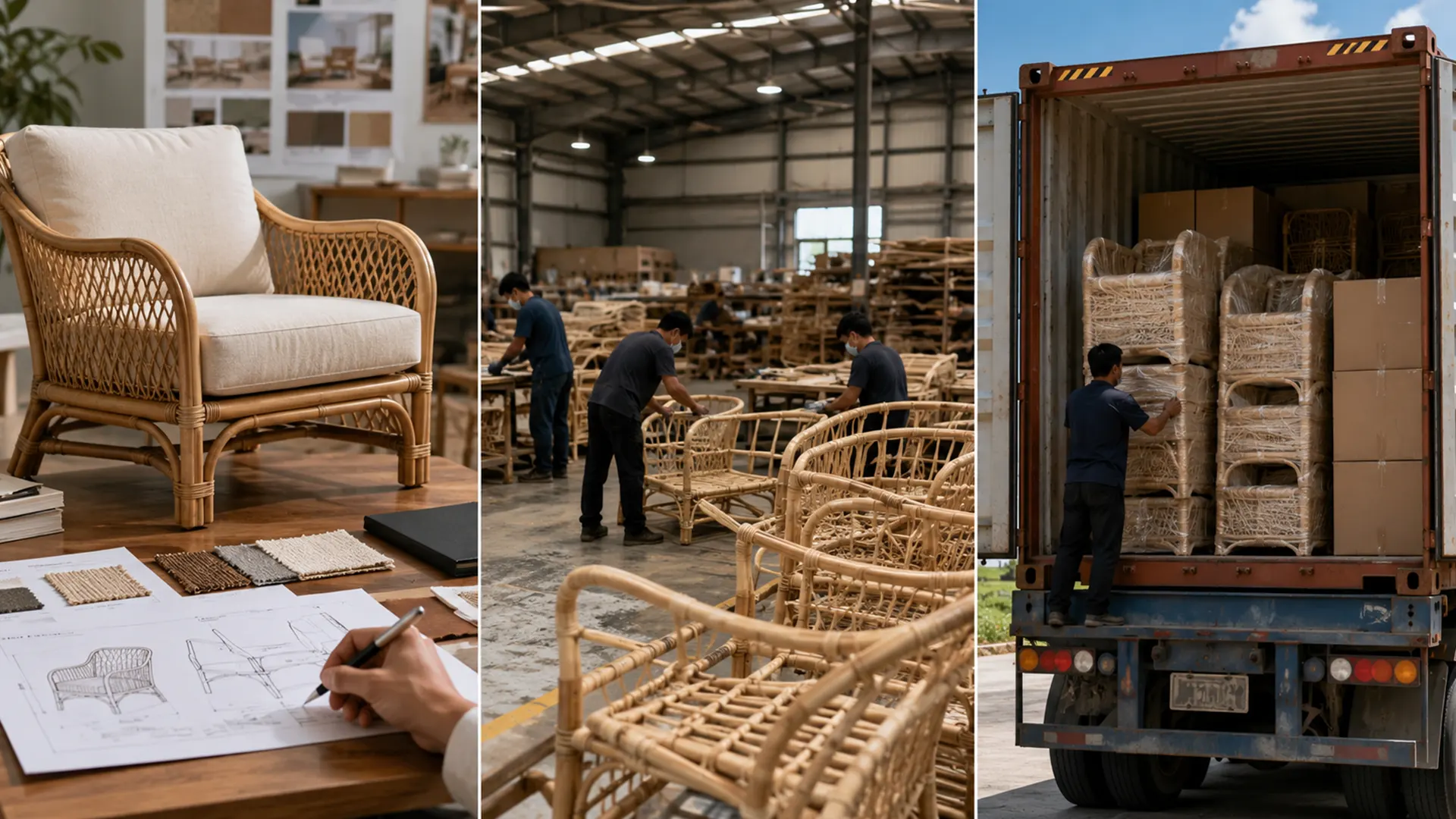
 Rattan Export buyer guide: How To Compare Rattan Furniture Quotations From Different Suppliers.
Comparing rattan furniture quotations from different suppliers is not as simple as placing FOB prices in a spreadsheet and choosing the lowest number. Two suppliers can quote what appears to be the same dining chair, lounge chair, table or storage product while actually pricing different materials, different frame construction, different weaving density, different finishing systems, different packaging and even different interpretations of the requested specification. Unless the quotations are normalized, the buyer may believe Supplier A is cheaper when Supplier A is simply quoting less product.
For international importers, wholesalers, distributors, retail chains and hospitality buyers, the correct objective is to create a like-for-like comparison covering technical specification, commercial terms, packed volume, quality controls, production timing and expected total cost at destination. This is particularly important when sourcing through the Vietnam rattan, bamboo and natural-fibre supplier ecosystem, where manufacturers may have very different strengths, production models and costing structures.
Start With One Common RFQ
The strongest quotation comparison begins before suppliers submit their prices. Every supplier should receive the same RFQ package.
That package should ideally contain:
- Product reference or drawing
- Exact dimensions
- Material specification
- Rattan or bamboo diameter where important
- Frame construction requirements
- Weaving pattern
- Colour and finish
- Hardware specification
- Cushion or upholstery requirements
- KD or fully assembled construction
- Packaging requirements
- Target quantity by SKU
- Required Incoterm
- Destination or loading-port information where relevant
If Supplier A receives a detailed specification while Supplier B receives only a photograph, their quotations are not comparable.
Do Not Compare A Photograph With A Specification
A photograph communicates style but does not communicate every manufacturing requirement.
It may not show:
- Hidden frame members
- Internal reinforcement
- Rattan diameter
- Material grade
- Exact dimensions
- Weaving spacing
- Finish layers
- Hardware
- Packaging
When suppliers interpret these details themselves, each may calculate a different product.
1. Confirm That Every Supplier Is Quoting The Same SKU
For each quotation, verify:
- SKU or model number
- Product description
- Revision number
- Reference drawing
- Colour
- Quantity
Revision control becomes essential when sample changes have already occurred.
2. Compare Product Dimensions
A chair that is 5 cm narrower or shorter may look similar in a quotation image but use less material and occupy less container space.
Compare:
- Overall width
- Overall depth
- Overall height
- Seat dimensions
- Arm dimensions
- Tabletop dimensions
- Other functional measurements
Small dimensional differences can affect cost, comfort and CBM.
3. Compare The Actual Rattan Or Bamboo Specification
Do not accept descriptions such as “natural rattan” as sufficient.
Where commercially important, clarify:
- Material type
- Diameter
- Grade or selection standard
- Natural variation allowed
- Whether material is structural or decorative
One supplier may use carefully selected structural rattan while another uses smaller or more variable material.
4. Compare Frame Construction
Two products that look almost identical can have different internal frames.
Ask suppliers to confirm:
- Main structural members
- Cross-bracing
- Seat reinforcement
- Joint method
- Additional support
- Mixed timber or metal components
A stronger frame may cost more but may be appropriate for the buyer's intended use.
5. Compare Weaving Pattern And Density
Weaving is a significant material and labour component.
Compare:
- Pattern
- Material size
- Spacing
- Density
- Areas covered
- Edge finishing
A dense handwoven seat and back should not be compared directly with a more open construction simply because the overall silhouette is similar.
6. Compare Finishing Systems
The words “natural”, “walnut”, “whitewash” or “black” do not define the complete finishing process.
Ask:
- How many preparation and coating stages are used?
- Is stain used?
- Is sealer used?
- Is a protective topcoat included?
- How is colour consistency managed?
- How long is curing allowed before packing?
A more complete finish system can raise FOB but reduce surface complaints.
7. Compare Hardware
This is particularly important for KD furniture.
Compare:
- Bolt and screw type
- Connector material
- Surface treatment
- Brackets
- Glides or feet
- Quantity per product
Hardware that looks similar can differ considerably in cost and durability.
8. Compare Cushions And Upholstery Separately
If products include cushions, request the complete cushion specification.
Compare:
- Fabric code
- Fabric composition
- Fabric weight where relevant
- Foam type
- Foam density
- Foam thickness
- Removable cover
- Zipper
- Piping
- Stitching details
Otherwise a large portion of the price difference may be hidden inside the cushion.
9. Compare Fully Assembled And KD Quotations Correctly
A fully assembled product and a KD version are not directly equivalent.
KD may require:
- Engineering changes
- More accurate drilling
- Additional hardware
- Assembly instructions
- Assembly testing
It may cost slightly more at factory level while producing lower packed CBM.
10. Compare Packaging Specifications
Packaging is one of the most frequently overlooked differences between quotations.
Confirm:
- Wrapping material
- Surface protection
- Corner protection
- Leg protection
- Internal separators
- Carton specification
- Units per carton
- Private-label requirements
A quotation with stronger packaging should not be treated as identical to one using minimal protection.
11. Request Final Packed Dimensions
FOB comparison without packed dimensions is incomplete for bulky rattan furniture.
Request for each SKU:
- Carton length
- Carton width
- Carton height
- Units per carton
- Gross weight
- CBM per carton
- CBM per saleable unit
12. Compare Packed CBM Per Unit
Use:
CBM per saleable unit = carton CBM ÷ units inside the carton.
This allows buyers to compare container efficiency even when suppliers use different carton configurations.
For example, a carton measuring 1.10 × 0.70 × 1.20 metres has an illustrative volume of 0.924 m³. If it contains six chairs, the illustrative packed volume is 0.154 m³ per chair. This is an arithmetic example only, not an industry standard.
13. Compare Estimated Container Loading
Ask each supplier for its estimated loading quantity for the relevant equipment:
- 20ft
- 40ft
- 40HC
The estimate should be based on final approved packaging rather than bare furniture dimensions.
Also ask whether the estimate has been physically validated on the same or a comparable product.
14. Do Not Assume Theoretical CBM Equals Practical Loading
Container loading depends on more than total mathematical volume.
Important factors include:
- Carton geometry
- Door clearance
- Stackability
- Crush limits
- Mixed SKU arrangement
- Handling space
- Weight distribution
This is why Supplier A and Supplier B can report different practical loading quantities even when their total quoted CBM appears similar.
15. Normalize The FOB Point
FOB quotations must refer to the same named port or agreed FOB point.
A quotation FOB Ho Chi Minh City should not automatically be compared with a different FOB location without understanding the inland and port-related cost structure.
These issues should be reviewed within the broader FOB, container and export-planning process.
16. Confirm What The FOB Price Includes
Ask suppliers to confirm whether the quoted price includes all agreed product and export preparation costs up to the named FOB point.
Potential areas of misunderstanding include:
- Export packing
- Carton printing
- Inland transport
- Export customs handling
- Port-related handling
- Buyer-specific documentation
The purpose is not to redefine the Incoterm but to make sure each supplier's quotation is commercially complete and uses the same assumptions.
17. Compare MOQ On The Same Basis
Supplier A may quote at 300 units while Supplier B quotes at 100 units. Their unit prices should not be treated as directly comparable.
Ask every supplier to quote the same target quantity where possible.
For container programs, also clarify whether MOQ is:
- Per SKU
- Per colour
- Per material
- Per order
- Per container
18. Compare Mixed-Container Flexibility
A supplier offering a good unit price may require very high quantities of every SKU, making a commercially useful mixed container difficult.
Compare:
- Minimum quantity per SKU
- Minimum per colour
- Number of SKUs allowed
- Mixed product categories allowed
- Ability to use remaining space with lower-volume products
For many importers, flexibility can be commercially more valuable than a small unit-price advantage.
19. Compare Lead Time
A quotation should state when production time starts and what event defines completion.
Compare:
- Sample-development time
- Production lead time
- Packaging readiness
- Inspection readiness
- Target loading date
A 40-day quotation and a 50-day quotation may not actually differ if the suppliers define their starting points differently.
20. Compare Current Capacity, Not Only Stated Capacity
A supplier may theoretically produce a high number of units each month but already have substantial existing orders.
Ask about:
- Current backlog
- Available weaving capacity
- Available finishing capacity
- Planned production window
- Other large orders during the same period
21. Compare Quality-Control Systems
FOB price should be evaluated together with the supplier's ability to maintain production consistency.
Compare whether suppliers perform:
- Incoming-material inspection
- Frame inspection
- In-process weaving checks
- Finish inspection
- Assembly checks
- Final inspection
- Packaging inspection
A stronger quality-control, moisture-management and pre-shipment inspection process has a real operating cost but may reduce claims and destination rework.
22. Compare Moisture-Control Procedures
For natural rattan and bamboo, ask how suppliers manage:
- Material conditioning
- Storage
- Production-area exposure
- Finished-goods storage
- Pre-packing condition
- Container suitability
Do not compare suppliers only on whether they quote a single moisture percentage. Process control is more important than a number without context.
23. Compare Inspection Terms
Clarify:
- Whether buyer or third-party inspection is accepted
- At what production stage inspection can occur
- How defects are corrected
- Whether reinspection is supported
- Who bears costs if failure is caused by supplier nonconformity, subject to agreed commercial terms
24. Compare Testing And Compliance Assumptions
One supplier may include required testing or documentation in its quotation while another excludes it.
Clarify any requirements for:
- Product testing
- Material documentation
- Traceability
- Labelling
- Destination-market requirements
Never assume a certificate mentioned by a supplier automatically covers the exact product, factory and shipment.
25. Compare Payment Terms
Two FOB prices using very different payment structures do not represent identical commercial risk.
Compare:
- Deposit percentage
- Balance-payment timing
- Payment before or after inspection
- Payment before or after shipment-document release
- Any credit period where applicable
More favourable payment terms can have meaningful working-capital value for the buyer.
26. Compare Quotation Validity
Check how long each price remains valid.
Also identify whether price is subject to:
- Material changes
- Exchange-rate movements
- Freight-related components where relevant
- Quantity changes
- Specification changes
27. Compare Sample Costs And Development Terms
For OEM or ODM projects, compare:
- Sample charge
- Tooling or jig charge if applicable
- Development time
- Number of revision rounds included
- Whether sample cost is credited against a production order
A low production quotation can become less attractive if development charges are unusually high.
28. Compare Private-Label Costs Separately
Private-label requirements may include:
- Branded labels
- Hangtags
- Printed cartons
- Barcodes
- Instruction sheets
- Custom hardware bags
- Retail inserts
Separate these costs when possible so the buyer can compare the underlying furniture cost clearly.
29. Compare The Supplier's Assumptions
A useful quotation should not contain only prices. It should show what assumptions were used.
Examples include:
- Quantity assumption
- Colour assumption
- Material assumption
- Packaging assumption
- Container assumption
- Payment assumption
Hidden assumptions are a major cause of later price revisions.
30. Compare Exclusions
Read what is not included.
A quotation may exclude:
- Testing
- Special packaging
- Retail labels
- Assembly instructions
- Third-party inspection
- Special documentation
A lower price can simply contain more exclusions.
31. Create A Normalized Supplier Comparison Table
| Comparison Item | Supplier A | Supplier B | Supplier C |
|---|---|---|---|
| FOB per unit | Enter quotation | Enter quotation | Enter quotation |
| Named FOB point | Confirm | Confirm | Confirm |
| Material specification | Confirm | Confirm | Confirm |
| Frame construction | Confirm | Confirm | Confirm |
| Weaving | Pattern/density | Pattern/density | Pattern/density |
| Finish | System | System | System |
| Hardware | Specification | Specification | Specification |
| Packaging | Method | Method | Method |
| Units/carton | Enter | Enter | Enter |
| CBM/unit | Enter | Enter | Enter |
| Estimated units/container | Enter | Enter | Enter |
| MOQ | Enter | Enter | Enter |
| Lead time | Enter | Enter | Enter |
| Payment terms | Enter | Enter | Enter |
| Inspection process | Confirm | Confirm | Confirm |
| Quotation validity | Enter | Enter | Enter |
32. Calculate Freight Allocation Per Unit
Once estimated loading quantity is available, the buyer can calculate an illustrative ocean-freight allocation:
Freight allocation per unit = relevant container freight ÷ saleable units loaded.
For illustration only, if relevant freight were USD 5,000 and 500 chairs were loaded, the freight allocation would be USD 10 per chair. If only 400 chairs were loaded, it would be USD 12.50. These figures are arithmetic examples, not current freight quotations.
33. Compare Expected Total Cost At Destination
The lowest FOB product can become more expensive after freight and destination costs are considered.
A more complete commercial model may include:
- FOB product cost
- Ocean freight allocation
- Insurance where applicable
- Import duty and taxes according to the destination and classification
- Port and destination charges
- Domestic transport
- Warehouse handling
- Assembly cost
- Expected damage or claim cost
Do not invent a fixed duty percentage; it depends on destination, product classification and applicable rules.
34. Compare Cost Per Saleable Unit
The most useful number is often not the factory cost of one produced unit but the expected cost of one saleable unit arriving in acceptable condition.
If weak packaging creates more damage, the apparently cheaper supplier may have a higher effective cost.
35. Include Damage Risk In The Comparison
Consider:
- Previous shipment performance
- Packaging quality
- Frame vulnerability
- Finish sensitivity
- Nesting contact points
- KD hardware completeness
Damage risk should be treated as a commercial variable, not only a quality issue.
36. Evaluate Supplier Reliability
A quotation is valuable only if the supplier can execute it.
Evaluate:
- Communication quality
- Accuracy of answers
- Consistency between documents
- Responsiveness
- Production transparency
- Ability to provide technical data
- Willingness to correct errors
A supplier that cannot confirm carton dimensions, construction or material specifications may present more purchasing risk even if its FOB price is attractive.
37. Verify Whether The Supplier Is A Manufacturer, Trader Or Sourcing Company
Each model can work, but buyers should understand who actually controls production.
Ask:
- Where will the product be made?
- Who purchases the raw material?
- Who controls quality?
- Who is responsible for corrective action?
- Who issues the commercial documents?
The comparison should reflect actual value delivered, not only organization type.
38. Compare Subcontracting Exposure
Rattan production may involve outside weaving groups, finishing partners, upholstery workshops or component suppliers.
Subcontracting is not automatically a problem, but the buyer should understand:
- Which processes are external
- How specifications are controlled
- How incoming work is inspected
- Who is accountable for nonconformity
39. Compare Sample Quality With Quoted Production Specification
Do not assume a premium development sample automatically represents normal production.
Confirm that the quotation is based on the same:
- Material
- Frame
- Weaving
- Finish
- Hardware
- Packaging
used in the approved sample.
40. Identify Abnormally Low Quotations
A quotation significantly below all others deserves analysis, not automatic selection.
Possible explanations include:
- Different specification
- Different material grade
- Lower weaving density
- Reduced reinforcement
- Basic packaging
- Different MOQ
- Missing export costs
- Pricing error
- Strategic introductory pricing
The buyer should determine which explanation applies.
41. Do Not Automatically Reject The Highest Quotation
The highest price may also be unjustified, but first determine whether it includes:
- Better material selection
- Stronger construction
- More labour-intensive weaving
- Higher-grade finish
- Better packaging
- More complete inspection
- More favourable payment conditions
Only after normalization should the buyer judge whether the premium is commercially worthwhile.
42. Ask Suppliers To Explain Major Price Differences
Instead of immediately demanding a discount, ask:
“Your quotation is approximately X% above another offer for the same reference. Which material, construction, finishing or packaging assumptions are driving the difference?”
A competent supplier should be able to explain the major drivers without disclosing confidential internal accounting.
43. Use Value Engineering When The Specification Is Too Expensive
If the preferred supplier exceeds the target price, consider controlled specification changes.
Potential areas include:
- Frame simplification
- Weaving optimization
- Finish simplification
- Local component substitution
- Packaging optimization
- Nesting improvement
- Limited KD construction
Any meaningful change should be re-sampled and approved before mass production.
44. Do Not Negotiate By Removing Hidden Quality
Reducing cost by weakening joints, shortening finish-curing time, reducing moisture control or removing necessary packaging protection can create much larger downstream costs.
The aim should be efficient engineering, not invisible degradation.
45. Rank Suppliers On More Than Price
A practical supplier scorecard can include:
| Area | Example Evaluation |
|---|---|
| Technical compliance | Does the quotation match the requested specification? |
| FOB competitiveness | Is the normalized price commercially attractive? |
| Packed CBM | How efficiently does the product use container space? |
| Quality system | Can the supplier maintain the approved standard? |
| Lead time | Is the schedule realistic? |
| MOQ flexibility | Does it support the buyer's assortment? |
| Payment terms | What working-capital impact exists? |
| Communication | Are answers accurate, fast and transparent? |
| Export capability | Can the supplier manage documentation and loading reliably? |
46. Weight The Scorecard According To Your Business Model
A hospitality project buyer may place greater weight on construction, finish consistency and delivery reliability. A wholesaler may place more weight on FOB, MOQ flexibility and mixed-container efficiency. A retail chain may prioritize packaging, barcoding and colour consistency.
There is no universal supplier ranking suitable for every buyer.
47. Keep Commercial And Technical Comparison Separate Initially
One useful method is to conduct two reviews:
- Technical review: Does the supplier meet the specification?
- Commercial review: Among technically acceptable suppliers, which offer provides the best total value?
This prevents a very low price from distracting the buyer from technical nonconformity.
48. Red Flags During Quotation Comparison
- Supplier refuses to confirm material specification
- Dimensions do not match the RFQ
- No packed dimensions are available
- Loading quantities appear unrealistically high
- MOQ changes repeatedly
- FOB point is unclear
- Payment instructions change unexpectedly
- Quotation contains many unexplained exclusions
- Supplier cannot explain a major price difference
- Lead time appears unusually short without a production explanation
- Packaging is described only as “standard export packing”
49. A Practical Quotation Review Sequence
- Send identical RFQ packages.
- Confirm every supplier quoted the same revision.
- Check dimensions and materials.
- Compare frame and weaving.
- Compare finish, hardware and cushions.
- Normalize packaging.
- Calculate CBM per saleable unit.
- Compare estimated container loading.
- Confirm the same FOB point.
- Normalize MOQ and order quantity.
- Compare lead time.
- Compare payment terms.
- Review quality and inspection systems.
- Calculate expected total destination cost.
- Score supplier reliability and commercial fit.
Frequently Asked Questions
Should I always choose the lowest FOB quotation?
No. The lowest FOB quotation may use a different specification, weaker packaging, higher packed CBM, different MOQ or fewer included services. Normalize the quotations first.
What is the most important number besides FOB?
For bulky rattan furniture, packed CBM per saleable unit is extremely important because it directly influences container utilization and freight allocation.
Why do two suppliers quote different CBM for the same chair?
They may use different carton dimensions, nesting depth, KD construction, protection thickness or units per carton. Verify the final packaging method.
Should I compare quotations before sample approval?
Initial comparison can begin earlier, but the most reliable final commercial comparison occurs once the product specification and packaging concept are sufficiently defined.
Can a more expensive FOB quotation produce a lower total cost?
Yes. Lower packed CBM, fewer damages, stronger quality control, better payment terms or improved container utilization can offset a higher FOB price.
How many suppliers should I compare?
There is no universal number. The goal is to compare enough qualified suppliers to understand the market and alternatives without creating an unmanageable sourcing process.
What should I do when quotations are extremely different?
Return to the specification. Check material, frame, weaving, finish, packaging, MOQ, Incoterm and exclusions before negotiating price.
The Best Quotation Is The Best Comparable Offer, Not The Lowest Number
A professional rattan furniture quotation comparison transforms several different supplier offers into one common commercial and technical framework. Only after dimensions, materials, construction, weaving, finish, hardware, cushions, packaging, CBM, MOQ, lead time, payment terms and quality requirements have been aligned does the FOB number become meaningful.
The objective is not to find the supplier willing to write the lowest figure on a quotation. It is to identify which supplier can deliver the required product, in the required condition, within the required schedule, at the strongest overall commercial value.
If you are comparing quotations for a 20ft, 40ft, 40HC or mixed-container rattan furniture program from Vietnam, send your RFQ, supplier quotations, SKU list, specifications, quantities and packing information so the offers can be structured on a like-for-like basis before a sourcing decision is made.