 Rattan Export buyer guide: Why Two Similar Rattan Products Can Have Very Different FOB Prices.
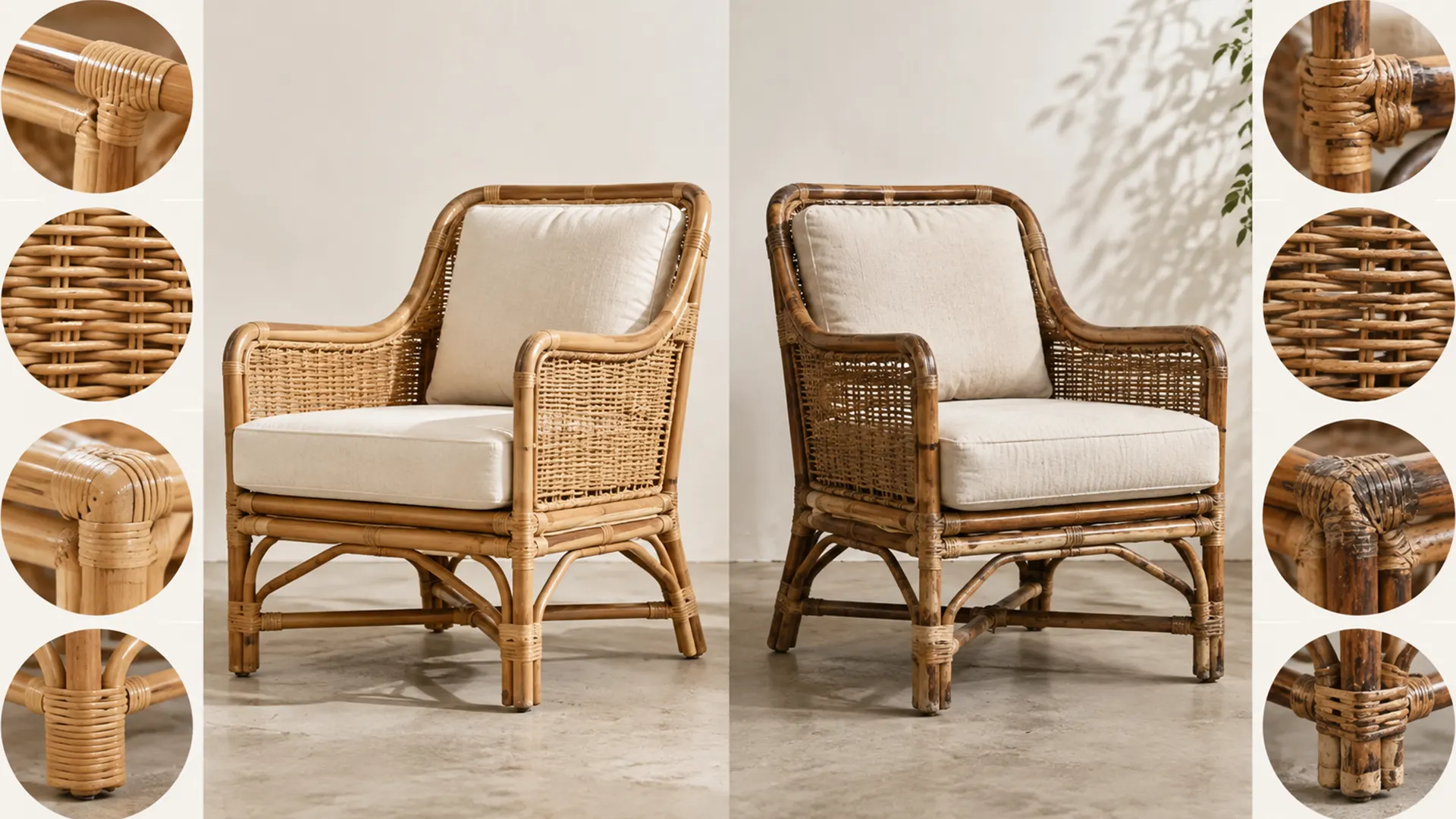
Two rattan products can look almost identical in a catalogue and still have very different FOB prices. For an international buyer, this can be confusing. One chair may be quoted at USD 62 FOB while another visually similar chair is quoted at USD 89 FOB. The immediate reaction is often that one supplier is expensive or the other supplier is cheaper. In reality, the products may only look similar from a distance while their material quality, construction, labour content, finishing system, quality-control requirements, packaging and export preparation are very different.
This is especially important with rattan, bamboo and natural-fibre furniture because a photograph hides many of the cost drivers that determine the real manufacturing price. Two chairs can share the same silhouette while using different rattan diameters, different frame structures, different joint reinforcement, different weave density, different finishing processes and completely different packaging methods.
Professional buyers should therefore compare specifications, not photographs. When sourcing through the Vietnam rattan, bamboo and natural-fibre production ecosystem, the correct question is not simply “Why is Supplier A more expensive?” but “What exactly is included in each product and each FOB quotation?”
Similar Appearance Does Not Mean Similar Construction
The external shape of a product tells only part of the story.
Two dining chairs may both have:
- A curved back
- Natural rattan colour
- A woven seat
- Four legs
- Similar overall dimensions
Yet internally they may be built in completely different ways.
One chair may use:
- Thicker structural rattan
- More frame members
- Additional cross-bracing
- Stronger joints
- More reinforcement under the seat
- A denser weave
- Several finishing stages
The second chair may use a lighter construction designed to achieve a lower price point.
Both products can look attractive in photographs, but their cost bases are not the same.
1. Raw Rattan Quality Changes The Cost
Natural rattan is not a perfectly standardized industrial input. Material can differ in diameter, straightness, colour, surface quality, flexibility, defect level and usable yield.
A factory using carefully selected material may pay more because more raw stock must be sorted or rejected before acceptable components are produced.
Cost differences may come from:
- Diameter requirements
- Length requirements
- Straightness
- Surface appearance
- Crack tolerance
- Colour consistency
- Required species or material grade
If a product requires long, clean and visually consistent rattan poles, the usable yield from purchased raw material may be lower than for a rustic product where more natural variation is accepted.
2. Material Yield Matters
The buyer normally sees the material used in the finished product, but the factory also pays for the material that cannot be used.
Suppose two factories buy comparable volumes of raw rattan. Factory A uses a stricter appearance standard and rejects more pieces. Factory B accepts more variation.
Factory A may have a higher material cost per finished chair even if both factories pay a similar price per kilogram or bundle of incoming material.
This is one reason why raw-material price alone does not explain finished-product cost.
3. Rattan Diameter Can Change Both Material And Labour Cost
Thicker rattan may increase material consumption and can require more demanding bending and preparation.
Smaller-diameter material may be easier to use in some decorative applications but may require additional members if structural strength must be maintained.
The correct material size therefore depends on product engineering rather than on a simple rule that thicker is always better.
4. Frame Engineering Is A Major Hidden Cost
Frame construction is one of the most important differences between visually similar furniture.
Compare two chairs with the same visible shape.
Chair A may include:
- Additional seat rails
- Cross-bracing
- Extra joint reinforcement
- More fixing points
- Stronger rear-leg integration
Chair B may use fewer structural members.
The stronger frame requires more material, more cutting, more bending, more drilling, more assembly time and often more finishing labour.
The difference may be almost invisible after weaving is completed.
5. Joint Construction Changes Price
A connection between two rattan members can be made in several ways depending on product design.
Differences can include:
- Joint preparation
- Fastener type
- Internal reinforcement
- Binding method
- Adhesive use where relevant
- Number of fixing points
A more carefully engineered joint normally requires more labour and may improve long-term stability, but it also raises manufacturing cost.
6. Bending Complexity Can Be Expensive
Curved rattan furniture often looks simple because the finished line appears smooth. Producing that curve consistently can require substantial skill.
Cost rises when the design requires:
- Tight radii
- Multiple bends in one component
- Symmetrical left and right parts
- Large curved frames
- Low tolerance for cracking or flattening
A straight-frame chair may therefore cost significantly less than a visually elegant chair built around complex bent components.
7. Weave Density Has A Direct Labour Cost
Hand weaving is one of the most obvious labour-cost drivers in rattan furniture.
Two chairs can use the same frame but different weaving patterns.
A simple open pattern may use:
- Less material
- Fewer weaving hours
- Less trimming
- Less finishing work
A dense decorative pattern may require considerably more labour.
The difference is especially important when the product has woven:
- Seat
- Back
- Arms
- Sides
- Decorative panels
8. Weaving Skill Level Matters
Not every weaving pattern can be produced by every worker at the same quality level.
Complex patterns may require more experienced artisans, slower production and more careful inspection.
When a supplier uses highly skilled weaving teams, labour cost may be higher but consistency can also improve.
9. Handcrafted Does Not Mean All Handwork Costs The Same
The word “handmade” is too broad to explain price.
A product requiring two hours of simple manual work is fundamentally different from one requiring many hours of skilled weaving, bending, binding, sanding and finishing.
Buyers should therefore ask what manual processes are involved rather than treating every handcrafted product as commercially equivalent.
10. Surface Preparation Can Change The Final Cost
Before staining or coating, the furniture may require substantial sanding, trimming and repair.
A higher visual standard can require:
- More sanding stages
- Finer surface preparation
- More filling or repair
- Additional cleaning
- More rejection of visibly imperfect components
These costs are largely invisible in a catalogue photograph.
11. Finish Systems Can Be Completely Different
“Natural finish” or “walnut finish” may sound like a simple specification, but different suppliers may use different finishing systems.
A finish may involve:
- Surface preparation
- Base colour
- Stain
- Sealer
- Topcoat
- Intermediate sanding
- Final touch-up
Another product may use fewer steps.
More complex systems increase:
- Material cost
- Labour
- Drying time
- Production space requirements
- Quality-control effort
12. Colour Consistency Can Cost Money
Natural materials vary naturally in tone. A buyer requiring a narrow colour range across thousands of units may force the factory to use stricter selection and more controlled finishing.
A rustic collection accepting broad natural variation can be cheaper to produce than a premium retail collection requiring close visual consistency.
13. Finish Durability Requirements Can Change The Specification
A product intended for light decorative indoor use may require a different finishing system from a high-use hospitality product.
Additional finish-performance expectations can influence both process and cost.
The buyer should therefore specify intended use rather than compare only colour names.
14. Hardware Can Create Unexpected Price Differences
Hardware is particularly important for KD furniture and mixed-material construction.
Differences may include:
- Fastener material
- Plating
- Corrosion resistance
- Custom brackets
- Adjustable feet
- Glides
- Connector quality
- Quantity of hardware
Two visually identical tables can therefore have significantly different component costs.
15. Imported Components Can Increase FOB
If a product requires imported fabric, special hardware, branded fittings or components not readily available locally, procurement cost and lead time may increase.
The supplier should clarify which components are local and which are imported.
16. Cushions And Upholstery Are Major Cost Variables
A chair with a cushion should not be compared only on the chair frame.
Cushion price can change with:
- Fabric type
- Fabric weight
- Colour
- Foam density
- Foam thickness
- Removable cover
- Zipper quality
- Piping
- Stitching complexity
- Fire-performance or destination requirements where applicable
A visually similar cushion may have a very different internal specification.
17. Timber And Metal Components Also Affect FOB
Many products sold as rattan furniture are actually mixed-material products.
A chair may combine:
- Natural rattan
- Solid timber
- Plywood
- Steel
- Aluminium
- Upholstery
The cost of these secondary materials can exceed the cost difference in the rattan itself.
18. Production Volume Influences Unit Cost
A factory normally produces more efficiently when an order uses a meaningful quantity of the same SKU, colour and finish.
Small production runs can create higher unit costs because setup time is spread over fewer units.
Cost may be affected by:
- Jig preparation
- Finish mixing
- Carton setup
- Material purchasing
- Production-line changeover
- Administrative handling
19. MOQ And FOB Price Are Related
A supplier may quote one FOB price at a full commercial batch and a different price at a smaller MOQ.
This does not necessarily mean the supplier is arbitrarily changing margin. Production economics may genuinely differ.
Buyers should compare quotations at the same quantity whenever possible.
20. Mixed-SKU Orders Can Increase Cost
A container containing twenty SKUs may require more planning than a container containing two SKUs.
Mixed programs can increase:
- Material variations
- Colour changes
- Packaging configurations
- Production scheduling complexity
- Warehouse handling
- Final loading coordination
The impact depends on the supplier and product structure.
21. Factory Efficiency Changes FOB Price
Two factories can use similar materials and still have different cost structures.
Efficiency depends on:
- Production layout
- Worker skill
- Rework rate
- Material waste
- Planning discipline
- Equipment
- Factory overhead
- Management systems
A higher-cost factory is not automatically inefficient, and a lower-cost factory is not automatically efficient. The buyer needs to understand what is driving the difference.
22. Rejection And Rework Rates Are Part Of The Cost
A factory producing to a stricter quality standard may spend more on inspection and may reject or rework more units.
Those costs ultimately enter the product price.
A very low quotation can sometimes be achieved by accepting a wider quality range rather than by operating more efficiently.
23. Quality Control Has A Cost
A structured quality system may include:
- Incoming material inspection
- Frame inspection
- Post-weaving inspection
- Finish inspection
- Assembly checks
- Final inspection
- Packaging inspection
These controls add labour and management cost, but they may reduce claims, rework at destination and shipment risk.
When comparing suppliers, buyers should consider the strength of the quality-control, moisture-management and pre-shipment inspection system, not only the quoted FOB number.
24. Moisture Management Can Affect Cost
Proper drying, conditioning, storage and moisture monitoring require time, space, equipment and process discipline.
A supplier that shortcuts these controls may appear cheaper at the factory gate but can expose the buyer to mold, cracking or dimensional problems after shipment.
25. Packaging Can Create A Large FOB Difference
Packaging is one of the most underestimated reasons for price differences.
Supplier A may quote:
- Basic wrapping
- Simple carton
- Limited corner protection
Supplier B may include:
- Surface protection
- Corner protection
- Leg protection
- Nesting separators
- Hardware bags
- Stronger export carton
- Private-label markings
The second quotation can be more expensive even if the furniture itself is nearly identical.
26. Retail-Ready Packaging Costs More Than Basic Export Packaging
Importers supplying retail chains may require:
- Printed cartons
- Barcodes
- Product labels
- Assembly instructions
- Hardware identification
- Specific handling marks
- Additional protection for distribution centres
These requirements should be included when comparing quotations.
27. Packed CBM Can Influence The Commercial Value Of The Quote
FOB price and packed CBM should be reviewed together.
Supplier A may offer a lower FOB price but use bulky packaging. Supplier B may have a slightly higher FOB price but achieve better nesting or KD packing.
The second product can potentially produce a lower landed cost because more saleable units fit in the same container.
28. Lower FOB Does Not Automatically Mean Lower Landed Cost
Consider an illustrative example only:
| Item | Supplier A | Supplier B |
|---|---|---|
| FOB per chair | USD 68 | USD 72 |
| Packed CBM per chair | 0.22 m³ | 0.15 m³ |
| Packaging | Fully assembled, bulky | Optimized nesting or KD |
Supplier B is USD 4 more expensive at FOB level, but its lower packed volume may reduce freight cost per chair enough to offset that difference. The figures above are illustrative only and are not market rates.
29. Container Utilization Should Be Part Of Price Comparison
Professional buyers should ask each supplier for:
- Final packed dimensions
- Units per carton
- CBM per carton
- Estimated units per 20ft
- Estimated units per 40ft
- Estimated units per 40HC
These estimates should be based on verified final packaging, not bare product dimensions.
30. KD Design Can Increase FOB And Still Reduce Total Cost
A KD version may require:
- Additional engineering
- More precise drilling
- Better hardware
- Assembly instructions
- Additional QC
That can increase the factory cost per unit.
However, if KD significantly reduces packed CBM, the final landed cost may still improve.
31. Nesting Can Also Change Cost
Stackable or nestable products may require additional design development, contact protection and more precise dimensional consistency.
The manufacturing cost can be slightly higher while shipping economics improve substantially.
32. Factory Location Can Influence FOB Structure
FOB includes more than the manufacturing cost of the furniture. The supplier must also manage the commercial and export activities required to deliver according to the agreed FOB point.
Inland transport, port-related handling and export preparation can vary according to factory location and shipping route.
These differences should be reviewed through the wider FOB, container and export-planning process.
33. Export Documentation And Administration Have Costs
Export orders require documentation, coordination and internal administration.
Depending on the shipment, this may involve:
- Commercial invoice
- Packing list
- Shipping instructions
- Container and seal records
- Origin documentation where applicable
- Buyer-specific documentation
A supplier with an experienced export department may carry higher overhead than a small workshop that depends heavily on outside agents.
34. Payment Terms Can Influence Price
Commercial terms affect supplier cash flow and financial risk.
A quotation based on one payment structure may not be directly comparable with another quotation using very different payment timing or credit exposure.
Buyers should compare identical commercial conditions whenever possible.
35. Currency Assumptions Can Affect Quotation Differences
Factories may price materials, labour and export costs in local currency while quoting the buyer in another currency.
Different exchange-rate assumptions or quotation-validity periods can therefore create price differences even for similar products.
36. Quotation Validity Matters
A supplier offering a firm price for a longer validity period may include more commercial risk than a supplier whose quotation is valid only briefly.
The buyer should compare not only price but also:
- Validity period
- Material assumptions
- Exchange-rate assumptions
- Quantity assumptions
37. Certification And Compliance Requirements Can Add Cost
Some buyer programs require specific testing, documentation, traceability or compliance processes.
These requirements may add:
- Laboratory testing
- Material documentation
- Additional inspections
- Special labels
- Supplier-management cost
Whether these costs are included in the FOB quotation should be clarified.
38. Hospitality And Project Furniture May Need A Different Cost Structure
Furniture for hotels, resorts, restaurants or contract projects can require:
- Stronger construction
- Project-specific dimensions
- Special finishes
- Custom fabrics
- Replacement components
- Room or area identification
- Phased delivery packaging
A project chair that looks similar to a retail chair may therefore carry a very different manufacturing cost.
39. Private Label Requirements Affect Price
Private-label programs can include:
- Custom carton printing
- Brand labels
- Hangtags
- Product inserts
- Barcodes
- Custom hardware bags
- Instruction sheets
These costs should not be confused with the furniture-only cost.
40. Development Cost May Be Included Differently
One supplier may absorb sample and engineering cost into future orders. Another may recover part of that development cost through the initial production price.
This is particularly relevant to custom OEM/ODM products.
41. The Cheapest Supplier May Be Quoting A Different Specification
This is one of the most important conclusions for buyers.
Before assuming a supplier is cheaper, verify whether both quotations include exactly the same:
- Material
- Dimensions
- Frame
- Weave
- Finish
- Hardware
- Cushion
- Packaging
- Inspection standard
- Quantity
- Incoterm
If any of these differ, the price comparison may be invalid.
42. Supplier A And Supplier B Comparison Framework
| Comparison Point | Supplier A | Supplier B |
|---|---|---|
| FOB price | Record quoted price | Record quoted price |
| Rattan specification | Confirm species/diameter/grade | Confirm species/diameter/grade |
| Frame construction | Confirm members and reinforcement | Confirm members and reinforcement |
| Weaving | Pattern and density | Pattern and density |
| Finish | System and number of steps | System and number of steps |
| Hardware | Material and specification | Material and specification |
| Cushion | Fabric and foam specification | Fabric and foam specification |
| QC | Inspection scope | Inspection scope |
| Packaging | Method and protection | Method and protection |
| Packed CBM | Verified final value | Verified final value |
| Container quantity | Estimated units | Estimated units |
| Lead time | Defined start and finish | Defined start and finish |
43. Use A Cost Breakdown When The Price Gap Is Large
If two quotations differ significantly, ask each supplier to explain the major cost drivers rather than demanding an immediate price reduction.
The buyer does not necessarily need confidential factory accounting. A useful commercial explanation may separate:
- Main material
- Secondary materials
- Hardware
- Upholstery
- Finishing complexity
- Packaging
- Special compliance requirements
44. Ask What Can Be Value-Engineered
If the product is above the buyer's target, the best solution may be specification engineering rather than simple discount pressure.
Possible value-engineering questions include:
- Can the frame be simplified without reducing required performance?
- Can weaving density be adjusted?
- Can the finish system be simplified?
- Can packaging be optimized?
- Can the product be made KD?
- Can components be nested?
- Can a locally available fabric or hardware be used?
Any change should be re-sampled and approved before mass production.
45. Do Not Reduce Cost By Removing Critical Quality Controls
Some cost reductions are commercially sensible. Others simply move cost from the factory to the importer.
Saving a small amount by reducing:
- Structural reinforcement
- Moisture control
- Finish curing
- Packaging protection
- Quality inspection
can create much larger costs through damage, claims and customer complaints.
46. Compare Cost Per Saleable Unit, Not Only FOB
The real commercial comparison should consider the cost of receiving a sellable product at destination.
A more complete framework includes:
- FOB price
- Packed CBM
- Ocean freight allocation
- Import costs
- Inland destination logistics
- Damage allowance
- Warehouse handling
- Assembly cost where applicable
This is why the lowest FOB quotation is not always the best commercial offer.
47. An Illustrative Landed-Cost Comparison
The following is purely illustrative and not a market quotation.
| Cost Element | Product A | Product B |
|---|---|---|
| FOB | Lower | Slightly higher |
| Packed CBM | Higher | Lower |
| Freight per unit | Potentially higher | Potentially lower |
| Packaging protection | Basic | Stronger |
| Expected damage risk | Potentially higher | Potentially lower |
| Final landed cost | Must be calculated | Must be calculated |
The table demonstrates why FOB alone cannot determine which product is commercially cheaper.
48. Questions Importers Should Ask When Two FOB Prices Differ
- Are both products made from the same rattan specification?
- Are the frame structures identical?
- Is the weaving pattern and density identical?
- Are dimensions and tolerances the same?
- Is the finish system the same?
- Is hardware identical?
- Are cushion specifications identical?
- Is packaging equivalent?
- Are final packed dimensions available?
- Is the quoted quantity the same?
- Are both quotations based on the same FOB point?
- Are the payment terms comparable?
- Are inspection and compliance requirements included?
49. Common Buyer Mistakes
- Comparing products only from photographs
- Assuming the same dimensions mean the same construction
- Ignoring rattan grade and diameter
- Ignoring weave density
- Comparing different finish systems as if they were identical
- Ignoring cushion specifications
- Ignoring packaging differences
- Comparing different quantities
- Ignoring packed CBM
- Comparing FOB without checking Incoterm details
- Assuming lower price always means better factory efficiency
- Pushing price down without understanding which specification will be changed
Frequently Asked Questions
Why can two identical-looking rattan chairs differ so much in price?
Because appearance does not reveal material grade, frame construction, weaving hours, finish system, hardware, cushions, quality control, packaging or factory cost structure. The chairs may not actually be technically identical.
Does a higher FOB price always mean better quality?
No. A higher price does not automatically prove better quality. The buyer still needs to verify specifications, production systems and supplier performance.
Does a lower FOB price mean the supplier is cutting quality?
Not necessarily. A supplier may genuinely be more efficient, have better material purchasing, lower overhead or a more suitable production setup. The reasons should be investigated rather than assumed.
What is the best way to compare two suppliers?
Use the same RFQ specification, quantity, Incoterm, packaging requirement and inspection standard. Then compare FOB, packed CBM, lead time, quality system and expected landed cost.
Should I ask suppliers for a complete cost breakdown?
You can ask for the major cost drivers, but factories may not disclose confidential internal costing. The main goal is to understand which specification differences explain the price gap.
Can a higher-priced product actually be cheaper to import?
Yes. Better nesting, KD construction, lower packed CBM, stronger packaging or lower damage risk can potentially offset a higher FOB price.
Should I always negotiate the higher quotation down?
Not before understanding the specification. If the price difference comes from better materials, stronger construction or better packaging, indiscriminate price pressure may simply remove value from the product.
The Buyer Should Compare The Product Behind The Price
Two rattan products can share the same photograph, dimensions and general design language while representing very different manufacturing specifications. That is why FOB should never be evaluated in isolation.
A professional comparison looks beneath the surface: material grade, usable yield, frame engineering, bending complexity, weaving hours, finishing system, hardware, upholstery, quality control, packaging, packed CBM, production volume and export preparation.
The goal is not to identify the lowest factory price. The goal is to identify the specification that delivers the required quality and commercial performance at the best total cost.
When buyers compare suppliers in this way, price negotiation becomes much more productive. Instead of asking a factory to “reduce USD 10,” the discussion can focus on which technical or packaging changes can reduce cost without creating unacceptable quality, damage or landed-cost risk.
If you are comparing FOB quotations for rattan furniture, bamboo products or natural-fibre collections from Vietnam, send your wholesale RFQ, product drawings, reference images, specifications, target quantity and packing requirements so the quotations can be compared on a like-for-like commercial and technical basis.