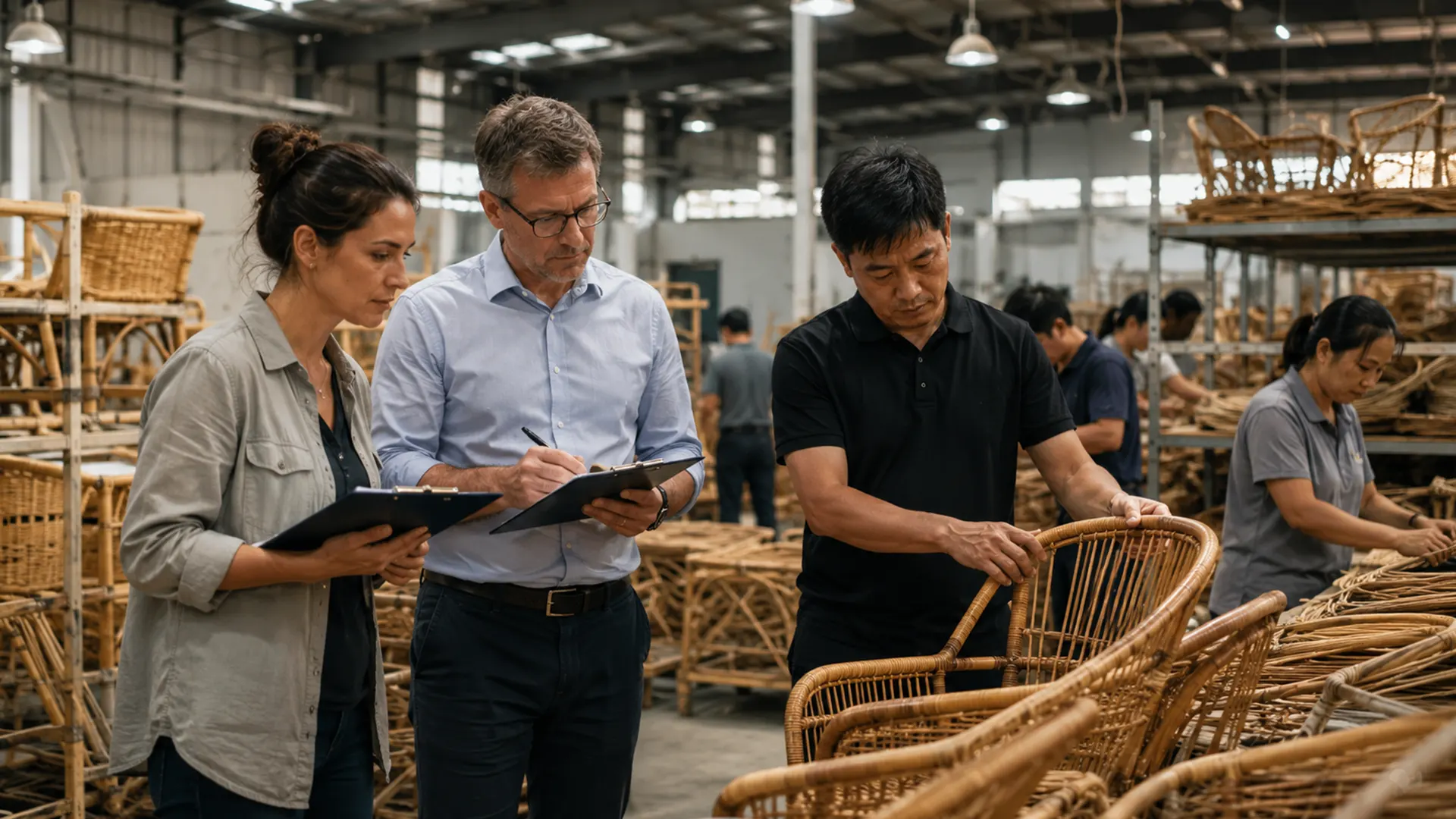
 Rattan Export buyer guide: How To Find And Verify Rattan Furniture Suppliers In Vietnam.
Finding a rattan furniture supplier in Vietnam is relatively easy. Finding a supplier that can reliably produce the right product, at the agreed quality, in the required quantity, with export-ready packaging and within the promised lead time is much harder. For international importers, wholesalers, distributors, retail chains, hospitality buyers and project procurement teams, supplier verification should therefore be treated as a structured due-diligence process rather than a simple search for the lowest quotation.
A supplier may have an impressive website, attractive catalogue and competitive price while still being unsuitable for a particular program. Another company may have a modest online presence but excellent production discipline and strong experience in the exact product category required. Professional sourcing means separating marketing presentation from verifiable capability.
This guide explains how B2B buyers can find, screen and verify rattan, bamboo and natural-fibre furniture suppliers in Vietnam before committing to 20ft, 40ft, 40HC, mixed-container, OEM, ODM, private-label or project orders.
Start By Defining What Type Of Supplier You Actually Need
Before searching for suppliers, define the commercial and technical requirements of the purchasing program. A buyer sourcing handcrafted decorative baskets needs a different supplier profile from an importer purchasing container volumes of dining chairs, hotel furniture or customized cabinets.
Prepare a basic sourcing brief covering:
- Product categories
- Natural rattan, bamboo, wood, metal or mixed-material construction
- Target dimensions and design references
- Indoor, covered outdoor, hospitality or residential application
- Expected order structure
- 20ft, 40ft, 40HC or mixed-container strategy
- OEM, ODM or private-label requirements
- Target destination market
- Required testing or compliance
- Target shipment window
This prevents buyers from wasting time contacting factories that are technically or commercially unsuitable from the beginning.
Understand The Different Types Of Suppliers
Not every company selling Vietnamese rattan furniture is necessarily the physical manufacturer. The counterparty may be a factory, trading company, exporter, sourcing company, production coordinator or a business working with a network of workshops.
That distinction matters, but a trading or sourcing company should not automatically be considered inferior. Some professional intermediaries can provide valuable supplier coordination, quality control, mixed-container consolidation and export management. The important issue is transparency.
Ask the company directly:
- Do you manufacture these products yourself?
- Which processes are performed at your own facility?
- Which processes are subcontracted?
- Who owns or controls the production facility?
- Who will be responsible for quality control?
- Which legal entity will issue the commercial invoice?
- Which company name will receive payment?
If several entities are involved, request a clear explanation of their roles rather than assuming that every mismatch indicates a problem.
Where To Find Rattan Furniture Suppliers In Vietnam
Professional buyers should build a supplier pool from several sources instead of relying on one online marketplace. Potential channels include search engines, B2B sourcing platforms, trade fairs, industry referrals, trade-promotion organizations, furniture and handicraft networks, export directories, sourcing agents and direct regional research.
Vietnam's furniture and natural-material supply ecosystem includes different production clusters, workshop networks and export-oriented companies. Understanding Vietnam's sourcing regions and production ecosystem can help buyers organize supplier discovery, but location alone should never be treated as proof of capability.
A useful first objective is to identify a longlist rather than immediately choosing one supplier. Ten potentially relevant companies may eventually become three serious candidates after documentation, technical discussions and sampling.
Do Not Let A Website Become Your Due Diligence
A professional website is useful but weak evidence by itself. Product photographs may be old, sourced from partners, produced by subcontractors or simply represent products the company once handled.
Likewise, a weak website does not automatically mean a weak factory. Many production-focused companies invest much less in digital marketing than international-facing trading businesses.
Use websites, social channels and B2B profiles for discovery, then verify the underlying business separately.
Verify The Legal Company
Before discussing significant deposits or purchase orders, confirm that the business actually exists as a registered legal entity. Buyers can use Vietnam's official business-registration information resources and request corporate documents directly from the supplier.
Key information to compare includes:
- Registered company name
- Enterprise or registration number
- Registered address
- Legal representative
- Current legal status
- Business activities where relevant
- Name shown on quotations and contracts
- Bank beneficiary name
Company registration confirms the legal entity; it does not confirm that the company owns a rattan furniture factory, has the claimed production capacity or can satisfy your quality requirements. Legal verification is only the first layer of due diligence.
Check Whether The Factory Is Real
If a supplier presents itself as a manufacturer, verify the physical production operation. The strongest option is an in-person factory visit. When that is not practical during initial screening, request a live video tour rather than relying only on edited corporate videos.
During the visit or video call, ask to see areas relevant to the proposed products, such as:
- Raw-material receiving and storage
- Rattan or bamboo preparation
- Frame construction
- Weaving areas
- Sanding and surface preparation
- Finishing areas
- Assembly
- Quality-control stations
- Finished-goods storage
- Packaging areas
- Container-loading area where applicable
The objective is not merely to see machinery. Rattan and natural-fibre furniture can involve substantial handcraft work. Buyers need to understand the actual production flow, workforce, subcontracting structure and quality controls behind the products.
Verify That They Actually Make Your Product Category
A supplier that produces baskets successfully may not necessarily be the right partner for structural furniture. Likewise, experience in simple dining chairs does not automatically demonstrate capability in large cabinets, complex lounge furniture or contract-grade hospitality products.
Ask for recent examples of similar construction rather than only visually similar designs. Look at frame geometry, joint methods, weaving complexity, finishing technique, upholstery requirements and packaging concept.
When confidentiality permits, ask the supplier to show products currently in production that demonstrate comparable manufacturing processes.
Evaluate Materials And Construction Knowledge
Technical discussion is one of the best filters in supplier verification. A capable supplier should be able to discuss product construction in practical terms rather than responding only with sales language.
Ask questions about:
- Frame material
- Rattan components and diameters
- Bamboo or wood components
- Internal reinforcement
- Joint construction
- Weaving material and pattern
- Natural-material variation
- Surface preparation
- Finish system
- Knock-down possibilities
- Nesting or stacking possibilities
- Packaging design
If the supplier proposes alternatives, ask why. Good production partners can often identify design details that are difficult to manufacture, vulnerable in transit or inefficient for container loading.
Ask About Subcontracting
Subcontracting is common in many manufacturing environments and is not automatically a negative sign. The risk arises when buyers do not know which processes are outsourced or who controls them.
A company may produce frames internally while outsourcing weaving, finishing, cushions or packaging components. Another may coordinate several specialist workshops. Ask which steps are subcontracted and how incoming, in-process and final quality are controlled.
For sensitive processes, buyers may need approval before production is transferred to a different facility or subcontractor.
Verify Production Capacity Carefully
A statement such as “we can produce thousands of pieces per month” is not enough to establish capacity. Capacity depends on product type, complexity, workforce, current orders, material availability, finishing process and subcontracting.
Instead of asking only for monthly capacity, discuss capacity for your specific product family and proposed order. Useful questions include:
- What production steps create the main bottleneck?
- How many production lines or working teams can handle this category?
- What other orders are scheduled during the proposed production period?
- What happens during peak season?
- Which processes depend on subcontractors?
- How does the supplier manage delayed materials or rejected components?
Production capacity should ultimately be tested through actual performance, not accepted only from a sales presentation.
Review Export Experience
A supplier can manufacture good furniture and still be inexperienced with international export requirements. Export capability matters because container orders involve packing lists, commercial invoices, shipping marks, container coordination, documentation deadlines and communication with logistics parties.
Ask which types of markets the company has served and what export documentation it normally handles. Buyers can request appropriately redacted examples of previous export documents where commercially acceptable, without expecting suppliers to disclose confidential customer information.
The supplier should also understand the agreed Incoterm and its responsibilities under the transaction. For buyers planning container shipments, our export operations and container logistics guidance provides a broader framework for evaluating shipping readiness.
Investigate Quality-Control Systems
Do not ask only, “Do you have QC?” Almost every supplier will answer yes. Ask how quality is controlled.
Useful questions include:
- Is there incoming-material inspection?
- Who checks frame dimensions?
- When is weaving inspected?
- How are finish and colour approved?
- How are defects recorded?
- Who authorizes rework?
- Is there a final inspection before packing?
- Are packed goods checked before loading?
The buyer should eventually convert these discussions into measurable acceptance criteria. Our quality control, inspection and compliance framework explains how specifications, inspections and shipment controls can be linked together.
Pay Special Attention To Moisture And Mold
Rattan, bamboo, wood and other natural plant materials can be vulnerable to moisture-related problems. Supplier verification should therefore include questions about drying, storage, production conditions, moisture checks, mold prevention and container preparation.
Walk through or inspect raw-material and finished-goods storage areas. Look for obvious exposure to rain, damp floors, poor ventilation or products packed before finishing processes appear fully stabilized.
No single moisture number should be treated as universally correct for every natural-fibre product. Appropriate limits and control methods depend on material, product construction, destination, buyer specification and environmental conditions.
Verify Certifications Instead Of Collecting Logos
Supplier presentations often contain certification logos, but a logo is not proof that the certificate is valid, current or applicable to the product being purchased.
When a certification matters to your order, request the actual certificate and check:
- Certificate holder
- Facility name and address
- Certification scope
- Issue and expiry dates
- Certificate or registration number
- Product or process coverage
- Issuing or certification body
Where possible, verify the certificate with the issuing organization or its official database. Also distinguish between factory-system certifications, product test reports, chain-of-custody documents and customer-specific audits. They are not interchangeable.
Never Assume A Certificate Solves Product Compliance
A factory certificate does not automatically prove that every product manufactured there meets every legal requirement in your destination market. Compliance can depend on materials, coatings, textiles, structural performance, chemicals, labeling and intended use.
The importer should identify destination-market requirements before production and confirm which tests, declarations or documents are required for the specific product.
Ask For References Carefully
Customer references can provide useful evidence, but many manufacturers are understandably reluctant to disclose buyer names because of confidentiality. A refusal to give a full customer list should therefore not automatically be considered suspicious.
Instead, ask for evidence appropriate to the relationship: export markets served, product categories supplied, anonymized case examples or customer references where permission exists. If references are provided, contact them independently rather than relying only on written testimonials.
Review Communication Quality
Communication is a practical indicator of how the supplier may perform after receiving a purchase order. Pay attention to whether technical questions receive specific answers.
Warning signs include repeatedly avoiding measurements, changing specifications without explanation, quoting before understanding the product, failing to identify assumptions or providing contradictory answers from different team members.
Good suppliers do not necessarily reply instantly. More important is whether their answers are complete, technically coherent and traceable to the correct product revision.
Send The Same RFQ To Shortlisted Suppliers
Supplier comparison becomes meaningless when each company receives different information. Create one structured RFQ and send substantially the same specification to every shortlisted candidate.
Include dimensions, materials, construction, weaving, finish, cushions, packaging expectations, expected quantities, container strategy, destination and Incoterm.
Then compare not only price but also assumptions and exclusions. A quotation that appears cheaper may simply exclude packaging upgrades, cushions, testing, hardware, private-label elements or other requirements.
Compare Suppliers On A Common Basis
| Verification Area | What To Confirm | Why It Matters |
|---|---|---|
| Legal entity | Registration, legal name, address and status | Confirms who the commercial counterparty is |
| Manufacturing role | Factory, trader, exporter or sourcing company | Clarifies control of production |
| Product capability | Comparable products and processes | Reduces technical execution risk |
| Capacity | Realistic capacity for the proposed order | Supports lead-time planning |
| Quality control | Incoming, in-process and final checks | Supports repeatable quality |
| Natural-material controls | Moisture, storage and mold prevention | Reduces material-related risk |
| Packaging | Protection and packed CBM | Affects damage and freight cost |
| Export capability | Documents, loading and Incoterm understanding | Reduces shipment risk |
| Customization | OEM, ODM and private-label ability | Supports product development |
| Communication | Accuracy, consistency and response quality | Affects day-to-day execution |
Order Samples Before Mass Production
A sample is one of the most important verification tools because it turns promises into a physical product. For customized furniture, review dimensions, frame construction, weaving, finish, colour, hardware, cushions, comfort, stability and workmanship.
Sampling should not be treated merely as receiving a product. Create a sample review record and document every required change. If a revised sample is necessary, confirm it before production.
The approved sample, drawings and specification sheet should work together as the production reference.
Check Packaging Before Approving The Order
For furniture imports, packaging capability should be verified almost as carefully as product construction. An excellent chair can still become a commercial loss if it arrives damaged.
Ask for a packing proposal showing carton dimensions, protective materials, units per carton, assembly configuration and expected CBM. If the product is KD, review hardware organization and assembly instructions.
Packaging must balance protection with container efficiency. Excessive packaging increases CBM, while inadequate packaging increases transit risk.
Calculate Container Utilization
For 20ft, 40ft and 40HC purchasing programs, request estimated loading quantities based on packed dimensions. Do not accept a piece count without understanding how it was calculated.
Container quantities provided before final packaging should be treated as planning estimates only. Actual loading depends on carton dimensions, nesting, knock-down construction, protective packaging, loading sequence and practical loading tolerances.
For mixed containers, prepare an SKU-by-SKU allocation showing quantities and CBM so that high-volume, low-value products do not unintentionally consume most of the container.
Verify The Bank Account Before Paying
Payment verification is critical. The beneficiary name and banking details should make commercial sense relative to the contracting entity. If the supplier asks for payment to a different company or individual, stop and obtain a documented explanation before transferring funds.
Changes in banking instructions deserve particular scrutiny, especially when communicated suddenly by email or messaging applications. Verify significant changes through a previously established communication channel and with known company contacts.
A mismatch is not automatically fraudulent because legitimate group companies, exporters or payment structures can exist, but unexplained mismatches should never be ignored.
Use Contracts And Purchase Orders To Lock The Specification
Once the supplier is selected, the commercial agreement should do more than state product names and prices. Attach or reference the approved specification, drawings, sample, packaging requirements, quantities, Incoterm, delivery expectations, quality criteria and inspection process.
For OEM or private-label projects, clearly identify artwork approvals, branding, intellectual-property responsibilities and any tooling ownership arrangements relevant to the transaction.
Consider A Factory Audit For Higher-Risk Programs
For strategically important suppliers, large programs, highly customized products or buyers that cannot visit Vietnam personally, an independent factory audit can add another layer of verification.
An audit may examine business legitimacy, facility organization, production systems, capacity indicators, quality processes, working conditions or other areas according to the buyer's requirements. The scope should be chosen based on actual commercial risk rather than treating every audit as equivalent.
Use Pre-Shipment Inspection Before Releasing The Container
Supplier verification should continue after the purchase order. Pre-shipment inspection can check whether finished production conforms to agreed specifications before final release.
Depending on the inspection plan, checks may include quantity, dimensions, workmanship, finish, weaving, stability, cushions, labeling, packaging, carton marks and visible moisture or mold issues.
For new suppliers or complex orders, in-process inspection may also be valuable because identifying a repeated defect halfway through production is generally easier than finding it after the entire batch is finished.
Start With Controlled Commercial Exposure
Even after documents, factory visits and samples look good, the strongest proof of supplier capability is successful execution of real orders. Buyers should manage initial commercial exposure according to their risk tolerance rather than immediately assuming that the relationship will perform perfectly at maximum scale.
The appropriate first order depends on supplier MOQ, freight economics, product type and buyer strategy. For some programs it may be a mixed 20ft container; for others a larger container may make more commercial sense. These are purchasing decisions, not universal rules.
Measure actual performance: production timing, defect rates, communication, packaging quality, loading accuracy, documentation and corrective-action responsiveness.
Red Flags That Deserve Further Investigation
No single red flag automatically proves that a supplier is fraudulent or incapable, but several unresolved inconsistencies should increase caution.
- Company name changes repeatedly across documents
- Bank beneficiary cannot be explained
- Supplier refuses any live view of the production facility
- Technical questions receive only generic sales answers
- Very different products are claimed as internally manufactured without explanation
- Production capacity claims cannot be supported
- Certificates are provided only as cropped logos or screenshots
- Factory address and legal information cannot be reconciled
- Pressure is applied for immediate payment before basic verification
- Quotation changes repeatedly without specification changes
- The supplier refuses reasonable inspection arrangements
- Samples and mass-production specifications are not documented
Green Flags Of A Professional Supplier
Positive signals are usually less dramatic but more valuable over time. Strong suppliers tend to explain technical limitations, identify assumptions in quotations, document revisions, answer questions consistently and admit when a requirement needs further engineering.
They also tend to provide realistic lead times rather than promising every requested deadline, discuss packaging and container efficiency, maintain traceable sample approvals and cooperate with reasonable quality-control procedures.
A supplier that occasionally says “this needs to be checked” may be more trustworthy than one that says yes immediately to every request.
Frequently Asked Questions
How can I check whether a Vietnamese furniture supplier is legally registered?
Verify the company through official Vietnamese business-registration resources and compare the registered name, enterprise information, address, legal representative and legal status with documents supplied by the company. Remember that registration confirms the entity, not its manufacturing capability.
Is a trading company automatically worse than a factory?
No. A competent trading or sourcing company may offer strong coordination, export management and quality control. The key is understanding who actually manufactures the goods and who controls quality, delivery and commercial responsibility.
Should I visit the factory before ordering?
For important programs, a factory visit provides valuable information. If an immediate visit is impractical, live video verification, third-party audits, samples and inspections can provide additional evidence, although they do not replace every benefit of an in-person visit.
Can I trust supplier certificates?
Certificates should be verified rather than accepted from logos alone. Check the certificate holder, facility, scope, validity and issuing body, and confirm through official verification channels where available.
How do I verify production capacity?
Discuss capacity for the specific product and proposed order, examine production flow and current workload, understand subcontracting and then compare claims with actual sample and order performance.
What is the safest way to choose between several suppliers?
Use a weighted comparison covering legal verification, product capability, sample quality, pricing basis, MOQ, production capacity, quality systems, packaging, container efficiency, export capability, communication and commercial terms. Selecting solely by lowest unit price creates unnecessary risk.
Supplier Verification Is A Process, Not A Single Check
There is no single document, certificate, factory photograph or marketplace badge that can prove a supplier is the right long-term partner. Reliable verification comes from combining independent company checks, direct technical communication, factory evidence, sample development, quality systems, export capability, commercial documentation and actual order performance.
For B2B importers sourcing rattan, bamboo and natural-fibre furniture from Vietnam, this process is especially important because container orders concentrate significant product value, freight cost and inventory exposure into each shipment. A disciplined supplier-selection process may require more work before the first purchase order, but it reduces the probability of much more expensive problems later.
If you are evaluating Vietnamese suppliers for a 20ft, 40ft, 40HC, mixed-container, OEM, ODM, private-label or project furniture program, send your wholesale sourcing requirements and RFQ to begin the evaluation on a structured technical and commercial basis.