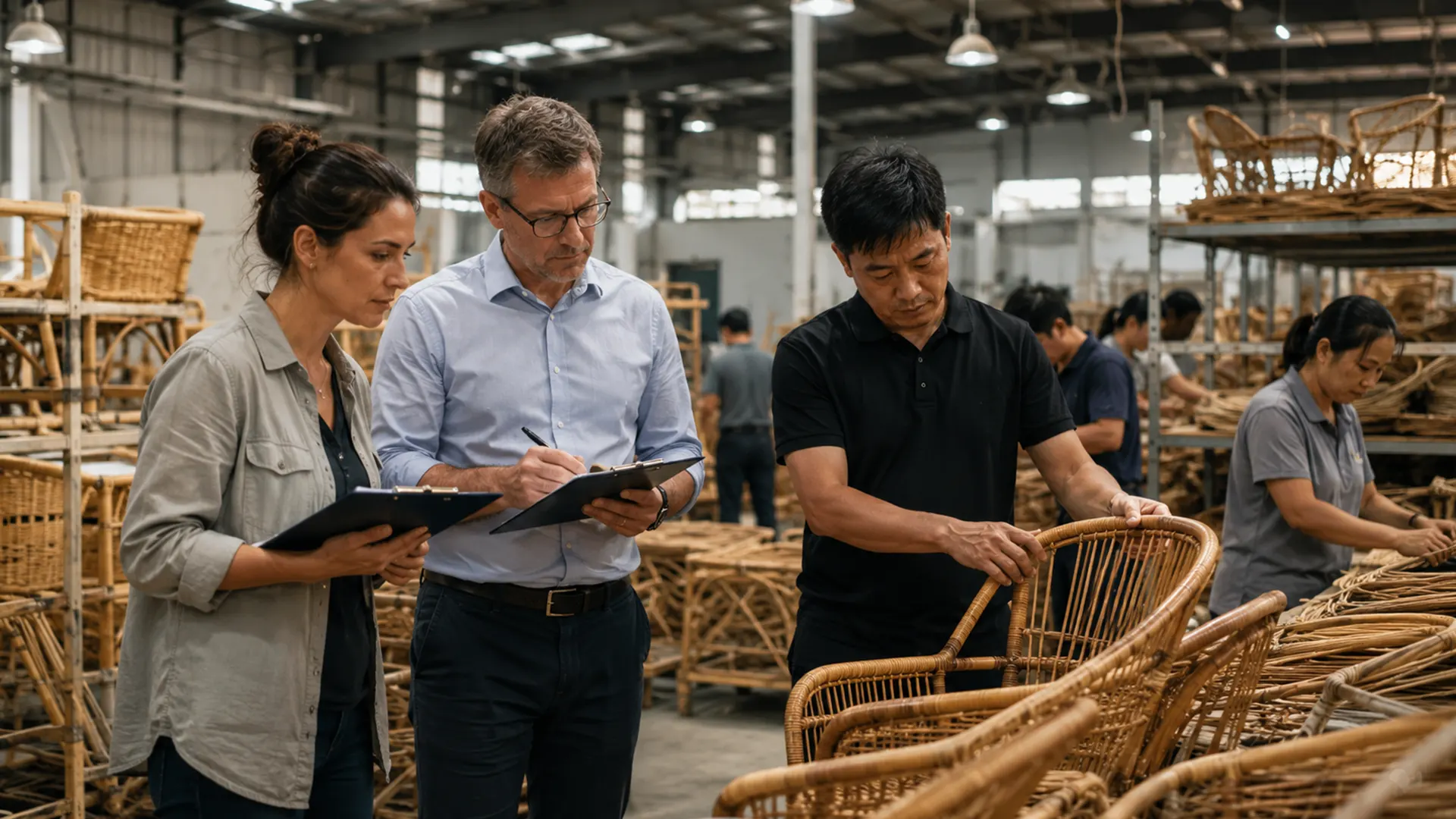
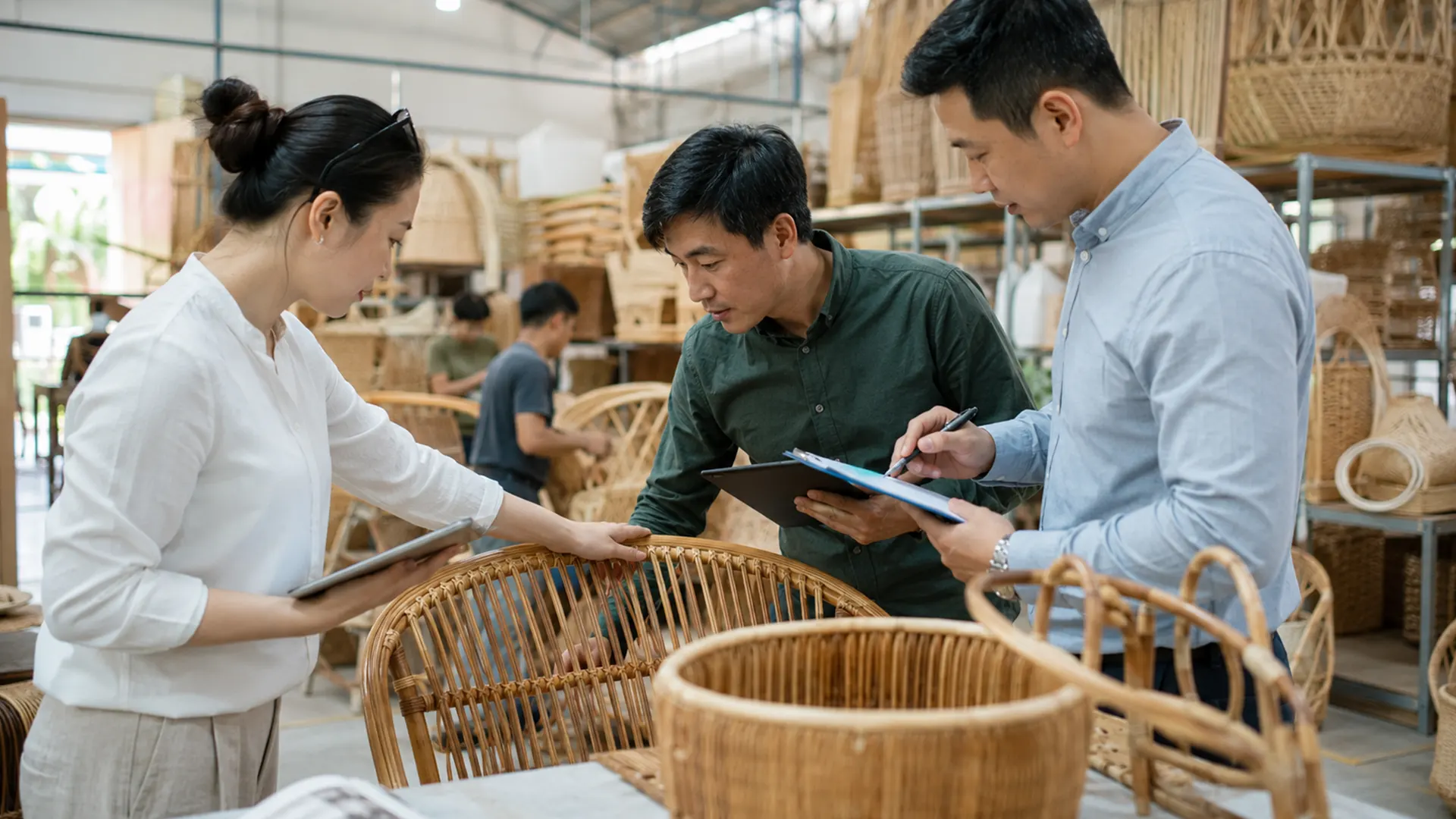
 Rattan Export buyer guide: Vietnam's Rattan And Bamboo Production Regions Explained.
Vietnam's rattan and bamboo industry cannot be understood by looking for one single “production capital.” The supply chain is geographically distributed. Raw materials may come from one province, weaving may be carried out by artisan households in another area, final furniture assembly and finishing may take place in an industrial factory elsewhere, and the finished container may leave through a port hundreds of kilometres away. For international buyers, understanding these regional differences is important because geography influences product specialization, labour structure, raw-material access, quality control, lead time, consolidation cost and export logistics.
A useful sourcing map therefore separates Vietnam into three overlapping systems: raw-material regions, traditional craft and weaving clusters, and industrial furniture/export hubs. A province that is strong in bamboo resources is not automatically the best place to source finished export furniture, while a major furniture-manufacturing province may depend on natural materials transported from other parts of the country.
Buyers exploring the wider Vietnam rattan, bamboo and natural-fibre sourcing ecosystem should evaluate suppliers according to their actual production network rather than assuming that company location alone explains where and how the product is made.
There Is No Single Vietnam Rattan And Bamboo Production Region
Unlike an industrial product whose entire supply chain may sit inside one manufacturing park, rattan and bamboo products often move through several stages and locations.
A typical supply chain may involve:
- Bamboo or rattan harvested or purchased from a raw-material region
- Initial sorting, drying or preparation near the material source
- Components transported to a craft village or factory
- Frames produced at one facility
- Weaving completed internally or by specialist artisan groups
- Finishing and final assembly performed at an export factory
- Products packed and consolidated near the manufacturing or logistics hub
- Container moved to the appropriate export port
This structure means the phrase “Made in Vietnam” can represent a genuinely Vietnamese but geographically distributed production system.
Three Different Maps International Buyers Should Understand
When evaluating regions, buyers should separate three questions.
1. Where Does The Raw Material Come From?
Natural bamboo and rattan availability depends on species, forestry conditions, harvesting networks and commercial supply chains. Material can travel significant distances before reaching the final furniture factory.
2. Where Is The Craft Skill Located?
Traditional weaving knowledge is concentrated in craft villages and rural artisan communities. These areas may provide skilled manual labour even when export management and final packing are handled elsewhere.
3. Where Is Export-Scale Manufacturing Located?
Larger manufacturing areas may provide factory management, finishing systems, upholstery, packaging, documentation and container logistics even if the original natural material or weaving labour comes from another region.
Hanoi And The Red River Delta: Vietnam's Most Recognizable Rattan And Bamboo Craft Belt
The Hanoi region is one of the most internationally recognizable areas for traditional bamboo and rattan handicrafts. The Chương Mỹ area, particularly the historic Phú Vinh craft community, has a long-established reputation for bamboo and rattan weaving.
Products associated with this broader craft environment can include:
- Baskets
- Trays
- Decorative objects
- Lighting shades
- Small furniture
- Woven panels
- Home accessories
- Artistic woven products
The importance of the Hanoi craft belt is not only the existence of individual villages. It is the surrounding ecosystem of artisans, workshops, trading companies, export businesses, designers and factories that can transform traditional craft skills into commercial product collections.
Phú Vinh And The Chương Mỹ Area
Phú Vinh is particularly important when explaining Vietnam's rattan and bamboo identity because weaving knowledge has been maintained there for generations. The area is known for sophisticated manual weaving techniques and a wide variety of decorative and functional products.
For international buyers, however, traditional reputation should not replace supplier verification. A company located near a famous craft village may operate as:
- A direct manufacturer
- An export factory
- A coordinator of artisan households
- A sourcing and consolidation company
- A combination of these models
Buyers should identify where the actual production stages take place.
Why The Hanoi Region Can Be Strong For Product Development
A mature craft ecosystem can make product development easier because suppliers may have access to different weaving skills and natural-material techniques.
This can be useful for:
- Custom baskets
- Decorative weaving
- Lighting
- Rattan accessories
- Woven cabinet panels
- Small furniture
- OEM collections requiring handcrafted detail
Some suppliers also combine artisan networks with centralized factories where quality control, finishing, packing and export preparation take place.
The Wider Northern Artisan Network
The northern Vietnamese natural-fibre supply chain extends beyond Hanoi. Commercial supplier networks can involve artisan communities and subcontract production in surrounding or neighbouring provinces.
Depending on the supplier and product category, these networks may extend toward areas such as Hòa Bình, Phú Thọ, Nam Định, Thái Bình and other northern provinces.
This does not mean every location is a major export manufacturing centre. The important point is that handwork can be distributed across rural production networks while final inspection and export packing remain centralized.
Northern Upland Areas And Raw-Material Supply
Vietnam's northern upland regions also contribute to bamboo and other natural-material supply chains. Some manufacturers source bamboo or related materials from mountainous provinces rather than from the province where their factory is located.
For buyers, the sourcing question should therefore be more specific than “Where is your factory?”
Ask:
- Where does the main bamboo species originate?
- Who supplies the raw material?
- Is material purchased directly or through traders?
- How is material graded?
- How is origin documented when required?
- How is material transported and stored before production?
Thanh Hóa: An Important Bamboo And Weaving Region
Thanh Hóa in north-central Vietnam is important in discussions of bamboo because the province has substantial bamboo resources and a long tradition of bamboo weaving and processing.
For international sourcing, Thanh Hóa should be understood as a broader natural-material region rather than being reduced to one type of furniture.
Potential product capabilities within the broader regional ecosystem can include:
- Bamboo handicrafts
- Woven baskets
- Household products
- Natural-fibre accessories
- Decorative products
- Processed bamboo components
Different factories and craft communities have very different levels of export readiness, so buyers should verify capacity, consistency, documentation and packing at company level.
Nga Sơn And The Broader Natural-Fibre Ecosystem
Within Thanh Hóa, the Nga Sơn area is particularly relevant to buyers of woven home products because the regional handicraft economy also works with materials such as sedge and other plant fibres alongside bamboo.
This creates opportunities for collections that combine:
- Bamboo
- Sedge
- Water hyacinth
- Jute
- Other woven plant fibres
For a buyer developing baskets, storage, planters, trays or home-decor collections, this multi-material capability may be more commercially important than searching for a supplier that uses only rattan.
Thanh Hóa Is Not Automatically A Furniture Factory Cluster
Raw-material strength and weaving traditions should not be confused with industrial furniture capacity. A buyer sourcing large structural furniture must still verify frame engineering, finishing, upholstery, packaging and container-loading capabilities at the individual factory.
Nghệ An: Traditional Skills And Local Natural Materials
Nghệ An also contains communities with traditional bamboo and rattan weaving knowledge, including rural and ethnic artisan traditions.
For international buyers, this illustrates an important principle: traditional craft capability may exist in areas that are not large industrial export hubs.
A supplier using artisan production in Nghệ An may therefore need to combine local weaving with centralized:
- Production management
- Quality control
- Finishing
- Packaging
- Export documentation
Buyers should not assume traditional craft automatically equals container-scale export capacity.
Central Vietnam: Smaller Craft Pockets And Specialized Production
Central Vietnam also contains bamboo and rattan craft traditions. Quảng Nam, for example, has had craft communities associated with bamboo-rattan work as part of its broader handicraft heritage.
These areas can be interesting for artisanal design and local craft sourcing, but buyers should distinguish craft heritage from industrial export capacity.
Questions to ask include:
- Is production performed inside one factory or distributed among households?
- Can the supplier handle repeat international orders?
- How is quality standardized?
- Where is finishing performed?
- Where are products packed?
- Which port is normally used?
Bình Định: A Major Furniture-Manufacturing Context, But Not Simply A Natural-Rattan Cluster
Bình Định in south-central Vietnam is important to the country's wider furniture export industry. It has a significant concentration of furniture and wood-processing businesses and established export manufacturing infrastructure.
For rattan buyers, however, this should be interpreted carefully. Bình Định's strength in furniture manufacturing does not mean every factory specializes in natural rattan or bamboo.
The region may be relevant when buyers require:
- Mixed-material furniture
- Wood-and-woven furniture
- Outdoor furniture
- Industrial-scale furniture production
- Export packaging and container programs
Natural-rattan capability must still be confirmed supplier by supplier.
Why Furniture Clusters Matter Even When Raw Materials Come From Elsewhere
International buyers sometimes focus heavily on where the rattan or bamboo grows. For finished furniture, however, industrial capabilities can be equally important.
An export furniture factory may add value through:
- Product engineering
- Frame construction
- Finishing systems
- Upholstery
- Quality management
- Carton engineering
- Container planning
- Export documentation
This is why a supplier located outside a traditional craft village may still be commercially stronger for a complex furniture program.
Southern Vietnam: Industrial Furniture And Export Infrastructure
Southern Vietnam, particularly the broader manufacturing belt around Bình Dương, Đồng Nai and Hồ Chí Minh City, is a major furniture-production environment.
The region has a large ecosystem of:
- Furniture factories
- Component suppliers
- Finishing specialists
- Upholstery businesses
- Packaging suppliers
- Freight and logistics providers
For buyers of rattan and natural-fibre furniture, this can be useful when products combine woven materials with timber, metal, upholstery or other industrial components.
Southern Furniture Capacity Does Not Mean Southern Raw-Material Origin
A factory in southern Vietnam may source rattan, bamboo or woven components from another province or use subcontracted artisan networks.
The buyer should map both the factory location and the upstream material and weaving network.
When Southern Vietnam Can Be Attractive
Southern manufacturers can be commercially attractive for programs requiring:
- Large factory management systems
- Mixed-material engineering
- Upholstered furniture
- Private-label production
- Retail packaging
- Container-based export logistics
- Large repeat orders
Again, actual natural-rattan specialization must be verified rather than assumed from the region.
Raw Material Region vs Finished-Goods Region
This distinction is one of the most important concepts for international buyers.
| Supply-Chain Function | Typical Regional Importance | Buyer Question |
|---|---|---|
| Raw-material source | Forested and rural material-producing areas | Where does the bamboo or rattan originate? |
| Craft weaving | Traditional villages and artisan networks | Who performs the weaving? |
| Furniture assembly | Factories and manufacturing clusters | Where is the frame and final product made? |
| Finishing | Factory or specialist subcontractor | Where is colour and coating controlled? |
| Packaging | Usually export factory or consolidation point | Where are final dimensions and CBM confirmed? |
| Export | Manufacturing and logistics hubs | Which entity and port handle shipment? |
Rattan Furniture And Rattan Handicrafts Are Different Supply Chains
A supplier capable of producing excellent baskets is not automatically capable of producing structural dining chairs. Likewise, a sophisticated furniture factory may not have the artisan network needed for highly detailed decorative weaving.
Rattan furniture requires competence in areas such as:
- Frame engineering
- Bending
- Structural joints
- Stability
- Repeat dimensions
- Furniture finishing
- Export packaging
Handicrafts may depend more heavily on:
- Manual weaving skill
- Shape development
- Decorative detail
- Flexible household production networks
Bamboo Furniture And Bamboo Handicrafts Also Require Different Capabilities
Bamboo can be used in baskets, decorative accessories, laminated components, furniture frames and many other forms. Buyers should specify the exact manufacturing technology rather than sourcing simply by the keyword “bamboo.”
Choose Regions According To Product Category
| Buyer Requirement | Regional Direction To Investigate |
|---|---|
| Fine rattan/bamboo weaving and handicrafts | Hanoi and northern craft-village networks |
| Baskets, storage and multi-fibre home decor | Hanoi-region networks and north-central natural-fibre areas such as Thanh Hóa |
| Traditional/local artisan products | Northern, north-central and selected central craft communities |
| Large mixed-material furniture | Established furniture-manufacturing clusters in central or southern Vietnam |
| Large repeat export programs | Supplier-specific factories with proven industrial systems, regardless of province |
This table is a sourcing framework, not a rule that every supplier in a region has the listed capability.
Region Alone Should Never Determine Supplier Selection
Two factories located ten kilometres apart can perform very differently.
Supplier selection should still consider:
- Product specialization
- Actual manufacturing role
- Quality systems
- Moisture management
- Capacity
- Lead time
- OEM/ODM capability
- Packaging
- Commercial transparency
- Export experience
Distributed Artisan Production Can Be An Advantage
Craft-village networks can provide a large pool of specialist weaving labour and enable complex handmade products to be scaled beyond one workshop.
When properly managed, this structure can support substantial commercial programs.
But Distributed Production Creates Quality-Control Challenges
When hundreds of units are woven across different households or workshops, variation can increase.
Control should cover:
- Material distribution
- Approved weaving pattern
- Dimensions
- Weaving tension
- Workmanship standard
- Collection and incoming inspection
- Rejected-unit control
Centralized final inspection alone may be too late if variation has already spread through a large production batch.
Regional Climate Does Not Replace Moisture Control
Vietnam's humid and tropical conditions are often discussed in relation to natural furniture, but location alone does not determine whether mold or cracking will occur.
Factory-level process control remains more important than a simple regional label. Buyers should examine drying, conditioning, storage, finishing, packing and container preparation through a structured quality and moisture-control program.
Transport Between Regions Can Affect Lead Time
If raw materials, frames or woven components move between provinces, inland transportation becomes part of production planning.
This can affect:
- Lead time
- Handling damage
- Material exposure
- Production synchronization
- Cost
Buyers should understand these movements when evaluating highly distributed supply chains.
Mixed-Factory Production Needs Clear Responsibility
A product may involve a weaving workshop, frame factory, finishing factory and export company. The buyer should know which company has final responsibility for the complete product.
Ask who owns:
- Approved sample
- Technical specification
- Quality approval
- Corrective action
- Final packaging
- Shipment release
How Region Influences Container Logistics
Factory location influences inland transport to the export port, but port selection depends on the supplier's location, freight route, carrier options and shipment plan.
Northern exporters commonly build their logistics around northern ports, while southern manufacturing programs may use southern port systems. Central suppliers may use ports that fit their specific location and routing.
These choices should be evaluated within the wider FOB, freight, container and export-planning process rather than assumed from province alone.
Do Not Compare FOB Without Considering Inland Structure
A factory located near a port may have different inland costs from a rural craft producer requiring consolidation and long-distance trucking.
However, the lower inland cost does not automatically produce the lower landed cost. Product CBM, packaging efficiency, quality performance and container utilization may have a much larger impact.
Regional Supplier Networks Can Support Mixed Containers
A sourcing company or export manufacturer may combine products from several specialist production areas into one container.
For example, one commercial collection might include:
- Rattan furniture from a specialist furniture factory
- Bamboo accessories from a craft network
- Natural-fibre baskets from another region
- Textiles or cushions from a separate supplier
This can create a commercially attractive collection, but synchronization and quality responsibility become more complex.
Regional Sourcing And MOQ
Access to large artisan networks does not automatically eliminate MOQ. Minimum quantities can still result from finish batches, frame production, material purchasing, carton printing or factory scheduling.
Likewise, a large industrial factory may have higher minimums than a small workshop.
MOQ should therefore be evaluated supplier by supplier rather than province by province.
Regional Sourcing And OEM Development
Different regional ecosystems can support different forms of OEM development.
Craft-oriented suppliers may be particularly useful for:
- New weaving patterns
- Handmade decorative structures
- Natural-fibre combinations
Industrial furniture factories may be stronger for:
- Structural engineering
- KD systems
- Mixed materials
- Upholstery
- Repeat dimensional control
- Retail-ready packaging
A Buyer Should Map The Complete Supply Chain
For an important new supplier, create a simple supply-chain map.
| Question | Information To Record |
|---|---|
| Raw material | Province or supplier source |
| Frame production | Factory location |
| Weaving | Internal, village network or subcontractor |
| Finishing | Location and responsible company |
| Final QC | Inspection location |
| Packing | Final packing facility |
| Consolidation | Warehouse or factory |
| Export | Exporter and planned port |
Questions To Ask A Vietnamese Supplier About Region And Production
- Which processes are performed at this factory?
- Where does your main rattan or bamboo come from?
- Do you use artisan households or subcontractors?
- Where is weaving performed?
- Where is finishing performed?
- Where is final quality inspection performed?
- Where are goods packed?
- Where are mixed-supplier goods consolidated?
- Which export port do you normally use?
- Who has final responsibility for product quality?
Regional Sourcing Red Flags
- Supplier refuses to explain where production occurs
- Factory address does not match the production shown
- Large portions of production are subcontracted without quality controls
- Raw-material origin claims cannot be explained
- Weaving households receive no controlled reference sample
- Products travel through several facilities without traceability
- No company accepts responsibility for the complete product
- Final packing dimensions are unknown until loading day
A Practical Regional Sourcing Matrix
| Region / Cluster Type | Typical Strength To Investigate | Main Buyer Risk To Verify |
|---|---|---|
| Hanoi / Chương Mỹ craft belt | Rattan and bamboo weaving, handicrafts, artisan development | Distributed production and quality consistency |
| Wider northern craft network | Artisan labour and specialized handwork | Subcontracting visibility and central control |
| Thanh Hóa / north-central natural-fibre areas | Bamboo resources, weaving, baskets and natural-fibre products | Export scale and furniture-specific capability |
| Nghệ An and other traditional craft pockets | Local bamboo-rattan craftsmanship | Commercial scale and export systems |
| Selected central craft communities | Artisanal and design-led production | Repeat capacity and logistics |
| Bình Định furniture cluster | Furniture manufacturing and export infrastructure | Verify actual natural-rattan specialization |
| Southern furniture belt | Industrial furniture, mixed materials, export systems | Trace natural-material and weaving sources |
Frequently Asked Questions
Where is most rattan furniture made in Vietnam?
There is no single province that should be treated as the universal centre for all Vietnamese rattan furniture. Production is distributed across traditional craft networks and modern furniture factories, and many suppliers combine materials or labour from several provinces.
Is Hanoi the main rattan and bamboo area?
Hanoi, especially the Chương Mỹ and Phú Vinh craft environment, is one of Vietnam's best-known centres for traditional bamboo and rattan weaving. That does not mean every export furniture program should automatically be sourced there.
Why is Thanh Hóa important?
Thanh Hóa is relevant because of its bamboo resources and weaving traditions, as well as broader natural-fibre handicraft production. Individual supplier capability still needs to be verified.
Are Bình Dương and Đồng Nai important for rattan?
They are important within Vietnam's wider industrial furniture ecosystem. Some suppliers may manufacture natural-fibre or mixed-material furniture there, but buyers should not assume every factory specializes in natural rattan.
Can raw material come from a different province than the factory?
Yes. This is common in distributed manufacturing systems. The important issue is whether the supplier controls material quality, storage, traceability and transport.
Are craft villages suitable for large orders?
They can be when a strong manufacturer or export company coordinates artisan production, standardizes specifications and maintains effective quality control. Craft reputation alone does not prove container-scale capability.
Which region is best for international buyers?
There is no universal best region. The correct region depends on whether the buyer needs furniture, baskets, home decor, fine weaving, mixed materials, OEM development or industrial-scale repeat production.
Vietnam's Strength Is The Combination Of Regions
Vietnam's rattan and bamboo sourcing strength does not come from one province. It comes from the interaction between raw-material regions, traditional artisan communities, export factories, furniture-manufacturing clusters and logistics infrastructure.
For international buyers, the most effective approach is therefore not to ask, “Which province is best?” The better question is, “Which production network is best for this specific product and buying program?”
A finely woven basket collection may benefit from a completely different regional network than a 40HC program of structural dining chairs. A hospitality collection combining rattan, timber, metal and upholstery may require yet another manufacturing ecosystem.
The supplier's ability to control this network—materials, artisans, factory processes, quality, packing and export execution—is ultimately more important than the province printed in the company address.
If you are planning container-based sourcing of rattan furniture, bamboo products, baskets, storage or natural-fibre home decor from Vietnam, send your wholesale RFQ, product categories, specifications, target quantities and container requirements so the appropriate production regions and supplier structures can be evaluated for your program.