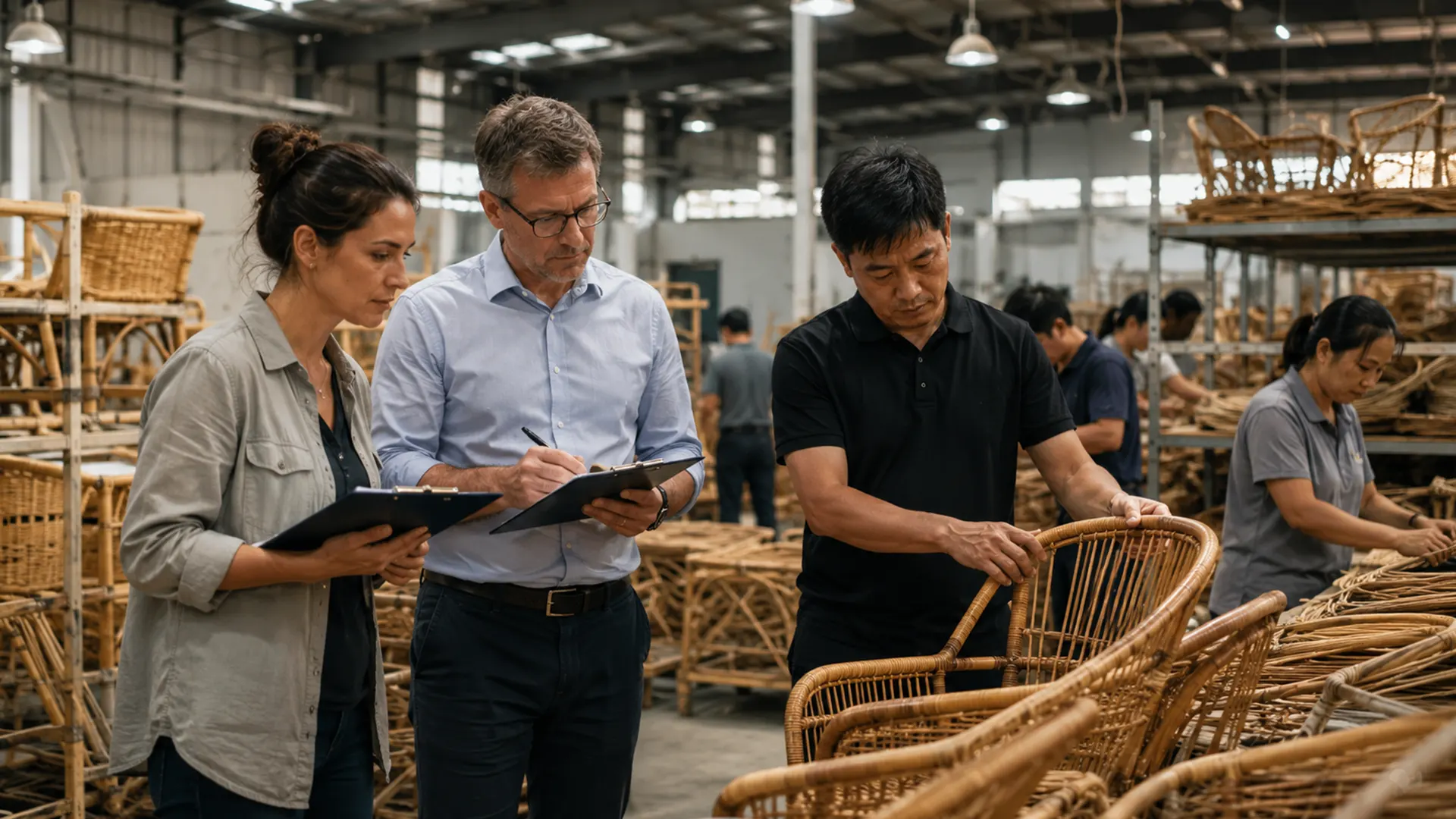
 Rattan Export buyer guide: How We Evaluate Rattan And Bamboo Suppliers In Vietnam.
Evaluating rattan and bamboo suppliers in Vietnam requires more than reviewing a catalogue, comparing FOB prices or asking whether a company has export experience. For international importers, wholesalers, distributors, retail chains, hospitality groups and project buyers, supplier qualification should determine whether a company can consistently produce the required product, at the required quality, within the required lead time, with reliable documentation, packaging and container-loading performance.
At Rattan Export Vietnam, supplier evaluation is approached as a structured commercial and operational process. We do not treat legal registration, an attractive showroom or a large catalogue as sufficient proof of manufacturing capability. Instead, we examine the complete chain: company identity, actual production role, product specialization, material control, production processes, quality systems, capacity, OEM and ODM capability, packaging, export readiness, communication and long-term reliability.
This guide explains the main criteria that professional international buyers should use when assessing rattan, bamboo and natural-fibre suppliers within the Vietnam sourcing and manufacturing ecosystem.
1. Verify The Company Before Evaluating The Products
The first step is confirming who the supplier actually is. A company name, website or quotation does not automatically prove the legal entity behind the transaction.
We normally want to understand:
- Registered legal company name
- Business registration details
- Registered address
- Factory or workshop address
- Authorized representative
- Exporting entity
- Bank account beneficiary
- Relationship between office, factory and any affiliated companies
The purpose is not bureaucracy for its own sake. The buyer needs to know which entity will sign the contract, receive payment, manufacture the goods and issue export documentation.
2. Determine Whether The Supplier Is Really A Manufacturer
Some companies manufacture directly. Others operate as exporters, trading companies, sourcing companies or networks coordinating specialist workshops. None of these models is automatically unacceptable, but the actual structure must be clear.
We ask which operations are performed internally and which are subcontracted.
Typical processes may include:
- Raw rattan or bamboo preparation
- Drying and conditioning
- Cutting
- Bending
- Frame assembly
- Weaving
- Sanding
- Staining and finishing
- Upholstery
- Final assembly
- Quality control
- Export packing
A supplier can use subcontractors successfully, but subcontracting should be transparent and subject to the same buyer specifications and quality controls.
3. Evaluate Product Specialization
A large catalogue does not necessarily indicate deep manufacturing capability. We place more value on demonstrated specialization.
For example, a supplier may be particularly strong in:
- Dining chairs
- Lounge furniture
- Rattan beds and headboards
- Cabinets with woven panels
- Bamboo furniture
- Rattan baskets
- Storage collections
- Natural-fibre home decor
- Hospitality furniture
- OEM furniture development
A specialist supplier often understands technical details such as bending radius, weaving tension, frame reinforcement, nesting geometry, moisture behavior and export packing better than a general supplier offering hundreds of unrelated products.
4. Inspect The Real Production Environment
A factory visit is one of the most useful qualification tools when practical. When an in-person visit is not immediately possible, a structured live video inspection can provide useful preliminary evidence.
We want to see more than a showroom. Useful areas include:
- Raw-material storage
- Material preparation
- Bending areas
- Frame production
- Weaving stations
- Sanding and finishing
- Finished-goods storage
- Quality-control points
- Packing area
- Loading area
Production evidence should match the products being quoted. A supplier showing a chair catalogue should be able to explain how those chairs are actually made.
5. Check Raw-Material Control
Rattan and bamboo are natural materials. Variation is normal, but uncontrolled material variation can create serious quality problems.
We assess how the supplier controls:
- Material diameter
- Material maturity
- Colour variation
- Straightness
- Surface defects
- Cracking or splitting
- Insect damage
- Moisture condition
- Storage environment
The supplier should be able to separate acceptable natural variation from material that should be rejected.
6. Understand Material Storage Conditions
Raw rattan and bamboo should not be stored carelessly on wet floors, exposed continuously to rain or mixed with visibly contaminated material.
We look at:
- Floor condition
- Air circulation
- Protection from rain
- Material separation
- Signs of mold
- General cleanliness
- Rotation of material stock
Material storage is important because final inspection cannot fully correct problems created much earlier in the production cycle.
7. Evaluate Moisture And Mold Management
Moisture is one of the major risks in rattan, bamboo and other natural-fibre exports. There is no single universal moisture percentage suitable for every product, species, construction or destination market, so we focus on process control rather than relying on one number alone.
Useful questions include:
- How are raw materials dried?
- Where are moisture checks performed?
- What measuring equipment is used?
- How are readings recorded?
- What happens when readings are outside the agreed range?
- How long do finished products stabilize before packing?
- How is finished-goods storage controlled?
Moisture management should continue through packing and container loading, not stop after raw-material drying.
8. Check Bending And Frame Construction
Curved rattan frames are visually attractive but technically demanding. Poor bending can produce hidden weaknesses, flattened material, cracks or asymmetry.
We examine:
- Smoothness of bends
- Hairline cracking
- Material crushing
- Frame symmetry
- Joint positioning
- Fastener location
- Structural reinforcement
- Consistency between units
The frame should be evaluated as a structure, not only as an aesthetic object.
9. Assess Weaving Quality
Handwoven furniture will naturally show some variation, but controlled consistency is still required.
We look for:
- Consistent weaving tension
- Even spacing
- Secure starting and finishing points
- No loose ends
- No broken strands
- No excessive gaps
- Clean edge finishing
- Pattern consistency across the order
The objective is not mechanical uniformity. It is a controlled handcrafted appearance within an approved quality standard.
10. Review Finish And Surface Quality
Natural rattan and bamboo can absorb stain differently from one piece to another. The supplier should demonstrate how colour and finish are controlled within acceptable limits.
We check:
- Colour consistency
- Surface smoothness
- Overspray or uneven coating
- Visible sanding marks
- Finish curing
- Gloss consistency where relevant
- Cleanliness around bindings and joints
A photograph alone is not a reliable colour standard. Physical approved samples or controlled colour references are preferable for important programs.
11. Examine Quality-Control Procedures
“Export quality” is not a measurable specification. A strong supplier should be able to explain how its quality-control system works.
We want to understand:
- Incoming-material inspection
- In-process checks
- Final inspection
- Defect classification
- Measurement procedures
- Rejected-product handling
- Corrective-action process
- Record keeping
For buyer orders, the supplier's internal system should be aligned with the buyer's approved specifications and the wider quality-control and pre-shipment inspection framework.
12. Check Production Capacity Realistically
Production capacity should be evaluated for the specific product, not accepted as a vague statement such as “we can produce 50 containers per month.”
Capacity depends on:
- Product complexity
- Number of weaving hours
- Finish requirements
- Material availability
- Available workforce
- Current order backlog
- Packaging resources
A supplier that can produce large volumes of simple baskets may have far less capacity for complex woven lounge chairs.
13. Verify Lead-Time Planning
Lead time should be built from actual production steps.
We normally want visibility into:
- Material preparation
- Sample approval
- Production start
- Frame production
- Weaving
- Finishing
- Stabilization
- Packing
- Inspection
- Container loading
Very short lead-time promises are not automatically an advantage if they depend on skipping necessary stabilization or quality-control stages.
14. Evaluate OEM And ODM Capability
A supplier claiming OEM capability should be able to do more than copy a reference photo.
We look for ability to work with:
- Drawings
- Technical dimensions
- Material specifications
- Custom weaving
- Custom finishes
- Private-label requirements
- Nesting improvements
- KD development
- Packaging optimization
For ODM, we also assess whether the supplier can contribute useful design and manufacturing solutions instead of waiting for every detail from the buyer.
15. Evaluate Sampling Discipline
The sample process often reveals how a supplier will behave during production.
We observe:
- How accurately instructions are followed
- How changes are documented
- How quickly technical questions are raised
- Whether dimensions are controlled
- Whether the supplier hides mistakes or discusses them openly
- Whether the final sample can become a reliable production reference
A good sample is useful only if mass production can reproduce it consistently.
16. Review Export Packaging Capability
Rattan and bamboo furniture are often cube-sensitive products, so packaging affects both damage risk and landed cost.
We evaluate:
- Surface protection
- Corner and leg protection
- Protection at nesting contact points
- Carton strength
- Carton dimensions
- Units per carton
- Hardware packing
- Cushion packing
- Moisture-control approach
- Carton markings
The best package protects the product without creating unnecessary CBM.
17. Check Container-Loading Knowledge
A serious export supplier should understand more than how many cartons are produced. It should understand how those cartons load into containers.
We ask for:
- Final packed dimensions
- CBM per carton
- Units per carton
- Estimated 20ft loading
- Estimated 40ft loading
- Estimated 40HC loading
- Mixed-container compatibility
- Loading restrictions
Container quantity should be based on the final protected package rather than bare product dimensions.
18. Assess Mixed-Container Capability
Mixed containers require more coordination than single-SKU loads. The supplier should be able to manage SKU counts, carton identification, CBM data, loading sequence and protection between different product types.
This becomes especially important when furniture is combined with baskets, storage or home decor.
19. Check Export Documentation Capability
The manufacturing quality can be excellent and the shipment can still fail commercially if documentation is inaccurate or late.
Depending on the commercial structure, the supplier should be able to prepare or coordinate:
- Commercial invoice
- Packing list
- Container and seal information
- Shipping instructions
- Origin-related documentation where applicable
- Buyer-required supporting documents
Documentation responsibilities should be confirmed as part of the overall export, Incoterm and container-shipping process.
20. Verify Experience, But Do Not Rely On Claims Alone
Export experience is useful, but statements such as “we export worldwide” should be supported by credible operational evidence.
Useful indicators can include:
- Export packing knowledge
- Professional documentation
- Understanding of FOB, EXW and CIF requests
- Ability to discuss container loading
- Familiarity with buyer inspections
- Structured communication
Customer references can also be useful where confidentiality permits, but refusal to reveal a full customer list is not automatically a warning sign.
21. Review Certifications Carefully
A certificate should never be accepted only because a PDF or logo is shown.
Where certifications are commercially important, verify:
- Certificate holder
- Facility covered
- Scope
- Certificate number
- Issue and expiry dates
- Issuing or auditing organization
A factory-level certificate also does not automatically prove that every individual product complies with all destination-market requirements.
22. Evaluate Communication Quality
Communication is one of the strongest predictors of operational performance.
We value suppliers that:
- Answer technical questions directly
- Admit when information is not yet available
- Separate confirmed facts from estimates
- Respond to problems with proposed solutions
- Maintain document version control
- Understand SKU-level requirements
A supplier that answers every question with “no problem” but cannot provide details may create significant risk later.
23. Assess Commercial Transparency
Professional cooperation requires clarity on:
- FOB price
- MOQ
- Sample charges
- Tooling or development cost
- Packaging cost
- Payment terms
- Lead time
- Quotation validity
- Subcontracting
- Who acts as exporter
Transparent suppliers do not need to be the cheapest suppliers. They need to provide enough information for the buyer to understand the transaction.
24. Verify Payment Details Carefully
The beneficiary name should logically match the agreed commercial entity or documented payment structure.
If banking information changes unexpectedly during an order, the change should be verified through an established independent communication channel before funds are transferred.
25. Look At How The Supplier Handles Problems
No real production program is completely free of problems. What matters is how the supplier responds.
We pay close attention to whether the supplier:
- Identifies the root cause
- Separates affected goods
- Documents corrective action
- Prevents recurrence
- Communicates quickly
- Accepts responsibility when justified
A supplier that hides defects can be more dangerous than one that openly reports a problem and solves it professionally.
26. Use A Trial Order When Appropriate
For a new supplier, a controlled first order can provide information that cannot be learned from a meeting or factory tour alone.
A trial production reveals:
- Actual lead-time performance
- Production consistency
- Communication under pressure
- Quality performance
- Packaging quality
- Documentation accuracy
- Loading discipline
The appropriate trial structure depends on the buyer's commercial model. Container-based buyers may still need a 20ft or mixed-container program rather than a small consumer-style order.
27. Supplier Approval Is Not Permanent
A supplier that performs well once should not be assumed to remain equally strong forever.
Performance can change because of:
- Management changes
- Workforce turnover
- Capacity pressure
- New subcontractors
- Material shortages
- Changes in production location
- Rapid growth
Supplier qualification should therefore continue through ongoing order performance.
A Practical Supplier Evaluation Scorecard
| Area | What We Evaluate |
|---|---|
| Company verification | Legal identity, addresses, payment and export entity |
| Production role | Internal production vs subcontracting |
| Specialization | Depth of capability in relevant products |
| Materials | Selection, storage, moisture and defect control |
| Manufacturing | Bending, frames, weaving, finishing and consistency |
| Quality | Incoming, in-process and final QC |
| Capacity | Realistic product-specific output |
| Lead time | Credible production planning |
| OEM/ODM | Technical development capability |
| Packaging | Protection, CBM and carton engineering |
| Loading | 20ft, 40ft, 40HC and mixed-container knowledge |
| Export | Documentation and shipment coordination |
| Communication | Accuracy, transparency and responsiveness |
| Commercial terms | FOB, MOQ, payment and quotation clarity |
| Corrective action | Problem solving and prevention |
Common Supplier Red Flags
- Refuses reasonable factory verification
- Cannot explain where quoted products are produced
- Claims exceptional capacity without product-level detail
- Cannot provide final packed dimensions
- Has no clear QC process
- Stores natural materials in visibly poor conditions
- Visible mold or persistent musty odor in storage areas
- Repeatedly gives unrealistic lead-time promises
- Changes specifications without approval
- Uses vague answers when defects are discussed
- Changes bank beneficiaries without clear explanation
- Cannot identify who carries export responsibility
Positive Supplier Indicators
- Clear and consistent company information
- Transparent production structure
- Strong specialization in relevant categories
- Organized material storage
- Visible quality-control checkpoints
- Realistic capacity and lead-time statements
- Good sample documentation
- Accurate packing and CBM data
- Open discussion of defects and corrective action
- Ability to support buyer inspections
- Professional export documentation
- Consistent communication
Frequently Asked Questions
Does legal registration prove that a supplier owns a factory?
No. Legal registration confirms the existence of an entity, but factory ownership and manufacturing capability must be verified separately.
Is a large factory always better?
No. A smaller specialist manufacturer can outperform a larger general factory for a specific product category.
Should subcontracting disqualify a supplier?
No. Subcontracting can be normal and effective when it is transparent, controlled and subject to the same specifications and QC requirements.
How important is a factory visit?
Very useful, especially for new strategic suppliers, but it should be combined with document checks, sampling, quality evaluation and actual order performance.
Should buyers rely on certificates?
Certificates can be useful evidence, but their holder, scope, validity and relevance should be verified. They do not replace product-level quality control.
What is the most important supplier criterion?
There is no single criterion. Reliable suppliers combine real manufacturing capability, transparent communication, consistent quality, realistic commercial terms and disciplined export execution.
When is a supplier fully approved?
Approval should be considered progressive. Initial screening, factory verification, sample approval, trial production and repeat-order performance all provide different levels of confidence.
Supplier Evaluation Is A Risk-Control Process
The purpose of supplier evaluation is not to find the company with the largest catalogue, the lowest quoted price or the most impressive presentation. It is to identify suppliers that can repeatedly convert a buyer's specification into saleable, export-ready products with predictable quality, timing and commercial performance.
For rattan and bamboo sourcing in Vietnam, the strongest supplier relationships are built on transparency, specialization, measurable specifications, disciplined quality control, realistic capacity, proper moisture management, export-ready packaging and reliable communication.
A supplier should therefore be evaluated before the first order, during the first production run and continuously throughout the commercial relationship.
If you are looking for qualified Vietnamese manufacturers for rattan furniture, bamboo products, baskets, storage or natural-fibre home decor, send your wholesale RFQ, product specifications, target quantities and container requirements so supplier suitability, production capability, quality expectations and export requirements can be evaluated before an order is placed.