 Rattan Export buyer guide: Manufacturer vs Sourcing Company: Which Model Is Better For International Rattan Buyers.
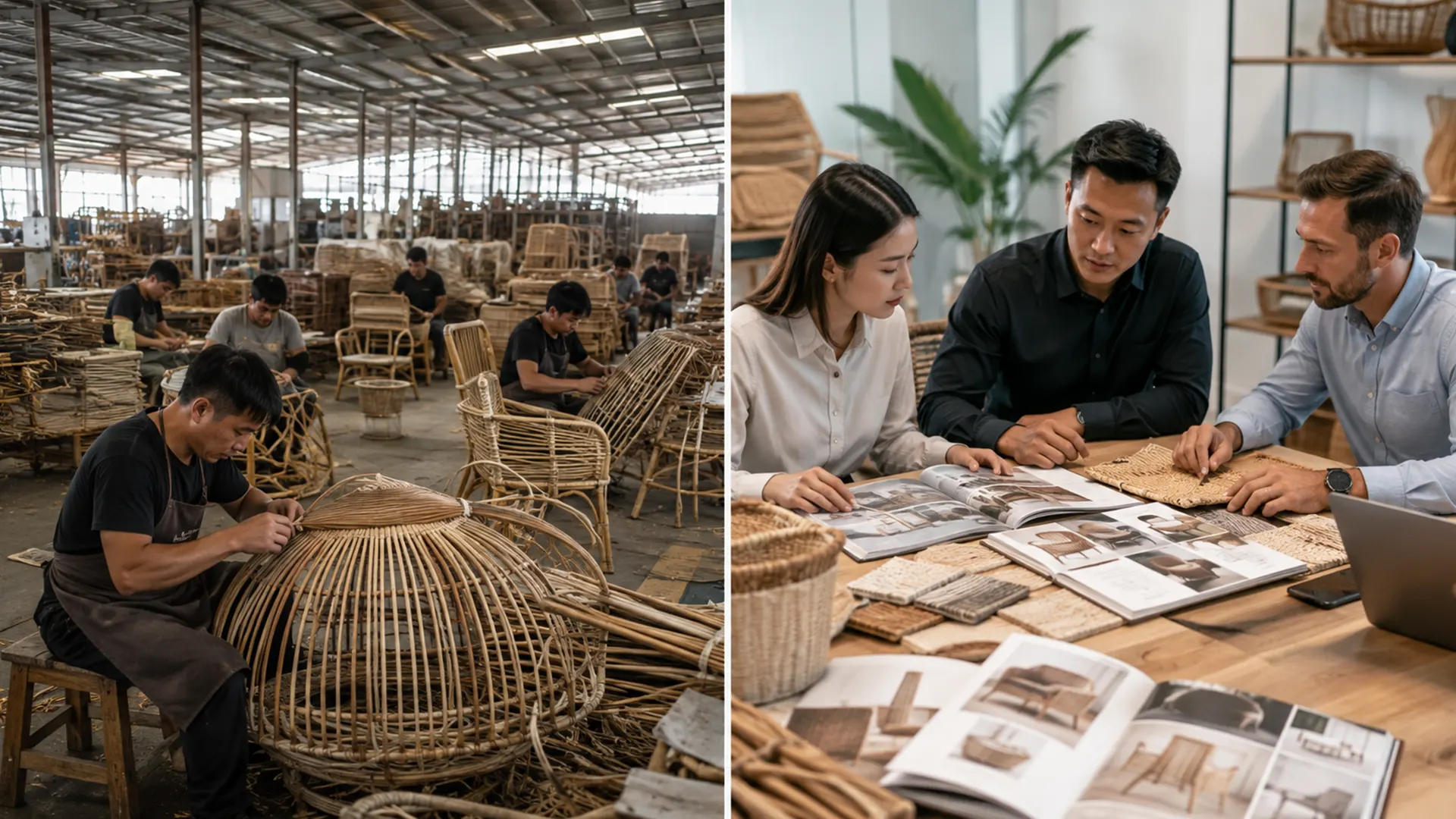
For international rattan buyers, choosing between working directly with a manufacturer and working through a sourcing company is not simply a question of removing a middleman. The two models solve different procurement problems. A capable manufacturer may offer direct technical communication, strong control over production and potentially clearer factory-level pricing. A capable sourcing company may offer access to multiple factories, broader product categories, mixed-container coordination, supplier screening and centralized quality control. Neither model is automatically better for every importer.
The correct choice depends on the buyer's purchasing volume, number of SKUs, product complexity, quality requirements, need for OEM or ODM development, willingness to manage factories directly and ability to coordinate production, inspection, documentation and container loading across multiple suppliers.
International buyers sourcing rattan, bamboo and natural-fibre products from the Vietnam manufacturing and supplier ecosystem should therefore evaluate the commercial structure behind the quotation, not merely the company title printed on a business card.
First Understand The Difference
A manufacturer is a company that produces at least some or all of the goods in its own manufacturing facility or controlled production operation. Depending on its structure, it may manage material preparation, frame production, bending, weaving, finishing, upholstery, assembly, packing and export documentation internally or through selected subcontractors.
A sourcing company does not necessarily manufacture the goods itself. Its role is usually to identify suitable factories, coordinate quotation and product development, manage communication, consolidate orders, supervise quality, organize packing and shipment, and act as the buyer's local procurement interface.
There are also hybrid businesses. A company may own one factory but outsource categories it does not produce. Another may operate as an exporter with long-term partner factories. A third may coordinate village workshops, specialist weaving units and larger export factories. Buyers should therefore verify the real operating model instead of relying only on labels such as “manufacturer,” “factory,” “exporter” or “sourcing agent.”
Manufacturer vs Sourcing Company At A Glance
| Area | Direct Manufacturer | Sourcing Company |
|---|---|---|
| Factory-level communication | Usually direct | Usually managed through sourcing team |
| Product range | Often strongest within defined capabilities | Potentially broader across multiple factories |
| Price structure | Can be more direct | May include service margin or commission |
| Mixed-container coordination | Easy within one factory's range | Potentially stronger across multiple suppliers |
| OEM development | Direct access to technical production team | Can coordinate specialists across factories |
| Quality responsibility | Factory manages its own production QC | Can provide additional independent coordination layer |
| Supplier management burden for buyer | Higher when using several factories | Potentially lower |
| Supply diversification | Limited to factory and subcontractor network | Potentially broader |
| Commercial transparency | Can be very high if relationship is direct | Depends strongly on sourcing-company model |
This comparison is directional rather than universal. An excellent sourcing company can outperform a weak manufacturer, and a disciplined manufacturer can provide a better result than an poorly managed intermediary.
The Main Advantage Of Buying Direct From A Manufacturer
The strongest argument for direct factory sourcing is proximity to production. Buyers can communicate technical requirements directly with the people responsible for making the product.
This can be particularly valuable for:
- Custom furniture
- OEM and ODM development
- Complex finishes
- Structural changes
- Nesting or knock-down engineering
- Packaging optimization
- Repeated long-term programs
When communication works well, fewer layers between buyer and production can reduce misunderstanding.
Direct Factory Pricing Can Be Easier To Understand
A manufacturer may quote its own FOB price without an additional sourcing-company service margin. This can make the commercial structure simpler.
However, buyers should not assume that direct factory purchasing always produces the lowest landed cost. A sourcing company may negotiate larger aggregated volumes, find a more efficient factory, improve packing, reduce defects or combine several categories into a more economical container.
The commercially relevant comparison is therefore total landed cost and operational performance, not only headline FOB.
Manufacturers Often Have Deeper Product-Specific Knowledge
A specialist rattan-chair factory may understand frame bending, chair nesting, weaving tension, finish behavior and carton optimization at a level that a general trading company does not.
That technical depth can become particularly important when a buyer wants to modify:
- Frame dimensions
- Rattan diameter
- Weaving pattern
- Seat construction
- Arm geometry
- Stackability
- KD connections
- Finish colour
- Carton dimensions
Direct Manufacturing Relationships Can Improve Repeatability
Buyers running repeat programs may benefit from building direct relationships with production management, quality staff and export teams. Over time, both sides can establish approved samples, defect criteria, packaging specifications and production procedures.
This institutional knowledge can reduce repeated explanation and improve consistency across orders.
But A Manufacturer Is Usually Limited By Its Own Capabilities
No factory is equally strong in every product category. A manufacturer specializing in dining chairs may not be the best source for storage baskets, large cabinets, lighting or mixed-material furniture.
When buyers try to force too many categories through one factory, that factory may subcontract unfamiliar products. Subcontracting is not automatically a problem, but it should be transparent and controlled.
A Factory Catalogue Does Not Always Mean Factory-Made
Some manufacturers include externally sourced products in their catalogues. Buyers should therefore ask which SKUs are:
- Produced internally
- Partially subcontracted
- Fully subcontracted
- Purchased from partner workshops
The goal is not to reject subcontracting automatically. The goal is to understand who controls production and quality.
Managing Multiple Manufacturers Creates Work For The Buyer
A buyer wanting dining chairs from one factory, baskets from another, tables from a third and decor from a fourth may need to manage:
- Separate quotations
- Different MOQ requirements
- Multiple samples
- Different production schedules
- Separate quality inspections
- Different packing methods
- Multiple payment arrangements
- Container consolidation
- Export documentation
For a sophisticated procurement team this may be manageable. For a smaller importer, it can become operationally heavy.
Where A Sourcing Company Adds Value
A sourcing company can act as a local procurement platform rather than merely a commission-taking intermediary.
A strong sourcing partner may:
- Identify factories by product category
- Compare quotations
- Verify supplier capabilities
- Coordinate samples
- Translate technical requirements
- Track production
- Conduct or coordinate inspections
- Consolidate mixed orders
- Coordinate export packing
- Manage shipment preparation
Access To Multiple Factories Can Be A Major Advantage
Rattan and natural-fibre collections often combine different production capabilities. One supplier may excel at bent-rattan furniture, another at basket weaving, another at timber-and-rattan cabinets and another at upholstery.
A sourcing company with a proven supplier network can allocate each category to the most appropriate producer instead of forcing every product into one factory.
Sourcing Companies Can Be Strong For Mixed Containers
Mixed-container orders are one of the clearest situations where a sourcing company can add operational value.
A buyer may want one 40HC containing:
- Dining chairs
- Lounge chairs
- Tables
- Baskets
- Storage products
- Home decor
If these products come from several factories, someone must coordinate production completion, inbound transport to the consolidation point, final carton quantities, CBM, inspections and loading sequence.
A competent sourcing company can centralize that work.
But Consolidation Is Not Free
Multi-factory consolidation may create additional costs such as domestic transport, temporary warehousing, handling, repacking or coordination fees.
Buyers should ask whether these costs are:
- Included in the quoted FOB price
- Charged separately
- Calculated per shipment
- Based on a percentage or fixed service fee
Commercial transparency matters more than whether a fee exists.
Sourcing Companies Can Reduce Supplier Search Time
International buyers entering a new market may spend significant time identifying credible factories, requesting quotations, comparing technical capability and resolving communication gaps.
An experienced sourcing company may shorten that process if it already understands which producers are appropriate for different categories and order structures.
Supplier Screening Is Valuable Only If It Is Real
A sourcing company should be able to explain how it evaluates factories. Useful screening may include:
- Legal company verification
- Physical factory verification
- Product-category capability
- Production capacity
- Quality systems
- Export experience
- Packaging capability
- Communication performance
A claim such as “we work only with the best factories” has little value without a real qualification process.
Quality Control: Manufacturer Model
When buying directly, the manufacturer normally performs its own production quality control. The buyer may supplement this with its own inspection team or an independent third-party inspector.
This can work extremely well when specifications are clear and the factory has a disciplined quality system.
Buyers should define measurable acceptance criteria within their quality-control and pre-shipment inspection program, including approved samples, dimensions, finish, weaving, stability, moisture condition, packaging and defect classification.
Quality Control: Sourcing Company Model
A sourcing company can create an additional control layer between factory and buyer. It may inspect goods during production, conduct final inspection or coordinate independent inspection.
This can be useful when several factories are involved because one sourcing team can apply a common buyer standard across suppliers.
However, buyers should understand who performs the inspection and who ultimately has authority to approve or reject shipment.
Potential Conflict Of Interest
If a sourcing company earns more when an order ships, buyers may question whether its inspectors are sufficiently independent when defects are found. This does not mean the model is inherently unreliable, but responsibilities should be clearly defined.
For critical orders, buyers may still use independent pre-shipment inspection even when a sourcing company manages day-to-day quality.
Price Transparency Matters In Both Models
Direct factory sourcing does not automatically guarantee complete transparency, and sourcing companies do not automatically hide their margin.
Several commercial models are possible:
- Factory price plus disclosed sourcing commission
- All-inclusive FOB price from sourcing company
- Fixed project management fee
- Percentage-based service fee
- Buyer-paid sourcing retainer
The buyer should understand what services are included and compare the total economic result.
The Cheapest Model Can Become The Most Expensive
Imagine that direct sourcing saves three percent on FOB but creates more defects, inefficient packaging and additional management cost. The apparent saving may disappear.
Conversely, paying a sourcing fee for a simple repeat order from one proven factory may add little value.
The correct question is not “Which model has the lowest margin?” but “Which model produces the lowest total cost and risk for this buying program?”
MOQ Differences
Manufacturers often set MOQ according to production efficiency, raw-material purchasing, finish batches and assembly schedules.
A sourcing company cannot automatically eliminate factory MOQ. However, it may sometimes coordinate several orders or categories in ways that provide greater flexibility.
Buyers should distinguish between:
- MOQ per SKU
- MOQ per colour or finish
- MOQ per material
- Total order MOQ
- Minimum container strategy
Mixed-Container MOQ Can Favor The Sourcing Model
If a buyer wants 20 or 30 SKUs in one container, direct management across several factories may become complex. A sourcing company may be useful if it can negotiate workable quantities and synchronize suppliers.
But the sourcing company should never promise unrealistic MOQ simply to secure the inquiry. Factory production economics still apply.
OEM And ODM Development
Direct manufacturers can be especially strong when the buyer develops a technically complex product that fits the factory's core capability. Engineers and production staff can discuss changes directly.
Sourcing companies can be advantageous when one collection requires different specialist factories. They can coordinate a consistent design language, finish standard and packaging specification across producers.
Sampling
With one manufacturer, sampling is relatively straightforward: develop, revise and approve within the same production organization.
With a sourcing company managing multiple suppliers, the buyer may gain access to wider capabilities but sample coordination becomes more complex. Colour, dimensions and materials need to be standardized across factories.
Approved Samples Must Remain The Reference
Regardless of commercial model, the buyer should maintain an approved reference package consisting of:
- Approved sample or master sample
- Drawings
- Dimensions and tolerances
- Material specification
- Finish standard
- Packaging specification
- Required labels and markings
Communication: Direct Manufacturer
Direct communication can be fast when the factory export team is experienced and technically capable. It can also become difficult if sales staff cannot accurately translate buyer requirements to production.
The buyer should evaluate communication quality rather than assuming direct communication is automatically better.
Communication: Sourcing Company
A strong sourcing company can translate not only language but also procurement intent. For example, it can convert a buyer's request for “better container efficiency” into concrete questions about nesting depth, KD design, carton dimensions and units per 40HC.
A weak intermediary can do the opposite by filtering or distorting technical information.
Responsibility Must Be Clear
One of the biggest risks in multi-party sourcing is unclear accountability.
The buyer should know:
- Who signs the sales contract
- Who receives payment
- Who manufactures the goods
- Who owns the approved specifications
- Who performs quality control
- Who handles corrective action
- Who prepares export documents
- Who is responsible for shipment claims
Who Should Receive The Purchase Order?
There is no universal correct structure. A PO may be placed directly with the manufacturer while the sourcing company charges a separate service fee, or the sourcing company may contract with the buyer and subcontract manufacturing.
The important point is that legal, payment and operational responsibilities match the agreed commercial arrangement.
Payment Risk
Buyers should verify the beneficiary account before making payment regardless of the model.
If bank details change unexpectedly, confirm the change using an established independent communication channel rather than relying only on the new email or message containing the bank instructions.
Export Documentation
Direct manufacturers with experienced export departments may handle commercial invoices, packing lists and shipment coordination effectively.
A sourcing company can be valuable when multiple producers are involved and documentation needs to be consolidated into one export shipment.
Documentation structure should be reviewed within the wider export, Incoterm, freight and container-shipping process.
FOB Management
When one manufacturer loads its own container, FOB responsibility can be relatively straightforward.
With multi-factory consolidation, buyers should clarify:
- Where goods are consolidated
- Who pays domestic transport
- Who controls final loading
- Which company acts as exporter
- How consolidation costs are treated
Container Utilization
A sourcing company can sometimes improve container utilization by combining complementary products from multiple factories. For example, bulky chairs may be combined with nested baskets or compact decor.
A manufacturer may achieve equally good or better loading efficiency when the entire collection falls within its own product range.
What matters is final packed CBM and the loading plan, not the business model alone.
Lead-Time Management
One factory creates one primary production schedule. Multiple factories create several schedules that must align before consolidation.
A sourcing company can coordinate this, but if one supplier is late the entire mixed container may still be delayed.
Buyers should therefore request:
- Production start dates
- Estimated completion by supplier
- Inspection windows
- Consolidation date
- Target container loading date
Supply Diversification
A sourcing company may reduce dependence on one factory by maintaining several qualified alternatives.
This can help when:
- Capacity is full
- A product category is outside one factory's capability
- Lead time becomes unacceptable
- A quality problem requires a backup source
However, moving a product between factories can create variation in dimensions, finish and workmanship. Requalification is still necessary.
Confidentiality And Design Protection
OEM buyers should understand who receives drawings, samples and brand information.
When a sourcing company distributes development information to multiple factories, confidentiality controls should be clear. The same principle applies when a manufacturer uses subcontractors.
When Direct Manufacturer Sourcing Is Usually Strongest
The direct model is often attractive when the buyer:
- Has one or a small number of proven factories
- Buys large repeat volumes
- Has its own sourcing or QC personnel
- Needs deep technical development
- Can manage supplier communication directly
- Has relatively concentrated product categories
- Can organize inspection and logistics independently
When A Sourcing Company Is Usually Strongest
The sourcing-company model is often attractive when the buyer:
- Needs many different product categories
- Wants mixed-container orders from several producers
- Is entering Vietnam for the first time
- Has limited local procurement resources
- Needs supplier screening
- Needs centralized production tracking
- Wants one communication point across factories
- Needs consolidation and coordinated loading
When A Hybrid Model May Be Best
Many experienced buyers do not choose only one model.
They may:
- Buy core high-volume SKUs directly from manufacturers
- Use a sourcing company for secondary categories
- Use sourcing support for supplier discovery but contract directly later
- Use independent QC even when a sourcing company manages production
- Consolidate selected direct-factory orders through a logistics or sourcing partner
A hybrid structure can combine direct control with local coordination.
A Practical Buyer Decision Matrix
| Buyer Situation | Manufacturer Model | Sourcing Company Model |
|---|---|---|
| One proven chair factory, repeat 40HC orders | Often very strong | May add limited value |
| Twenty SKUs across furniture, baskets and decor | Requires several suppliers | Potentially strong |
| Complex custom chair engineering | Strong with specialist factory | Useful if technically capable |
| Buyer has no local sourcing team | More buyer management required | Potentially strong |
| Buyer has experienced Vietnam QC team | Strong | May be optional |
| Multi-factory mixed container | Operationally complex | Potentially very strong |
| Need maximum price transparency | Often easier | Depends on fee model |
| Need broad supplier diversification | Buyer manages network | Potentially easier |
Questions To Ask A Manufacturer
- Which products are made in your own facility?
- Which processes are subcontracted?
- What product categories are your strongest?
- What are your MOQ requirements?
- What is your production capacity for our specific products?
- How do you control quality?
- Can you support OEM, ODM and custom packing?
- How do you calculate 20ft, 40ft and 40HC loading quantities?
Questions To Ask A Sourcing Company
- Do you disclose the actual manufacturing factories?
- How do you qualify suppliers?
- How is your service fee or margin structured?
- Who signs the commercial contract?
- Who receives payment?
- Who performs inspections?
- How do you manage corrective action?
- How do you coordinate mixed-container consolidation?
- Who is responsible if one factory delays the container?
- Can the buyer visit the factories?
Red Flags In The Manufacturer Model
- Refuses to clarify which products are actually made internally
- Claims to manufacture unrelated categories without explanation
- Cannot show production processes for the quoted product
- Provides vague capacity claims
- Cannot explain QC procedures
- Frequently changes payment entities without clear documentation
Red Flags In The Sourcing-Company Model
- Refuses to identify factories without a credible commercial reason
- Will not explain how suppliers are selected
- Cannot explain its fee or commercial role
- Prevents reasonable factory access
- Claims every factory is “exclusive” or “the best” without evidence
- Has no clear inspection or corrective-action process
- Cannot explain who carries contractual responsibility
Transparency Is More Important Than Company Type
A transparent sourcing company that clearly explains factories, fees, inspections and responsibilities may be safer than a company claiming to be a manufacturer while secretly subcontracting most production.
Likewise, a genuine manufacturer with excellent communication and disciplined export management may remove the need for an intermediary entirely.
Do Not Confuse Legal Registration With Manufacturing Capability
A legally registered company may still operate as a trader, exporter, sourcing company or manufacturer. Legal existence should be verified, but factory ownership and production capability require separate verification.
Factory Visits Remain Valuable
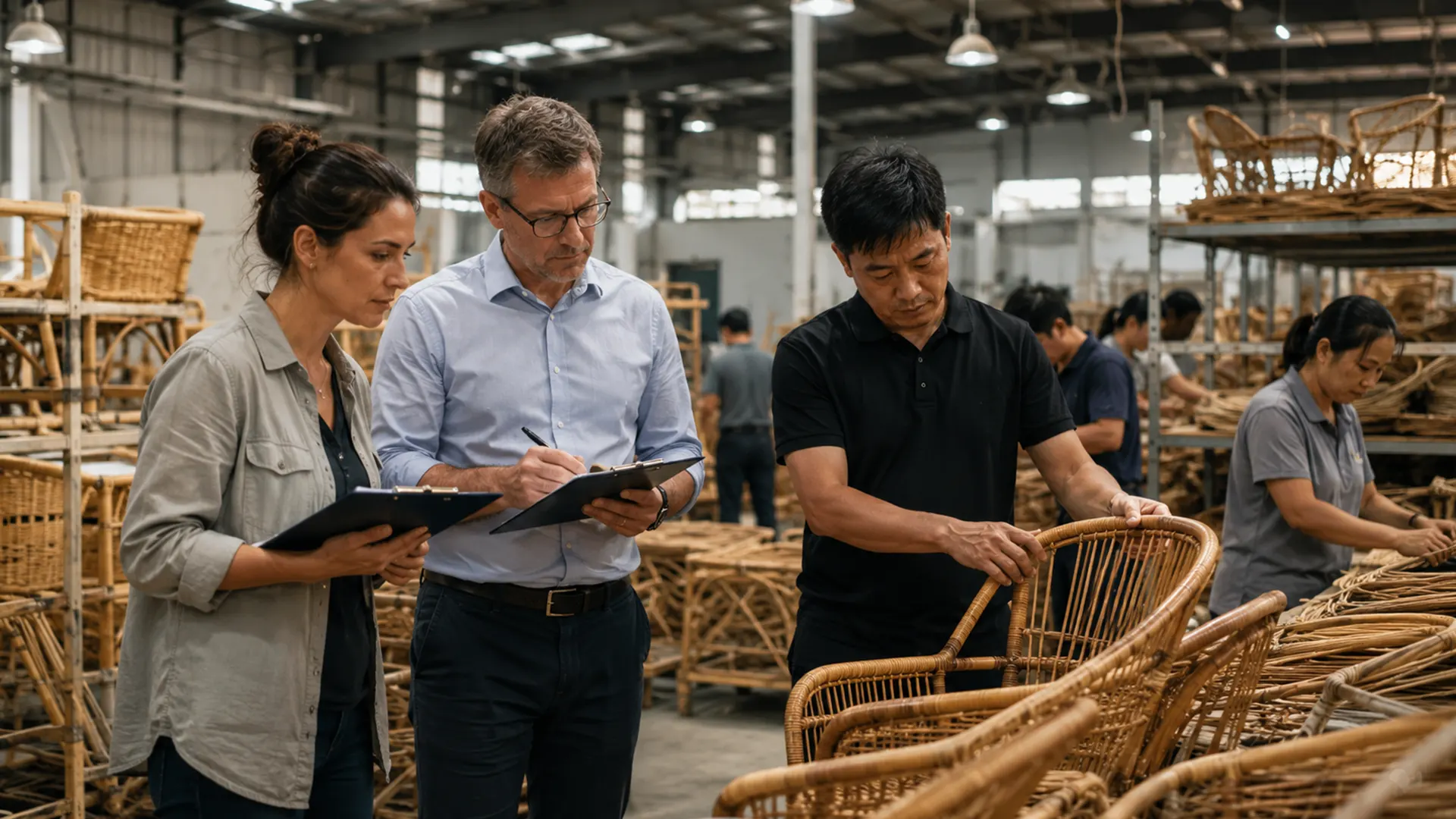
Whether working directly or through a sourcing company, factory visits or credible live-video verification can help buyers understand:
- Production processes
- Material storage
- Work-in-progress
- Finishing areas
- Quality-control stations
- Packing operations
A sourcing company should normally be able to facilitate reasonable factory access when commercial conditions permit.
Common Buyer Mistakes
- Assuming direct factory always means lowest cost
- Assuming sourcing companies are only unnecessary middlemen
- Choosing a model without considering SKU complexity
- Ignoring mixed-container coordination cost
- Accepting hidden subcontracting
- Comparing only FOB price
- Failing to define inspection responsibility
- Failing to verify payment beneficiaries
- Using one factory for categories outside its strengths
- Allowing too many intermediaries between buyer and production
- Failing to document approved specifications
Frequently Asked Questions
Is buying directly from a manufacturer always cheaper?
No. It may reduce intermediary fees, but the buyer must also consider quality, packaging efficiency, management time, consolidation, freight and defects. Total landed cost may favor either model.
Is a sourcing company the same as a trading company?
Not necessarily. A sourcing company may provide supplier identification, technical coordination, quality control and consolidation services. Business models vary and should be verified individually.
Can a sourcing company offer FOB?
Yes, depending on its legal and commercial structure. Buyers should clarify which entity acts as seller or exporter and which costs are included.
Should a sourcing company reveal the factory?
For serious long-term procurement, reasonable factory transparency is generally valuable. Commercial confidentiality may affect how information is shared, but buyers should understand who actually produces the goods.
Is direct sourcing better for OEM?
Often, when one specialist factory can handle the complete product. A sourcing company may be better when an OEM collection requires several different production specialists.
Which model is better for mixed containers?
A sourcing company can be particularly useful when several factories must be synchronized, although experienced buyers can also manage consolidation directly.
Can I use both models?
Yes. Many buyers source core items directly while using sourcing partners for secondary categories, supplier discovery, inspection or consolidation.
The Best Model Is The One That Gives The Buyer Control
The manufacturer-versus-sourcing-company decision should not be ideological. International rattan procurement works best when the buyer has clear visibility into who manufactures the goods, how prices are built, how quality is controlled, how specifications are communicated and who is accountable when something goes wrong.
Direct manufacturers can provide excellent technical depth, pricing clarity and long-term production relationships. Sourcing companies can provide valuable supplier access, multi-factory coordination, mixed-container management and local procurement support. The better model depends on the structure of the buying program.
For a simple repeat order from one proven specialist factory, direct sourcing may be the most efficient route. For a broad collection involving furniture, baskets, storage and decor from several production specialists, a transparent sourcing company may reduce complexity significantly. In many professional procurement programs, the strongest answer is a carefully designed hybrid model.
If you are evaluating manufacturers, sourcing companies or a mixed supplier structure for container-based rattan, bamboo or natural-fibre purchasing, send your wholesale RFQ, product categories, target quantities and container requirements so the sourcing structure can be evaluated together with pricing, supplier capability, quality control and shipment planning.