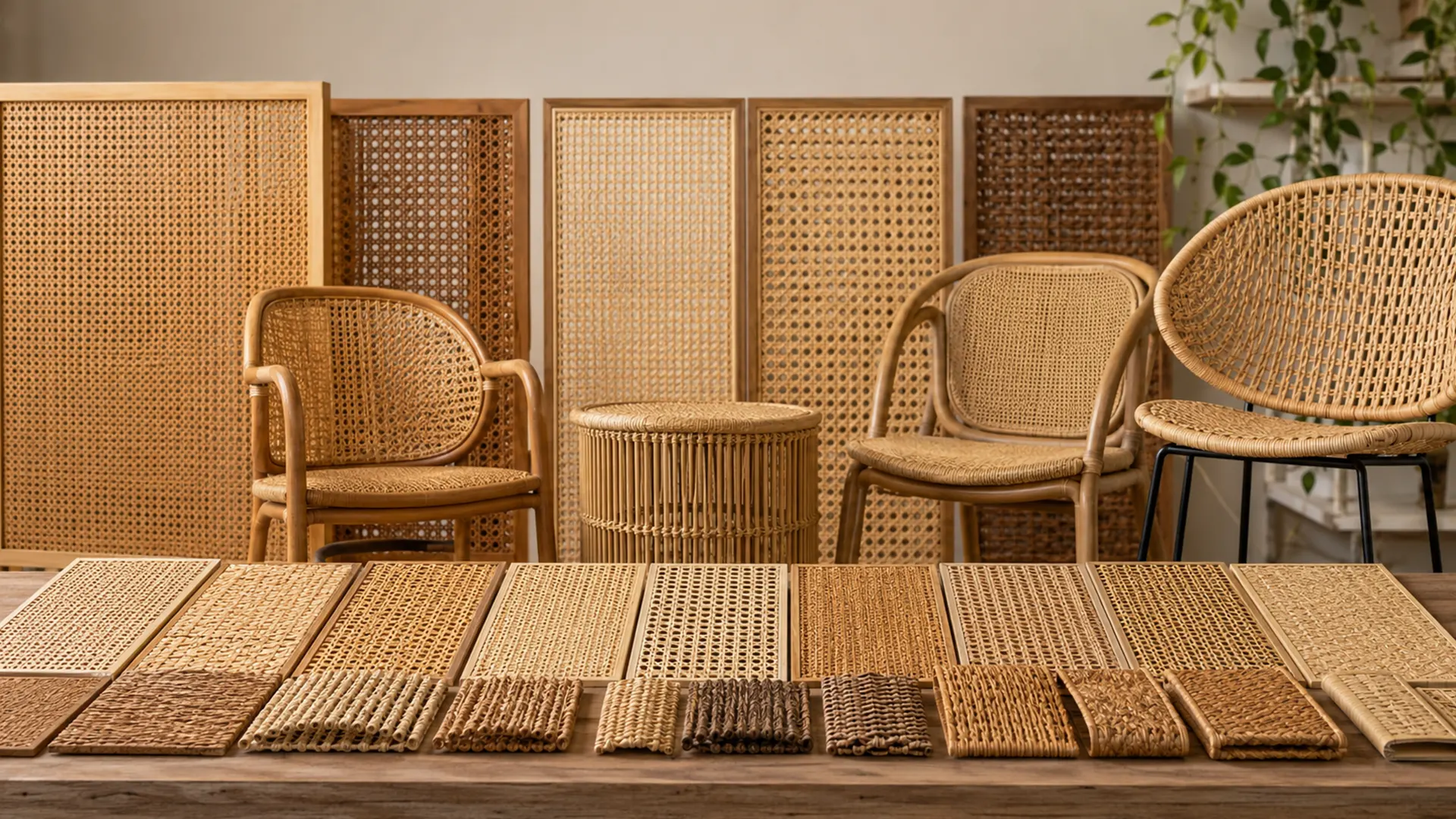
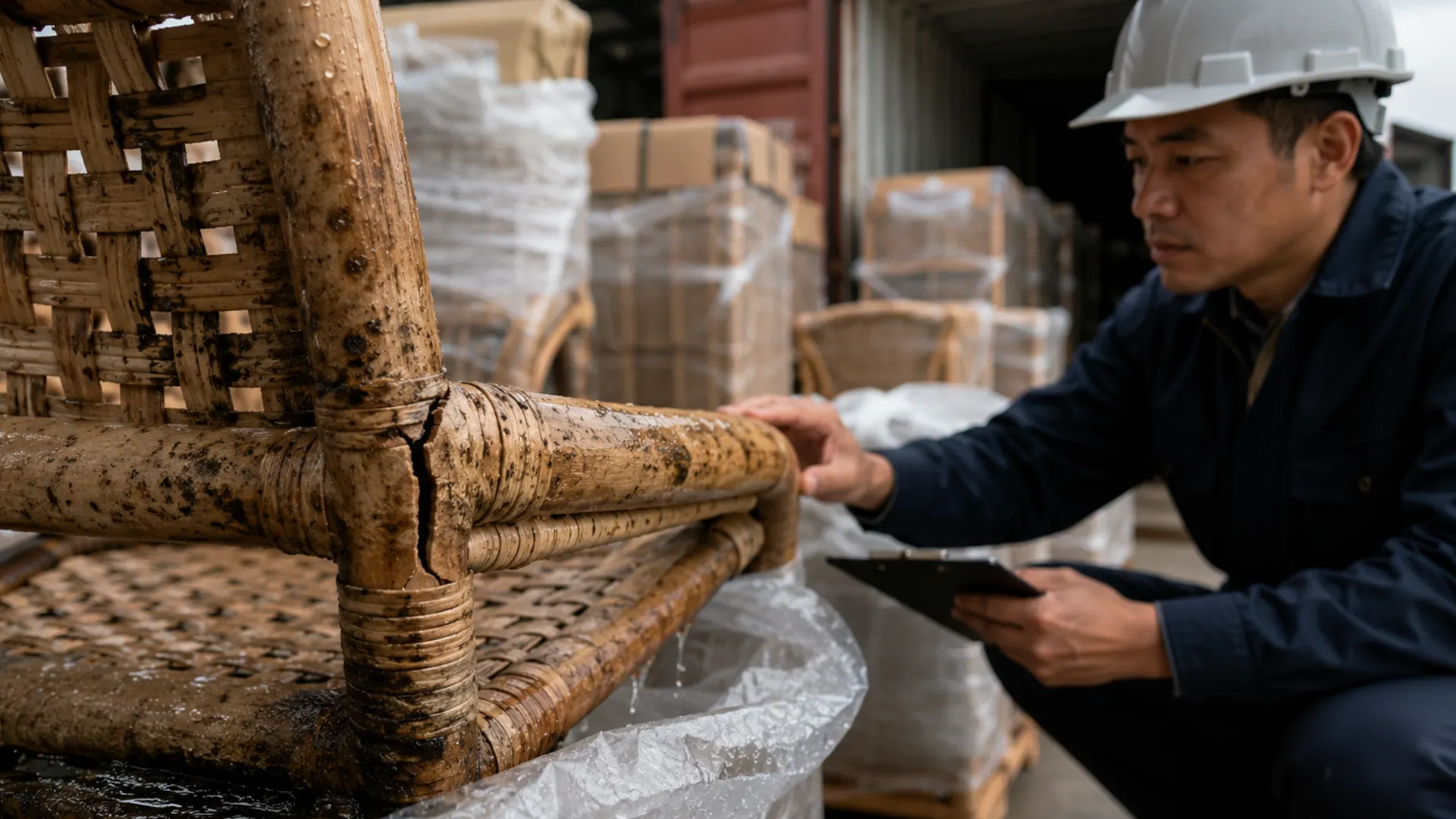
 Rattan Export buyer guide: Moisture, Mold And Cracking: Major Risks In Rattan Furniture Exports.
Moisture, mold and cracking are among the most commercially serious risks in rattan, bamboo and natural-fibre furniture exports. They can affect appearance, structural integrity, packaging, customer acceptance and the resale value of an entire shipment. For importers, wholesalers, distributors, retail chains, hospitality buyers and project procurement teams, these problems should not be treated as random defects discovered after arrival. They are supply-chain risks that should be controlled from raw-material preparation through production, finishing, storage, export packing, container loading and ocean transit.
Natural rattan is hygroscopic, which means it can exchange moisture with the surrounding environment. Bamboo, timber and other plant-based components behave similarly to varying degrees. If materials are too wet, finished products may become vulnerable to mold, staining, odor, finish failure or dimensional movement. If drying is too aggressive or uneven, cracking, splitting, distortion and joint problems may appear. The buyer therefore needs a balanced moisture-control strategy rather than a simplistic instruction to make the product “as dry as possible.”
This guide explains how moisture enters the export process, why mold develops, how cracking occurs, which warning signs importers should monitor and how professional buyers can build practical preventive controls into 20ft, 40ft, 40HC, mixed-container, OEM, ODM, private-label and project furniture programs.
Why Natural Rattan Furniture Is Sensitive To Moisture
Rattan originates from a natural plant structure containing fibres and cellular material that react to surrounding humidity. Even after processing, the material does not behave like an inert plastic or metal component. It can absorb or release moisture depending on environmental conditions.
This is not automatically a defect. Natural materials always contain some environmental responsiveness. The commercial risk arises when moisture conditions are uncontrolled or when different parts of the product move at different rates.
A rattan chair, for example, may combine large frame members, thinner binding material, woven strands, wooden reinforcement, steel hardware, adhesives, coatings and cushions. Each component responds differently to moisture, drying and temperature. A stable export product therefore depends on the whole construction system, not only on the rattan itself.
The Three Risks Are Connected But Not Identical
Moisture, mold and cracking are often discussed together, but buyers should distinguish them.
- Moisture is a condition. It may come from raw material, humid production areas, wet floors, rain exposure, finishing processes, storage, packaging or condensation.
- Mold is biological growth that may develop when environmental conditions support it. Excess moisture is a major enabling factor, but surface contamination, temperature, airflow and time also matter.
- Cracking is a physical failure that can result from material stress, rapid drying, uneven drying, poor bending, unsuitable material selection, structural design or environmental change.
Reducing one risk does not automatically eliminate the others. Over-drying a material in an attempt to avoid mold can create cracking or distortion if the drying process is poorly controlled.
Risk Stage 1: Raw-Material Receiving
Moisture control should begin when raw rattan, bamboo or timber enters the production facility. If unsuitable material is accepted into production, later inspection may only discover the problem after substantial labour has already been invested.
Buyer or factory controls can include:
- Visual inspection for mold or mildew
- Checking for excessive staining
- Checking splits and existing cracks
- Looking for insect damage or deterioration
- Reviewing material dimensions and consistency
- Checking storage history where available
- Moisture measurement where part of the agreed specification
A supplier should also separate obviously compromised material rather than mixing it into general production stock.
Risk Stage 2: Raw-Material Storage
Good material can deteriorate if storage conditions are poor. Rattan and bamboo stored directly on damp floors, against wet walls or under leaking roofs may absorb moisture before production begins.
Professional storage practices can include keeping material elevated from floors, separating it from exterior walls, allowing appropriate airflow, protecting it from rain and monitoring obvious humidity or condensation problems.
Importers evaluating suppliers in Vietnam can include storage practices when reviewing the broader Vietnam sourcing and natural-material production environment. However, regional reputation should never replace factory-level verification.
Risk Stage 3: Material Preparation And Drying
Drying is not simply a matter of reducing a number on a moisture meter. The process should prepare material for stable production and the expected destination environment.
Problems may develop when:
- Material is processed before sufficiently stabilized
- Outer surfaces dry much faster than internal material
- Heat is excessive
- Drying is too rapid
- Material bundles are packed too tightly for airflow
- Different material thicknesses are treated identically
- Material is dried and then re-exposed to high humidity before production
There is no single moisture-content figure that should be treated as universally correct for every rattan product. The appropriate range depends on species or material type, component thickness, construction, destination, finishing system and buyer requirements. Buyers should therefore avoid copying a generic number into every RFQ without technical justification.
Why Over-Drying Can Be A Problem
Importers sometimes assume that the driest possible material must be the safest. This can be misleading. Excessive or aggressive drying may increase internal stress and contribute to cracking, splitting, distortion or difficult assembly.
The real objective is stable material appropriate for the product and the conditions it will experience. Supplier drying procedures should therefore be evaluated as a process rather than judged from one isolated measurement.
Risk Stage 4: Bending And Frame Formation
Many rattan frames rely on bending. The material may be conditioned to allow shaping, then stabilized afterward. This creates another moisture-management stage.
Inspectors should look for:
- Hairline cracks at bends
- Flattened sections
- Crushed fibres
- Burning or heat marks
- Asymmetrical curves
- Splitting near fasteners or joints
A frame may look acceptable immediately after bending but develop cracking later if residual stress remains or if the product moves significantly during drying and finishing.
Risk Stage 5: Weaving Materials
Thin weaving strands can react to moisture more quickly than thick structural members. If weaving is applied under one condition and later dries or absorbs moisture significantly, tension may change.
Potential problems include:
- Loose weaving
- Over-tight weaving
- Broken strands
- Warping of woven panels
- Gaps developing between strands
- Binding loosening around joints
The buyer should therefore inspect weaving tension and consistency after the product has progressed through finishing and stabilization, not only immediately after weaving.
Risk Stage 6: Adhesives And Mixed Materials
Modern rattan furniture may include adhesives, plywood, solid timber, engineered panels, foam, fabric, steel and aluminium. Moisture-related failures can occur where these materials meet.
Examples include veneer movement, adhesive failure, rust staining from unsuitable hardware, cushion odor, panel swelling or joint movement caused by different expansion and contraction behaviour.
This is one reason quality control should assess the complete bill of materials rather than treating “rattan furniture” as one homogeneous material category.
Risk Stage 7: Finishing
Stains, paints, clear coatings and other finishes can change how moisture moves through the surface. Finishing also introduces liquids and drying time into the manufacturing process.
Potential problems include:
- Coating applied before the material is sufficiently stable
- Uneven drying between coated and uncoated surfaces
- Trapped moisture
- Blistering
- Cloudy coating
- Poor adhesion
- Uneven stain absorption
- Finish cracking when the underlying material moves
The buyer should confirm that the supplier allows appropriate curing and stabilization before packing.
Do Not Pack Immediately After Finishing Without Control
A furniture piece that feels dry to the touch may not necessarily be ready for sealed export packaging. Finishes, adhesives and internal components may still be releasing moisture or solvents.
Packing too early can create an enclosed microenvironment inside the carton. If airflow is restricted and moisture remains elevated, odor, finish marking or mold risk may increase during storage and transit.
Risk Stage 8: Finished-Goods Storage
Finished furniture can absorb moisture again after production. A product may leave the finishing area in acceptable condition and then spend days or weeks in a humid warehouse waiting for the rest of a mixed-container order.
Inspectors should look at:
- Warehouse floor condition
- Distance from exterior walls
- Roof leaks
- Ventilation
- Rain exposure during movement
- How cartons are stacked
- Whether finished products remain packed for long periods
Mixed-container programs deserve special attention because the first SKU completed may wait significantly longer than the final SKU.
How Mold Develops
Mold is not created simply because a product travels through a tropical country. Mold risk increases when sufficient moisture, suitable temperature, biological material, contamination and time combine in favourable conditions.
Natural rattan, bamboo, wood, paper cartons and certain packaging materials can provide surfaces on which mold may develop. Poor airflow and enclosed packaging can make the problem more serious.
The objective of a mold-prevention program is therefore to control the environment throughout the process rather than relying on one chemical treatment or one final moisture reading.
Visible Mold Is Not The Only Warning Sign
Buyers should also take seriously:
- Musty odor
- Unusual spotting
- Grey, white, green or dark surface growth
- Damp cartons
- Condensation marks
- Staining around bindings or joints
- Finish haze or surface cloudiness
Not every discoloration is mold, especially with natural fibres, so questionable findings should be investigated rather than automatically classified without evidence.
Why Mold Can Become A Container-Level Loss
Mold does not need to affect every piece to create a serious commercial problem. An importer may face customer rejection, retailer claims, warehouse segregation, cleaning cost, reinspection, destruction or reputational damage if a shipment arrives with visible biological growth or strong odor.
Because furniture is bulky, reworking a full container after destination arrival can be significantly more expensive than correcting problems at origin.
Cracking: Why It Happens
Cracking may be caused by several interacting factors:
- Material already damaged before production
- Rapid moisture loss
- Uneven moisture distribution
- Incorrect bending process
- Excessive mechanical stress
- Poor joint design
- Fasteners installed too close to vulnerable areas
- Environmental change after production
- Material thickness inconsistent with the design
Cracking can be immediate or delayed. This is why sample approval alone does not guarantee that mass production will remain stable after packing and shipment.
Hairline Cracks vs Structural Cracks
Not every small surface mark has the same commercial importance. Buyers should classify cracks according to location, size, depth and effect.
An illustrative classification might include:
| Condition | Possible Assessment |
|---|---|
| Minor superficial mark in a non-structural area | May be cosmetic depending on approved natural appearance |
| Visible crack at a bend | Requires closer evaluation because stress may continue |
| Split through a structural frame member | Likely major or potentially critical depending on product use |
| Crack around a screw or joint | May indicate structural stress or poor fastening method |
| Multiple repeated cracks across production | Possible systemic material or process issue |
These examples are illustrative only. Defect classification should be defined for each product and risk profile.
Cracking Can Continue After Shipment
One of the most important importer risks is delayed movement. A product can pass factory inspection and still crack later as it acclimatizes to a different environment.
This possibility is especially relevant when goods move from a humid production environment to a much drier destination or heated indoor environment. Good material preparation and stable construction reduce the risk but cannot turn natural material into a completely dimensionally inert substance.
Risk Stage 9: Export Packaging
Packaging has to protect furniture physically while also supporting sensible moisture management. Excessively sealed packaging around insufficiently stabilized products can create problems, while inadequate packaging can expose furniture to changing humidity or water.
Buyers should review:
- Carton condition
- Plastic wrapping strategy
- Surface protection
- Ventilation where relevant
- Moisture-control materials where specified
- Separation between product and damp surfaces
- Packaging timing after finishing
The correct packaging approach depends on product design, finish, transit route, destination and distribution model. Buyers should avoid universal packaging formulas.
Desiccants Are Not A Substitute For Dry Products
Moisture-control materials can be useful in some export programs, but they should not be used to compensate for furniture that was packed excessively wet or for a leaking container.
The amount, placement and type of moisture-control material should be based on the actual shipment and packaging system. More is not automatically better.
Risk Stage 10: Container Condition
Before loading, the container itself should be inspected. A high-quality furniture shipment should not be placed into a container showing obvious water ingress or unsuitable internal conditions simply to avoid a shipping delay.
Typical checks include:
- Interior cleanliness
- Visible holes or daylight penetration
- Wet flooring
- Roof or wall damage
- Strong abnormal odor
- Door condition
- Evidence of previous water ingress
Container preparation and loading should be incorporated into the broader export and container-shipping process.
Container Rain And Condensation
During ocean transport, temperature changes can contribute to condensation inside containers. Moisture can move between cargo, packaging and the container environment as temperatures change during day-night cycles and geographic transit.
This is sometimes described using terms such as container rain or container sweat. The practical implication for buyers is that cargo should enter the container in stable condition, packaging should be appropriate and obvious moisture sources should be minimized before sealing.
Do Not Confuse Condensation Risk With A Single Climate
Condensation is not only a “tropical export” issue. It can occur whenever temperature and moisture conditions create condensation within the closed container environment.
The complete route, season, destination and cargo condition should be considered.
Risk Stage 11: Container Loading
Poor loading can also contribute indirectly to cracking. Furniture forced tightly into inappropriate positions may be stressed during transit. Heavy cartons placed on weaker products can distort frames or create pressure points.
Loading supervision should check:
- Correct carton orientation
- Reasonable stacking
- No excessive crushing pressure
- Protection from container walls where necessary
- No visibly damp cartons
- Final container condition before sealing
- Container seal number
Risk Stage 12: Destination Handling
Risk management does not end when the vessel arrives. Goods can encounter very different humidity and temperature conditions during customs clearance, inland transport and warehouse storage.
Importers should avoid storing natural-material furniture in persistently damp facilities and should consider acclimatization where product design or local climate makes it relevant.
Build Moisture Requirements Into The RFQ
Moisture control should be discussed before price confirmation rather than introduced after the purchase order.
An RFQ may include requirements concerning:
- Material preparation
- Moisture measurement method where required
- Inspection stage
- Storage expectations
- Visible mold acceptance criteria
- Packaging method
- Container inspection
- Pre-shipment verification
The requirement should be technically realistic and agreed with the supplier rather than copied blindly from another product category.
Pre-Production Sample Evaluation
Sample review should include more than appearance. Buyers should inspect bends, joints, weaving tension, finish, hardware locations and any areas likely to crack after movement.
If a sample shows early cracking, repair marks or unstable binding, mass production should not begin until the cause is understood.
In-Process Inspection
For new suppliers, complex products or large orders, in-process inspection can identify moisture and cracking problems before they spread across the full production batch.
Useful checks include:
- Raw-material condition
- Frame cracking during bending
- Joint stress
- Weaving condition
- Storage practices
- Finish preparation
- Recurring defects by production team
Finding a systemic problem when 20% or 30% of production is complete is usually more manageable than discovering it after all goods are packed.
Pre-Shipment Inspection
Pre-shipment inspection should include direct checks for moisture-related and cracking risks before release.
A practical checklist can include:
- No visible mold
- No abnormal musty odor
- No damp cartons
- No significant cracks
- No repeated splitting at bends
- Bindings remain secure
- Weaving tension remains acceptable
- Finish has cured appropriately
- Required moisture measurements completed
- Packaging matches approved specification
The inspection criteria should be integrated into the buyer's wider quality-control and pre-shipment inspection framework.
Moisture Meter Readings: Useful But Not Magical
Moisture meters can provide useful data when the correct instrument, material setting, calibration method and test location are appropriate. However, one reading should not be treated as definitive proof that an entire container is safe.
Results can vary according to material species, thickness, surface finish, meter technology and test location. Buyers should define how measurements will be performed if readings form part of acceptance criteria.
Create A Measurement Procedure
A professional procedure may specify:
- Which components are measured
- How many units are checked
- Where on the product readings are taken
- Which instrument is used
- How results are recorded
- What happens if readings exceed agreed limits
The exact procedure should reflect the product rather than attempting to create one universal rule.
Quality-Control Responsibility
Moisture and mold control should not belong to only one person at the end of production. Responsibility can be distributed across purchasing, production, warehouse, QC, packaging and logistics teams.
The importer should know who has authority to stop packing or loading if conditions are unsuitable.
Supplier Questions Importers Should Ask
- How are raw rattan and bamboo stored?
- How is material dried or stabilized before production?
- Which stages include moisture checks?
- How do you prevent mold in finished goods?
- How long is allowed between finishing and packing?
- How are goods stored while waiting for container loading?
- What packaging is used for long ocean transit?
- How do you inspect the container before loading?
- How are cracked frame components handled?
- What corrective action is taken if mold is discovered?
Red Flags During Factory Evaluation
- Raw material directly on damp floors
- Visible mold in storage
- Strong musty warehouse odor
- Leaks or obvious rain exposure
- Finished products packed immediately after wet finishing processes
- Repeated frame cracks treated only with cosmetic repair
- No documented separation of rejected material
- Supplier refuses reasonable moisture-related inspection
- Damp cartons waiting for loading
- Visible condensation or water inside the proposed container
One observation does not automatically prove the supplier is unsuitable, but repeated unresolved conditions deserve serious attention.
Corrective Action For Mold
If mold is found before shipment, the correct response depends on severity, product materials, finish, affected quantity and buyer requirements. Simply wiping the visible surface may not address the root cause.
Corrective action may require segregation, investigation of moisture source, cleaning or rework using an agreed method, drying or stabilization, packaging replacement and reinspection before shipment approval.
For serious or widespread contamination, buyers should avoid approving shipment until the commercial and technical risk has been properly evaluated.
Corrective Action For Cracking
Cracking should also be treated according to cause rather than cosmetically hidden. Repeated cracks in the same location may indicate poor material selection, unsuitable drilling, excessive fastening pressure, incorrect bending or structural design weakness.
If the defect is systemic, replacing only visibly cracked pieces may not solve the problem. Production method or component design may need revision.
Why Cosmetic Repairs Can Be Dangerous
Filler, stain or wrapping can sometimes hide a crack visually. If the underlying structural stress remains, the defect may reopen after shipment. Buyers should therefore distinguish legitimate finishing repair from repair that conceals structural failure.
Mixed Containers Create Additional Risk
Mixed-container programs can extend the total production and storage period because several SKUs must be completed before consolidation. Early-completed products may sit in storage significantly longer than later products.
Buyer planning should therefore consider:
- Production sequence
- Storage duration by SKU
- Packaging timing
- Final moisture and mold inspection of early-completed goods
- Whether cartons need to be reopened for reinspection before loading
OEM And New Product Development
New OEM designs can carry more cracking risk than established repeat products because frame geometry, bending radius, fastener locations and material thickness may not yet be fully proven.
Prototype and pre-production samples should therefore be evaluated after reasonable stabilization rather than approved immediately after manufacture.
Hospitality And Project Furniture
For hotel, resort and commercial project orders, moisture or cracking problems can be particularly disruptive because replacement products may need to match existing rooms or installation schedules.
Project buyers should establish spare-parts or replacement procedures where appropriate and maintain clear records of approved finish, material and dimensions for future replacement production.
A Practical Risk-Control Matrix
| Stage | Main Risk | Buyer Control |
|---|---|---|
| Raw material | High moisture, existing mold, cracks | Incoming inspection and material segregation |
| Storage | Reabsorption of moisture | Dry, elevated, ventilated storage |
| Drying | Under-drying or over-drying | Controlled stabilization procedure |
| Bending | Stress cracks and crushing | Frame inspection during production |
| Weaving | Loose or broken strands after movement | Post-stabilization weaving inspection |
| Finishing | Trapped moisture and coating failure | Curing and stabilization control |
| Warehouse | Humidity exposure before shipment | Finished-goods storage inspection |
| Packaging | Moisture trapped inside cartons | Controlled packing timing and specification |
| Container | Water ingress or condensation risk | Container inspection and appropriate moisture management |
| Loading | Frame stress and damp cargo loaded | Loading supervision |
| Transit | Condensation and environmental changes | Stable cargo and appropriate export packing |
| Destination | Acclimatization and damp storage | Suitable warehouse and handling procedures |
Common Importer Mistakes
- Checking moisture only on the day of shipment
- Using one universal moisture number for every product
- Assuming desiccants can fix wet furniture
- Packing immediately after finishing
- Ignoring raw-material storage
- Accepting cosmetic repair of recurring cracks
- Ignoring musty odor because visible mold is absent
- Loading into a visibly wet container because the vessel cutoff is near
- Failing to reinspect early-produced SKUs in mixed-container programs
- Assuming tropical sourcing automatically means mold is unavoidable
- Assuming the driest possible material is always safest
- Failing to document corrective action after repeated defects
Frequently Asked Questions
What moisture level should rattan furniture have before shipment?
There is no single universal number suitable for every rattan product. The appropriate target depends on material, component thickness, construction, finish, destination environment and buyer specification. The measurement method should also be defined.
Can mold develop inside a sealed carton?
Yes, if conditions inside the packaging support growth. Packing insufficiently stabilized furniture into a closed environment can increase risk, particularly during long storage or transit.
Can desiccants prevent all mold?
No. Moisture-control materials may be useful when properly specified, but they do not replace correct material preparation, dry storage, appropriate packaging or a suitable container.
Why does rattan crack after delivery?
Possible causes include residual stress, rapid environmental change, unsuitable drying, poor bending, weak material, joint design or dimensional movement after acclimatization.
Should buyers reject every hairline crack?
Not necessarily. Crack classification should consider location, depth, structural significance and the approved natural appearance. Structural or repeated cracking requires much greater concern than a minor superficial mark.
Is mold mainly a Vietnam problem?
No. Mold risk is related to moisture, storage, production, packaging and environmental conditions, not nationality. Natural-material furniture from any sourcing country requires appropriate controls.
When should moisture be inspected?
For higher-risk programs, controls may be appropriate at raw-material receiving, during production, before packing and before container loading rather than only at final inspection.
Moisture Management Should Be Designed Into The Order
The most reliable way to control moisture, mold and cracking is not to search for problems only when the goods are ready to ship. Buyers should define expectations before production, verify supplier practices, inspect materials and processes, allow proper stabilization, confirm packaging and check container conditions before release.
Natural rattan will always retain the characteristics of a natural material, including some normal variation and environmental response. Professional quality control does not attempt to remove those characteristics. It aims to prevent uncontrolled moisture, biological growth, structural cracking and avoidable commercial loss.
If you are preparing a 20ft, 40ft, 40HC, mixed-container, OEM, ODM, private-label or project order for rattan, bamboo or natural-fibre furniture from Vietnam, send your wholesale RFQ, product specifications and moisture-control requirements so the sourcing and export program can be evaluated before production begins.