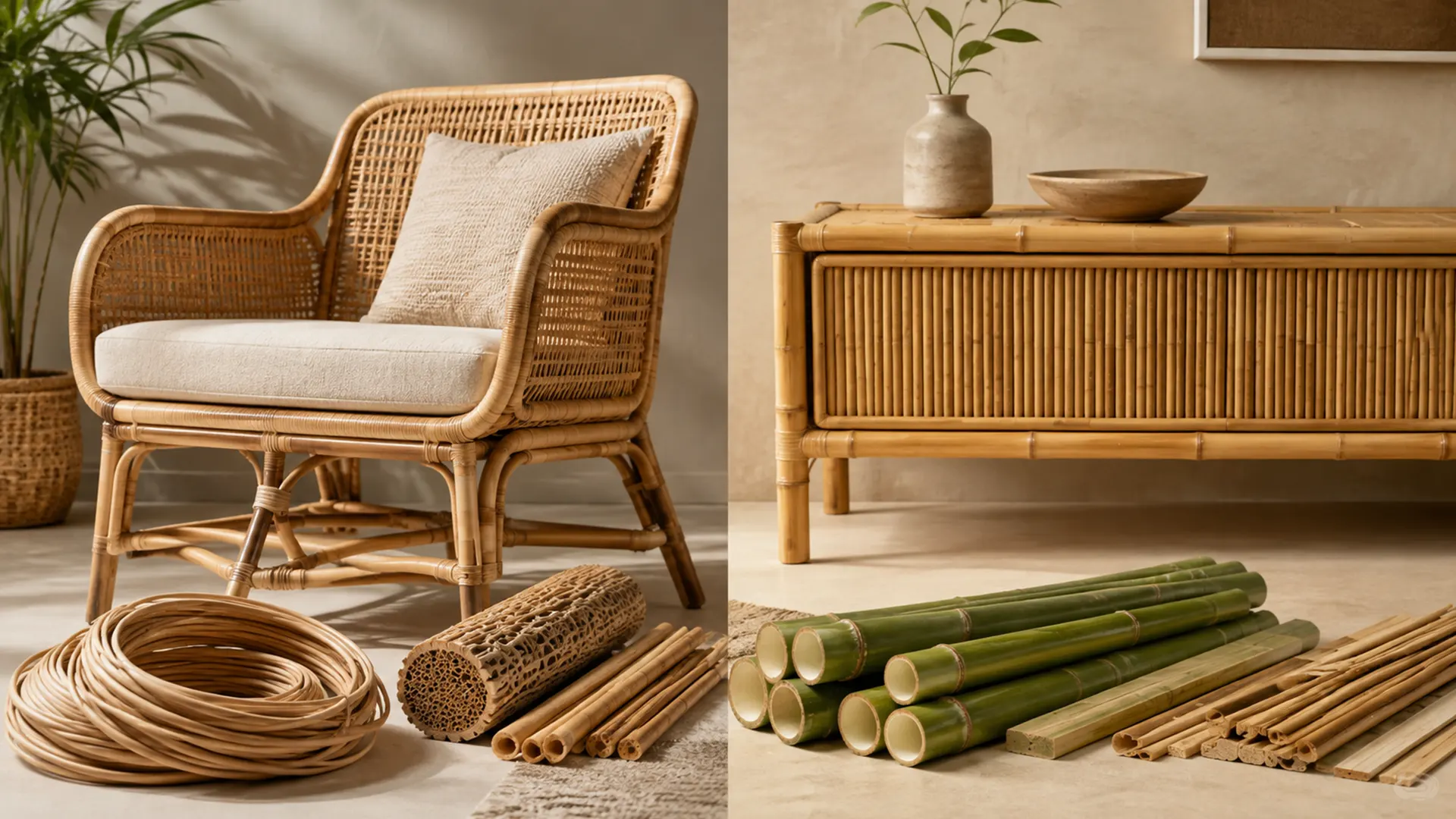
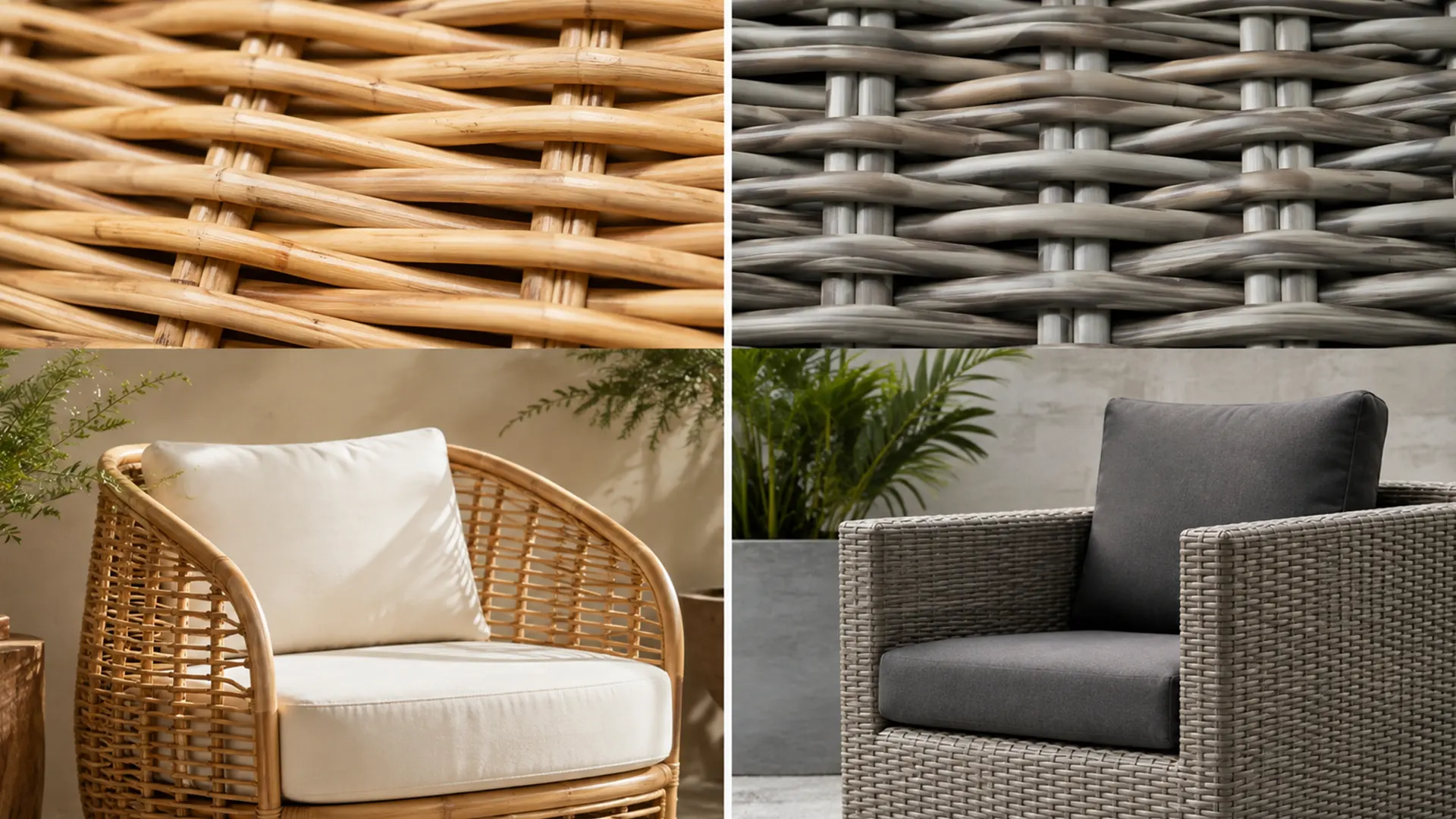
 Rattan Export buyer guide: Natural Rattan vs Synthetic PE Rattan: A Buyer's Guide.
Natural rattan and synthetic PE rattan are often grouped together because both can be used to create woven furniture with a similar visual language. For professional buyers, however, they are two fundamentally different material systems. Natural rattan is a plant-based material traditionally used for frames, bindings and weaving, while PE rattan is a synthetic polyethylene-based weaving material generally applied over a separate structural frame, often metal. The two options differ in appearance, environmental suitability, structure, manufacturing process, quality-control priorities, maintenance, packaging and commercial positioning.
For importers, wholesalers, distributors, retail chains, hospitality buyers and project procurement teams, the right question is not simply whether natural or synthetic rattan is “better.” The better question is which material system fits the intended product, market, usage environment, target price, design language and after-sales expectations.
Vietnam has production capabilities across natural-fibre furniture, woven furniture and mixed-material manufacturing, but supplier capability should always be verified at company level. Buyers evaluating manufacturers within the Vietnam furniture and natural-fibre production ecosystem should therefore specify from the beginning whether they require genuine natural rattan, synthetic PE weaving or a combination of materials.
What Is Natural Rattan?
Natural rattan is a climbing palm material used in furniture and handicraft production. Depending on the product, different parts or processed forms of rattan may be used for structural frames, bindings, decorative wrapping or weaving.
Natural rattan furniture is valued for:
- Organic appearance
- Natural variation
- Warm tactile character
- Handcrafted visual quality
- Ability to form curved furniture structures
It should not be treated as a perfectly uniform industrial material. Diameter, colour, nodes, surface character and bending behaviour naturally vary.
What Is Synthetic PE Rattan?
Synthetic PE rattan is a man-made polyethylene-based weaving material designed to imitate the appearance of natural woven fibres. It is commonly manufactured as strips, cords or profiles and woven over a separate support frame.
PE rattan is usually associated with:
- Woven outdoor-style furniture
- Metal-framed seating
- Dining sets
- Loungers
- Modular sofas
- Hospitality and garden furniture
The quality of synthetic rattan furniture depends not only on the visible weave but also on the formulation and quality of the weaving material, frame, joints, coating, hardware, cushions and overall construction.
1. The Structural Systems Are Usually Different
Traditional natural rattan furniture may use natural rattan itself as a structural frame material. Synthetic PE rattan, by contrast, is normally a weaving surface rather than the principal structural material.
A typical synthetic woven chair may contain:
- Metal frame
- PE weaving
- Welded joints
- Powder-coated or otherwise treated frame surface
- Hardware
- Cushions
This distinction matters because a buyer should not evaluate a PE rattan product by looking only at the weave. The hidden frame is a major part of product quality.
2. Natural Rattan Has A More Organic Visual Character
Natural rattan shows genuine material variation in:
- Colour tone
- Node appearance
- Diameter
- Surface markings
- Curvature
For many brands, this is part of the appeal. The product can feel warmer, more artisanal and less industrial.
However, buyers must define what level of natural variation is commercially acceptable. “Natural material” should not become an excuse for poor workmanship, severe colour inconsistency, structural cracking or uncontrolled defects.
3. PE Rattan Can Offer More Controlled Visual Uniformity
Synthetic weaving can usually be produced with more consistent:
- Profile dimensions
- Colour
- Surface texture
- Weaving input material
This can be useful for retail programs that require a more uniform appearance across large production quantities.
Uniformity still depends on supplier control. Different production batches of synthetic material may vary, and weaving workmanship can still differ between workers.
4. Natural Rattan And Outdoor Use Require Careful Distinction
Natural rattan should not automatically be assumed suitable for prolonged outdoor exposure. Moisture, repeated wetting, strong sunlight, temperature changes and poor drying conditions can affect natural material over time.
A darker stain or additional topcoat does not automatically convert indoor natural-rattan furniture into permanent outdoor furniture.
Buyers should state the intended environment clearly during product development.
5. PE Rattan Is Commonly Chosen For Outdoor-Oriented Programs
Synthetic PE weaving is widely used where buyers need furniture intended for terraces, gardens, poolside areas or other outdoor-oriented applications. However, “PE rattan” alone does not prove that a finished product is suitable for every outdoor environment.
The complete system must be reviewed, including:
- Quality of the synthetic weaving material
- Frame material
- Weld quality
- Frame coating
- Hardware
- Cushion materials
- Drainage and construction details
Outdoor suitability is therefore a complete-product issue, not merely a weaving-material label.
6. Buyers Should Confirm The Actual Synthetic Material
Terms such as “synthetic rattan,” “plastic rattan” and “wicker” can be used loosely in the market.
A buyer should ask the supplier to identify the actual material rather than assuming every synthetic weave is the same.
If PE is specified, the quotation and sample documentation should use the same material description.
7. Natural Rattan Is Highly Suitable For Indoor Decorative Furniture
Natural rattan can be especially attractive for:
- Dining chairs
- Lounge chairs
- Headboards
- Cabinets
- Benches
- Side tables
- Lighting and decorative products
- Hotel and residential interiors
It works particularly well when the buyer wants a warmer natural-material story and handcrafted visual identity.
8. PE Rattan Is Often Used For Repetitive Outdoor Furniture Programs
For larger outdoor-oriented collections, synthetic weaving can be useful where the buyer values:
- Consistent colour
- Repeatable weaving material
- Large coordinated sets
- Outdoor-oriented product positioning
- Relatively standardized frame construction
Again, these benefits depend on actual material and manufacturing quality.
9. Frame Material Must Be Evaluated Separately
With synthetic woven furniture, buyers should confirm whether the frame is:
- Aluminium
- Steel
- Another metal or mixed-material system
Different frame systems affect:
- Weight
- Corrosion considerations
- FOB price
- Packaging
- Handling
- Long-term performance
A low-priced synthetic weave is not necessarily commercially attractive if the hidden frame is weak or poorly protected.
10. Weld Quality Matters In Synthetic Woven Furniture
For metal-framed PE rattan furniture, buyers should inspect:
- Weld continuity
- Weak or incomplete welds
- Grinding quality
- Sharp edges
- Frame alignment
- Structural distortion
Much of this structure becomes difficult to inspect after weaving covers the frame.
Frame inspection should therefore take place before or during weaving.
11. Natural Rattan Requires Different Structural Checks
For natural-rattan frames, buyers should focus on:
- Material diameter
- Cracking
- Bending quality
- Joint construction
- Bindings
- Internal reinforcement where used
- Symmetry
- Frame stability
The relevant quality-control method is therefore different from that used for welded metal frames.
12. Weaving Quality Matters In Both Systems
Whether natural or synthetic, poor weaving can reduce the commercial quality of the product.
Buyers should inspect:
- Tension
- Pattern consistency
- Spacing
- Loose ends
- Broken or damaged strands
- Edge finishing
- Symmetry
A visually attractive material cannot compensate for poor weaving workmanship.
13. Natural Weaving Has More Inherent Material Variation
Natural weaving materials can vary in:
- Thickness
- Colour
- Flexibility
- Surface character
The buyer should approve an acceptable range rather than compare every strand as if it were an industrial extrusion.
14. Synthetic Weaving Should Be Checked For Profile Consistency
For PE rattan, inspect:
- Profile width or diameter
- Thickness
- Colour consistency
- Surface finish
- Visible defects
- Consistency between production batches
If the buyer is purchasing repeat orders, the material reference should be retained for future comparison.
15. Colour Development Works Differently
Natural rattan colour can be influenced by:
- Raw material tone
- Sorting
- Sanding
- Stain
- Sealer
- Topcoat
Synthetic PE colour is generally built into or applied to the manufactured weaving material itself, depending on the material system.
For both materials, physical colour references are stronger than approving colour only from a phone or computer screen.
16. Natural Rattan Can Be Stained Or Painted
Buyers can develop natural, honey, darker brown, black, washed and other controlled finish directions depending on factory capability and product design.
The final sample should establish:
- Colour
- Gloss
- Surface preparation
- Acceptable natural variation
17. PE Rattan Offers Different Colour Possibilities
Synthetic weaving may be available or developed in multiple colours, including natural-fibre-inspired tones and more uniform contemporary colours.
However, buyers should confirm:
- Colour availability
- Minimum quantity by colour
- Batch consistency
- Replacement availability for future orders
18. Natural Rattan Requires Moisture Management
Moisture control is a significant issue in natural-material furniture.
Buyers and suppliers should consider:
- Material conditioning
- Drying
- Warehouse conditions
- Finish curing
- Packaging timing
- Container environment
Poor moisture management can increase risk of mold, deformation, cracking or finish problems.
These controls should be part of the quality-control and pre-shipment program.
19. PE Weaving Does Not Remove All Moisture Risks
Although the synthetic weaving itself behaves differently from natural rattan, the finished furniture can still contain moisture-sensitive components such as:
- Timber
- Natural-fibre accessories
- Fabric
- Foam
- Cartons
Metal frames can also create their own corrosion-related risks if construction and protection are inadequate.
20. Cushion Specification Matters In Both Categories
For both natural and synthetic furniture, cushions can materially affect:
- Comfort
- Appearance
- FOB
- Packed CBM
- Target-market suitability
Buyers should define fabric, foam, thickness, colour, construction and intended use rather than treating cushions as a minor accessory.
21. Natural Rattan Often Supports A More Artisanal Brand Story
Natural rattan is frequently selected by brands that want to communicate:
- Natural material character
- Craft-based production
- Organic forms
- Interior warmth
- Visible handwork
Any sustainability or environmental claims, however, should be based on actual evidence and documentation rather than assumed automatically from the material name.
22. PE Rattan Often Supports A More Functional Outdoor Positioning
Synthetic woven collections are commonly positioned around outdoor practicality, coordinated sets and repeatable colour.
Again, buyers should avoid unsupported claims such as “weatherproof,” “UV-proof” or “maintenance-free” unless the specific product and material specification support those claims.
23. Maintenance Expectations Differ
Natural rattan generally requires more care around prolonged moisture exposure, harsh environments and storage conditions.
Synthetic woven furniture may be easier to clean in some applications, but maintenance also depends on frame coating, hardware, cushions and construction.
Buyer care instructions should match the actual product rather than generic assumptions about the category.
24. Repairability Can Differ
Natural rattan furniture may sometimes be repaired by experienced craftspeople through localized replacement, reweaving or binding repair, depending on construction.
Synthetic woven furniture can also sometimes be repaired, but colour and profile matching may become difficult if the original PE material is no longer available.
For long-running programs, keeping material references can therefore be commercially useful.
25. Natural Rattan Requires More Acceptance Of Controlled Variation
Buyers purchasing natural materials should establish realistic tolerances for:
- Colour
- Diameter
- Surface character
- Hand weaving
- Minor visual asymmetry
Structural defects, severe cracking, instability and uncontrolled workmanship should not be classified as acceptable natural variation.
26. Synthetic Rattan Requires More Focus On Material Consistency
For PE rattan, buyers may focus more strongly on:
- Profile consistency
- Colour batch consistency
- Surface defects
- Weaving tension
- Frame quality
- Coating quality
27. Sampling Is Essential For Both
A commercial buyer should approve a representative sample before container production, especially for new designs.
Sample review should cover:
- Dimensions
- Comfort
- Structure
- Weaving
- Colour
- Finish
- Hardware
- Cushions
- Packaging
28. Do Not Compare FOB Prices Without Comparing Specifications
A natural rattan chair and a PE rattan chair that look similar in a photograph may have completely different:
- Frame systems
- Material costs
- Labour structures
- Finishing processes
- Hardware
- Packaging
Even two synthetic-rattan quotations may not be comparable if one uses a different frame, weave profile or cushion specification.
29. Natural Rattan Is Not Automatically More Expensive
There is no universal rule that natural rattan must always cost more than synthetic PE rattan or vice versa.
FOB depends on:
- Design complexity
- Material grade
- Frame construction
- Weaving hours
- Finish
- Hardware
- Cushions
- Quantity
- Packaging
30. Synthetic Rattan Is Not Automatically Cheaper
A premium synthetic woven product with a strong metal frame, high-quality finish, complex weaving and substantial cushions can cost more than a relatively simple natural-rattan item.
Buyers should compare final specifications, not material labels alone.
31. Container Utilization Can Differ
Both natural and synthetic woven furniture can be bulky relative to weight.
Container efficiency depends mainly on:
- Product geometry
- Nesting
- Stackability
- KD construction
- Units per carton
- Final packed dimensions
Theoretical material density alone does not determine logistics cost.
32. PE Rattan Furniture May Use Different KD Strategies
Metal-framed synthetic woven products can sometimes be designed with removable legs, modular sections or KD construction.
However, assembly points must be engineered and tested carefully.
A poor KD system can create:
- Loose joints
- Assembly complaints
- Missing hardware
- Instability
33. Natural Rattan Can Also Be Designed For Better Packing
Natural-rattan chairs and accessories may use:
- Nesting
- Stacking
- Removable components
- Carefully controlled dimensions
Logistics should be considered during product development, not after the sample is finalized.
34. Final Packed Dimensions Should Drive Container Planning
For both categories, buyers should request:
- Units per carton
- Carton length
- Carton width
- Carton height
- Gross weight
- CBM per carton
- CBM per saleable unit
These figures should feed into the container-loading and export-planning process.
35. Packaging Protection Priorities Differ
Natural-rattan furniture may require particular protection around:
- Bindings
- Natural woven surfaces
- Curved frames
- Finished surfaces
- Moisture-sensitive components
Synthetic woven furniture may require attention to:
- Metal frame contact points
- Powder-coated surfaces
- Weaving compression
- Sharp hardware
- Stacking damage
36. Mixed-Material Furniture Needs Its Own Evaluation
Many products do not fit neatly into one category.
A buyer may encounter:
- Timber frame + natural rattan weaving
- Metal frame + natural-fibre weaving
- Metal frame + PE weaving
- Rattan frame + textile upholstery
- Mixed natural and synthetic woven details
Each product should be assessed based on the complete material system.
37. Indoor And Outdoor Collections Can Coexist
A brand does not always need to choose one material category exclusively.
For example, an indoor collection may use natural rattan while an outdoor-oriented range uses synthetic PE weaving.
The important issue is to keep product claims, care instructions, quality standards and commercial positioning clear.
38. Hospitality Buyers Should Define The Exact Application
“Hospitality” alone is not a sufficient specification.
A buyer should distinguish between:
- Indoor restaurant
- Hotel room
- Covered terrace
- Poolside area
- Lobby
- Resort villa interior
The intended environment can materially change the recommended construction.
39. Retail Buyers Should Think About Returns And Customer Expectations
Natural variation that looks attractive to a designer may be interpreted differently by consumers who expect identical products.
Retailers using natural rattan should therefore communicate material variation appropriately and establish realistic quality limits with suppliers.
For synthetic products, colour matching and consistency between sets may become a stronger customer expectation.
40. Private-Label Programs Need Precise Material Naming
Retail packaging, product pages, care instructions and internal specifications should accurately identify the product materials.
Natural rattan should not be confused with synthetic weaving, and synthetic products should not be described as natural rattan if they are not.
41. Environmental Claims Require Evidence
It is tempting to describe natural rattan automatically as environmentally superior or synthetic PE automatically as environmentally inferior.
Professional buyers should avoid simplistic claims.
Environmental performance can depend on:
- Material sourcing
- Manufacturing
- Product life
- Repairability
- Transport
- Waste management
- Documentation
Claims such as certified, recycled, recyclable, sustainable or responsibly sourced should be supported by relevant evidence.
42. Ask Suppliers Specific Questions
For natural rattan:
- What part of the product is structural rattan?
- What material is used for weaving?
- How is material conditioned and stored?
- How is colour variation controlled?
- What moisture-related controls are used?
For PE rattan:
- What is the actual weaving material?
- What is the frame material?
- How is the metal surface treated?
- How are welds inspected?
- How is colour consistency controlled?
- What material reference will be used for repeat orders?
Natural Rattan vs Synthetic PE Rattan Comparison
| Factor | Natural Rattan | Synthetic PE Rattan |
|---|---|---|
| Material origin | Plant-based natural material | Manufactured polyethylene-based material |
| Typical structural system | Can form part of the structural frame | Usually woven over a separate frame |
| Visual character | Organic, naturally varied | More controlled and repeatable |
| Typical positioning | Indoor, natural-material, craft-led collections | Outdoor-oriented and coordinated woven programs |
| Colour consistency | Natural variation requires tolerance | Potentially more uniform, but batch control still needed |
| Moisture focus | Material conditioning and moisture management are critical | Focus shifts more toward frame, cushions and mixed components |
| Structural QC | Bending, joints, cracking, bindings, frame stability | Frame material, welds, coating, alignment, hardware |
| Weaving QC | Natural-material variation plus workmanship | Profile consistency plus workmanship |
| Repair considerations | Some traditional repair and reweaving may be possible | Repair may depend on matching original synthetic profile and colour |
| Outdoor suitability | Should not be assumed for prolonged exposure | Commonly used for outdoor-oriented products, but complete product must be verified |
| FOB | Depends on design and specification | Depends on design and specification |
| Container efficiency | Depends on geometry, nesting, KD and packaging | Depends on geometry, nesting, KD and packaging |
Which Material Is Better For A Buyer?
Natural rattan may be more suitable when the program prioritizes:
- Authentic natural-material appearance
- Indoor furniture
- Craft-oriented design
- Organic variation
- Warm residential or hospitality interiors
Synthetic PE rattan may be more suitable when the program prioritizes:
- Outdoor-oriented furniture
- More controlled weave colour
- Metal-frame construction
- Coordinated garden or hospitality sets
- Repeatable synthetic weaving profiles
Neither list should be treated as an absolute rule. Product engineering, material quality and supplier capability remain essential.
Common Buyer Mistakes
- Calling all woven furniture “rattan” without identifying the material
- Assuming synthetic rattan is always PE
- Assuming natural rattan is automatically outdoor suitable
- Assuming PE weaving alone proves outdoor durability
- Ignoring the hidden metal frame
- Comparing FOB prices without matching specifications
- Ignoring weaving-material quality
- Ignoring weld and coating quality
- Treating natural variation as a defect in every case
- Treating every natural-material defect as acceptable variation
- Ignoring moisture control for natural rattan
- Using unsupported sustainability claims
- Calculating container capacity before final packaging is approved
- Approving colour only from digital photographs
Frequently Asked Questions
Is synthetic PE rattan real rattan?
No. PE rattan is a synthetic polyethylene-based weaving material designed to create a woven-rattan appearance. It should be identified accurately in product specifications and marketing.
Is natural rattan better quality than PE rattan?
Not automatically. They serve different product concepts. Quality depends on material grade, construction, workmanship, finish, hardware, packaging and supplier control.
Is PE rattan always suitable for outdoor use?
No. PE weaving is commonly used for outdoor-oriented furniture, but the full product system, including frame, coating, hardware, cushions and construction, must be suitable for the intended environment.
Can natural rattan be used outside?
Usage depends on the product design, protection and exposure conditions, but buyers should not assume untreated or typical indoor natural-rattan furniture is suitable for prolonged outdoor exposure.
Which material is cheaper?
There is no universal answer. A simple natural-rattan chair may cost less than a premium synthetic woven product, while a complex natural design may cost more. Compare equivalent specifications.
Which is better for hotels?
It depends on location within the property. Natural rattan may suit interiors, while synthetic woven systems may be considered for outdoor-oriented areas when the complete construction is appropriate.
Can natural and synthetic materials be used in the same collection?
Yes. Some brands create separate indoor and outdoor ranges or use mixed-material products, provided the specification and customer communication are clear.
What should I request before placing a container order?
Request an approved sample, complete material specification, frame details, weaving reference, finish, cushion specification, packaging method, final packed dimensions, gross weight, quality criteria and confirmed commercial terms.
The Best Choice Depends On The Complete Product System
Natural rattan and synthetic PE rattan should not be compared as if they were two grades of the same raw material. Natural rattan is an organic furniture material with its own structural and visual characteristics. PE rattan is a manufactured weaving material normally used as part of a different frame and construction system.
For buyers, the correct decision comes from matching the material to the intended environment, design language, quality expectations, commercial positioning, production system and logistics plan. A well-made natural-rattan product can be an excellent choice for an interior collection, while a properly engineered synthetic woven product can be more appropriate for an outdoor-oriented program.
The strongest sourcing process therefore begins with precise material identification, supplier verification, representative sampling and quality criteria designed specifically for the selected construction.
If you are comparing natural rattan and synthetic PE rattan products for wholesale, hospitality, OEM, ODM or private-label production in Vietnam, send your product references, intended use, target market, quantities and container requirements so the most suitable material and construction options can be evaluated before quotation and sampling.