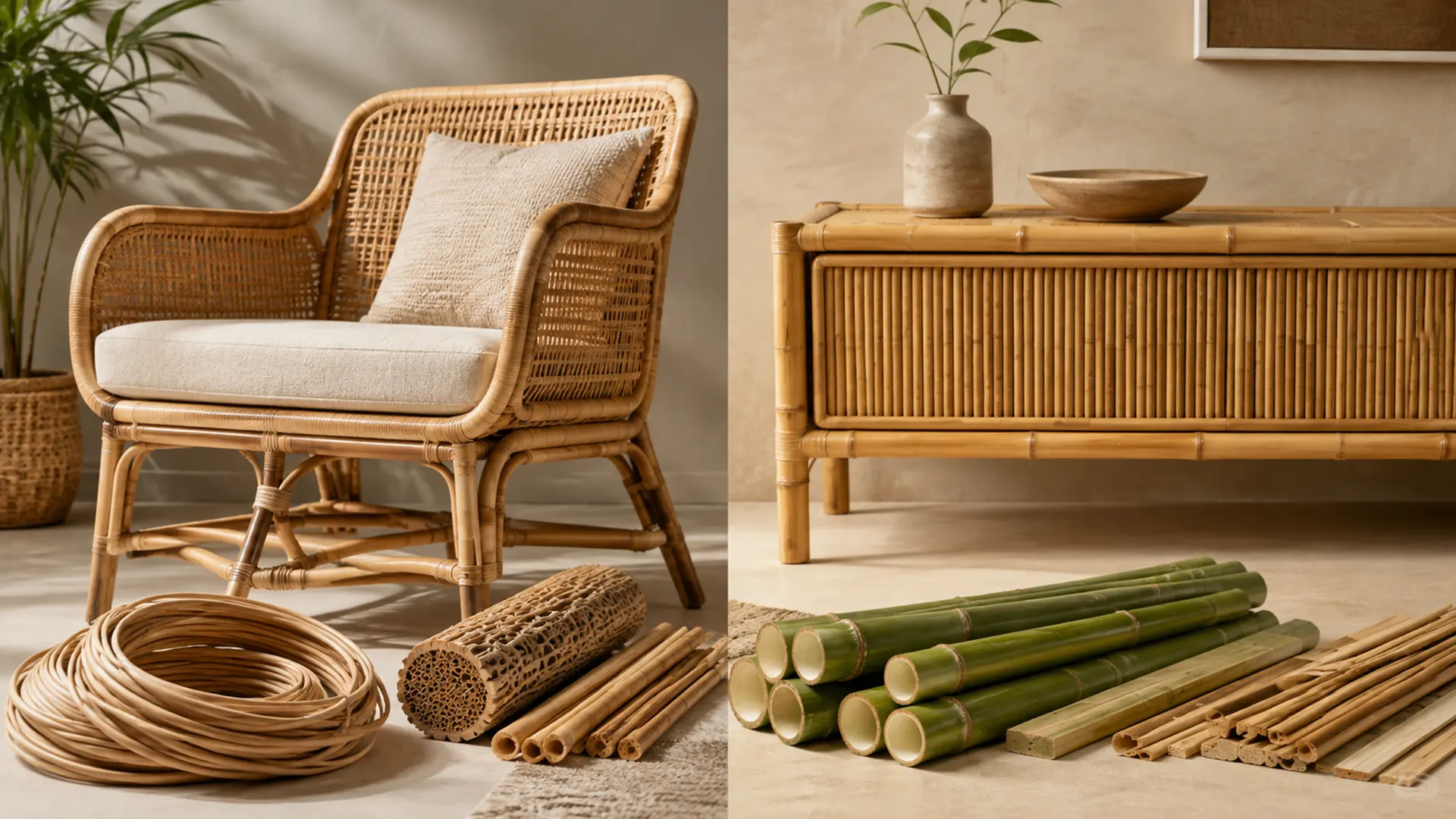
 Rattan Export buyer guide: Rattan vs Bamboo: Which Material Fits Your Product.
Rattan and bamboo are both natural materials widely used in furniture, lighting, home décor and handicraft production, but they should not be treated as interchangeable raw materials. They differ in structure, weight, flexibility, appearance, joining methods, bending behaviour, available diameters, manufacturing techniques and suitable product applications. For professional buyers, the right question is therefore not whether rattan or bamboo is universally better. The correct question is which material fits the specific product design, intended use, target market, production method and commercial program.
Within the Vietnam rattan, bamboo and natural-fibre production ecosystem, manufacturers may specialize in one material, work with both, or combine them with timber, metal, upholstery and other fibres. Buyers should evaluate material suitability at product level rather than selecting a supplier simply because its catalogue contains both rattan and bamboo products.
What Is Rattan?
Rattan is a climbing palm material traditionally used for furniture frames, curved structures, bindings, weaving and decorative elements. Depending on the product and processing method, different diameters and forms of rattan may be used for structural and decorative functions.
Rattan is particularly valued for:
- Its ability to form curved furniture shapes
- Relatively smooth continuous lengths
- Warm natural appearance
- Handcrafted visual character
- Suitability for frames, bindings and weaving
Natural variation in diameter, colour, nodes, surface character and straightness is normal and should be managed through material sorting and production control.
What Is Bamboo?
Bamboo is a fast-growing grass with hollow culms divided by natural nodes. It can be used in furniture frames, tables, shelving, decorative structures, panels, lighting and many home-decor products.
Bamboo is valued for:
- Distinctive segmented appearance
- Good structural potential in suitable designs
- Relatively large diameters
- Strong visual identity
- Suitability for straight or geometric structures
Because bamboo is hollow and has a different wall structure from rattan, its engineering and joining methods must be considered separately.
1. Rattan And Bamboo Have Different Internal Structures
One of the most important differences is physical structure. Rattan is generally solid or relatively solid through its cross-section, while bamboo culms are typically hollow between nodes.
This affects:
- Drilling
- Fastening
- Joint design
- Load transfer
- Bending
- Repair methods
A construction detail that works well in rattan should not automatically be copied into bamboo.
2. Rattan Is Usually Better Suited To Tight Curves
Rattan is widely used in designs featuring:
- Rounded backs
- Curved arms
- Looped frames
- Organic silhouettes
- Continuous bent components
Its bending characteristics make it especially useful when the design relies on flowing curves.
The achievable bend radius still depends on material diameter, preparation, workmanship and product geometry. Very tight curves can create cracking or deformation risks.
3. Bamboo Often Works Well In Straighter Geometric Structures
Bamboo is commonly used where the design benefits from:
- Straight members
- Geometric frames
- Vertical or horizontal rhythm
- Visible nodes
- Architectural forms
Bamboo can be bent in certain applications, but it should not be assumed to behave exactly like rattan.
4. Material Diameter Creates A Different Visual Language
Rattan can be used in relatively slender structural members, bindings and woven forms. Bamboo often creates a stronger segmented and architectural appearance because culm diameters may be larger and the natural nodes are more visually prominent.
This can make bamboo particularly effective for:
- Statement chairs
- Tables
- Shelving
- Decorative ladders
- Lighting structures
5. Rattan Is Highly Suitable For Traditional Furniture Frames
Rattan is frequently used for:
- Dining chairs
- Lounge chairs
- Armchairs
- Benches
- Headboards
- Side tables
- Cabinets
It can work as the visible structural frame while also supporting woven surfaces, bindings and cushions.
6. Bamboo Can Be Strong In Larger Structural Forms
Bamboo can be effective where the design uses larger straight members or framed assemblies.
However, buyers should evaluate:
- Wall thickness
- Diameter
- Node position
- Joint method
- Splitting risk
- Moisture condition
Two bamboo culms with similar outer diameter may not behave identically if wall thickness and maturity differ.
7. Rattan Is More Common For Bindings And Fine Structural Wrapping
Rattan peel, narrow strips and related processed forms are often used for:
- Joint bindings
- Decorative wrapping
- Edge details
- Fine weaving
This allows the material to perform both structural and visual roles in the same product.
8. Bamboo Is Usually Less Suitable For Fine Binding Work
Bamboo can be split into narrower elements, but its behaviour differs from rattan peel and similar binding materials.
If a product needs tightly wrapped joints or detailed woven bindings, rattan or another suitable natural fibre may be more practical.
9. Weaving Applications Differ
Rattan is strongly associated with furniture weaving because it can be processed into peel, cane, strips and round elements.
Bamboo can also be split and woven into panels, baskets, mats and decorative surfaces, but the final texture and behaviour are different.
Buyers should specify:
- Material form
- Strip width
- Pattern
- Density
- Colour
- Surface character
10. Rattan Often Creates Softer Visual Forms
Curved rattan can create furniture that feels:
- Light
- Organic
- Relaxed
- Residential
- Craft-oriented
This is especially effective for hospitality interiors, resort-inspired collections and warm residential furniture.
11. Bamboo Often Creates A Stronger Architectural Character
Visible bamboo nodes and larger straight sections can create a more graphic or architectural effect.
Bamboo can work particularly well where the buyer wants the natural material itself to become a strong design feature.
12. Surface Preparation Is Different
Rattan and bamboo do not necessarily require the same sanding, preparation and finishing system.
Factories should understand:
- Surface skin behaviour
- Absorption
- Sanding requirements
- Joint preparation
- Coating compatibility
A finish developed for one material should not automatically be applied to the other without testing.
13. Colour Response Can Differ
Rattan and bamboo may absorb stains or coatings differently because their surfaces and material structures are different.
If a collection combines both materials, a single stain formulation may not produce visually identical colours.
Buyers should approve the complete mixed-material sample rather than only approving a colour chip.
14. Natural Colour Variation Should Be Controlled Separately
Both materials vary naturally, but the type of variation differs.
Rattan may vary in:
- Diameter
- Surface tone
- Node appearance
- Straightness
Bamboo may vary in:
- Culm diameter
- Node spacing
- Wall thickness
- Surface tone
- Natural markings
Commercial quality should define an acceptable range for the specific product rather than expecting artificial uniformity.
15. Bamboo Splitting Requires Attention
Because of its hollow construction and longitudinal fibre structure, bamboo can split if drilling, fastening, drying or joint design is poorly controlled.
Buyers should inspect areas around:
- Screws
- Bolts
- Drilled holes
- Cut ends
- Joints
16. Rattan Has Its Own Cracking Risks
Rattan can also crack, especially around:
- Tight bends
- Over-dried material
- High-stress joints
- Poorly prepared surfaces
Neither material should be considered automatically problem-free.
17. Moisture Management Matters For Both
Both rattan and bamboo are natural materials and require attention to material condition, drying, storage, finishing and packaging.
Poor control can contribute to:
- Mold
- Cracking
- Splitting
- Deformation
- Finish problems
Moisture-related controls should form part of the quality-control and pre-shipment inspection program.
18. Do Not Assume Either Material Is Automatically Suitable For Permanent Outdoor Exposure
Natural rattan and untreated or conventionally finished bamboo should not automatically be classified as permanent outdoor furniture simply because they are natural materials.
Outdoor suitability depends on the complete material, construction, treatment, hardware and exposure conditions.
19. Joint Engineering Is Critical
Rattan frames may use combinations of:
- Mechanical fasteners
- Internal reinforcement
- Bindings
- Adhesive where appropriate
Bamboo structures may require different solutions to avoid crushing or splitting the hollow culm.
Buyers should evaluate the finished joint and, where necessary, inspect hidden structural details before production.
20. Furniture Weight Can Differ
The final weight of a product depends on design, material diameter, frame density, reinforcement, mixed materials and cushions.
It is therefore unsafe to assume that every bamboo item is lighter or heavier than every rattan item.
Actual product weight should be measured from the approved sample.
21. Material Efficiency Depends On Design
A product designed specifically around rattan may use the material efficiently, while converting the same design into bamboo may create waste or require structural changes.
The reverse can also be true.
Material substitution should therefore be evaluated through redesign, not merely through price replacement.
22. Rattan Can Be Better For Rounded Seating
Products such as:
- Barrel chairs
- Curved lounge chairs
- Loop-arm chairs
- Rounded headboards
often benefit from rattan's ability to create continuous curved components.
23. Bamboo Can Be Better For Linear Furniture
Products such as:
- Shelving
- Console tables
- Display structures
- Decorative screens
- Some dining tables
may suit bamboo particularly well when straight lines and visible nodes are part of the design language.
24. Mixed Rattan And Bamboo Products Can Work Well
The two materials do not always need to compete.
A product can combine:
- Bamboo structural members
- Rattan bindings
- Rattan woven panels
- Timber or metal reinforcement
The combination should be designed deliberately rather than improvised during production.
25. Mixed Materials Can Improve Product Development
Using the best material for each function can improve:
- Appearance
- Manufacturability
- Structural logic
- Cost efficiency
- Packaging
For example, a buyer may prefer bamboo for major straight frame members and rattan for binding or woven details.
26. Material Selection Can Affect FOB Price
FOB differences may result from:
- Material grade
- Diameter
- Sorting requirements
- Labour intensity
- Bending complexity
- Joint construction
- Finishing
- Waste rate
- Packaging
There is no universal rule that bamboo is cheaper than rattan or that rattan is cheaper than bamboo.
27. Supplier Specialization Can Affect Price More Than Material Name
A supplier highly experienced in one material may produce it more efficiently and consistently than a factory using the same material only occasionally.
Buyers should evaluate:
- Existing production capability
- Worker skill
- Jigs and tooling
- Material sourcing
- Quality system
- Relevant product experience
28. Product Complexity Often Matters More Than Raw Material Cost
A complex rattan chair with multiple bends and dense hand weaving can have a very different cost structure from a simple bamboo side table.
Conversely, a large bamboo structure with complex joinery may cost more than a relatively simple rattan product.
Buyers should compare complete specifications rather than raw material assumptions.
29. Packaging Requirements Can Differ
Rattan products may need protection around:
- Curved frames
- Bindings
- Woven surfaces
- Finished contact points
Bamboo products may require protection around:
- Cut ends
- Nodes
- Long straight members
- Joint areas
- Surface cracking points
30. Final Packed Dimensions Matter More Than Material Choice Alone
Container cost is driven heavily by:
- Product geometry
- Nesting
- Stackability
- KD design
- Carton size
- Protective packaging
A well-designed bamboo product can load efficiently, and a well-designed rattan product can also load efficiently.
Final carton dimensions and CBM should feed into the container-loading and export-planning process.
31. Rattan Often Has Strong Nesting Potential In Chairs
Curved chair designs can sometimes be engineered to nest inside each other, reducing CBM per saleable unit.
This requires careful control of:
- Leg angle
- Seat width
- Arm geometry
- Protective contact points
32. Bamboo Products May Benefit From KD Construction
Linear bamboo furniture can sometimes be designed with removable or flat-pack components, but joint engineering is critical.
Poor KD design can create splitting, loose connections or difficult assembly.
33. Product Development Should Begin With The Material
One of the biggest buyer mistakes is designing a product without considering material behaviour and then asking the factory to build the same geometry in either rattan or bamboo.
A better process is:
- Define product function
- Choose the most appropriate material system
- Develop the structure around that material
- Build and review a sample
- Optimize packaging and production
34. Sample Approval Is Essential
The approved sample should confirm:
- Dimensions
- Material
- Diameter
- Joint construction
- Bending
- Weaving
- Finish
- Stability
- Packaging
The buyer should not approve only the overall visual appearance.
35. Supplier Quotations Must Use The Same Material Definition
When comparing suppliers, the RFQ should clearly define whether the product uses:
- Natural rattan frame
- Bamboo frame
- Rattan weaving
- Bamboo weaving
- Mixed natural materials
Otherwise, two quotations may appear comparable while representing very different constructions.
36. Ask For Material Recommendations When The Design Is Still Flexible
If the buyer has only a concept image, it can be useful to ask:
- Would you recommend rattan or bamboo for this frame?
- Which material is easier to reproduce consistently?
- Which option creates better container efficiency?
- Which option has lower structural risk?
- Can both options be sampled?
37. Sustainability Claims Should Be Evidence-Based
Both materials are frequently associated with natural or sustainable product positioning, but buyers should avoid unsupported marketing claims.
Claims about:
- Responsible sourcing
- Certification
- Traceability
- Environmental impact
should be supported by relevant documentation where required.
38. Quality-Control Checklists Should Be Material-Specific
For rattan, important checks may include:
- Diameter consistency
- Bending quality
- Cracking
- Bindings
- Frame stability
For bamboo, important checks may include:
- Wall condition
- Splitting
- Node position
- Drilled areas
- Joint construction
- Frame alignment
39. Retail Positioning Can Differ
Rattan often supports:
- Organic interiors
- Resort-inspired collections
- Curved furniture
- Handcrafted visual identity
Bamboo often supports:
- Architectural natural design
- Linear furniture
- Visible structural rhythm
- Statement natural-material products
Neither positioning is inherently superior.
40. Hospitality Buyers Should Match Material To Location
A rattan lounge chair may fit a hotel room or lobby, while bamboo shelving, screens or decorative structures may work elsewhere in the same property.
The best material depends on the exact location, design and operating requirements.
Rattan Vs Bamboo Comparison
| Factor | Rattan | Bamboo |
|---|---|---|
| Internal structure | Generally solid or relatively solid | Typically hollow between nodes |
| Curved forms | Very suitable for many bent furniture shapes | Possible in selected applications but behaves differently |
| Straight architectural forms | Suitable | Often particularly suitable |
| Bindings | Highly suitable in processed forms | Less commonly used for fine joint wrapping |
| Weaving | Common for furniture and decorative weaving | Can be split and woven, with different texture and behaviour |
| Visual character | Soft, curved, organic | Segmented, linear, architectural |
| Joint engineering | Must control cracking and reinforcement | Must control splitting and hollow-wall behaviour |
| Moisture control | Important | Important |
| FOB | Depends on design and specification | Depends on design and specification |
| Container efficiency | Depends on geometry, nesting and packing | Depends on geometry, KD and packing |
Which Material Fits Which Product?
Rattan may be particularly suitable for:
- Curved dining chairs
- Lounge chairs
- Armchairs
- Rounded headboards
- Woven cabinet fronts
- Decorative bindings
Bamboo may be particularly suitable for:
- Shelving
- Console tables
- Decorative screens
- Lighting structures
- Linear furniture
- Architectural home décor
Mixed rattan-and-bamboo construction can also be appropriate when each material is used for the function it performs best.
Common Buyer Mistakes
- Treating rattan and bamboo as interchangeable materials
- Changing material without redesigning the structure
- Assuming bamboo always costs less
- Assuming rattan always bends without risk
- Ignoring bamboo splitting around drilled areas
- Ignoring rattan cracking around tight bends
- Using the same joint design for both materials
- Using the same colour expectations for both materials
- Approving only from photographs
- Ignoring moisture management
- Calculating container capacity before packaging approval
- Comparing quotations with different material specifications
Frequently Asked Questions
Is rattan stronger than bamboo?
There is no useful universal answer. Strength depends on diameter, material condition, wall structure, joint design, geometry and intended load. The correct comparison should be made at product level.
Is bamboo cheaper than rattan?
Not necessarily. Final FOB depends on material grade, product complexity, labour, joinery, finishing, quantity and packaging.
Which is better for curved chairs?
Rattan is often a more natural choice for designs relying heavily on continuous curved members, although the final engineering still needs to be validated.
Which is better for tables or shelving?
Bamboo can be very effective in straight, architectural structures, but the best option depends on the exact design and joint system.
Can rattan and bamboo be used together?
Yes. Mixed-material designs can combine bamboo for major structural members with rattan for bindings, woven panels or decorative details.
Are both materials suitable outdoors?
Neither should automatically be assumed suitable for prolonged outdoor exposure. Suitability depends on treatment, construction, hardware and actual environmental conditions.
Which material is easier to ship?
Shipping efficiency depends more on final product geometry, nesting, KD construction and packaging than on the material name alone.
What should buyers request before placing a container order?
Request an approved sample, final material specification, structural details, finish reference, packaging method, final carton dimensions, CBM, gross weight and agreed quality criteria.
The Best Material Is The One Designed Into The Product Correctly
Rattan and bamboo are both valuable natural materials, but their strengths come from different physical characteristics. Rattan is especially useful for curved frames, bindings and woven furniture details. Bamboo can be highly effective for linear, architectural and larger-diameter structures. Neither should simply replace the other without technical review.
For buyers, the strongest product-development process begins by defining the function and visual objective, then selecting the material system that naturally supports that design. Structure, joinery, finish, quality control, packaging and container planning should then be developed around that choice.
If you are evaluating rattan, bamboo or mixed natural-material construction for a wholesale, hospitality, OEM, ODM or private-label collection in Vietnam, send your product references, drawings, intended use, target quantities and container requirements so the most appropriate material and production approach can be reviewed before sampling and quotation.