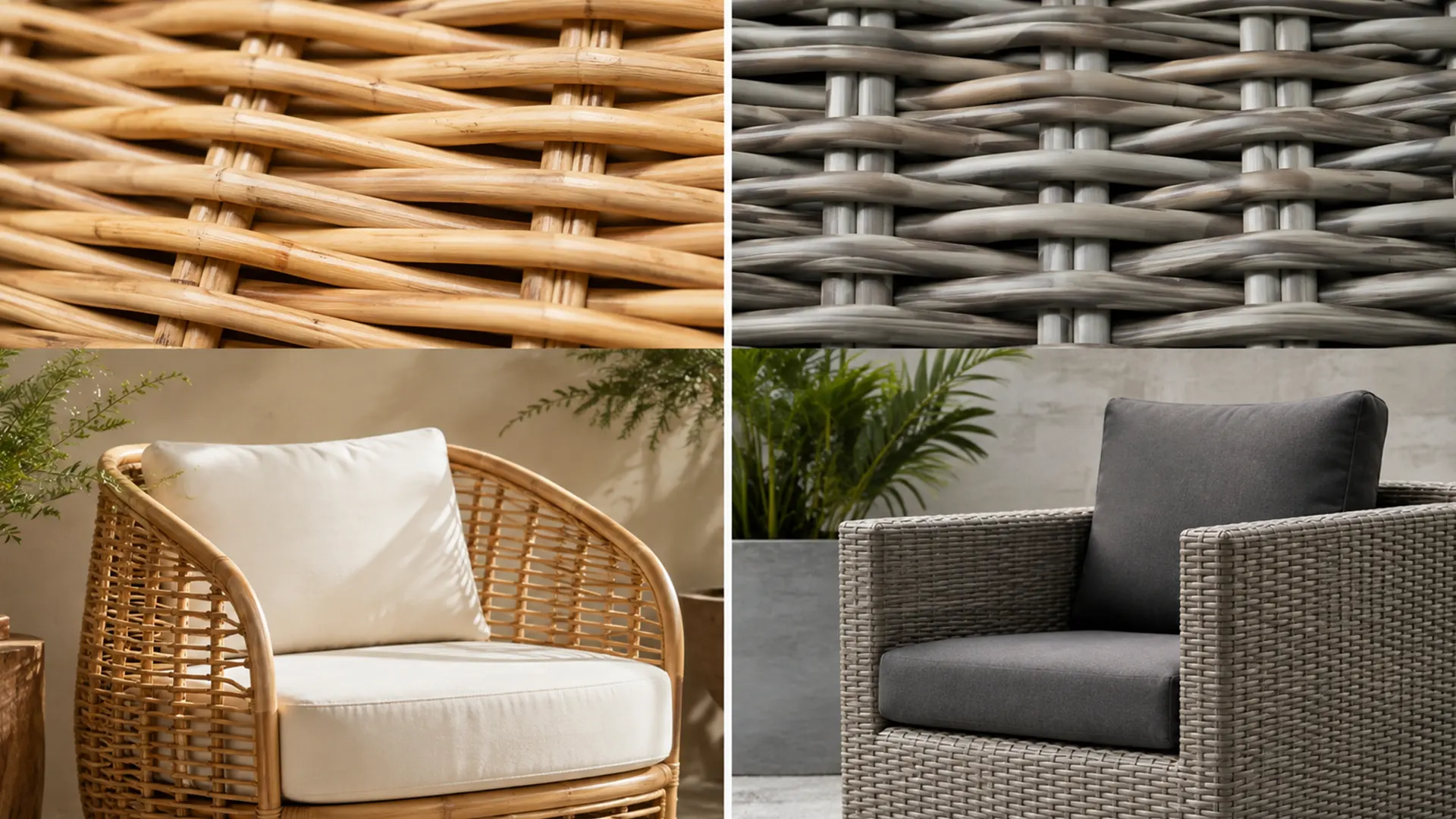
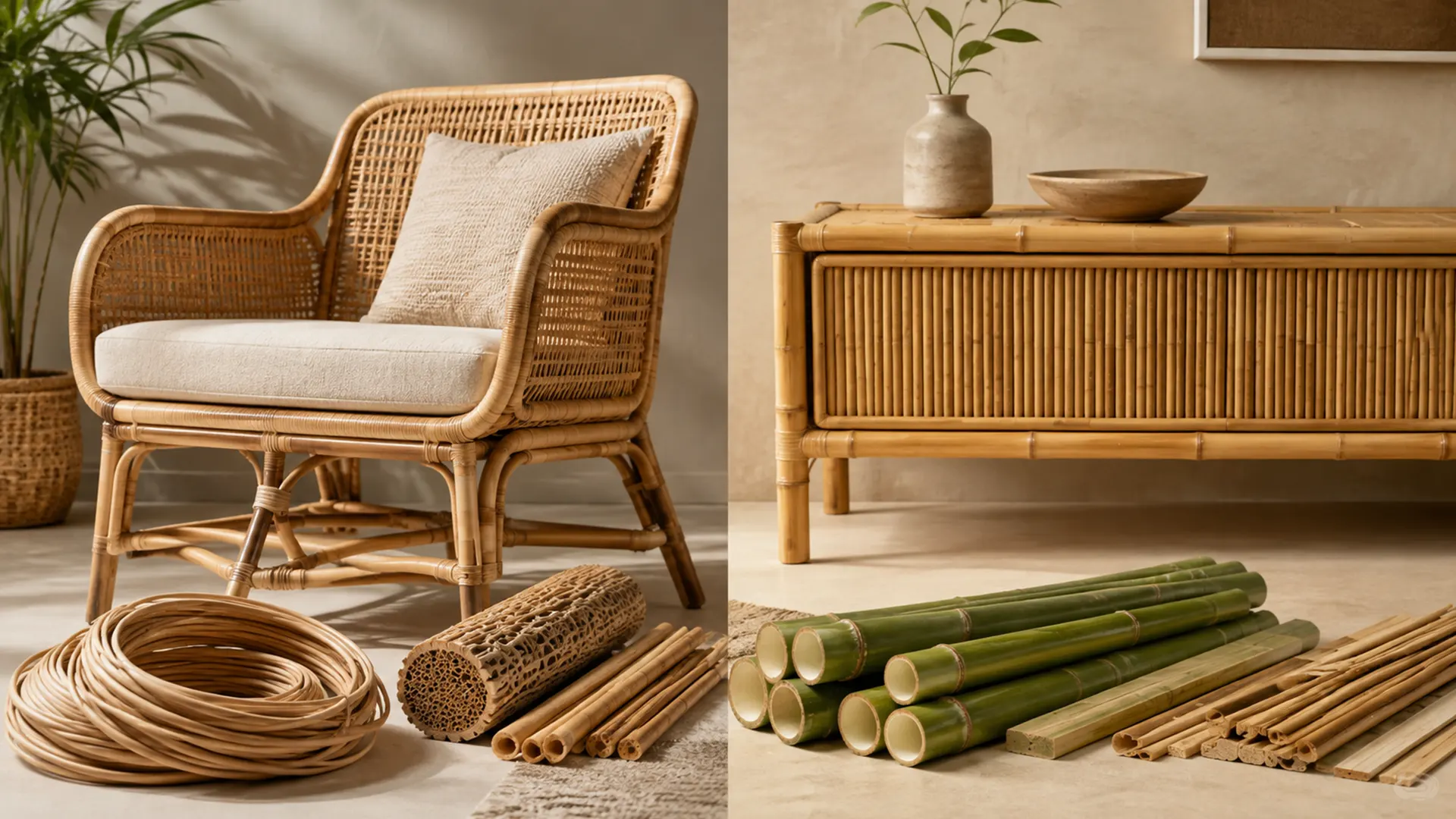
 Rattan Export buyer guide: Rattan vs Seagrass vs Water Hyacinth For Wholesale Products.
Rattan, seagrass and water hyacinth are all used in natural-fibre furniture, baskets, storage products and home décor, but they perform very different roles in commercial production. Buyers should not compare them as if they were three grades of the same material. Natural rattan can be used for structural furniture frames as well as bindings and weaving. Seagrass is generally used as a woven, braided or wrapped surface material. Water hyacinth is commonly dried and processed into soft, relatively substantial strands that are woven or wrapped around another supporting structure.
For importers, wholesalers, distributors, retail chains, hospitality buyers and private-label programs, the best material depends on the product architecture, visual target, intended use, price positioning, quality expectations and shipping plan. A material that works beautifully for a storage basket may be inappropriate for a load-bearing chair frame. Likewise, a visually attractive natural fibre can create commercial problems if its moisture condition, weaving density, packaging or supporting structure are not properly controlled.
Within the Vietnam rattan, bamboo and natural-fibre production ecosystem, buyers can encounter manufacturers and craft networks working with multiple fibres. Commercial terminology may also vary between suppliers, so the buyer should confirm the actual material being quoted rather than relying only on names such as “seagrass,” “natural fibre” or “wicker.”
The First Difference: Structural Material Versus Weaving Material
The most important distinction is the role the material performs in the finished product.
Rattan can potentially function as:
- A structural furniture frame
- A curved frame component
- A binding material
- A woven surface
- A decorative detail
Seagrass is more commonly used for:
- Woven seating surfaces
- Basketry
- Storage products
- Wrapped panels
- Decorative surfaces
Water hyacinth is commonly used for:
- Baskets
- Storage bins
- Planters and covers
- Decorative furniture weaving
- Wrapped or braided surfaces
Seagrass and water hyacinth products therefore frequently depend on a separate structure made from rattan, bamboo, timber, metal or another suitable material.
What Is Rattan?
Rattan is a climbing palm material that can be processed into different diameters and forms for furniture and handicraft production. Its combination of length, flexibility and structural potential makes it especially useful for curved furniture frames.
Typical rattan applications include:
- Dining chairs
- Lounge chairs
- Armchairs
- Headboards
- Tables
- Cabinets
- Shelving
- Bindings
- Woven panels
Natural rattan has visible variation in colour, diameter, nodes, surface character and straightness. Commercial quality therefore requires controlled sorting rather than an unrealistic expectation of mechanical uniformity.
What Is Seagrass?
In the natural-fibre furniture and handicraft trade, the term “seagrass” is often used for dried plant fibres that are twisted, braided or woven into baskets, furniture surfaces and decorative products. Commercial terminology can vary by region and supplier, so professional buyers should confirm exactly what local material is being supplied and how it is processed.
Seagrass typically creates a relatively fine, textured woven appearance and may be used for:
- Dining-chair seats
- Stool seats
- Baskets
- Laundry products
- Storage boxes
- Trays
- Decorative panels
It normally works as a surface or weaving component rather than as the principal structural frame.
What Is Water Hyacinth?
Water hyacinth is an aquatic plant whose stems can be harvested, dried and processed into material for weaving and wrapping. Compared with many finer natural weaving fibres, dried water-hyacinth material can create a fuller, softer and more substantial texture.
Common applications include:
- Storage baskets
- Laundry baskets
- Planter covers
- Trunks
- Ottomans
- Furniture panels
- Decorative storage products
Like seagrass, water hyacinth normally requires an internal frame or supporting form where the finished item needs significant structural stability.
1. Rattan Has The Strongest Structural Role Of The Three
If a buyer needs the natural material itself to form a curved chair frame, arm, leg or structural hoop, rattan is usually the most relevant of these three materials.
Seagrass and water hyacinth are normally better evaluated as weaving or surface materials rather than replacements for structural rattan.
2. Seagrass Creates A Finer, More Linear Texture
Seagrass is often twisted, braided or woven into relatively regular patterns. Depending on processing, it can create a cleaner and more linear surface than the fuller appearance typically associated with water hyacinth.
This can suit:
- Minimal baskets
- Chair seats
- Storage collections
- Neutral home décor
3. Water Hyacinth Creates A Fuller, Softer Look
Dried water-hyacinth stems can produce a more substantial visual volume. The material is frequently used where the buyer wants a pronounced handcrafted texture.
It can be attractive in:
- Large baskets
- Storage trunks
- Planter covers
- Ottoman surfaces
- Statement decorative products
4. Rattan Can Create Both Frame And Surface
One advantage of rattan is that a single product family can use different processed forms of the same general material system. Larger pieces may form the frame while thinner material is used for bindings or weaving.
This can create a coherent natural-material appearance while allowing different parts to perform different functions.
5. Seagrass Usually Needs A Separate Supporting Structure
A woven seagrass seat or basket may be supported by:
- Rattan
- Bamboo
- Timber
- Metal
The buyer should therefore inspect both the visible fibre and the hidden frame.
6. Water Hyacinth Also Depends Heavily On The Underlying Structure
A thick woven exterior can hide the frame underneath. Buyers should not assume that a substantial-looking water-hyacinth product is structurally strong simply because the weaving appears thick.
Frame material, joint construction and internal reinforcement should be specified separately.
7. Material Identity Should Be Confirmed In The RFQ
Natural-fibre names are sometimes used loosely in commercial communication. The RFQ should specify the exact material required or ask the supplier to identify the actual fibre used.
A quotation should ideally distinguish between:
- Structural rattan
- Rattan peel or other rattan weaving
- Seagrass weaving
- Water-hyacinth weaving
- Mixed natural fibres
8. Colour Variation Is Different For Each Material
Rattan may show differences in natural tone, nodes and diameter. Seagrass can vary according to drying, fibre selection and processing. Water hyacinth can show natural differences across dried stems and woven areas.
The correct commercial approach is to define an acceptable colour range using approved samples rather than expecting every natural fibre to be identical.
9. Natural Ageing Can Change Appearance
Natural fibres may change visually over time depending on light exposure, environment, surface treatment and storage.
Buyers should avoid promising permanent colour stability unless the product specification and testing support that claim.
10. Rattan Can Receive Different Finish Systems
Depending on the product, rattan may be supplied in:
- Natural tones
- Stained finishes
- Painted finishes
- Washed effects
- Clear-coated finishes
The finish should be approved on the real production material because underlying natural colour affects the result.
11. Seagrass Is Often Valued For Its Natural Surface
Many seagrass products are designed to retain the material's natural woven character rather than hide it with an opaque finish.
Buyers should therefore pay attention to:
- Fibre selection
- Colour range
- Twist consistency
- Weaving pattern
- Surface cleanliness
12. Water Hyacinth Is Also Primarily A Texture-Driven Material
Water hyacinth is often selected because of its tactile and visually substantial surface. Excessively inconsistent stem thickness, uncontrolled dark areas, loose weaving or damaged strands can therefore be highly visible.
13. Moisture Control Is Critical For All Three
Rattan, seagrass and water hyacinth are natural plant materials. Drying, conditioning, warehouse environment, production timing and packaging conditions are therefore important.
Poor control can increase the risk of:
- Mold
- Odour
- Discolouration
- Deformation
- Surface deterioration
Moisture management should be incorporated into the quality-control and pre-shipment inspection process.
14. Water Hyacinth Deserves Particular Attention Before Packing
Because woven water-hyacinth products can use relatively substantial dried stems and dense woven surfaces, buyers should pay close attention to material condition before goods are sealed inside export packaging.
Packaging should not trap unnecessary residual moisture inside a closed environment.
15. Seagrass Weaving Should Be Checked For Consistent Tension
Important inspection points include:
- Even pattern
- Consistent strand direction
- Loose ends
- Open gaps
- Edge finishing
- Seat tension where used for seating
A visually attractive fibre can still produce a poor product if weaving tension is inconsistent.
16. Water-Hyacinth Weaving Should Be Checked For Compression And Shape
On baskets and storage products, inspectors should look for:
- Uneven walls
- Bulging
- Loose strands
- Distorted rims
- Weak handles
- Irregular bases
17. Rattan Furniture Requires Structural Inspection
When rattan forms the frame, quality inspection should include:
- Frame stability
- Bending quality
- Joint construction
- Bindings
- Cracking
- Symmetry
- Dimensions
This structural inspection is different from evaluating a fibre used mainly as weaving.
18. Basket Products Need Shape Control
For seagrass and water-hyacinth baskets, commercial quality often depends heavily on:
- Overall dimensions
- Rim shape
- Base flatness
- Handle alignment
- Nesting compatibility
- Set consistency
Handmade does not mean uncontrolled.
19. Handles Need Their Own Load And Construction Review
On baskets, handles are often a failure point. Buyers should check:
- Attachment method
- Reinforcement
- Symmetry
- Comfort
- Interaction with nesting
The decorative fibre itself should not be assumed to provide sufficient handle strength without proper construction.
20. Storage Products Often Use Hidden Frames
Large hampers, trunks and storage boxes may incorporate metal, timber, bamboo or rattan frames.
The RFQ should identify this internal construction because it materially affects FOB, weight, durability and packaging.
21. Furniture Applications Require More Than Fibre Selection
A chair with seagrass weaving or water-hyacinth panels should also be evaluated for:
- Frame material
- Joint strength
- Seat support
- Edge treatment
- Comfort
- Wear points
The natural fibre is only one component of the furniture system.
22. Rattan Usually Offers More Design Freedom For Curved Frames
Where the design requires curved arms, rounded backs or structural loops, rattan has a different role from seagrass and water hyacinth.
This makes it particularly valuable for natural-material furniture whose frame itself is part of the visual identity.
23. Seagrass Is Often Effective For Cleaner Woven Collections
Seagrass can be well suited to buyers looking for:
- Neutral colour
- Fine woven texture
- Simple storage forms
- Natural seating surfaces
- Minimalist decorative collections
24. Water Hyacinth Is Effective For More Textural Collections
Water hyacinth can be particularly suitable when the collection emphasizes:
- Thicker natural texture
- Handwoven character
- Large baskets
- Soft visual volume
- Decorative storage
25. Material Choice Changes Labour Content
Labour requirements depend on:
- Preparation of the fibre
- Weaving pattern
- Product size
- Frame complexity
- Finishing
- Required uniformity
A simple product in one material can cost less than a complex product in another, so material name alone does not determine FOB.
26. Rattan Is Not Automatically The Most Expensive
A simple rattan accessory may cost less than a large, densely woven water-hyacinth storage piece. Conversely, a complex structural rattan chair with multiple bends and detailed bindings can carry much more labour.
27. Seagrass Is Not Automatically The Cheapest
Fine weaving, reinforced frames, precise dimensions, private-label packaging and small production runs can significantly affect the final cost of a seagrass product.
28. Water Hyacinth Can Be Labour-Intensive
Large woven forms can require significant manual preparation and weaving time. Buyers should therefore compare construction and labour content, not only raw fibre cost.
29. Supplier Specialization Matters
A workshop experienced in water-hyacinth basketry may not be equally strong in structural rattan furniture. Likewise, a furniture factory may not have the artisan network needed for large quantities of handwoven storage products.
Supplier evaluation should match the product category.
30. Distributed Artisan Production Can Require Stronger Coordination
Some natural-fibre products may involve work completed across multiple artisan groups or external workshops. This is not automatically a problem, but buyers should understand:
- Where production occurs
- How materials are issued
- How dimensions are controlled
- How goods are collected
- Where final QC occurs
31. Nesting Can Be A Major Advantage For Baskets
Baskets and storage products can often be designed to nest inside one another. This can significantly improve container utilization.
However, nesting must be tested with actual protective materials installed because excessive compression can distort:
- Rims
- Handles
- Woven walls
- Decorative edges
32. Set Packing Can Improve Commercial Efficiency
Nested sets of two, three or more sizes can be commercially efficient where the product and retail program support it.
Buyers should calculate CBM both:
- Per packed set
- Per saleable unit
33. Bulky Fibres Can Increase Packed Volume
A fuller water-hyacinth weave can create more volume than a finer woven surface, depending on product design. That does not automatically make it inefficient, especially when the product nests well.
Final packed dimensions are more important than visual assumptions.
34. Furniture Is Often Cube-Limited
Rattan furniture and natural-fibre furniture can occupy substantial container volume relative to weight. The actual commercial loading result depends on final geometry, nesting, stacking, KD construction, protection and carton size.
Final carton dimensions should therefore feed into the container-loading and export-planning process.
35. Cartons Are Not Always Necessary For Every Basket Program
Some products may use individual cartons, master cartons, nested protective wrapping or other buyer-approved systems depending on destination and distribution requirements.
The packaging method should be selected around protection, handling and receiving requirements rather than a universal rule.
36. Retail Packaging Can Change The Economics
Private-label programs may require:
- Hangtags
- Barcode labels
- Product labels
- Individual cartons
- Printed inserts
- Set identification
These requirements can increase labour, packaging cost and packed CBM.
37. Product Dimensions Need Realistic Handmade Tolerances
Handwoven baskets and storage products should not be expected to achieve injection-moulded precision. However, commercial buyers still need an agreed tolerance for:
- Width
- Depth
- Height
- Rim shape
- Handle position
- Set nesting
38. The Approved Sample Should Become The Visual Reference
For all three materials, an approved sample helps define:
- Material identity
- Colour range
- Texture
- Weaving pattern
- Dimensions
- Workmanship
- Packaging
A physical sample is especially useful where natural fibre variation is difficult to describe in writing.
39. Mixed-Material Collections Can Be Commercially Strong
A wholesale collection does not need to choose only one fibre. Buyers can develop:
- Rattan furniture
- Seagrass storage
- Water-hyacinth baskets
- Mixed rattan-and-seagrass seating
- Water-hyacinth panels over timber or metal frames
The collection can remain visually coherent through colour, finish, proportion and styling.
40. Mixed Containers Need SKU-Level Planning
Natural-fibre collections often contain products with dramatically different packing efficiency. A chair, planter cover, basket set and large hamper should not be planned using one average CBM assumption.
The loading plan should use actual packed dimensions per SKU.
41. Product Category Should Drive Material Choice
Rattan may be the better starting point when the buyer needs:
- Structural furniture frames
- Curved furniture
- Bindings
- Fine rattan weaving
Seagrass may be attractive when the buyer needs:
- Fine woven texture
- Chair-seat weaving
- Storage baskets
- Neutral home décor
Water hyacinth may be particularly appropriate for:
- Substantial basketry
- Laundry and storage products
- Planter covers
- Highly textured decorative weaving
42. Ask The Supplier The Right Questions
Before quotation, ask:
- What is the exact natural fibre?
- What material forms the internal frame?
- Where is the fibre used structurally and where decoratively?
- How is the material dried and stored?
- What variation is considered acceptable?
- What is the weaving pattern?
- How are handles reinforced?
- Can the product nest?
- What are the final packed dimensions?
- What packaging is included?
Rattan Vs Seagrass Vs Water Hyacinth
| Factor | Rattan | Seagrass | Water Hyacinth |
|---|---|---|---|
| Typical role | Structural frame, binding and weaving | Mainly weaving and wrapped surfaces | Mainly weaving and wrapped surfaces |
| Typical texture | From smooth frame material to fine weaving | Relatively fine, linear woven texture | Fuller, softer and more substantial texture |
| Furniture frames | Can be used structurally | Usually needs separate frame | Usually needs separate frame |
| Baskets | Suitable | Very common application | Very common application |
| Curved furniture | Strong application | Not normally a structural frame material | Not normally a structural frame material |
| Natural variation | Colour, diameter, nodes, surface | Colour, fibre and weave variation | Stem thickness, colour and weave variation |
| Moisture control | Critical | Critical | Critical |
| QC emphasis | Structure plus surface workmanship | Weaving, shape and frame | Weaving, shape, frame and material condition |
| FOB | Depends on product specification | Depends on product specification | Depends on product specification |
| Container efficiency | Depends on product geometry and packing | Often benefits from basket nesting | Often benefits from nesting despite bulkier texture |
Common Buyer Mistakes
- Assuming all natural fibres perform the same function
- Using seagrass or water hyacinth as if they were structural rattan
- Not confirming the actual fibre identity
- Ignoring the hidden supporting frame
- Assuming handmade means dimensions do not matter
- Ignoring moisture condition before packing
- Approving only one photograph instead of a physical sample
- Comparing FOB prices without matching construction
- Ignoring handle reinforcement on baskets
- Over-compressing nested products
- Using theoretical dimensions instead of final packed CBM
- Failing to calculate CBM per saleable unit
- Making unsupported environmental claims
Frequently Asked Questions
Which material is strongest?
This is not a useful direct comparison because the materials normally perform different functions. Structural performance depends on the full product design, frame and joints.
Can seagrass be used for furniture?
Yes. It can be used for seats, panels and woven surfaces, usually over or within a separate supporting structure.
Can water hyacinth be used for furniture?
Yes. It is commonly used for woven furniture panels, ottomans and decorative surfaces, but structural support normally comes from another frame material.
Which is best for baskets?
Both seagrass and water hyacinth are widely suitable, while rattan can also be used. The best choice depends on desired texture, shape, construction, price and packing efficiency.
Which material gives a finer appearance?
Seagrass often creates a finer, more linear woven texture, while water hyacinth often creates a fuller and more pronounced handcrafted texture.
Which one is cheaper?
There is no universal answer. FOB depends on material processing, weaving hours, frame, size, quality requirements, quantity and packaging.
Which material is easiest to load efficiently?
Basket products that nest well can be highly efficient regardless of fibre. Final packed geometry matters more than material name alone.
What should buyers approve before a container order?
Approve material identity, frame construction, weaving pattern, dimensions, colour range, workmanship, handles, nesting method, packaging, final packed dimensions and quality criteria.
Choose The Fibre For The Function, Not Just The Look
Rattan, seagrass and water hyacinth can all create commercially attractive natural-fibre collections, but they should be selected for the roles they perform best. Rattan offers unique value when the material must contribute to structural furniture, curves, bindings or fine weaving. Seagrass can provide a cleaner, finer woven character for seating and storage products. Water hyacinth can create a fuller, tactile handcrafted appearance that is particularly strong in baskets and decorative storage.
The strongest sourcing decision combines material selection with the correct supporting frame, realistic handmade tolerances, moisture control, approved samples, packaging engineering and SKU-level container planning.
If you are developing a wholesale, hospitality, OEM, ODM or private-label collection using rattan, seagrass, water hyacinth or mixed natural fibres in Vietnam, send your product references, dimensions, material preferences, target quantities and container requirements so the appropriate construction, fibre and packing approach can be evaluated before quotation and sampling.