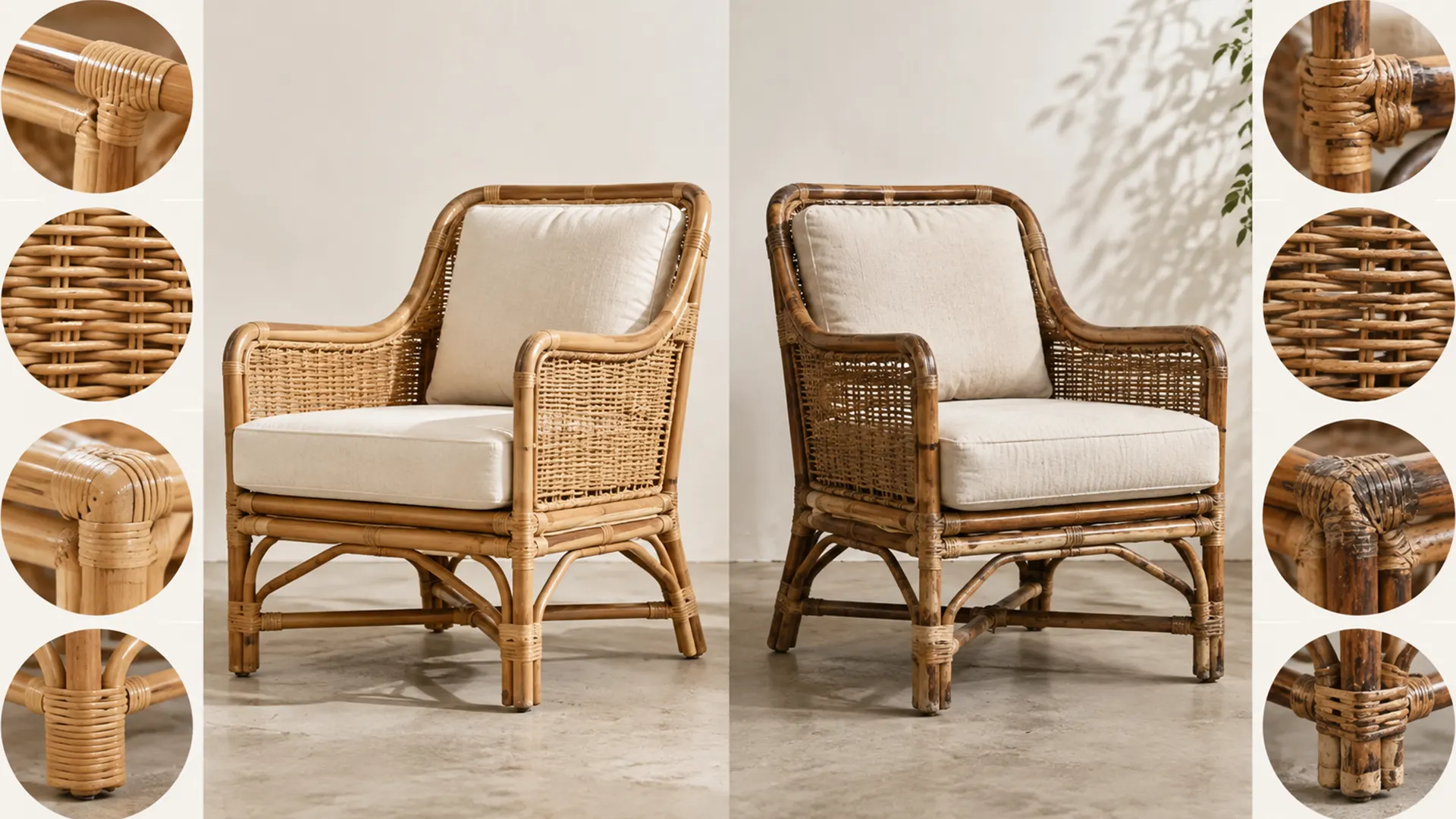
Rattan Export buyer guide: Rattan Furniture MOQ: What Container Buyers Should Expect.
For importers purchasing by full container, rattan furniture MOQ is not usually a single number that applies to every product, finish, factory or order. Minimum order quantity can exist at several levels at the same time: per SKU, per colour, per material, per production batch, per packaging type and for the total commercial order. This is why a supplier may accept a mixed 20ft, 40ft or 40HC container while still requiring minimum quantities for individual chair, table or lounge models inside that container. Container buyers should therefore avoid asking only, “What is your MOQ?” A more useful question is, “What are the minimums for each SKU, finish, material and total order under the specifications we are requesting?” Understanding this structure early helps buyers build commercially realistic product mixes, compare quotations correctly and avoid discovering production constraints after samples have already been approved.
What Does MOQ Mean In Rattan Furniture Buying?
MOQ means Minimum Order Quantity. It is the minimum quantity a supplier is prepared to manufacture or sell under a particular commercial condition.
For rattan furniture, MOQ may be influenced by:
- product construction;
- natural rattan or other material requirements;
- frame production;
- finish and colour;
- weaving pattern;
- hardware purchasing;
- cushion or upholstery production;
- carton and packaging requirements;
- private-label requirements;
- production setup time;
- total commercial order size.
Because these factors differ from one product to another, buyers should not assume that one MOQ applies across an entire supplier catalogue.
Container MOQ And SKU MOQ Are Different
A supplier may work primarily with full-container exports but still apply separate production minimums within the container.
For example, a buyer may intend to place one 40HC order containing:
- rattan dining chairs;
- dining tables;
- lounge chairs;
- coffee tables;
- baskets;
- lighting.
The overall commercial requirement may be one full container, while each model inside that container may have its own minimum production quantity.
This distinction is important because full-container buying does not automatically mean unlimited SKU flexibility. A buyer cannot necessarily order five pieces of twenty different furniture models simply because the combined volume fills a container.
Why Suppliers Set MOQ
MOQ is not only a sales policy. In many cases it reflects real production economics.
A supplier may need to prepare:
- specific rattan diameters or grades;
- timber or metal frames;
- custom staining or finishing materials;
- weaving materials;
- hardware;
- foam and fabric;
- labels;
- cartons;
- production jigs or templates.
Producing a very small quantity can create disproportionate setup, purchasing and labour costs. A workshop may spend almost the same preparation time for ten custom chairs as for a significantly larger production batch.
MOQ therefore helps the supplier spread these fixed or semi-fixed costs across enough units to make production commercially workable.
There Is No Universal MOQ For Rattan Furniture
Buyers should be cautious with statements such as “rattan furniture MOQ is 20 pieces” or “every Vietnam supplier requires 50 pieces per model.” These kinds of universal figures are unreliable.
The real minimum can vary according to:
- supplier size;
- product complexity;
- whether the model already exists;
- whether materials are already in stock;
- whether the finish is standard or custom;
- whether the order is repeat business;
- whether multiple SKUs share the same components;
- total value of the container order.
When reviewing rattan sourcing and production options in Vietnam, MOQ should therefore be confirmed directly against the exact specification and commercial order structure.
Standard Products Often Have More Flexible Minimums
Existing catalogue products can sometimes be easier to order in smaller commercial batches because the supplier may already have:
- established construction methods;
- standard materials;
- existing jigs or patterns;
- known packing methods;
- historical cost data.
If the buyer selects the supplier's standard finish, existing size and normal packaging, production can be simpler than a fully customized order.
This does not guarantee a low MOQ, but it can reduce some of the setup reasons that create higher minimums.
Custom Furniture Usually Creates Additional Minimum Requirements
OEM and custom rattan furniture can introduce additional minimums because the supplier may need to purchase materials specifically for one buyer.
Customization can involve:
- new dimensions;
- new frame geometry;
- custom weaving;
- custom colour;
- special finish;
- buyer-selected fabric;
- custom cushion construction;
- special hardware;
- custom carton printing;
- private labels.
A factory may accept a certain quantity for its standard chair but require a larger batch when the buyer requests a unique colour or fabric that must be purchased separately.
Colour And Finish Can Have Their Own MOQ
One of the most commonly overlooked issues is finish MOQ. A buyer may meet the model MOQ but split the quantity into too many colours.
Suppose an order contains one chair model in:
- natural;
- dark walnut;
- black;
- whitewashed;
- custom green.
From the buyer's perspective, these are variations of one SKU. From the production perspective, they may require separate finish preparation, spraying or coating batches and additional quality control.
Therefore, buyers should confirm both MOQ per model and MOQ per finish.
Fabric And Cushion Materials Can Create Separate Minimums
Rattan lounge furniture, sofas and dining chairs may use cushions or upholstered components. In these cases, the furniture supplier's MOQ is only part of the calculation.
Fabric suppliers, foam suppliers or sewing subcontractors may also impose purchasing minimums.
Questions to ask include:
- Is the fabric already available?
- Is it a standard supplier option?
- Does the selected colour require a minimum fabric purchase?
- Can the same fabric be shared across several models?
- Does custom branding affect the minimum?
Using one fabric across several lounge models can sometimes simplify material purchasing and make a mixed collection more commercially practical.
Packaging Can Influence MOQ
Custom packaging may introduce another minimum. Standard blank cartons may be commercially easier for smaller production runs, while printed retail cartons can require a separate packaging order.
Packaging-related MOQ may be affected by:
- printed cartons;
- custom inserts;
- private-label stickers;
- barcodes;
- instruction sheets;
- branded hardware bags;
- retail-ready packaging.
For full-container wholesale orders, buyers should separate the product MOQ from the packaging MOQ and confirm both before issuing the purchase order.
Mixed Containers Can Help Buyers Work With MOQ
A mixed container allows the buyer to allocate capacity across several product categories while still meeting reasonable minimum quantities for each SKU.
For example, rather than ordering only one dining-chair model, a buyer may build a container around:
- two core dining-chair models;
- matching tables;
- selected lounge furniture;
- compact baskets or accessories.
The commercial challenge is to balance SKU MOQ with packed CBM. Meeting every supplier minimum is not enough if the resulting products exceed the container capacity.
Likewise, a container may have plenty of cubic capacity but the requested quantity of one SKU may still be below the supplier's production minimum.
Start With Core Sellers
For a first container, buyers can often manage MOQ more effectively by concentrating on a limited number of core products.
A practical structure can be:
| Product Role | MOQ Strategy |
|---|---|
| Core Seller | Allocate sufficient quantity to comfortably meet production minimum |
| Collection Support | Use moderate quantities that complement core products |
| New Product Test | Include only where supplier minimum is commercially reasonable |
| Custom Product | Evaluate development cost and MOQ before committing |
| Compact Add-On | Use where MOQ and container space both make commercial sense |
This is generally more manageable than trying to create a first container with a very large number of low-volume SKUs.
Too Many SKUs Can Make The First Order Difficult
A buyer may want maximum assortment, but every additional SKU can create new:
- production planning;
- material requirements;
- finish batches;
- sample approvals;
- carton specifications;
- labels;
- inspection points;
- packing-list lines.
A container with forty different models is operationally very different from one with eight carefully selected models.
More variety is not automatically better. The right number of SKUs is the number that creates a commercially useful assortment while remaining realistic for production, quality control and inventory management.
MOQ Should Be Evaluated Together With CBM
MOQ and container capacity are directly connected. A bulky lounge chair can consume significantly more container space than a knock-down side table or nested basket.
Buyers should therefore request:
- MOQ per SKU;
- packed dimensions;
- units per package;
- CBM per package;
- CBM per saleable unit;
- estimated container quantity.
This information allows the buyer to test whether the MOQ is practical inside the proposed 20ft, 40ft or 40HC container.
MOQ should be incorporated into the broader container planning and export process rather than discussed separately from logistics.
Illustrative MOQ And CBM Planning Example
The following figures are purely illustrative and are not standard industry MOQs.
| SKU | Illustrative MOQ | Illustrative Packed CBM Per Unit | CBM At MOQ |
|---|---|---|---|
| Dining Chair A | 50 | 0.20 | 10.00 |
| Dining Table B | 20 | 0.25 | 5.00 |
| Lounge Chair C | 20 | 0.45 | 9.00 |
| Basket Set D | 40 | 0.08 | 3.20 |
| Total | - | - | 27.20 CBM |
This example shows why MOQ should be translated into CBM. A buyer may technically meet every SKU minimum yet still have substantial unused capacity depending on the chosen container. The buyer can then decide whether to increase proven sellers, add another commercially relevant SKU or use a smaller container where appropriate.
Again, the example is only a planning illustration. Actual supplier minimums and packing values must be confirmed for the exact products.
Can MOQ Be Negotiated?
Sometimes, but negotiation depends on the reason behind the minimum.
A supplier may have flexibility if:
- the product is already in regular production;
- standard materials are being used;
- the buyer accepts standard finishes;
- several products share the same material;
- the total container value is commercially attractive;
- the buyer is establishing a repeat-order program.
MOQ may be much less flexible when it is driven by an upstream material supplier, custom fabric purchase, custom carton printing or specialized production setup.
Professional negotiation should therefore begin by understanding why the MOQ exists.
Lower MOQ Can Increase Unit Cost
If a supplier agrees to produce below its normal efficient batch size, the unit cost may increase.
This can happen because:
- setup costs are spread over fewer units;
- material purchasing becomes less efficient;
- production transitions increase;
- custom finishing costs are spread over a smaller quantity;
- packing purchasing may become more expensive.
For buyers, the question is not simply whether a low MOQ is available. The better question is whether the resulting unit economics are commercially attractive.
A Very Low MOQ Is Not Always An Advantage
Buyers sometimes treat the lowest possible MOQ as automatically positive. In a container-based business, that can be misleading.
A very low SKU quantity may create:
- too many models in one container;
- higher sampling workload;
- more complex QC;
- more difficult inventory management;
- higher unit production cost;
- more fragmented sales data.
For proven products, ordering a commercially meaningful quantity may be more efficient than minimizing every SKU.
MOQ For Repeat Orders May Be Easier To Manage
Once a product has been developed, sampled, approved and produced, repeat orders can sometimes become operationally simpler.
The supplier may already have:
- approved drawings;
- production jigs;
- finish references;
- packing specifications;
- hardware information;
- quality references.
This does not guarantee that MOQ will fall, but the buyer and supplier may have more flexibility when planning repeat containers.
Private Label And OEM MOQ
Private-label and OEM programs often create multiple minimums rather than one.
A buyer should ask separately about:
- product MOQ;
- custom finish MOQ;
- fabric MOQ;
- label MOQ;
- printed carton MOQ;
- custom hardware MOQ;
- overall order MOQ.
This prevents a situation where the furniture quantity is acceptable but one branding component creates an unexpected minimum.
MOQ And Quality Control
MOQ planning also affects quality management. A larger number of very small SKUs means the inspection team must review more models, specifications, finishes and packing configurations.
For each SKU, inspection may need to verify:
- correct product;
- dimensions;
- materials;
- finish;
- weaving;
- construction;
- labels;
- packaging;
- quantities.
Buyers should consider this operational complexity as part of the broader quality and pre-shipment control process.
What Container Buyers Should Ask In An RFQ
Instead of asking for one general MOQ number, request structured information for every shortlisted product.
Useful RFQ questions include:
- What is the MOQ per SKU?
- What is the MOQ per colour or finish?
- Does custom fabric change the MOQ?
- Does private labeling change the MOQ?
- Does printed packaging have a separate minimum?
- Can multiple models share the same material or finish batch?
- What are the packed dimensions?
- What is the CBM per unit?
- What is the estimated loading quantity?
- Is the MOQ different for repeat orders?
- Can the supplier support mixed-container production?
How To Compare MOQ Between Suppliers
Do not automatically prefer the supplier with the lowest stated MOQ.
Compare:
- MOQ;
- FOB price;
- product quality;
- packed CBM;
- packing standard;
- lead time;
- custom capability;
- communication;
- quality-control capability;
- commercial fit with your full-container strategy.
A supplier with a slightly higher MOQ may offer substantially better container efficiency, quality consistency or pricing.
Buyer Checklist Before Accepting MOQ
- Confirm MOQ per SKU.
- Confirm MOQ per colour and finish.
- Confirm material-related minimums.
- Confirm fabric and cushion minimums.
- Confirm packaging and private-label minimums.
- Obtain packed dimensions.
- Calculate CBM at MOQ.
- Compare MOQ with container capacity.
- Check whether related products can share materials.
- Review whether the quantity matches expected sales demand.
- Calculate the effect on landed cost.
- Document the confirmed MOQ in the quotation or purchase order.
Frequently Asked Questions
What Is The Typical MOQ For Rattan Furniture?
There is no universal MOQ. It varies by supplier, product, material, finish, customization, packaging and total commercial order. Buyers should request the minimum for each specific SKU and specification.
Can I Order A Full Container With Different Rattan Products?
Yes, mixed-container buying can be possible, but each product may still need to meet its own production minimum. The total product mix must also fit the container's practical loading capacity.
Does Custom Colour Increase MOQ?
It can. A separate colour or finish may require its own production batch or material preparation, so buyers should confirm minimums per finish.
Can I Negotiate A Lower MOQ?
Sometimes. Flexibility depends on whether the minimum is driven by internal production setup, upstream material purchasing, custom packaging or another real cost constraint.
Does A Lower MOQ Mean A Higher Price?
It can. Producing below an efficient batch size may increase unit cost because setup and purchasing costs are distributed across fewer pieces.
Should First-Time Buyers Choose Many SKUs With Low Quantities?
Usually the commercial and operational impact should be evaluated carefully. A smaller number of well-selected SKUs can simplify production, quality control, container loading and inventory management.
Think Of MOQ As Part Of Container Economics
For full-container buyers, MOQ should not be viewed as an isolated supplier rule. It is part of the economics of production, packing, container utilization and inventory planning.
The right order structure balances supplier production efficiency with the buyer's sales requirements. It meets realistic SKU minimums without filling the container with unwanted inventory or creating unnecessary complexity.
Professional buyers should therefore evaluate MOQ alongside FOB price, packed CBM, product quality, customization requirements and landed cost. The objective is not simply to achieve the lowest possible minimum, but to build an order that works commercially for both production and destination sales.
Planning a full-container rattan furniture order and need to evaluate SKU quantities? Send your target products, estimated quantities, preferred finishes, customization requirements and destination through our wholesale inquiry so the proposed order can be reviewed from sourcing, MOQ and container-planning perspectives.