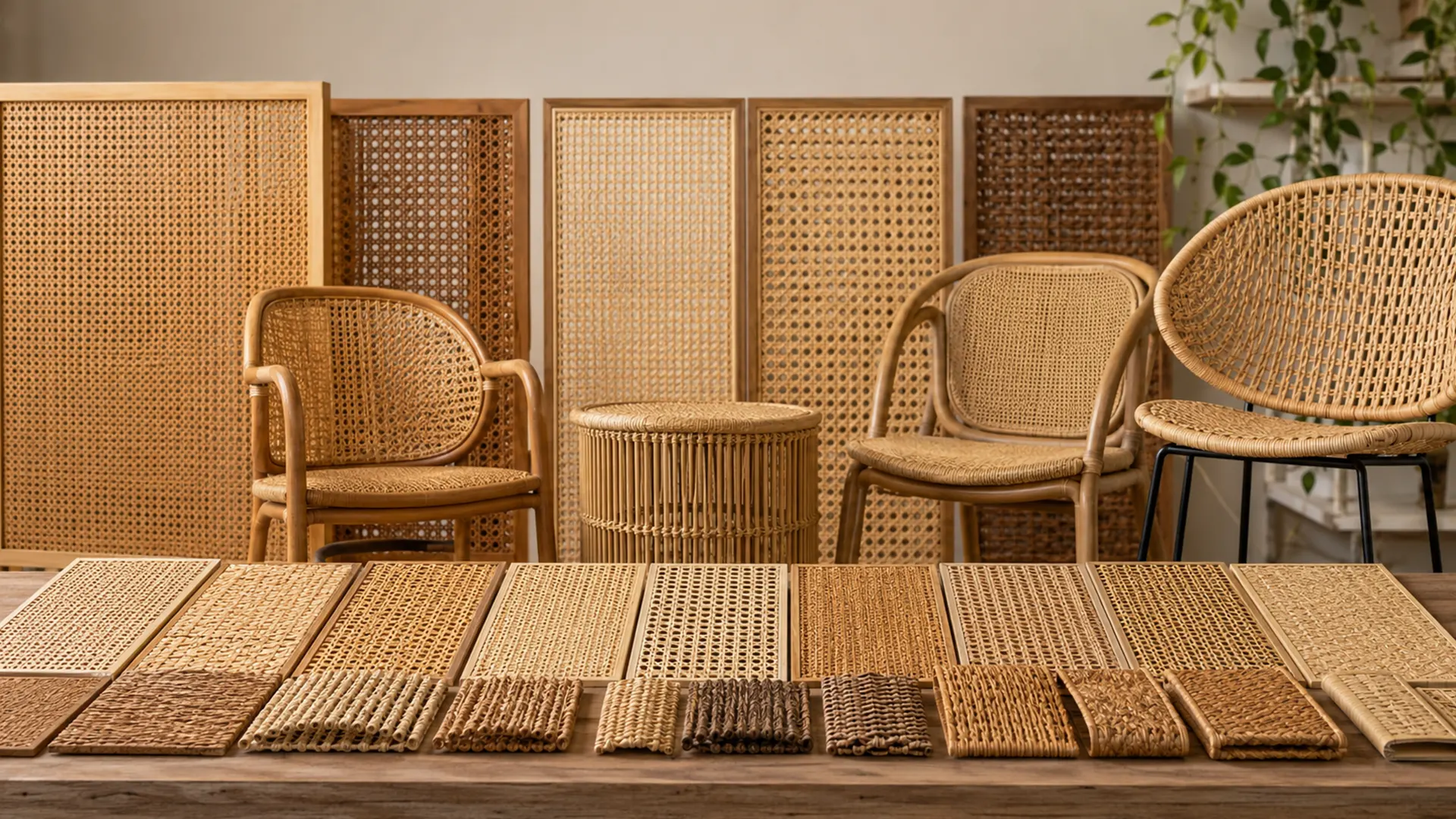
Rattan Export buyer guide: Rattan Furniture Quality Control Checklist For Importers.
Quality control for rattan furniture should begin long before the container is loaded. For importers, wholesalers, distributors, retail chains, hospitality buyers and project procurement teams, a good inspection process is not simply a final visual check. It is a documented system that connects the approved sample, product specifications, material requirements, workmanship standards, packaging instructions and shipment conditions to measurable acceptance criteria.
This is especially important for natural rattan, bamboo and natural-fibre furniture because these materials naturally vary in colour, grain, diameter and surface character. The buyer must distinguish acceptable natural variation from defects that affect appearance, durability, safety, assembly, packaging or commercial usability.
The following checklist is designed for professional B2B import programs involving 20ft, 40ft, 40HC, mixed-container, OEM, ODM, private-label and project orders. It can be adapted to individual products, supplier capabilities and destination-market requirements.
Quality Control Starts With A Clear Approved Standard
An inspector cannot reliably decide whether a product is acceptable if the purchase order simply says “good quality” or “export quality.” These phrases are subjective and should not be used as acceptance standards.
Before production begins, the buyer should establish a reference package that may include:
- Approved product sample
- Technical drawings
- Confirmed dimensions and tolerances
- Bill of materials
- Rattan, bamboo, wood, metal and textile specifications
- Approved weaving pattern
- Approved finish and colour sample
- Cushion and fabric specification
- Hardware list
- Packaging specification
- Label and carton-mark requirements
- Required testing or compliance criteria
The same reference package should be available to production, quality-control personnel and any third-party inspector.
1. Verify Product Identification
Before checking workmanship, confirm that the inspected product is the correct SKU and revision. This sounds basic, but mixed collections and private-label programs can involve many similar models, colours and packaging versions.
Check:
- SKU or model number
- Product description
- Finish code
- Colour code
- Size or variant
- Customer reference
- Latest approved revision
A perfectly manufactured product can still be commercially unusable if it is the wrong colour, wrong size or obsolete revision.
2. Check Raw Material Condition
Natural materials should be inspected before they become finished furniture. Poor raw material creates defects that cannot always be corrected later.
For rattan and bamboo, inspect for:
- Visible mold
- Excessive staining
- Splits or cracks
- Severe insect damage
- Soft or deteriorated areas
- Abnormal deformation
- Material inconsistent with the agreed specification
- Excessive variation outside the approved visual range
Natural variation should not automatically be classified as a defect. The acceptance standard should reflect the character of the approved material and the intended market positioning.
3. Moisture Control And Mold Prevention
Moisture is one of the most important risk areas in natural-material furniture. Rattan, bamboo and wood can develop mold, staining, odor, finish problems or dimensional instability when materials or finished products are exposed to unsuitable moisture conditions.
Inspection should consider:
- Condition of raw-material storage
- Condition of work-in-progress storage
- Finished-goods storage environment
- Visible mold or mildew
- Unusual odor
- Damp packaging
- Moisture readings where required by the buyer specification
- Time allowed between finishing and packing
- Container condition before loading
There is no single moisture figure that should be treated as universally correct for every rattan or bamboo product. Appropriate limits depend on material, construction, destination climate, finishing system and buyer requirements. Moisture requirements should therefore be documented specifically for the order.
Buyers developing these controls can integrate them into a wider quality control, inspection and compliance program.
4. Verify Overall Dimensions
Dimensions affect product usability, stacking, merchandising, cushion fit, project installation and container planning. Inspectors should measure products against the approved drawing rather than relying only on visual comparison.
Depending on the product, check:
- Overall width
- Overall depth
- Overall height
- Seat height
- Seat depth
- Arm height
- Tabletop height and thickness
- Shelf spacing
- Cabinet opening dimensions
- Component dimensions
- Assembly clearances
Tolerances should be defined before production where dimensions are critical.
5. Check Frame Construction
The frame is the structural foundation of the product. A visually attractive chair can still be unacceptable if the frame is weak, twisted or incorrectly assembled.
Inspect:
- Frame alignment
- Symmetry
- Joint fit
- Internal reinforcement where specified
- Screws, bolts, dowels or brackets
- Loose joints
- Visible gaps
- Cracked members
- Distorted frame components
- Unapproved construction changes
For products with natural rattan frames, some material variation may be expected, but the finished structure should still meet dimensional, stability and functional requirements.
6. Stability And Wobble
Tables, chairs, stools, cabinets and shelving should stand correctly on a suitable flat surface. Excessive rocking or uneven contact points can create customer complaints even when the product appears visually acceptable.
Check:
- All legs contact the floor appropriately
- No excessive wobble
- Cabinets stand square
- Doors do not cause instability
- Tables remain stable under normal handling
- Stackable products remain stable when stacked as intended
Where formal stability or strength testing is required, visual inspection is not a substitute for the specified laboratory or performance test.
7. Inspect Rattan Bending And Shape
Bent rattan components should follow the approved profile without excessive flattening, cracking, scorching or asymmetry.
Inspect:
- Curve consistency
- Left-right symmetry
- Cracking at bends
- Flattening or crushing
- Burn marks or discoloration
- Surface damage caused during forming
Complex curves should be compared directly with the approved sample or production template.
8. Inspect Weaving Quality
Weaving is one of the most visible and labour-intensive aspects of many rattan and natural-fibre products. Inspection criteria should consider both aesthetics and functional integrity.
Check:
- Correct weaving pattern
- Strand width and material
- Spacing consistency
- Weaving tension
- Loose strands
- Broken strands
- Protruding ends
- Uneven edges
- Missing sections
- Visible repair marks
- Symmetry between matching areas
Handwoven furniture will not look mechanically identical from piece to piece. The goal is controlled consistency within the approved natural and handmade appearance.
9. Check Binding And Wrapped Joints
Many rattan products use binding material around structural joints or decorative connection points. Poor binding can quickly make a product look inexpensive or unfinished.
Verify:
- Binding position
- Consistent width
- Correct number of wraps where specified
- Tension
- Secure ends
- No loose or unraveling sections
- Reasonable symmetry
10. Surface Preparation
Before finishing, rattan, bamboo and wooden surfaces should be prepared to the agreed standard. Poor sanding can remain visible after staining or coating.
Inspect for:
- Rough surfaces
- Sharp fibres
- Splinters
- Excessive sanding marks
- Glue residue
- Tool marks
- Unfilled defects where filling is required
- Dirty or contaminated surfaces
Hand-contact areas such as chair arms, seat edges, table edges and handles deserve particular attention.
11. Finish And Colour Inspection
Finish should be checked against an approved physical reference whenever colour accuracy is commercially important.
Inspect:
- Overall colour
- Acceptable natural variation
- Gloss level
- Coverage consistency
- Runs or drips
- Blisters
- Dust trapped in coating
- Orange-peel texture where unacceptable
- Bare spots
- Overspray
- Uneven stain absorption
- Finish damage after assembly
Digital photographs should not be the only colour standard because lighting and screens can distort appearance.
12. Check Glue And Adhesive Work
Visible adhesive can damage the appearance of otherwise high-quality handmade furniture.
Check:
- Excess glue around joints
- Glue staining on natural fibres
- Adhesive visible through weaving
- Loose components caused by insufficient bonding
13. Hardware Inspection
For KD furniture, cabinets, tables and mixed-material products, hardware quality and installation are critical.
Check:
- Correct hardware type
- Correct quantity
- Correct finish
- No corrosion
- No stripped screw heads
- Fasteners tightened appropriately
- Hinges aligned
- Drawer slides operate correctly
- Bolts and inserts align during assembly
- Hardware bags are complete
Missing one low-cost screw can make an entire product unusable for the customer, so hardware completeness should never be treated as a minor issue.
14. Knock-Down Assembly Check
Products shipped KD should be test-assembled using the hardware and instructions supplied in the carton.
Verify:
- Parts fit together without forced modification
- Holes align correctly
- Correct tools are specified
- Hardware quantity is complete
- Assembly sequence is logical
- Finished product is stable
- Instructions match the actual product
KD engineering affects both customer experience and packed CBM, so assembly quality is also part of container economics.
15. Cushion And Upholstery Inspection
If furniture includes cushions or upholstery, these components should be inspected as separate products rather than treated as accessories.
Check:
- Correct fabric
- Correct colour
- Fabric direction where relevant
- Cushion dimensions
- Foam specification where measurable
- Seam quality
- Piping
- Zippers
- Loose threads
- Stains
- Pattern alignment where applicable
- Fit on the furniture
- Removable covers where specified
Hospitality and contract buyers should also confirm any required textile performance criteria through the appropriate testing process.
16. Functional Checks
Any moving or usable feature should be tested.
Examples include:
- Doors open and close correctly
- Drawers operate smoothly
- Hinges do not bind
- Folding components lock correctly
- Swivel mechanisms operate properly
- Adjustable components hold position
- Stacking works as intended
17. Safety And User-Contact Areas
Inspect for obvious safety risks that could affect customers or handling personnel.
Check:
- Sharp edges
- Exposed staples
- Protruding nails or screws
- Sharp rattan ends
- Pinch points
- Broken fibres
- Unstable components
- Loose hardware
Product-specific legal or testing requirements should be assessed separately according to destination-market rules.
18. Appearance And Workmanship
Commercial furniture quality is heavily influenced by overall appearance. Inspect the product from normal viewing distance as well as close range.
Look for:
- Visible asymmetry
- Uneven gaps
- Misaligned panels
- Colour mismatch
- Incorrect weaving orientation
- Poor edge finishing
- Visible repairs
- Surface contamination
- Excessive natural variation beyond the approved range
19. Check Product Cleanliness
Finished furniture should be packed clean and dry. Dust, sanding residue, fingerprints, oil marks, adhesive residue and workshop debris can create unnecessary customer complaints.
20. Verify Labels And Private-Label Requirements
Private-label and retail programs often require detailed SKU-level identification.
Check:
- Product labels
- Brand labels
- Country-of-origin marking where required
- SKU labels
- Barcodes
- Care labels
- Warning labels
- Assembly labels
- Customer-specific stickers
Labels should match the correct SKU and destination requirement.
21. Inspect Export Packaging
Packaging should protect the furniture while avoiding unnecessary CBM. Buyers should verify the packaging specification before shipment rather than assuming the supplier's normal packing is suitable.
Inspect:
- Correct carton dimensions
- Correct units per carton
- Carton strength and condition
- Protective wrapping
- Corner protection
- Edge protection
- Surface separators
- Hardware protection
- Moisture-control materials where required
- Product movement inside the carton
- Carton closure
A stronger carton is not automatically better if excessive packaging significantly reduces container utilization. Packaging must balance protection and logistics efficiency.
22. Check Carton Marks
Carton information should match the purchase order and shipping instructions.
Check:
- SKU
- Product name
- Quantity
- Carton number
- Purchase-order number
- Destination marks
- Handling symbols
- Barcode where required
- Gross and net weight where specified
- Carton dimensions where required
23. Verify Packed Dimensions And CBM
For container-based furniture sourcing, inspectors should confirm that actual packed dimensions are reasonably consistent with those used for logistics planning.
A supplier may quote a good FOB price but create a worse landed cost if cartons become larger than expected. Final packed dimensions therefore affect freight allocation, container utilization and unit economics.
Container loading and shipment responsibilities should be coordinated with the wider export and container planning process.
24. Pre-Shipment Quantity Verification
Before loading, confirm that the finished and packed quantity matches the purchase order and packing list. Mixed-container programs deserve particular attention because multiple SKUs, finishes and carton formats can increase counting errors.
Check:
- Total cartons
- Total units
- Quantity per SKU
- Quantity per colour or finish
- Replacement or spare quantities where applicable
25. Sampling Plan And AQL
Many professional inspections use a statistical sampling plan rather than inspecting every unit. AQL-based inspection can be useful, but buyers should understand that the chosen sampling level and acceptance limits must match the commercial risk of the order.
The buyer should define:
- Inspection level
- Critical defect definition
- Major defect definition
- Minor defect definition
- Acceptance and rejection criteria
There is no single AQL setting that should automatically be applied to every furniture order. A premium retail program, a hospitality project and a lower-risk decorative accessory program may require different inspection strategies.
Critical, Major And Minor Defects
A practical defect classification can help buyers and inspectors make consistent decisions.
| Defect Type | Typical Meaning | Illustrative Furniture Examples |
|---|---|---|
| Critical | Potential safety, legal or severe usability issue | Exposed sharp metal, unstable structural failure, prohibited component where applicable |
| Major | Defect likely to cause rejection, return or substantial functional problem | Wrong dimensions, severe wobble, broken weaving, incorrect finish, missing hardware |
| Minor | Smaller workmanship issue that does not substantially affect use | Small cosmetic variation outside preferred workmanship but within an agreed limit |
These examples are illustrative only. The buyer should define defect categories specifically for the product and market.
26. Pre-Shipment Inspection Checklist
| Area | Key Checks |
|---|---|
| Product identity | SKU, model, colour, finish, revision |
| Dimensions | Overall and functional dimensions |
| Frame | Alignment, joints, reinforcement, damage |
| Weaving | Pattern, tension, loose or broken strands |
| Surface | Sanding, sharp fibres, glue, contamination |
| Finish | Colour, consistency, coating defects |
| Stability | Wobble, alignment, functional stability |
| Hardware | Correct type, quantity, installation |
| Cushions | Fabric, dimensions, seams, fit |
| Moisture | Visible mold, odor, required measurements |
| Labels | SKU, barcode, branding, warnings |
| Packaging | Protection, carton condition, packing method |
| Carton marks | PO, SKU, carton number, destination information |
| Quantity | Units and cartons by SKU |
| Packed CBM | Actual packing consistent with logistics plan |
27. Container Inspection Before Loading
The container itself should also be checked before furniture is loaded.
Typical checks include:
- Container is reasonably clean
- No obvious water ingress
- No strong abnormal odor
- No visible major damage affecting cargo protection
- Floor condition is acceptable
- Doors close correctly
- Container identification matches shipping documents
Natural-material furniture should not be loaded into a visibly wet or unsuitable container merely because a shipping deadline is approaching.
28. Monitor Container Loading
Good products can still be damaged by poor loading. Loading supervision can verify that cartons are handled correctly and arranged according to the agreed plan.
Check:
- Correct SKU sequence where required
- Heavy cartons do not crush vulnerable products
- Cartons are not unnecessarily thrown or dragged
- Unused gaps are managed appropriately
- Products are not forced into damaging positions
- Final carton count is recorded
- Container seal number is documented
29. Document Defects With Evidence
A useful inspection report should not simply state “quality poor.” Defects should be documented with photographs, quantities, product references and descriptions.
For recurring problems, record where the defect occurs and whether it appears systemic. This helps the supplier identify root causes and implement corrective action.
30. Define Corrective Action Before Shipment
If an inspection fails, the buyer should decide which defects require rework, replacement, sorting or further inspection. Shipment should not be approved merely because production is late.
Corrective action should specify:
- Defect to be corrected
- Quantity affected
- Rework method
- Responsibility
- Reinspection requirement
- Revised shipment timing where necessary
Common Quality-Control Mistakes Importers Make
- Inspecting only finished goods and ignoring raw materials
- Using vague terms such as “export quality”
- Failing to approve a physical sample
- Not defining acceptable natural variation
- Ignoring moisture and mold risk
- Checking appearance but not stability or assembly
- Ignoring packaging until production is finished
- Using estimated CBM without checking actual cartons
- Failing to classify critical, major and minor defects
- Allowing specification changes without documentation
- Skipping reinspection after major rework
- Approving shipment because of deadline pressure
Quality Control For Mixed Containers
Mixed containers create additional inspection complexity because many SKUs may have different dimensions, finishes, packaging and quality risks.
Create an inspection matrix by SKU rather than using one generic checklist. High-value, complex or newly developed products may deserve more intensive inspection than repeat products with stable production history.
For mixed containers, also verify that all SKUs are ready at the same quality level before consolidation and loading.
Quality Control For OEM And Private Label
OEM and private-label programs require strict revision control. The supplier may be managing custom dimensions, customer branding, carton artwork, labels, hardware and instructions simultaneously.
The inspector should confirm that mass production follows the final approved version, not an earlier sample or outdated artwork file.
Quality Control Should Support Supplier Development
Inspection should not be treated only as a method for rejecting goods. Over time, inspection data can identify recurring defects, weak production processes and opportunities for supplier improvement.
Professional buyers can track defect rates, rework frequency, packaging failures, moisture incidents, late corrections and repeated specification misunderstandings. This makes supplier performance measurable across repeat orders.
Frequently Asked Questions
Should every piece of rattan furniture be inspected?
Not necessarily. The inspection method depends on order size, risk, supplier history, product complexity and buyer requirements. Many professional inspections use statistical sampling, while critical or high-risk features may require broader verification.
What is the most important quality risk in rattan furniture?
There is no single universal risk. Frame strength, weaving, moisture, finish, stability, packaging and specification accuracy can all become commercially important depending on the product.
How much natural variation should be accepted?
The acceptable level should be defined through approved samples and specifications. Natural rattan and bamboo will not be perfectly identical, but excessive variation beyond the agreed appearance should still be controlled.
Should moisture be checked before shipment?
Where moisture risk is relevant, yes. The appropriate measurement method and acceptable range should be defined for the specific product rather than relying on one universal figure.
Is pre-shipment inspection enough?
For simple repeat orders from a proven supplier, it may provide substantial verification. For new suppliers, complex products or high-risk projects, incoming-material or in-process inspection may also be appropriate.
Who should perform the inspection?
Inspection may be performed by the supplier's QC team, the buyer's own team, an independent inspection company or a combination. The important issue is independence appropriate to the commercial risk and use of a clear approved standard.
A Good Checklist Protects More Than Product Quality
A disciplined quality-control checklist protects the buyer's inventory, freight spend, launch schedule, customer satisfaction and supplier relationship. For container-based rattan furniture imports, problems discovered after arrival can be far more expensive than problems identified during production.
The best inspection system begins with a clear specification, continues through material and production controls, verifies finished goods and packaging, and ends only after the correct products are loaded into a suitable container. Buyers sourcing from Vietnam should integrate supplier evaluation, inspection planning, export packing and container logistics rather than treating them as separate activities.
If you are preparing a 20ft, 40ft, 40HC, mixed-container, OEM, ODM, private-label or project order for rattan, bamboo or natural-fibre furniture, send your wholesale RFQ and quality-control requirements so the project can be evaluated against a clear technical, inspection and shipment framework.