 Rattan Export buyer guide: Vietnam vs Indonesia For Rattan Furniture Sourcing.
Vietnam and Indonesia are two of Southeast Asia's most relevant sourcing markets for rattan furniture, natural-fibre furniture and related handcrafted interior products. For an international importer, however, the correct question is not simply, “Which country makes better rattan furniture?” The more useful question is: “Which sourcing base is better for this product, this order structure, this quality requirement and this landed-cost target?”
Both countries can support export-oriented furniture programs, but their strengths are not identical. Indonesia is strongly associated with natural rattan craftsmanship and specialist rattan production, while Vietnam combines natural-material manufacturing with a broader export furniture ecosystem that includes wood, bamboo, metal, upholstery and mixed-material construction. Depending on the collection, one country may be commercially stronger than the other, and sophisticated buyers may even use both within the same regional sourcing strategy.
This guide compares Vietnam and Indonesia from the perspective of importers, wholesalers, distributors, retail chains, hospitality buyers and project procurement teams evaluating 20ft, 40ft, 40HC, mixed-container, OEM, ODM and private-label furniture programs.
There Is No Universal Winner
Country comparison can become misleading when buyers try to reduce an entire manufacturing market to a single statement such as “Indonesia is cheaper” or “Vietnam has better quality.” Neither conclusion can be applied universally.
Actual commercial performance depends on:
- Product category
- Natural rattan content
- Frame construction
- Weaving complexity
- Finish
- Order quantity
- Supplier specialization
- Packaging design
- Container utilization
- Quality requirements
- Destination market
- Incoterm
- Current logistics costs
A specialist Indonesian factory may outperform a Vietnamese supplier on one natural-rattan chair, while a Vietnamese supplier may be much stronger for a mixed-material collection combining rattan, wood, steel and upholstery. Supplier-level verification matters more than country stereotypes.
Vietnam As A Rattan Furniture Sourcing Base
Vietnam has a large and internationally oriented furniture manufacturing ecosystem. Its sourcing value is not limited to traditional rattan products. Buyers can develop collections combining natural rattan, bamboo, wood, metal, woven natural fibres, cushions and other furniture components within a broader manufacturing network.
This can be especially useful for retail chains, furniture distributors and project buyers that need coordinated collections rather than a single material category. A sourcing program may include rattan dining chairs, timber tables, woven cabinets, bamboo accessories, lighting and upholstered pieces while maintaining a relatively integrated regional supply strategy.
Buyers researching the Vietnamese production environment can review our overview of Vietnam sourcing regions and natural-material production as a starting point, while still verifying each supplier individually.
Indonesia As A Rattan Furniture Sourcing Base
Indonesia has deep commercial association with natural rattan and a long-established ecosystem of rattan furniture and handicraft production. Areas such as Cirebon in West Java are widely associated with rattan and woven furniture production, and buyers can find suppliers specializing in traditional, contemporary and mixed-material designs.
For collections in which natural rattan itself is the dominant design and technical element, Indonesian suppliers can be particularly interesting. Their production knowledge may cover bending, frame construction, binding, detailed hand weaving and the practical behavior of different natural weaving materials.
However, buyers should avoid assuming that every Indonesian supplier is automatically a rattan specialist. As in Vietnam, manufacturers, exporters, traders and workshop coordinators have different capabilities and levels of control.
Natural Rattan Material Expertise
If a collection depends heavily on natural rattan, Indonesia deserves serious consideration. Its long-standing rattan supply and manufacturing traditions can create a strong base of material knowledge and specialist craftsmanship.
This can matter for products such as:
- Full-rattan lounge chairs
- Rattan armchairs
- Handwoven seating
- Decorative rattan cabinets
- Rattan headboards
- Natural-rattan tables
- Lighting and decorative objects
- Complex woven furniture
Vietnam also manufactures natural-rattan products, but buyers evaluating highly rattan-intensive collections should compare actual material sourcing, frame-making and weaving expertise supplier by supplier.
Mixed-Material Furniture Capability
Vietnam can be particularly attractive where rattan forms only one part of a broader furniture construction. Many modern collections combine woven natural materials with timber frames, steel structures, upholstery, engineered panels, cushions, stone or other components.
A buyer developing a complete lifestyle furniture range may therefore benefit from Vietnam's broader furniture manufacturing environment. This does not mean every Vietnamese factory can produce every material combination, but it can make supplier-network development easier for complex multi-category programs.
Indonesia also produces substantial mixed-material furniture, including combinations of rattan, wood and metal. The decision should therefore be based on specific supplier capability rather than a strict country-level division.
Handcraft Intensity And Weaving
Rattan furniture often contains significant manual labour, particularly in bending, binding and weaving. Labour efficiency cannot be evaluated simply by comparing national wage levels because production productivity, artisan specialization, reject rates and design complexity all affect final cost.
For complex weaving, ask both Vietnamese and Indonesian suppliers to quote from the same physical reference or detailed weaving specification. A visually similar weave may use different strand widths, spacing, edge treatment or labour time.
Buyers should compare completed product quality rather than only hourly labour assumptions.
Product Design And Development
Both countries can support OEM and ODM development, but actual performance varies widely between suppliers.
For OEM sourcing, the buyer normally provides design direction, drawings, dimensions or benchmark samples. The supplier is then expected to develop the construction and production method.
For ODM sourcing, suppliers may offer existing designs that buyers can modify through changes in dimensions, colours, finish, cushions or material combinations.
When comparing Vietnam and Indonesia, evaluate:
- Speed of technical feedback
- Drawing capability
- Sample development quality
- Understanding of international dimensions
- Ability to engineer KD construction
- Ability to improve container efficiency
- Finish development
- Private-label capability
Strong product development can be worth more than a small difference in unit price because poor engineering often creates problems later in production and logistics.
MOQ: Do Not Compare Countries Using One Number
There is no meaningful universal MOQ for either Vietnam or Indonesia. MOQ is determined by supplier structure, product complexity, material preparation, finish, production setup and customization.
For container-based buyers, the more useful questions are:
- What is the MOQ per SKU?
- What is the MOQ per colour?
- What is the MOQ per finish?
- Can several models share the same material or finish batch?
- Can products be mixed inside one container?
- Does customized development require a higher MOQ?
Any MOQ figure discussed during supplier comparison should therefore be treated as supplier-specific and illustrative rather than a national or industry standard.
Mixed Container Flexibility
Mixed containers are highly relevant to distributors, retailers and project buyers. Instead of purchasing one full container of a single chair, a buyer may want to combine dining chairs, lounge chairs, tables, cabinets and accessories.
Vietnam can be attractive for mixed-category sourcing because of its broad furniture manufacturing ecosystem, especially where collections include several materials. However, mixed-container feasibility still depends on whether the products are produced by one supplier, several facilities or a coordinated sourcing network.
Indonesia can also support mixed-container furniture programs, particularly when products come from a supplier or cluster capable of coordinating multiple rattan and complementary furniture categories.
The key questions are operational: minimum quantity per SKU, production timing, consolidation, packing compatibility and loading coordination.
20ft vs 40ft vs 40HC
Country selection should not be separated from container strategy. Rattan furniture can be highly volume-sensitive, so freight cost per piece may depend more on packed CBM than on a relatively small difference in factory price.
A 20ft container may be useful for a trial order or limited collection, while a 40ft or 40HC container can offer more efficient freight allocation when enough sellable volume exists. The best choice depends on the specific products and commercial program.
Never assume that an Indonesian or Vietnamese supplier's estimated container quantity is guaranteed. Loading depends on final product dimensions, carton size, nesting, stacking, KD construction, protective packaging and the actual loading plan.
Knock-Down Construction Can Change The Comparison
A product that appears cheaper in one country may become more expensive after freight allocation if it ships fully assembled while an alternative product can be engineered as knock-down.
For example, consider two suppliers offering visually similar chairs. Supplier A has the lower FOB unit price but packs one assembled chair per large carton. Supplier B has a slightly higher unit price but has redesigned the frame for efficient nesting or KD packing. Supplier B may produce the lower landed cost per chair.
This is only an illustrative commercial example, not a rule. Actual results must be calculated using confirmed packed dimensions and freight costs.
FOB Price Comparison
FOB is often the most practical basis for comparing export furniture quotations, but buyers must confirm that both quotations contain the same specification.
A useful FOB comparison requires identical or equivalent:
- Dimensions
- Materials
- Rattan grade or specification
- Frame construction
- Weaving
- Finish
- Cushions
- Hardware
- Packaging
- Labels
- Testing obligations
If the specification differs, the lower price does not prove better sourcing economics.
EXW And CIF Comparison
Buyers may also receive EXW or CIF quotations. These should not be compared directly with FOB without adjusting the commercial scope.
EXW shifts more origin-side responsibilities to the buyer. FOB includes a different allocation of responsibilities up to the agreed port basis. CIF adds freight and insurance components to the named destination port according to the agreed terms.
For a structured comparison of Vietnam or Indonesia, normalize all quotations to the same basis and then calculate freight allocation. Container planning, Incoterms and shipment responsibilities should be integrated into the broader export and container logistics analysis.
Packaging Capability
Packaging can substantially change the economics of rattan furniture imports. Buyers often pay attention to product workmanship but overlook carton engineering until late in the sourcing process.
Compare:
- Carton dimensions
- Carton quality
- Protective wrapping
- Corner protection
- Surface protection
- Hardware organization
- Assembly instructions
- Moisture-control materials where appropriate
- Private-label requirements
- Barcode and shipping marks
The ideal packaging specification minimizes damage without consuming unnecessary container volume.
Moisture And Mold Risk
Both Vietnam and Indonesia have tropical environments, and natural-material furniture requires careful moisture management. The country name does not control this risk; factory discipline does.
Buyers should investigate material drying, raw-material storage, production conditions, finished-goods storage, moisture checks, packaging timing and container preparation.
Rattan, bamboo and wood should not be evaluated using one universal moisture figure. Appropriate requirements depend on material type, construction, destination climate and buyer specification.
Quality and moisture-control expectations should be integrated into the buyer's inspection and quality-control program before mass production begins.
Finish Quality And Consistency
Natural furniture may require clear coating, staining, painting, washed finishes, antique effects or other surface treatments. Finish consistency can become a significant challenge on large orders, especially where natural materials vary in absorption and colour.
When comparing suppliers, request physical finish samples and agree on an acceptable range. Do not rely entirely on digital photographs because lighting and screen conditions can distort colour.
For retail chains, repeatability between shipments may be more commercially important than achieving one perfect sample.
Quality Control
Neither Vietnam nor Indonesia should be assumed to have inherently higher quality. Quality is produced by specifications, process control, workforce discipline, management, inspection and corrective action.
Evaluate each supplier's controls for:
- Incoming materials
- Frame dimensions
- Joint construction
- Weaving quality
- Sanding
- Finish
- Stability
- Cushions
- Hardware
- Packaging
For important orders, pre-production sample approval, in-process inspection and pre-shipment inspection can reduce execution risk.
Export Experience
Export experience matters because container sourcing involves more than manufacturing. Suppliers need to handle commercial invoices, packing lists, shipping marks, loading coordination and document deadlines correctly.
Vietnam's broad export furniture sector can be advantageous when working with established export-oriented suppliers. Indonesia also has experienced rattan and furniture exporters serving international markets.
Again, the correct evaluation is supplier-specific. Ask for evidence of relevant export experience while respecting customer confidentiality.
Private Label And Retail Programs
Retail chains often require more than product manufacturing. They may need branded cartons, barcodes, SKU labels, warning labels, assembly instructions, multilingual packaging or customer-specific documentation.
Both countries can potentially support such programs, but buyers should verify the supplier's actual packaging and data-management capability. A factory excellent at craftsmanship may still struggle with complex retail labeling or multi-SKU packaging control.
Hospitality And Project Procurement
Hotels, resorts, restaurants and commercial projects can place different demands on furniture sourcing. Buyers may require customized dimensions, particular fabrics, replacement quantities, room-by-room packaging or staged delivery.
For these programs, country choice should be secondary to supplier project-management capability. Ask how technical revisions, approvals, project schedules and replacement pieces are controlled.
If a project combines rattan furniture with timber, metal, lighting and accessories, Vietnam's broader multi-material ecosystem may be useful. If the design concept is strongly centered on artisanal natural rattan, Indonesian specialist suppliers may deserve particular attention.
Lead Time
There is no reliable rule that one country is always faster. Lead time depends on raw-material availability, factory workload, product complexity, sample approval, finishing, order volume and subcontracting.
Ask suppliers in both countries to quote lead time against the same RFQ and define when the production clock begins. It may begin after deposit, sample approval, artwork approval or confirmation of materials depending on the agreement.
Supplier Communication
Communication quality can determine whether an international order runs smoothly. Strong suppliers should identify assumptions, respond accurately to technical questions and maintain revision control.
Do not judge communication only by English fluency. A technically accurate supplier with disciplined documentation may be a stronger partner than a polished sales team that gives vague answers.
Supplier Verification
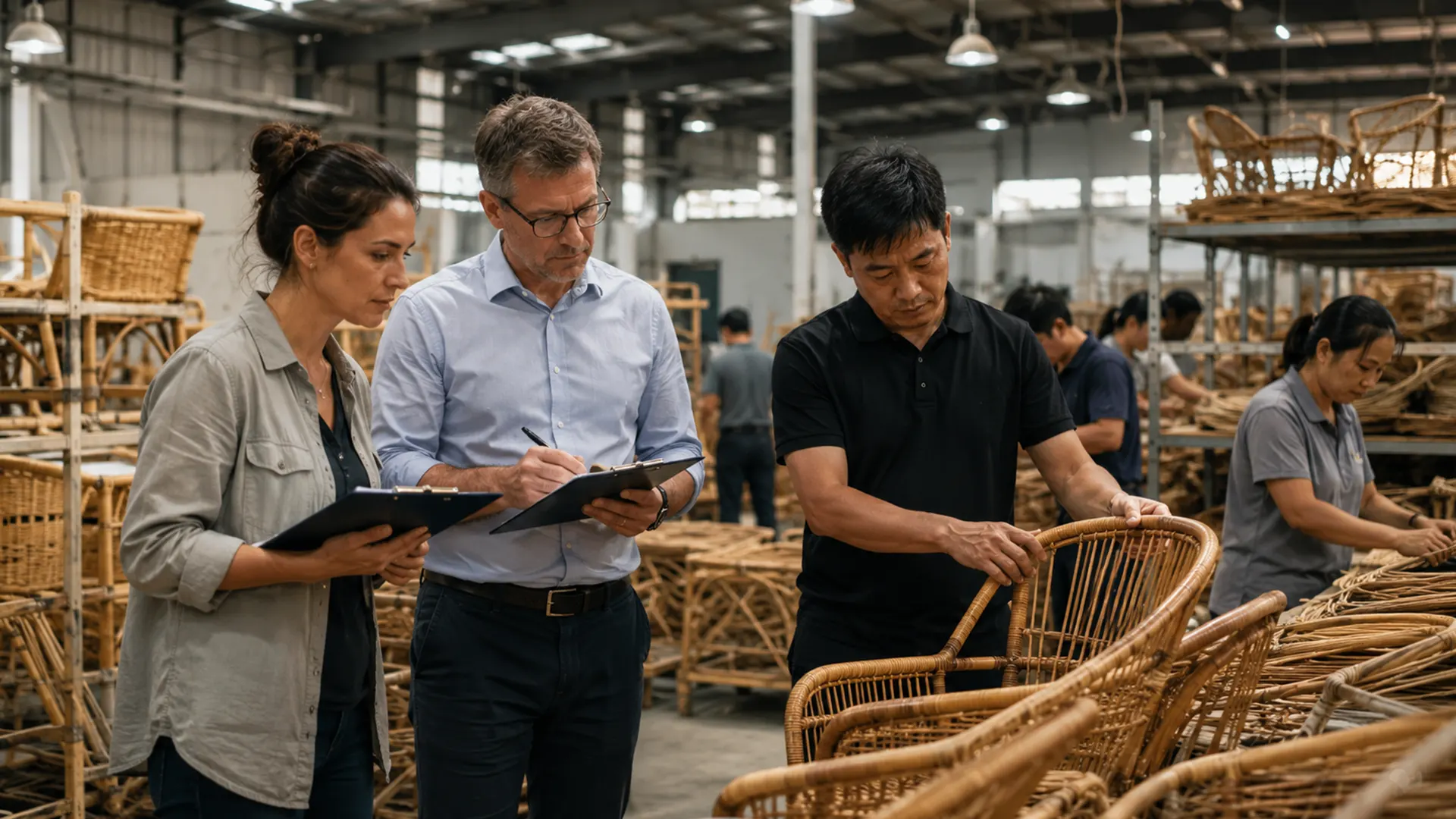
Regardless of country, buyers should verify the legal company, actual production facility, product capability, quality systems, export capability and bank details before significant commercial exposure.
A country with a strong manufacturing reputation does not protect the buyer from choosing the wrong individual supplier. Factory visit, live video verification, samples, documentation checks and third-party audits can all be useful depending on order risk.
Vietnam vs Indonesia: Procurement Comparison
| Procurement Area | Vietnam | Indonesia |
|---|---|---|
| Natural rattan specialization | Available and supplier-dependent | Particularly strong area for many specialist suppliers |
| Broader furniture ecosystem | Strong across multiple furniture and material categories | Strong furniture capability with significant rattan specialization |
| Mixed materials | Often attractive for rattan, wood, metal and upholstery combinations | Also widely available, especially rattan combined with wood or metal |
| Handwoven rattan | Available through specialist manufacturers and workshops | Major sourcing strength in established rattan production networks |
| OEM / ODM | Available; capability must be verified per supplier | Available; capability must be verified per supplier |
| Mixed containers | Can be attractive for broad multi-category collections | Can be attractive for coordinated rattan-focused collections |
| Quality | Supplier-specific | Supplier-specific |
| MOQ | Supplier and product-specific | Supplier and product-specific |
| Lead time | Order and supplier-specific | Order and supplier-specific |
| Landed cost | Depends on FOB, CBM, freight and destination costs | Depends on FOB, CBM, freight and destination costs |
Which Country Is Better For Low Prices?
Neither country should be selected using a general assumption about price. A supplier's unit price reflects materials, construction, labour, finish, scale, packaging and commercial strategy.
More importantly, the lowest unit price can be commercially misleading. Buyers should compare landed cost per sellable unit after freight allocation and expected quality risk.
If one supplier offers a chair at a lower FOB price but loads substantially fewer pieces per container, its landed cost may be worse. Conversely, a higher-priced product may not necessarily be better if its packaging and production quality provide no measurable advantage.
Which Country Is Better For Premium Natural Rattan?
Indonesia should normally be included in the supplier search for collections heavily focused on natural rattan craftsmanship because of its specialist production heritage and supplier base. However, this does not mean buyers should exclude Vietnam. Vietnamese manufacturers and workshop networks can also produce sophisticated natural-rattan products.
The correct process is to shortlist suppliers in both countries, request comparable samples and evaluate workmanship, materials, consistency, packing and price.
Which Country Is Better For Large Multi-Category Collections?
Vietnam can be particularly attractive where buyers need broader furniture programs involving rattan plus other construction materials or product categories. Its wider furniture export ecosystem can simplify certain multi-category sourcing strategies.
Nevertheless, consolidation across several independent factories creates its own challenges. Buyers must establish responsibility for quality, packaging, timing and export coordination.
Can Buyers Source From Both Countries?
Yes. For larger purchasing organizations, dual-country sourcing can reduce dependence on a single supply base and allow each market to be used for its strongest product categories.
For example, a buyer might develop highly rattan-intensive designs in Indonesia while sourcing complementary mixed-material furniture or other natural-fibre products from Vietnam. This is only an illustrative sourcing strategy, not a universal recommendation.
The disadvantage is additional operational complexity: more supplier relationships, potentially different ports, separate containers, additional inspections and more inventory coordination.
Calculate Landed Cost Before Choosing
A serious Vietnam-versus-Indonesia decision should end with a landed-cost model, not a catalogue comparison.
For each shortlisted SKU, compare:
- FOB unit price
- Packed dimensions
- CBM per unit
- Estimated container quantity
- Ocean freight allocation
- Testing and inspection cost
- Tooling or development cost
- Destination charges
- Applicable import duties
- Inland transportation
- Expected damage exposure
Freight, duties and other numerical costs change over time and by destination. Any examples used in early planning should be considered illustrative until current commercial rates are confirmed.
A Practical Supplier Selection Scorecard
| Factor | Suggested Buyer Question |
|---|---|
| Product expertise | Which supplier demonstrates the strongest experience with this exact construction? |
| Sample | Which sample best matches specification and workmanship requirements? |
| Materials | Are material specifications transparent and repeatable? |
| FOB price | Are quotations genuinely based on equivalent specifications? |
| CBM | Which packaging solution creates better container economics? |
| MOQ | Which supplier fits the planned SKU mix? |
| Quality system | Which supplier has the strongest process control? |
| Lead time | Which production plan is realistic rather than simply attractive? |
| Export capability | Can documentation and loading be handled reliably? |
| Communication | Which supplier responds accurately and manages revisions correctly? |
| Landed cost | Which option produces the strongest total commercial result? |
Frequently Asked Questions
Is Indonesia always cheaper than Vietnam for rattan furniture?
No. Pricing depends on the supplier, product, material, construction, finish, quantity and packaging. Country-level assumptions are not a substitute for comparable quotations.
Is Indonesia better for natural rattan?
Indonesia has a particularly strong reputation and specialist ecosystem around natural rattan, making it an important sourcing market for rattan-intensive collections. However, supplier-level quality and capability still require verification.
Is Vietnam better for mixed-material furniture?
Vietnam can be especially attractive for collections combining rattan with wood, metal, upholstery and other furniture categories because of its broad manufacturing ecosystem. Specific capability must still be confirmed with each supplier.
Which country has lower MOQ?
There is no reliable country-wide answer. MOQ depends on the individual supplier, SKU, finish, material and customization requirements.
Which country offers better quality?
Neither country has automatically better quality. Quality depends on the manufacturer, specification, process control, sample approval and inspection system.
Should I source from both Vietnam and Indonesia?
For sufficiently large purchasing programs, sourcing from both countries can diversify supply and match product categories with specialist capabilities. It also increases coordination and logistics complexity, so the commercial benefit should justify the additional management effort.
The Better Country Is The One That Produces The Better Commercial Result
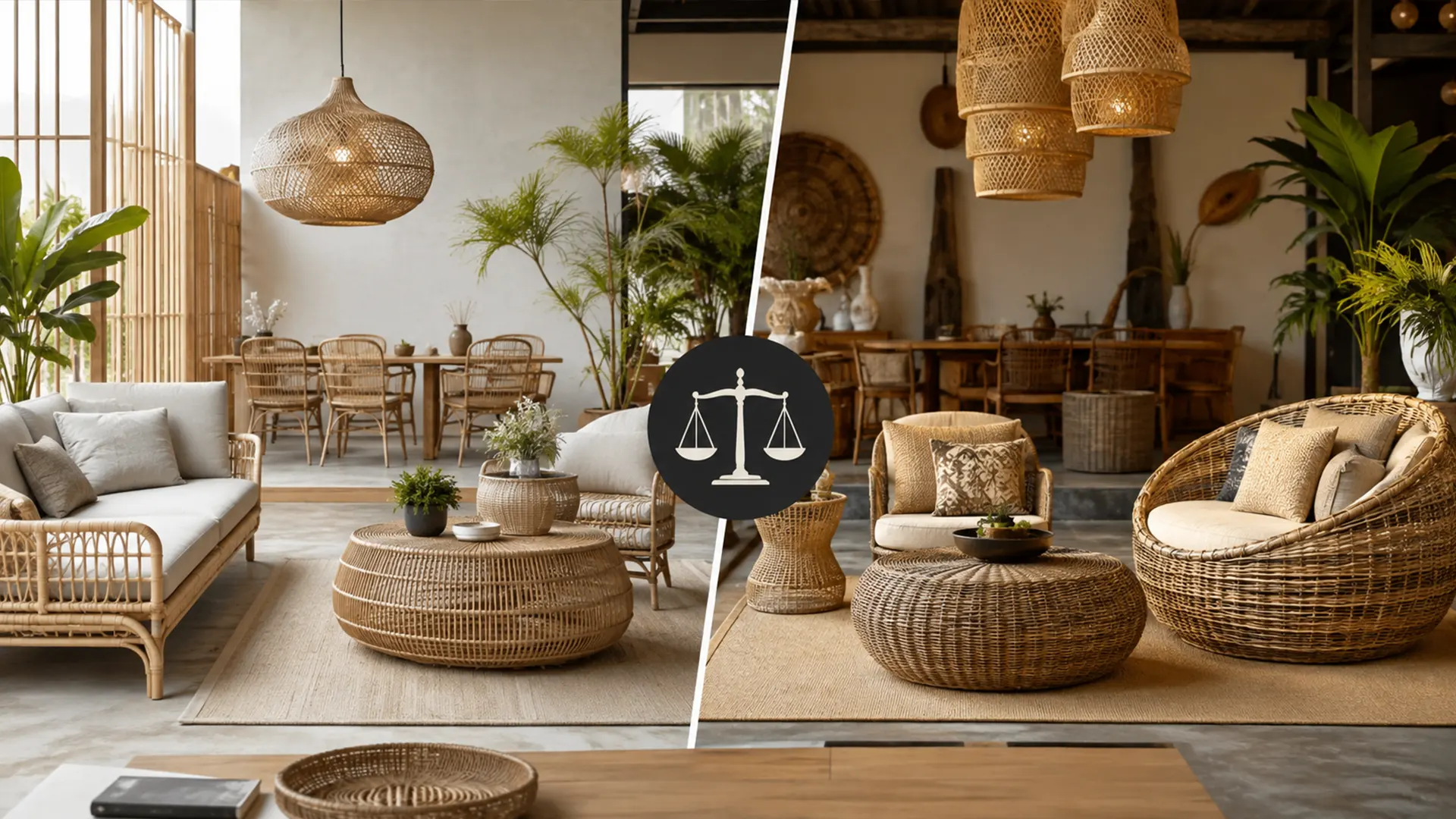
Vietnam versus Indonesia should not be treated as a competition with one permanent winner. Indonesia can be highly attractive for natural-rattan specialization and artisan-intensive furniture, while Vietnam can be particularly strong for broader export furniture programs, mixed-material development and multi-category sourcing. Both markets can produce excellent or disappointing results depending on the supplier selected.
Professional importers should compare actual factories using the same RFQ, the same quality requirements and the same commercial basis. Evaluate samples, packed CBM, MOQ, lead time, quality systems, export capability and landed cost before choosing the sourcing base.
If you are comparing Vietnam, Indonesia or a broader Southeast Asian sourcing strategy for a 20ft, 40ft, 40HC, mixed-container, OEM, ODM or private-label furniture program, send your wholesale RFQ and sourcing requirements to evaluate the project on a product-by-product and container-by-container basis.