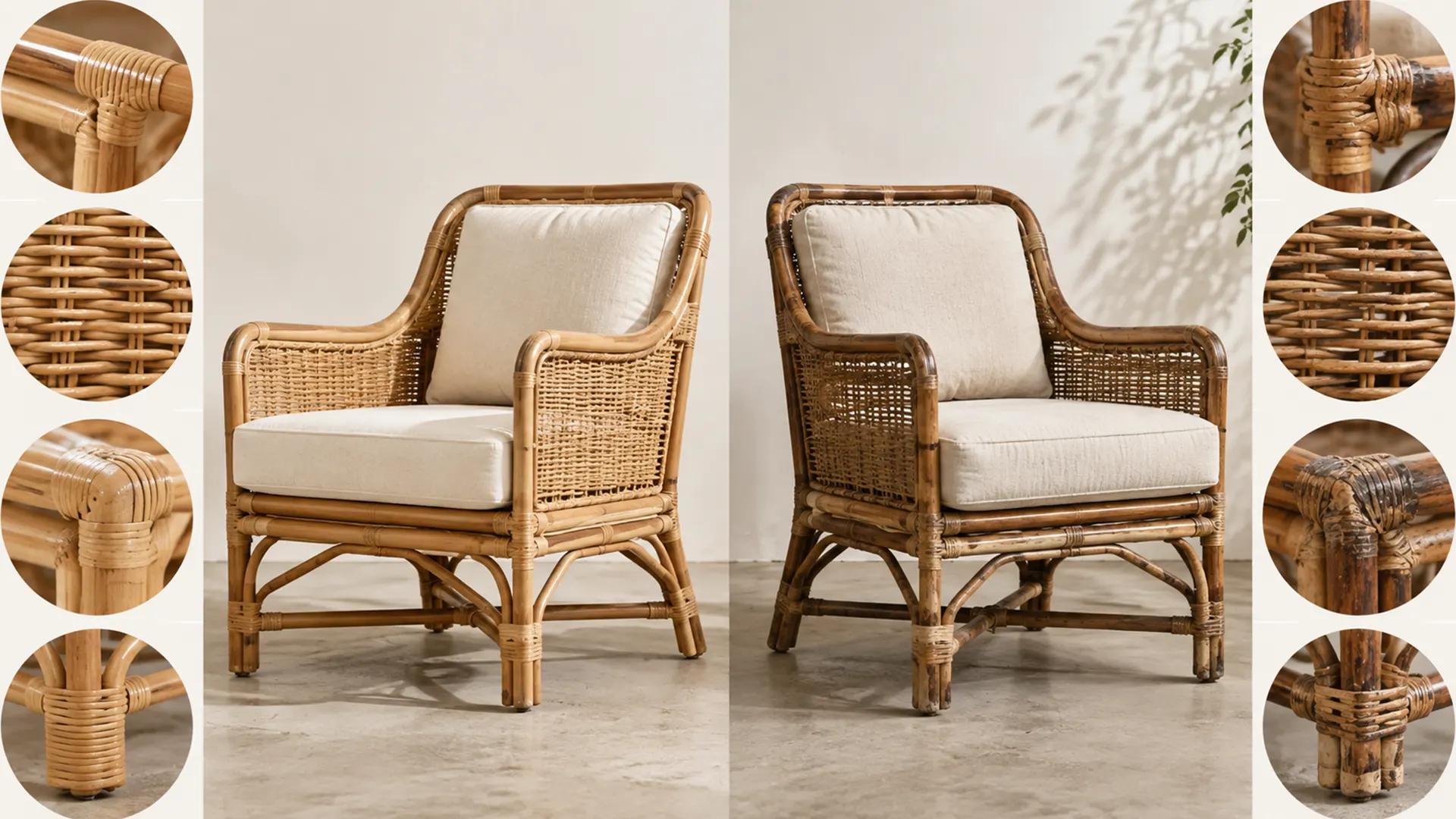
Rattan Export buyer guide: What Determines The FOB Price Of Rattan Furniture.
The FOB price of rattan furniture is determined by much more than the amount of natural rattan used in the product. For international importers, wholesalers, distributors, retail chains and hospitality buyers, the quoted FOB unit price reflects a combination of raw materials, frame construction, labour, weaving complexity, finishing, hardware, cushions, packaging, order quantity, customization, quality requirements, inland export costs and supplier operating structure. Two chairs that look almost identical in a photograph can therefore have significantly different FOB prices because their internal construction, material grade, production time and packing specifications are different. Buyers should not evaluate a quotation by unit price alone. The stronger approach is to understand exactly what is included in the specification and then compare FOB price together with quality, packed CBM, expected container quantity and landed cost.
What Does FOB Mean For Rattan Furniture?
FOB means Free On Board. Under an FOB transaction, the commercial responsibilities of the seller and buyer are divided according to the agreed Incoterm and named port of shipment.
For a rattan furniture order exported from Vietnam, an FOB quotation normally needs to identify the relevant port clearly. Buyers should avoid treating “FOB Vietnam” as a complete commercial term because the actual named port matters.
FOB pricing is only one part of the wider export and container purchasing process. Ocean freight, destination charges, import clearance, duties or taxes where applicable and onward transportation are not the same thing as the supplier's FOB furniture price.
Raw Material Is A Major Price Driver
The type, quantity and quality of materials used in a product can significantly affect its FOB price.
Rattan furniture may incorporate:
- natural rattan poles;
- rattan peel or binding material;
- cane webbing;
- bamboo;
- timber;
- plywood or engineered panels;
- metal frames;
- foam;
- fabric;
- leather or synthetic upholstery;
- glass, stone or other tabletop materials;
- hardware and fittings.
A chair made primarily from a simple rattan frame is commercially different from a chair that combines selected rattan, hardwood framing, handwoven cane panels, upholstered seating and metal hardware.
Natural Rattan Grade Can Affect Cost
Natural rattan is not a perfectly uniform industrial material. Diameter, straightness, surface condition, colour, maturity and usable length can vary.
Different product designs may require different material selection. A visible structural pole for a premium chair may require more careful sorting than rattan used in a less visible component.
Material preparation may also involve:
- sorting;
- cutting;
- straightening;
- bending;
- drying;
- sanding;
- surface preparation;
- treatment appropriate to the production process.
Higher material-selection requirements can increase both raw-material consumption and labour.
Frame Construction Changes The FOB Price
The internal construction of a rattan product is one of the most important reasons why visually similar furniture can have different prices.
Price can be affected by:
- number and thickness of structural members;
- type of internal reinforcement;
- joint construction;
- use of timber or metal support frames;
- number of bending operations;
- complexity of the geometry;
- amount of hand fitting required.
A simple side table with a basic frame can require far less production time than an ergonomic lounge chair with multiple curves, reinforced joints and a complex back structure.
Hand Weaving Is A Labour Cost
Many rattan and natural-fibre products involve substantial manual work. Weaving complexity can therefore become a major part of the FOB price.
The cost can vary according to:
- area being woven;
- density of weaving;
- pattern complexity;
- material thickness;
- number of colour changes;
- edge finishing;
- skill level required;
- time needed to maintain consistent tension.
A large open weave may require much less labour than a tight and detailed pattern covering the same physical area.
Complex Shapes Require More Labour
Curved rattan furniture often requires heating, bending, forming, positioning and securing natural material into the required shape. More complex geometry increases production time and can also increase rejection or rework risk.
Products with:
- multiple curves;
- asymmetrical forms;
- complex arm structures;
- sculptural backs;
- tight radius bends;
- many connection points;
may cost more than simpler rectangular or straight-frame designs even when their overall dimensions are similar.
Product Size Matters, But Not By Itself
A larger product generally consumes more material, but size alone does not determine price.
A large, simple bench may sometimes require less labour than a smaller chair with detailed weaving, complex bending and upholstered components.
When comparing quotations, buyers should therefore consider:
- overall dimensions;
- material quantity;
- construction complexity;
- manual labour hours;
- surface area requiring finish;
- packing volume.
Finishing Can Create Significant Price Differences
The finishing system can materially influence FOB price. Natural, stained, painted, washed or multi-step finishes require different labour and consumables.
Finishing may involve:
- sanding;
- surface cleaning;
- staining;
- sealer application;
- painting;
- top coating;
- distressing or special effects;
- drying between stages;
- touch-up;
- final inspection.
A simple natural finish generally has a different production structure from a custom colour requiring several coating stages and strict colour matching.
Custom Colours Can Increase Cost
Custom colours can create additional material preparation, production setup and quality-control requirements.
Small quantities in a special finish can be especially inefficient because the factory may need to prepare a separate finish batch for only a limited number of units.
Buyers should clarify:
- whether the colour is standard;
- whether colour matching is required;
- whether a physical colour sample must be approved;
- whether the finish has its own MOQ;
- whether additional sampling costs apply.
Cushions And Upholstery Can Be A Large Cost Component
For lounge chairs, sofas, dining chairs and daybeds, the furniture frame may represent only part of the total FOB price.
Cushion and upholstery cost can depend on:
- foam type and density;
- cushion thickness;
- number of cushions;
- fabric type;
- fabric consumption;
- zipper and sewing details;
- removable or fixed covers;
- piping;
- water-resistant or performance requirements;
- buyer-specified fabric.
Two identical rattan frames can therefore have materially different final prices depending on the cushion specification.
Hardware And Additional Components Affect Price
Hardware becomes particularly important in knock-down and semi-knock-down furniture.
Costs can include:
- bolts;
- screws;
- threaded inserts;
- brackets;
- leveling feet;
- hinges;
- drawer runners;
- handles;
- assembly tools;
- replacement hardware.
Higher-quality hardware can increase the factory cost but may reduce structural problems and customer complaints.
Knock-Down Construction Can Change Both Production Cost And Shipping Economics
Knock-down construction may require extra engineering, machining and hardware compared with a permanently assembled product. This can increase the unit production cost.
At the same time, KD construction can significantly reduce packed CBM and allow more units to fit inside the same container.
This means a KD version can have a slightly higher FOB unit price but still produce a lower landed cost after freight is allocated across a larger number of units.
For container buyers, FOB and packed CBM should therefore be evaluated together.
Order Quantity Influences Unit Price
Production economics usually improve when setup activities and material purchasing can be spread across a larger batch.
A supplier may need similar preparation for:
- production jigs;
- material purchasing;
- finish preparation;
- sample references;
- quality setup;
- packaging preparation;
whether the buyer orders a small or larger quantity of the same model.
This is one reason FOB pricing can change with quantity. However, buyers should not assume a fixed percentage discount for larger orders. The effect depends on the actual cost structure of the product.
MOQ And FOB Price Are Connected
If a buyer requests a quantity below the supplier's efficient production batch, the factory may either reject the quantity or quote a higher unit price.
This may happen because setup and purchasing costs are divided across fewer pieces.
For mixed containers, buyers should therefore evaluate:
- MOQ per SKU;
- quantity requested;
- price at that quantity;
- CBM at that quantity;
- commercial importance of the SKU.
Very low quantities are not always economically beneficial even when the supplier agrees to produce them.
Standard Products vs OEM Products
Existing catalogue products may have more established costing because the supplier already knows the materials, labour, tooling, packing and production process.
OEM or new custom products may require:
- technical drawings;
- new templates or jigs;
- prototype development;
- sample corrections;
- new packing development;
- new component sourcing;
- special quality-control references.
Some of these costs may appear directly as development or sampling charges, while others may be reflected in the quoted unit price.
Packaging Is Part Of The FOB Cost
Export packaging is not free. The cost and complexity of protecting rattan furniture for international shipping contribute to the commercial price.
Packaging may include:
- corrugated cartons;
- protective wrapping;
- foam sheets;
- corner guards;
- internal separators;
- hardware boxes;
- labels;
- printed instructions;
- moisture-control materials where appropriate.
Large retail-ready cartons may cost more than basic wholesale protective packing.
Packaging should also be evaluated through the broader quality and pre-shipment control process, because reducing packing cost too aggressively can increase transit damage.
Better Packaging Can Also Reduce Landed Cost
The lowest-cost carton is not always the lowest-cost commercial solution. Packaging affects both damage risk and CBM.
An excessively large carton can increase shipping volume, while inadequate protection can increase claims, repairs and product loss.
The ideal packaging system balances:
- product protection;
- material cost;
- CBM;
- handling efficiency;
- destination unpacking requirements.
Quality-Control Requirements Affect Price
Higher quality standards can require additional inspection, sorting, rework and rejection of non-conforming pieces.
For example, a buyer may specify stricter controls around:
- colour consistency;
- dimensions;
- weaving quality;
- frame stability;
- surface finish;
- natural material variation;
- cracks or splits;
- hardware alignment;
- packing condition.
Tighter tolerances can increase production costs if more pieces require adjustment or rejection.
Natural Material Variation Has A Commercial Impact
Rattan and other natural fibres contain inherent variation. A supplier producing for a highly standardized retail program may need to sort materials more aggressively to achieve the buyer's desired visual consistency.
More material selection can increase waste and labour. Buyers should therefore define what variation is commercially acceptable instead of requiring unrealistic uniformity from a natural material.
Production Volume And Factory Utilization Matter
Supplier pricing can also be influenced by production scheduling and capacity utilization.
A factory operating near full capacity may price an urgent additional order differently from an order scheduled during a less constrained production period.
Likewise, very short lead-time requests can increase costs if they require:
- overtime;
- priority material purchasing;
- production rescheduling;
- expedited packaging;
- additional coordination.
Buyers should avoid assuming that the same product will always have exactly the same commercial price regardless of timing.
Seasonal Raw-Material And Input Costs Can Change Quotations
Supplier costs can change over time as raw materials, timber, metal, foam, fabric, packaging and labour inputs move.
This is why professional quotations usually have a validity period. Buyers should confirm whether an older quotation is still valid before issuing a purchase order months later.
Currency Movements Can Influence Supplier Pricing
International quotations may be issued in USD while many supplier expenses are paid in local currency. Exchange-rate movements can influence future quotations and margins.
This does not mean every currency movement results in an immediate price change, but buyers should understand why a quotation issued at one time may not remain unchanged indefinitely.
Inland Logistics And Export Handling Are Part Of FOB Economics
FOB is not the same as ex-factory pricing. Moving products from the production location toward the named port and completing the seller-side export responsibilities creates costs.
Depending on the transaction, these may include:
- inland transportation;
- container positioning or loading-related operations;
- export documentation;
- customs-related handling;
- port or terminal-related seller-side costs;
- coordination and administration.
The precise responsibility depends on the agreed commercial structure and named port.
Factory Location Can Affect FOB Price
A supplier located farther from the export gateway may face higher inland transportation costs than one located closer to the relevant port.
However, factory location should not be evaluated in isolation. A supplier farther inland may still offer a better total product cost, stronger quality or a more suitable production capability.
When evaluating rattan furniture sourcing in Vietnam, buyers should compare the complete commercial offer rather than selecting suppliers solely by geographic proximity to a port.
Full-Container Efficiency Influences The Real Cost Of The Product
Although packed CBM does not directly define the supplier's FOB unit price in every quotation, it strongly influences the buyer's total economics.
Consider two illustrative products:
| Factor | Chair A | Chair B |
|---|---|---|
| FOB Unit Price | Lower | Slightly Higher |
| Packed CBM Per Unit | Higher | Lower |
| Container Efficiency | Lower | Higher |
| Possible Freight Allocation | Higher per unit | Lower per unit |
Without actual freight and loading data, it is impossible to state which has the better landed cost. The example demonstrates why FOB price alone is not enough for container purchasing decisions.
Mixed Containers Can Change Commercial Quantities
In a mixed container, buyers may order several SKUs at different volumes. The quantities selected can influence each item's production economics.
A buyer should avoid forcing every model to the lowest possible quantity. It may be more economical to concentrate volume on core sellers and maintain fewer small production batches.
Container planning should therefore connect:
- FOB;
- MOQ;
- packed CBM;
- sales forecast;
- inventory strategy;
- container utilization.
Supplier Business Model Also Influences Pricing
Different suppliers have different operating structures. A large factory, specialized workshop and sourcing organization may not calculate commercial pricing in exactly the same way.
The buyer should understand what services are included, which can potentially involve:
- product development;
- supplier coordination;
- quality control;
- consolidation;
- documentation;
- export management.
The lowest visible factory price is not automatically the lowest total procurement cost if additional coordination has to be purchased separately.
Illustrative FOB Cost Structure
The following table is conceptual and does not represent a fixed percentage breakdown for the industry.
| Cost Area | Examples |
|---|---|
| Raw Materials | Rattan, timber, metal, fabric, foam, hardware |
| Production Labour | Frame making, bending, weaving, sanding, assembly |
| Finishing | Stain, paint, coating, drying and touch-up |
| Packaging | Cartons, protection, labels and instructions |
| Quality | Inspection, sorting, correction and rejection allowance |
| Factory Overhead | Facilities, equipment, supervision and administration |
| Export-Side Costs | Inland and seller-side export handling associated with the agreed FOB term |
| Commercial Margin | Supplier's required return on the transaction |
The proportions vary significantly by product and supplier. A labour-intensive woven chair can have a very different cost structure from a simple knock-down table.
Why Two Similar Chairs Can Have Different FOB Prices
When two quotations differ, buyers should investigate the specification before negotiating only on price.
Differences may include:
- rattan diameter or quality;
- frame reinforcement;
- weaving density;
- joint construction;
- finish system;
- cushion specification;
- hardware;
- packing method;
- quality tolerances;
- order quantity.
A photograph rarely reveals all of these differences.
Questions Buyers Should Ask When Comparing FOB Quotes
- What exact materials are included?
- What are the finished dimensions?
- What frame construction is used?
- What weaving specification is included?
- What finish is included?
- Are cushions included?
- What fabric and foam specifications apply?
- What hardware is included?
- What is the MOQ?
- What quantity is the price based on?
- What is the packing method?
- What are the packed dimensions?
- What is the CBM per unit?
- Which named FOB port applies?
- How long is the quotation valid?
- What quality requirements are included?
Common FOB Comparison Mistakes
- Comparing prices without matching specifications.
- Ignoring material grade.
- Ignoring frame construction.
- Comparing different finish systems as if they were identical.
- Ignoring cushions and fabric specifications.
- Not checking MOQ.
- Ignoring export packaging.
- Not comparing packed CBM.
- Using different named ports without noticing.
- Assuming an old quotation is still valid.
- Choosing the lowest FOB without estimating landed cost.
Frequently Asked Questions
Is Rattan Material The Main Factor In FOB Price?
It is an important factor, but labour, frame construction, weaving, finishing, upholstery, hardware, packing, quantity and export-side costs can also materially affect the final price.
Why Can Two Similar Rattan Chairs Have Different Prices?
They may use different material grades, internal frames, weaving density, finishes, cushions, hardware, packaging or quality standards even if their photographs look similar.
Does A Larger Order Always Reduce FOB Price?
Not automatically. Larger quantities can improve production economics, but the effect depends on the supplier's actual material and labour cost structure.
Does Knock-Down Furniture Have A Lower FOB Price?
Not necessarily. KD furniture may require additional hardware and engineering, which can increase production cost. Its benefit may instead come from lower packed CBM and improved container utilization.
Does Custom Colour Increase FOB Price?
It can, particularly when a separate finish batch, sample matching or low production quantity is required.
Should Buyers Choose The Lowest FOB Quote?
Not without comparing specifications, quality, MOQ, packed CBM, container quantity and landed cost. A lower factory price can become more expensive after logistics or quality problems are considered.
Evaluate FOB Price As Part Of Total Procurement Cost
The FOB price of rattan furniture is the result of many connected decisions: material selection, product engineering, hand labour, finish, upholstery, hardware, packaging, order quantity, quality standard and export structure.
Professional container buyers should therefore compare quotations line by line rather than treating visually similar products as equivalent. The goal is not simply to obtain the lowest FOB number. The goal is to identify the specification and supplier structure that delivers the required quality with efficient container utilization and a commercially competitive landed cost.
Need to evaluate FOB pricing for a full-container rattan furniture order? Send your product list, specifications, target quantities, preferred finishes and destination through our wholesale inquiry so the proposed order can be reviewed from sourcing, pricing, packing and container-planning perspectives.