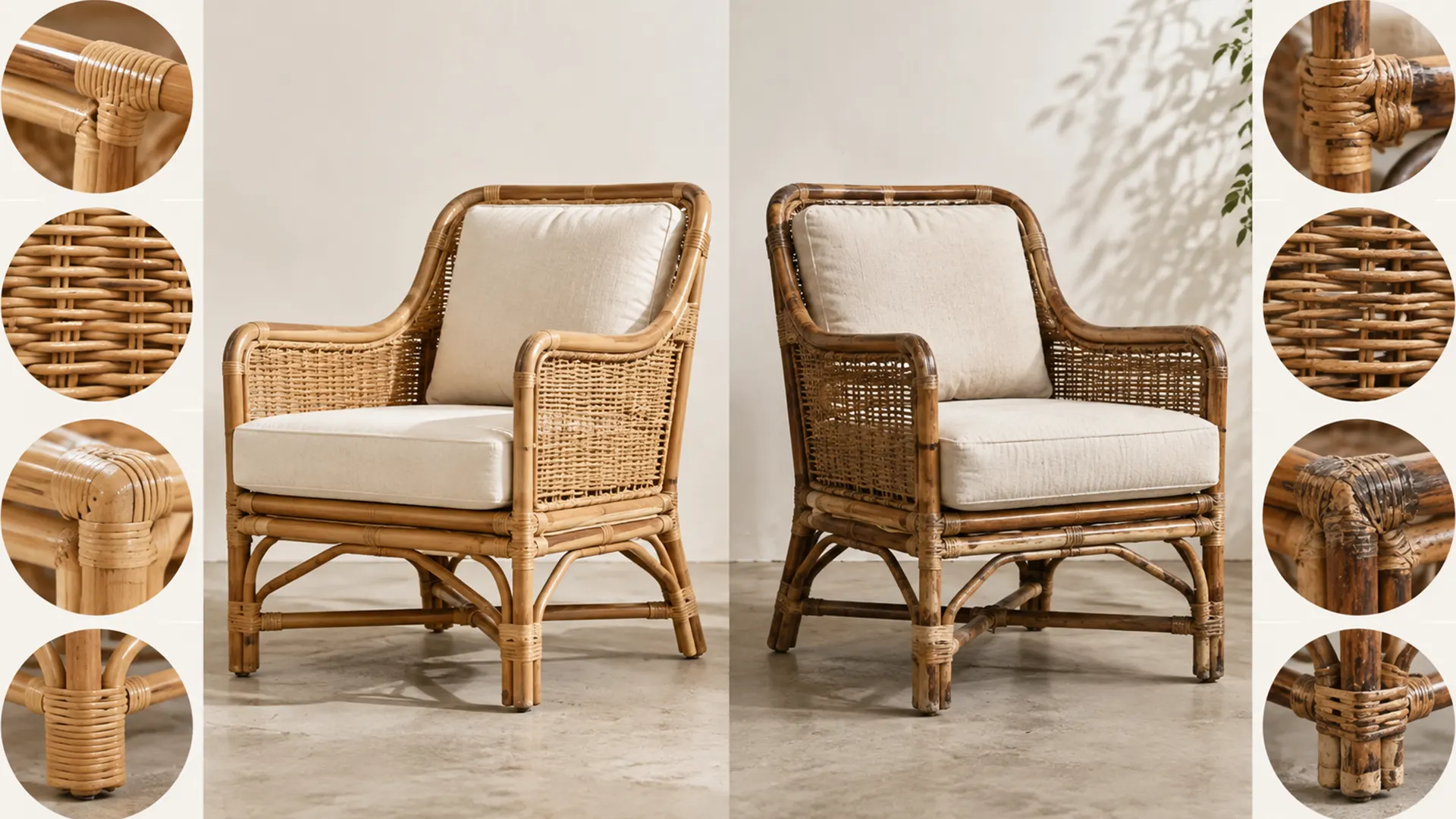
Rattan Export buyer guide: What Information Should You Send To Get An Accurate Rattan Furniture Quote.
An accurate rattan furniture quotation starts with an accurate request for quotation. In professional B2B sourcing, sending a supplier only a product photo and asking for the “best FOB price” is rarely enough. Rattan, bamboo and natural-fibre furniture can look similar in photographs while differing significantly in material grade, frame construction, dimensions, weaving density, finishing process, cushions, hardware, packing method and quality requirements. Each of these variables can affect production cost, CBM, container utilization and ultimately the landed cost paid by the importer.
For international importers, wholesalers, distributors, retail chains, hospitality buyers and project procurement teams, the goal of an RFQ should therefore be simple: give the supplier enough information to price the same product you actually intend to purchase. A detailed RFQ also makes it much easier to compare several suppliers on a like-for-like basis instead of comparing quotations that were calculated using different assumptions.
Why Incomplete RFQs Produce Unreliable Prices
When important specifications are missing, the supplier must fill the gaps with assumptions. One factory may assume natural rattan of one grade, another may calculate with a different weaving specification, and another may use a cheaper packing method. All three can return apparently competitive quotations, but they are not necessarily quoting the same product.
This is one of the most common problems in international furniture sourcing. A buyer may initially receive an attractive price and later discover that the quotation did not include the expected cushion specification, carton protection, moisture control, private-label packaging, export testing or requested surface finish. The revised quotation then appears to have increased even though the original RFQ simply did not define the product sufficiently.
A good RFQ reduces this ambiguity before commercial negotiations begin.
1. Provide A Clear Product Reference
Start by identifying exactly what product you want quoted. If the item already exists in the supplier's catalogue, provide the supplier's item code or model number. If the product is your own design, include your internal SKU or project reference so that all future communication, samples and quotations refer to the same item.
If you are sourcing from a photograph, Pinterest reference, competitor product or concept image, make it clear that the image is only a design reference unless you have complete specifications. A photograph alone cannot reliably communicate dimensions, frame thickness, material type, internal reinforcement, weaving density or production method.
For each SKU, ideally provide:
- Product name and reference number
- Product photographs or technical drawings
- Front, side and rear views where relevant
- Close-up photographs of weaving, joints, legs, handles or special details
- Required dimensions
- Any existing sample or benchmark product information
When sourcing products from Vietnam, understanding the available manufacturing ecosystem and material origins can also help buyers define realistic product requirements. Our overview of Vietnam sourcing and production origins provides additional context for buyers evaluating rattan, bamboo and natural-fibre supply options.
2. Specify Exact Product Dimensions
Dimensions are fundamental to both manufacturing cost and container planning. A quotation should normally be based on confirmed dimensions rather than visual estimation.
Depending on the product, provide overall width, depth and height as well as relevant functional dimensions such as seat height, seat depth, arm height, tabletop thickness, shelf spacing or basket diameter. For modular or project furniture, include component dimensions and assembly relationships.
If dimensions are not finalized, state that clearly and ask the supplier to quote according to a provisional specification. This allows both parties to understand that pricing may need revision once dimensions are confirmed.
Small dimensional changes can affect material consumption, packing dimensions and loading efficiency. This becomes especially important when hundreds of units must be allocated across a 20ft, 40ft or 40HC container.
3. Define The Rattan, Bamboo And Structural Materials
The term “rattan furniture” alone does not define the bill of materials. Buyers should identify, as far as possible, the expected structural and decorative materials.
Important questions may include:
- Is the main structure natural rattan, bamboo, wood, metal or a combination?
- Which parts must use natural rattan?
- Is synthetic weaving acceptable anywhere in the product?
- Is the frame intended for indoor, covered outdoor or other specified use?
- Are there requirements regarding material diameter, appearance or consistency?
- Are plywood, MDF or other engineered components allowed?
- Are metal reinforcements or brackets required?
If a specific botanical species, material origin or grade is commercially important, include that requirement in the RFQ and request documentation where appropriate rather than assuming that all natural rattan is interchangeable.
4. Describe The Construction Method
Construction has a direct impact on both price and durability. The supplier should know whether the product will be fully assembled, knock-down, partially knock-down, nested or stackable.
For chairs, tables, beds, shelving, cabinets and larger furniture pieces, clarify how joints should be made and whether visible screws or bolts are acceptable. If the item must support a specified commercial-use load or hospitality application, communicate the intended performance requirements at quotation stage.
Knock-down construction can reduce packed CBM for some products, but it may add hardware, machining, assembly instructions and additional packaging requirements. Fully assembled construction can simplify installation for the final customer while consuming more container volume. The most economical option therefore depends on both factory cost and logistics cost rather than manufacturing price alone.
5. Provide Weaving Specifications
For woven furniture, baskets, lighting, decorative accessories and natural-fibre products, weaving specifications can materially change labour cost. A dense, complex handmade weave generally requires more time than a simple open pattern.
Send close-up references showing the desired weaving pattern and identify important characteristics such as strand width, spacing, pattern direction, edge finishing and consistency. Where colour variation is acceptable because of the natural material, define an acceptable visual range during sampling rather than expecting factory production to reproduce one photograph with perfect uniformity.
6. Specify Finish And Colour Requirements
Natural, clear-coated, stained, painted, washed, antique-style and other finishes require different processes. The RFQ should clearly identify the desired appearance.
Useful information includes:
- Natural or coloured finish
- Reference sample, colour code or approved colour image
- Matte, satin or other required sheen level
- Visible grain or natural variation expectations
- Distressed, washed or aged effects
- Required coating or finishing restrictions for the destination market
Colour matching should normally be confirmed using physical samples or an agreed approval procedure. Screen colours and photographs can vary considerably and should not be treated as precise production standards.
7. Include Cushion And Textile Specifications
If furniture includes cushions, upholstery or removable covers, these elements must be specified separately. A chair quotation excluding cushions cannot be meaningfully compared with another quotation that includes complete cushions and covers.
Provide requirements for fabric composition, colour, fabric weight where relevant, foam type or density requirements, cushion thickness, zipper construction, removable covers, piping, fire-performance requirements and customer-supplied fabric if applicable.
For hotel, resort and contract projects, textile specifications may have a substantial impact on compliance, durability and final pricing.
8. Explain Intended Use And Destination Market
The supplier should know where and how the product will be used. Furniture intended for a residential retailer, hotel room, restaurant, covered terrace or commercial lobby may require different construction, testing or finishing standards.
The destination country is equally important because packaging, labelling, documentation, fumigation requirements, product testing and chemical restrictions may differ between markets.
Do not simply write “export quality.” That phrase is too vague to function as a technical requirement. Instead, identify the destination market and specify the standards, buyer protocols or testing requirements that apply to the order.
9. Send Your Expected Order Quantity And Container Strategy
Suppliers need to understand the commercial scale of the inquiry. Instead of asking only for “MOQ,” explain the order scenario you are evaluating.
For example, indicate whether you are considering a 20ft container, 40ft container, 40HC container, mixed container order, repeat wholesale program or project-specific procurement.
If several SKUs will be combined, provide a provisional quantity or percentage allocation for each product. This helps the supplier evaluate production planning, MOQ per SKU and container loading.
Container-based buyers should also ask whether different finishes or colours can be combined within one production order and whether MOQ applies per model, per colour, per material or per shipment.
Any container quantity supplied during early quotation should be treated as an estimate until final packed dimensions and the loading plan are confirmed. Actual loading depends on product dimensions, carton dimensions, nesting, knock-down construction, protective packaging and loading method.
10. Request Packed Dimensions And CBM
For international furniture imports, unit price alone is not enough. Buyers should request export packing dimensions, gross weight, net weight and CBM per carton or packed unit.
CBM should be calculated from the final packed dimensions, not only from the external dimensions of the assembled furniture. A product that appears slightly cheaper at FOB level may become more expensive after freight allocation if its packaging uses substantially more container space.
This is why procurement teams should evaluate both FOB cost and logistics efficiency. Container planning, Incoterms and shipment responsibilities are discussed further in our guide to export operations and container logistics.
11. Define Export Packaging Requirements
Furniture packaging should be specified before final quotations are compared. Different protection levels can materially affect cost and CBM.
Possible requirements include:
- Carton packing
- Individual or multi-unit cartons
- Foam, corner guards or protective wrapping
- Hardware bags and assembly instructions
- Moisture-control materials where appropriate
- Palletization if required
- Shipping marks
- Barcode labels
- Retail labels
- Private-label cartons
- Customer-specific packaging artwork
For bulky furniture, overpacking can reduce container utilization, while insufficient protection can increase transit damage. The objective is therefore not simply to use the strongest possible packaging, but to develop a packing specification appropriate for the product, transportation route and buyer's distribution system.
12. Communicate Moisture, Mold And Quality Expectations
Natural rattan, bamboo, wood and other plant-based materials require disciplined moisture management during production, storage and export preparation. Buyers should communicate any required moisture parameters, mold-prevention procedures, inspection criteria or destination-specific requirements at RFQ stage.
Quality expectations should also cover workmanship such as weaving consistency, surface preparation, colour variation, joint quality, stability, sharp edges, visible glue, hardware installation and carton condition.
When applicable, define whether quality inspections will be performed during production, before shipment or both. Buyers can review the broader approach to quality control, inspection and export compliance before building these requirements into an RFQ.
13. State Testing And Compliance Requirements
If the product must meet specific buyer standards, retailer protocols or national regulations, communicate them before the quotation is finalized. Testing can involve structural performance, stability, coatings, restricted substances, textiles, packaging or other product-specific requirements.
Do not assume the factory has automatically included every possible test in the unit price. Specify which tests are mandatory, who will arrange them, which laboratory or protocol is acceptable where relevant and who is expected to pay the associated costs.
14. Clarify OEM, ODM And Private-Label Requirements
If the product requires customization, explain the scope clearly. OEM and ODM can involve much more than changing colour.
Customization may include dimensions, weaving patterns, frame details, logos, metal tags, woven labels, packaging, instruction sheets, barcodes, carton artwork or completely new product development.
The supplier should understand which elements are already designed and which require engineering or development support. If tooling, molds, jigs, prototypes or development samples may be needed, ask for these costs to be identified separately.
15. Explain Your Sampling Requirements
Sampling is an important stage when developing furniture with a new supplier. State whether you need an existing factory sample, customized sample, pre-production sample, finish sample, material swatch or approval sample.
Ask the supplier to identify sample cost, development lead time, courier or freight arrangement and whether sample charges can be credited against a future production order if that is part of their commercial policy.
A sample should also have a defined approval purpose. Buyers should document dimensions, finish, construction, weaving, cushions and packaging changes before authorizing mass production.
16. Specify The Incoterm You Want Quoted
Commercial quotations are not comparable unless they use the same delivery basis. State whether you require EXW, FOB, CIF or another agreed Incoterm and specify the relevant named place or port.
A low EXW price may require the buyer to manage inland transport, export procedures and other origin costs. FOB includes a different scope of seller responsibilities, while CIF incorporates additional freight and insurance elements under the agreed terms. Buyers should therefore avoid comparing an EXW quotation from one supplier directly with a FOB or CIF quotation from another without normalizing the cost structure.
17. Provide The Destination Port Or Delivery Location
If you request CIF or freight-related estimates, the supplier or logistics partner needs the destination port. Even for FOB inquiries, providing the final destination can help suppliers understand documentation and market requirements.
If the shipment will move to an inland warehouse after arrival, procurement teams should calculate the wider landed-cost structure, including ocean freight, destination charges, customs duties where applicable, inland transportation and warehousing.
18. Ask For Lead Time And Production Assumptions
Request the supplier's estimated sample lead time, production lead time and loading readiness based on the proposed quantity and specification.
Lead time should not be treated as a universal fixed number. It can change according to order size, material availability, customization, finishing complexity, factory workload, approval timing and seasonal conditions. Buyers should also clarify when the production clock begins: deposit payment, sample approval, artwork approval or another agreed milestone.
19. State Your Required Quotation Validity And Currency
Ask suppliers to identify the quotation currency and validity period. Raw material, labour, packaging and logistics costs can change, so an old quotation should not automatically be assumed to remain valid for a future shipment.
If your company requires a particular quotation format, provide the template at the beginning. This saves time and makes supplier comparison easier.
20. Request A Clear Price Breakdown Where Needed
For standard products, a simple unit price may be sufficient. For customized or project orders, it can be useful to separate certain costs such as product price, cushions, packaging upgrades, tooling, samples, testing, private-label materials or development charges.
A transparent breakdown helps procurement teams identify which specification changes have the greatest commercial impact without forcing the supplier to disclose confidential internal costing.
A Practical Rattan Furniture RFQ Checklist
| RFQ Information | Why It Matters |
|---|---|
| Product reference and images | Ensures both parties discuss the same item |
| Dimensions | Affects material usage, manufacturing and CBM |
| Materials | Defines the product construction and cost basis |
| Weaving specification | Affects labour time and appearance |
| Finish and colour | Defines finishing processes and approval requirements |
| Cushions and textiles | Prevents missing components from the quotation |
| Order quantity | Supports MOQ and production planning |
| Container strategy | Supports mixed-load and loading calculations |
| Packed dimensions and CBM | Allows freight allocation and landed-cost analysis |
| Packaging | Affects protection, CBM and cost |
| Quality requirements | Establishes acceptance criteria |
| Testing and compliance | Prevents unplanned certification or testing costs |
| OEM / private label | Defines customization and development scope |
| Incoterm | Defines the commercial delivery basis |
| Destination | Supports freight and market-specific requirements |
| Lead time | Supports purchasing and launch planning |
How To Compare Supplier Quotations Correctly
After receiving quotations, do not rank suppliers only by the lowest unit price. First check whether every quotation is based on the same dimensions, materials, finish, cushions, packaging, quality requirements and Incoterm.
Then compare packed CBM, estimated container utilization, MOQ structure, sample conditions, lead time, testing responsibilities and payment terms. A slightly higher FOB price may still produce a better landed cost if the product packs more efficiently or includes specifications that another supplier has excluded.
For mixed containers, calculate the commercial value and CBM contribution of each SKU. This prevents high-volume, low-value products from consuming disproportionate container space and helps purchasing teams design a more commercially balanced shipment.
Common RFQ Mistakes Buyers Should Avoid
- Sending only a photograph without dimensions or specifications
- Requesting a “best price” without indicating expected order scale
- Comparing EXW, FOB and CIF prices as if they were equivalent
- Ignoring packed dimensions and CBM
- Leaving cushion specifications undefined
- Using vague terms such as “good quality” or “export quality”
- Failing to identify the destination market
- Adding packaging, testing or private-label requirements after price negotiation
- Assuming estimated container quantities are guaranteed loading quantities
- Requesting customized development without explaining which details can change
Frequently Asked Questions
Can I request a quotation using only a product photograph?
You can request an initial indication, but it should normally be treated as preliminary. Accurate production pricing requires dimensions, construction, material, finish, packing and commercial assumptions.
Should I ask for MOQ before sending product details?
You can ask, but MOQ often depends on the model, material, finish, customization and order structure. A more useful approach is to explain your intended container or purchasing program and request MOQ by SKU, finish or colour where relevant.
Why should CBM be included in a furniture quotation?
Furniture is often freight-sensitive because it occupies substantial container volume. CBM allows the buyer to estimate container utilization and allocate ocean freight across products when calculating landed cost.
Can a supplier guarantee how many pieces fit in a container?
Reliable loading quantities should normally be confirmed after final dimensions, export packing and loading configuration are known. Early figures should be treated as planning estimates because nesting, KD design, carton dimensions and protective packaging can change the result.
Should I request FOB or CIF?
The appropriate Incoterm depends on your logistics structure and purchasing strategy. Many professional importers compare FOB costs and arrange their own freight, while others prefer quotations incorporating additional logistics. The important point is to compare suppliers using the same commercial basis.
What is the most important information in a rattan furniture RFQ?
There is no single field that replaces the others. Product specification, dimensions, materials, order quantity, packaging, quality requirements and Incoterm collectively determine whether the quotation accurately represents the intended order.
A Better RFQ Creates A Better Quotation
The most effective way to obtain an accurate rattan furniture quotation is to remove uncertainty before asking the supplier to calculate a price. A professional RFQ tells the supplier what the product is, how it should be made, how it should be packed, how much the buyer expects to order, where the goods are going and which commercial terms should apply.
This does not mean every detail must be finalized before the first conversation. Early-stage buyers can clearly mark certain information as provisional and ask suppliers to identify assumptions. What matters is transparency. When assumptions are visible, quotations can be updated systematically as the product develops.
For container-based sourcing from Vietnam, a well-structured RFQ is also the foundation for supplier comparison, sample development, quality planning, container utilization and landed-cost analysis. If you are preparing a 20ft, 40ft, 40HC or mixed-container order for rattan, bamboo or natural-fibre furniture, send your wholesale RFQ and project requirements so the inquiry can be evaluated on a clear technical and commercial basis.