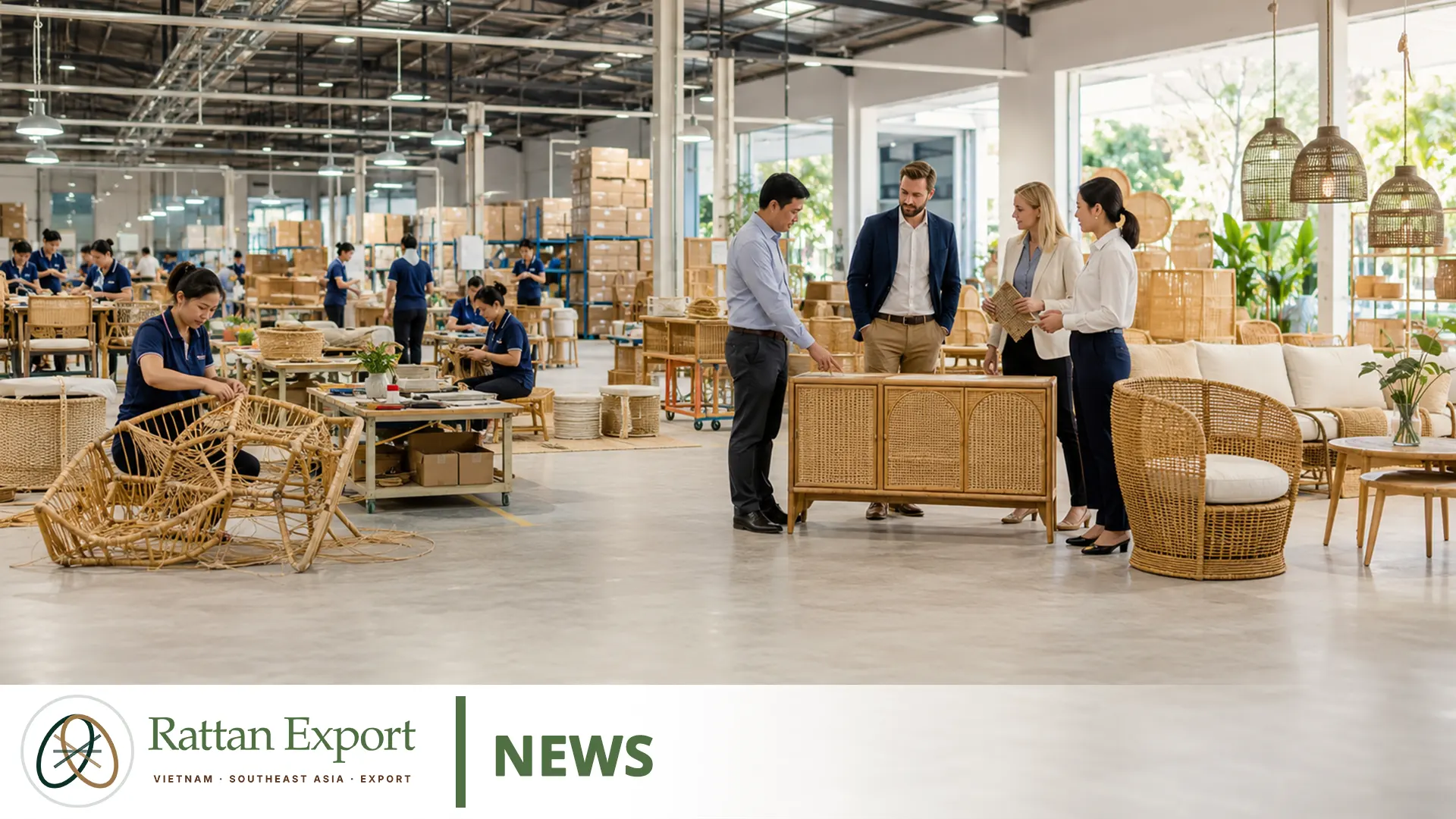
HawaExpo 2026 demonstrated that Vietnam's furniture manufacturing base is not a single type of factory or a single-material industry, but a broad export ecosystem ranging from high-volume industrial manufacturers to specialist mixed-material producers, upholstery factories, outdoor furniture suppliers, project contractors and design-led manufacturers. Held from March 4–7, 2026 at the Saigon Exhibition and Convention Center in Ho Chi Minh City, the fair brought 450 exhibitors and more than 2,500 booths and showcases across approximately 40,000 square metres. The official post-show report recorded 16,449 buyers and visitors, including 3,284 international buyers from 83 countries and territories. For global importers and sourcing teams, the importance of those figures is not simply the size of the exhibition. HawaExpo offered a concentrated view of the different production models, material capabilities, factory scales and commercial structures available inside Vietnam's furniture sector.
Vietnam's Furniture Manufacturing Base Is Large, but It Is Also Highly Diverse
The phrase “Vietnam furniture manufacturer” can describe very different businesses. One supplier may operate a highly automated industrial plant producing hundreds of containers each month. Another may specialize in mixed-media furniture combining wood, metal, stone and natural fibres. A third may focus on upholstery, contract furniture, hospitality projects or smaller customized programmes. HawaExpo's official exhibitor data make those differences visible.
| Example Manufacturer Profile | Reported Production Scale | Specialization |
|---|---|---|
| Large indoor furniture manufacturer | 90,000 m²; 300–400 containers/month | Dining, lounge and bedroom furniture in hardwood species |
| Nitori Furniture Vietnam | 568,000 m²; approximately 1,780 TEU capacity | Sofas, dining furniture and mattresses |
| Hao Hung | 5,000+ employees; approximately 500 containers/month | Indoor and outdoor wood furniture |
| ScanCom Vietnam | 116,000 m²; approximately 350 containers/month | Outdoor furniture using wood, metal, rope and composites |
| Fine Scandinavia | 11,000 m²; approximately 100 containers/month | Metal and mixed-material indoor and outdoor furniture |
| Sen Interior | 40,000 m²; approximately 50 containers/month | Hospitality and project furniture |
These examples should not be read as a ranking of suppliers. They illustrate something more useful to international procurement teams: Vietnam contains manufacturers operating at fundamentally different scales and with different commercial strengths. Selecting the right supplier therefore requires more than asking whether a factory “makes furniture.”
Export Scale Provides the Economic Foundation
Vietnam's manufacturing base sits inside one of the world's important wood and furniture export industries. Industry reporting ahead of HawaExpo showed that Vietnam exported more than US$17.2 billion of wood and wood products in 2025, up approximately 5.7% from 2024. The United States remained the largest market, accounting for roughly 54.65% of the industry's export value, or close to US$9.5 billion. The Department of Forestry and Forest Protection also reported that Vietnam remained among the world's five largest exporters of wood and wood products and ranked second, behind China, in deeply processed wood products with approximately US$11.7 billion in export turnover.
Those figures help explain why a furniture exhibition in Vietnam can display such a wide range of manufacturing capability. The supplier base has developed around decades of export production, international quality requirements, large retailer programmes, contract manufacturing and increasingly sophisticated OEM and ODM relationships.
From Solid Wood to Upholstery and Mixed Media
One of the clearest messages from HawaExpo 2026 was material diversity. Official exhibitor profiles included factories working with white oak, walnut, maple, birch, beech, ash, rubberwood, acacia, teak and eucalyptus alongside plywood, MDF and veneer. Other manufacturers combined wood with steel, stainless steel, aluminium, rope, fabric, leather, stone, cement, rattan and seagrass.
- Solid-wood manufacturers serve indoor dining, bedroom, living-room and outdoor programmes.
- Upholstery producers manufacture sofas, modular seating, recliners, mattresses and textile-based furniture.
- Mixed-material factories combine timber with metal, rope, stone, concrete, natural fibres and upholstery.
- Outdoor specialists work with teak, acacia, eucalyptus, aluminium, steel, rope and synthetic weaving.
- Hospitality and project manufacturers manage bespoke furniture, interior packages and contract specifications.
- Natural-material suppliers integrate rattan, seagrass and other fibres into furniture and home-furnishing collections.
For buyers, this diversity means Vietnam can support very different design languages. Scandinavian-style timber furniture, contemporary mixed-media collections, resort furniture, upholstered seating, mass-market garden products and natural-fibre interiors can all require different supplier profiles even when they sit inside the same broad furniture category.
Factory Size Does Not Tell the Whole Story
Large production capacity is valuable for major retail programmes, but it is not automatically the right answer for every buyer. A manufacturer capable of hundreds of containers each month may operate with commercial systems optimized for large quantities, standardized specifications and scheduled production programmes. A smaller specialist may be more flexible when the project involves complex materials, lower quantities, custom finishes or hospitality requirements.
Official HawaExpo profiles also show substantial differences in MOQ. Some manufacturers listed minimum orders at a 20ft container or a full 40HQ container. Others indicated 100 pieces, 50 pieces per SKU or different commercial requirements depending on the collection. This range is important because supplier selection should match the buyer's actual purchasing model.
| Buyer Type | Likely Supplier Priority | Questions to Ask |
|---|---|---|
| Large retail chain | High capacity and repeatability | Monthly output, production allocation, testing and delivery schedule |
| Importer / wholesaler | Container economics and assortment flexibility | MOQ, mixed-SKU rules, loading quantity and replenishment |
| Private-label brand | OEM/ODM and customization | Design ownership, samples, tooling and target costing |
| Hospitality buyer | Project capability | Custom dimensions, finishes, installation and project coordination |
| Natural-material buyer | Material expertise and artisan capacity | Fibre identity, treatment, consistency and subcontracting |
Large Export Factories and Specialist Producers Can Coexist
This combination of scale and specialization is one of Vietnam's practical sourcing advantages. HawaExpo's exhibitor profiles included factories employing thousands of workers and producing hundreds of containers per month alongside manufacturers with narrower product ranges and more specialized material capabilities. International buyers therefore do not have to evaluate Vietnam as one homogeneous manufacturing market.
A large retailer seeking several hundred containers of standardized outdoor furniture has fundamentally different requirements from a boutique hospitality group developing a custom resort collection. The first buyer may prioritize capacity, automation, testing systems and delivery reliability. The second may place more value on sample development, material flexibility, custom finishes and communication with engineering or design teams.
Manufacturing Diversity Extends Across Commercial Models
The diversity visible at HawaExpo was not limited to products and materials. Suppliers also represented different manufacturing relationships. Some factories focus heavily on OEM production, executing specifications supplied by international customers. Others offer ODM capabilities, providing existing collections or participating in product development. Project manufacturers may work from architectural drawings, while private-label suppliers can adapt established models for retailer-specific collections.
This creates several possible sourcing routes for an international buyer:
- Purchase an existing export-ready product with limited modification.
- Customize dimensions, materials, colors or finishes on an existing model.
- Develop a private-label version of a supplier collection.
- Provide a complete OEM drawing and manufacturing specification.
- Co-develop an ODM product around a target market and target price.
- Create contract or hospitality furniture around project-specific requirements.
The correct route depends on the buyer's internal design resources, order size, intellectual-property strategy, development timeline and destination market.
Material Diversity Requires Better Product Data
A diversified manufacturing base creates another challenge: product descriptions need to become more precise. A chair displayed as “rattan furniture” may use a hardwood structure with only a rattan-cane panel. A dining table may combine acacia, aluminium and stone. An outdoor sofa can contain metal, synthetic fibre, foam and fabric. A cabinet may combine MDF, veneer, solid wood, metal hardware and natural weaving.
For professional sourcing, these components should not be collapsed into one marketing label. Buyers need to distinguish the primary material, structural material, secondary materials and accessory materials. Correct composition can influence price, durability, customs classification, labeling, sustainability documentation, testing requirements and repeat-production consistency.
Certifications Also Vary by Manufacturer and Market
HawaExpo exhibitor profiles demonstrate another layer of supplier diversity: certification and management systems. Depending on the factory, listed certifications included FSC Chain of Custody, ISO 9001, ISO 14001, BSCI, SMETA, CTPAT and CARB/EPA-related compliance. The existence of a certificate should never be interpreted as universal compliance for every product, process or destination market. Buyers still need to verify certificate scope, validity and relevance to the exact SKU being purchased.
A supplier selling into Europe, the United States, Japan and Australia may face different product, chemical, timber, packaging and documentation requirements. This is why export-market experience can matter almost as much as machinery. A factory that understands a buyer's destination market may identify potential compliance or packaging problems earlier in the development process.
HawaExpo Also Shows the Importance of the Supporting Supply Chain
The official HawaExpo post-show report described the exhibitor base as offering complete supply-chain solutions covering furniture, indoor and outdoor collections, accessories and materials. That distinction matters. Furniture manufacturing does not happen inside a single isolated factory. It depends on timber and board suppliers, hardware, coatings, fabrics, foam, natural fibres, metal processing, packaging, logistics, testing and other services.
The event's industry programmes also addressed design, technical standards, digital transformation, sustainability and export-market development. Vietnam's manufacturing competitiveness therefore increasingly depends on how effectively factories can coordinate these supporting capabilities, not simply on how many production lines they operate.
What Buyers Should Compare Between Vietnamese Factories
- Actual manufacturer identity: confirm whether the supplier owns the factory or operates as a trader, exporter or production coordinator.
- Product specialization: identify what the factory repeatedly manufactures rather than what it can make as a one-off sample.
- Monthly capacity: compare available capacity with the proposed order programme.
- MOQ: confirm minimums by SKU, color, finish and total order.
- Material capability: determine which materials are processed internally and which are subcontracted.
- OEM/ODM capability: establish whether the supplier executes drawings, adapts existing designs or develops new products.
- Quality systems: review incoming, in-process and final inspection procedures.
- Certification scope: verify that documents apply to the actual factory and intended products.
- Packaging and container loading: collect carton dimensions, CBM and loading quantities before comparing landed cost.
- Export-market experience: assess whether the manufacturer understands the buyer's destination requirements.
Scale Becomes Valuable Only When It Matches the Buyer
The central sourcing lesson from HawaExpo 2026 is not that the largest factory is always the best factory. The value of Vietnam's manufacturing base comes from having multiple supplier types available within one export ecosystem. A 500-container-per-month manufacturer may be ideal for a multinational retail programme and unsuitable for a specialized 50-piece hospitality project. A smaller mixed-media factory may be excellent at customized development but unable to support a national retail rollout.
The buyer's task is therefore to translate manufacturing diversity into supplier fit. Product, volume, material, quality, customization, documentation, lead time and container economics need to be evaluated together.
What HawaExpo 2026 Means for Rattan Export Vietnam Buyers
This is directly relevant to the sourcing model being developed by Rattan Export Vietnam. Vietnam already has a large manufacturing base. The harder problem for international buyers is identifying which manufacturer is actually suitable for a particular product and commercial programme.
Our developing product catalogue is designed around supplier-linked product records rather than anonymous images, allowing buyers to evaluate rattan, bamboo, seagrass, water hyacinth, wood, metal, fabric, lacquer and other materials with clearer sourcing context. Buyers can also review our approach to quality and compliance, learn more about Vietnam sourcing and export or submit SKU, quantity, destination, packaging and container requirements through the wholesale inquiry.
HawaExpo 2026 showed that Vietnam can offer both industrial scale and manufacturing diversity. For global buyers, the opportunity is not simply access to more factories. It is the ability to identify the right production partner within a supplier base that ranges from high-volume exporters to specialized manufacturers capable of supporting increasingly sophisticated international sourcing programmes.
Sources and Data References
- HawaExpo 2026 Official Post Show Report.
- HawaExpo 2026 official exhibitor and manufacturer profiles.
- Ho Chi Minh City Investment and Trade Promotion Centre, Vietnam wood industry export reporting ahead of HawaExpo 2026.
- Vietnam Ministry of Industry and Trade, HawaExpo 2026 international trade and B2B cooperation reporting.