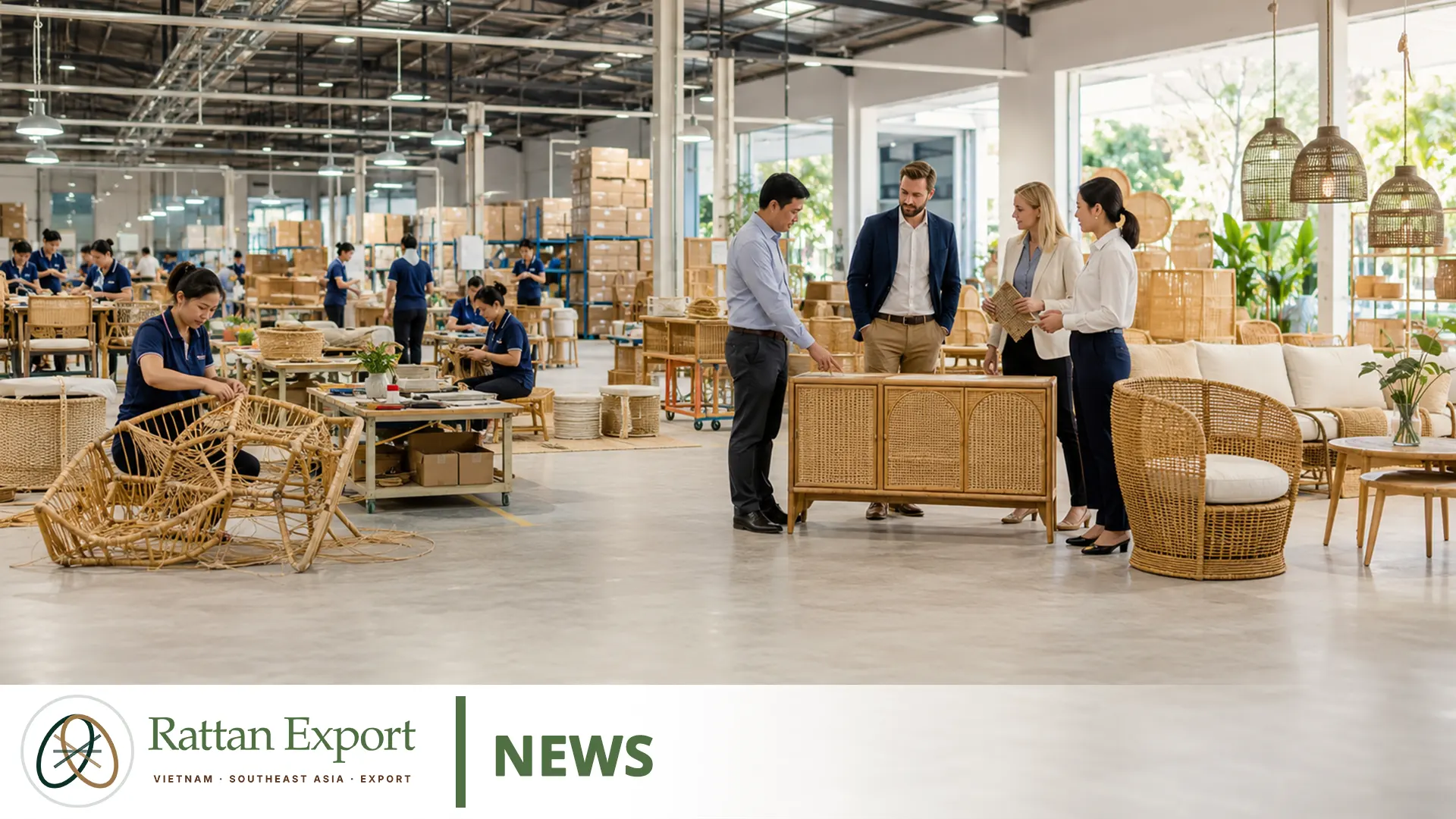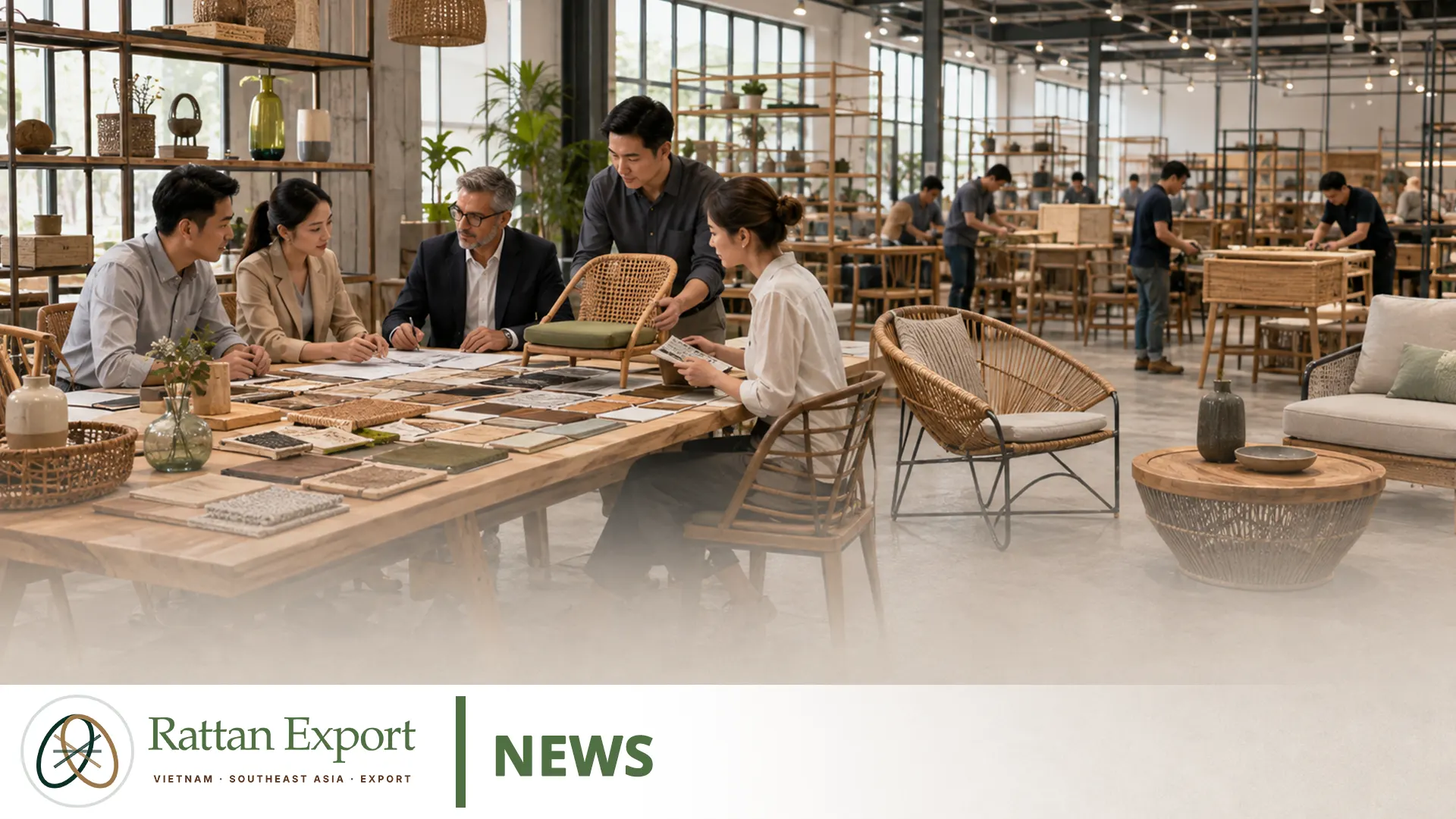
Vietnamese furniture factories are expanding their ability to combine wood, rattan, bamboo, natural fibres, metal, stone, rope, textiles and other materials within commercially scalable furniture collections, giving international buyers more flexibility in design, sourcing and product positioning in 2026. The shift is increasingly visible across Vietnam's export furniture and home-furnishing sector. Rather than operating only within traditional material silos such as solid-wood furniture or woven handicrafts, a growing group of manufacturers is building production systems capable of integrating several materials into one product or coordinated collection. For importers, wholesalers, retail chains, hospitality groups and private-label brands, mixed-material manufacturing can open new design possibilities, but it also requires more disciplined specifications, supplier qualification and material documentation.
Mixed-Material Manufacturing Is Becoming More Visible in Vietnam
HawaExpo 2026 provided a useful view of this development. The official post-show report recorded 450 exhibitors, more than 2,500 booths and showcases, 16,449 buyers and visitors and 3,284 international buyers from 83 countries and territories. The exhibitor profile was described as offering complete supply-chain solutions across furniture, indoor and outdoor collections, accessories and materials. Within that supplier base, manufacturers presented products combining conventional furniture materials with woven fibres, metals, stone, upholstery and decorative surfaces.
Individual factory profiles make the trend easier to see. Vietnam Housewares Corporation lists materials including walnut, rubberwood, oak, acacia, plywood, MDF, rattan, seagrass, bamboo, metal, clay, glaze and cement across three factories. HawaExpo reports production facilities exceeding 100,000 square metres and capacity of approximately 300 containers per month. Fine Scandinavia describes its specialization as metal and mixed-material indoor and outdoor furniture using steel, stainless steel, aluminium, copper, brass, teak, acacia, walnut, veneer, stone and rope. Tien Hung combines solid woods such as oak, ash, acacia and pine with fabric, iron, marble, paper cord and rattan. Other manufacturers combine woven water hyacinth, seagrass, natural rattan or synthetic wicker with wood and metal frames.
2026 Export Data Shows Demand Across Multiple Material Categories
Vietnam Customs statistics through May 2026 also show commercially meaningful activity across several material-related export categories. Bamboo and rattan products reached approximately US$399.96 million during the first five months of the year, an increase of 8.6% year-on-year. Wood and wooden products reached approximately US$7.02 billion, increasing 2.9%. Furniture made from materials other than wood reached approximately US$1.75 billion, with reported growth of 17.3%, while ceramic products reached about US$277.59 million.
| Vietnam Export Category | Jan-May 2026 | Year-on-Year | Relevance to Furniture Buyers |
|---|---|---|---|
| Bamboo & rattan products | US$399.96 million | +8.6% | Supports woven furniture, baskets, décor and natural-fibre sourcing |
| Wood & wooden products | US$7.02 billion | +2.9% | Provides the structural base for a large furniture manufacturing ecosystem |
| Furniture of materials other than wood | US$1.75 billion | +17.3% | Highlights commercial demand beyond conventional wood-only furniture |
| Ceramic products | US$277.59 million | +5.7% | Relevant to home accessories and coordinated mixed-material collections |
These categories should not be added together as if they represented one unified mixed-material industry, because customs classifications describe different product groups. They do, however, show that Vietnam's export economy supports multiple material supply chains at meaningful commercial scale.
Why International Furniture Buyers Want More Material Flexibility
Global furniture collections increasingly use material contrast as part of product identity. Wood may provide structure while rattan cane creates a lighter visual surface. Powder-coated steel can provide strength for an outdoor chair while rope or synthetic wicker creates comfort and texture. Marble, ceramic or engineered stone can be combined with timber bases. Upholstery may be added to wood or metal frames, while woven natural fibres can transform cabinets, beds, lighting and storage products into more differentiated retail collections.
For international buyers, this creates several commercial advantages:
- Greater design differentiation: mixed materials can make products less generic and easier to position as exclusive collections.
- Broader price architecture: materials can be adjusted to meet target price points without completely redesigning a product.
- Different market aesthetics: Nordic, coastal, tropical, industrial, contemporary and hospitality styles can use different material combinations.
- Improved functionality: structural and decorative materials can be selected according to their specific strengths.
- ODM opportunities: manufacturers with multiple material capabilities can contribute more actively to product development.
Natural Fibres Are Increasingly Used as Components, Not Only Complete Products
Vietnam's natural-material industry has traditionally been associated with baskets, handicrafts and fully woven products. Mixed-material manufacturing expands the role of those fibres. Rattan cane can become a cabinet-door panel rather than the entire cabinet. Seagrass may be wrapped around a metal frame. Water hyacinth can form a woven surface over an iron structure. Paper cord can be used for chair seats. Bamboo can serve as a structural, decorative or woven component depending on the product.
| Material Combination | Potential Product Applications | Buyer Consideration |
|---|---|---|
| Wood + rattan cane | Chairs, cabinets, beds, sideboards | Confirm wood species and actual woven material |
| Metal + rope | Outdoor chairs, lounge furniture, hospitality seating | Check coating, corrosion resistance and rope specification |
| Metal + water hyacinth / seagrass | Baskets, storage, occasional furniture | Confirm frame construction and fibre treatment |
| Wood + stone / ceramic | Tables, consoles, vanities | Review weight, breakage protection and packaging |
| Wood + upholstery | Dining chairs, beds, sofas, benches | Evaluate foam, textile and fire-performance requirements |
| Bamboo + paper / textile | Lighting and decorative products | Confirm electrical and destination-market requirements |
Mixed Materials Also Make Product Data More Complicated
The design opportunity creates a sourcing challenge: a simple product label becomes less reliable. A chair marketed as a “rattan chair” may actually have a solid-wood frame with only a rattan-cane backrest. A “seagrass basket” may use an iron frame. A “wood table” can have a stone top, metal reinforcement and plastic floor protectors. These distinctions matter to professional buyers.
Accurate material composition can affect costing, tariff classification, product testing, labeling, sustainability documentation and quality control. It may also affect destination-market rules. If a product contains wood, the buyer may need information about species and origin. If it includes metal, coating performance may become relevant. Upholstery introduces foam and textile specifications. Electrical lighting requires an entirely different compliance discussion.
For this reason, mixed-material sourcing should separate at least four types of information: primary material, structural material, secondary material and accessory material. One material can sometimes perform more than one role, but the distinction helps the buyer understand what actually determines product identity and performance.
Supplier Capability Must Extend Beyond Material Availability
A factory having access to several materials does not automatically mean it is good at mixed-material manufacturing. Combining materials creates technical challenges. Wood moves with moisture. Metal and timber require different tolerances and fastening methods. Natural fibres can vary in thickness, color and moisture content. Stone adds weight. Upholstery introduces sewing, foam and fabric-control processes. Every additional material also adds another supplier or production step that must be coordinated.
Buyers evaluating a mixed-material factory should therefore ask:
- Which materials are processed internally and which are purchased from external suppliers?
- Which production stages are subcontracted?
- Who controls dimensional tolerances between different components?
- How are natural-fibre moisture and color variations managed?
- How are metal coatings tested for the intended environment?
- How are stone, ceramic or glass components protected during transport?
- Can replacement materials be sourced consistently for repeat orders?
- Who approves the final master sample and material specification?
- Can the supplier document every significant material used in the SKU?
Mixed-Material Design Can Improve Container Economics, but It Can Also Hurt Them
Product development also needs to account for export logistics. Combining materials may allow a factory to create lighter or more compact products, but decorative shapes and fragile components can increase carton size and protective packaging. The lowest factory price therefore does not necessarily produce the lowest landed cost.
A steel chair frame with detachable woven panels may ship efficiently in knock-down form. Nesting natural-fibre baskets can make extremely good use of container volume. In contrast, a stone-top table may require heavy protective packaging and reduce loading quantities. Large woven lamps may be lightweight yet consume substantial cubic volume. These variables should be considered during product engineering rather than after purchase-order confirmation.
| Data Point | Why Buyers Need It |
|---|---|
| Assembled dimensions | Retail, warehouse and project planning |
| Knock-down dimensions | Determines potential freight savings |
| Carton size and CBM | Required for container calculations |
| Gross / net weight | Important for handling and freight planning |
| Units per 20ft / 40ft / 40HQ | Allows true unit landed-cost comparison |
| Mixed-SKU rules | Determines whether collections can be consolidated efficiently |
Mixed-Material Capability Supports OEM and ODM Buyers Differently
For OEM buyers, the main value is execution. The buyer already owns the concept and needs a factory capable of managing multiple materials to a defined specification. The challenge is technical coordination and quality consistency. For ODM buyers, a wider material library creates additional creative value. The manufacturer can propose combinations based on local material availability, target price, trend direction and production capability.
This can be particularly useful for private-label and hospitality projects. Instead of searching separately for a wood factory, weaving supplier, metal processor and upholstery producer, the buyer may be able to work with one lead manufacturer capable of coordinating the complete product. That can simplify communication, although the buyer should still understand which stages are performed internally and which rely on subcontractors.
HawaExpo 2026 Shows the Breadth of the Supply Base
The scale and diversity visible at HawaExpo reinforce this broader manufacturing direction. The official post-show report described the exhibition as bringing together furniture, indoor and outdoor collections, accessories and materials under one roof. Separate 2026 supplier profiles included factories specializing in mixed-material furniture, woven home accessories, ceramics, wood furniture and integrated homeware manufacturing. The fair's design and technical programmes also focused on improving design, production and management capabilities rather than treating manufacturing as a single-material process.
The important conclusion is not that every Vietnamese factory can manufacture every material. They cannot. Vietnam's advantage is the increasing availability of specialized manufacturers and supplier networks that can be combined around a product programme. The sourcing task is identifying which factory has the correct combination of internal capability, external partners, design knowledge and export experience for a specific project.
What This Means for Rattan Export Vietnam Buyers
Mixed-material manufacturing is directly relevant to the sourcing model being developed by Rattan Export Vietnam. A product should not be classified only by the material that is most visible in a photograph. Buyers need to know the real supplier, the primary material, structural components, secondary materials, dimensions, packaging and commercial requirements before comparing products properly.
This is particularly important as our product catalogue expands across rattan, bamboo, seagrass, water hyacinth, jute, wood, lacquer, ceramics, metal, fabric and other materials. The objective is to connect buyers with supplier-linked product data that can support more accurate sourcing decisions rather than presenting thousands of anonymous images.
Importers, wholesalers, distributors, retail chains, hospitality buyers and private-label brands developing mixed-material furniture or homeware can also review our approach to quality and compliance, learn more about Vietnam sourcing and export, or submit a structured product brief through the wholesale inquiry. As product design becomes more material-diverse, the competitive advantage is no longer simply finding a factory that can make furniture. It is finding the manufacturer and supply network capable of managing every material in that furniture consistently, commercially and at export scale.
Sources and Data References
- General Department of Customs of Vietnam, Statistics of Main Exports by Month, May 2026.
- HawaExpo 2026 Official Post Show Report.
- HawaExpo 2026 official manufacturer and home-accessories exhibitor profiles.
- HawaExpo 2026 furniture manufacturing and mixed-material sourcing information.