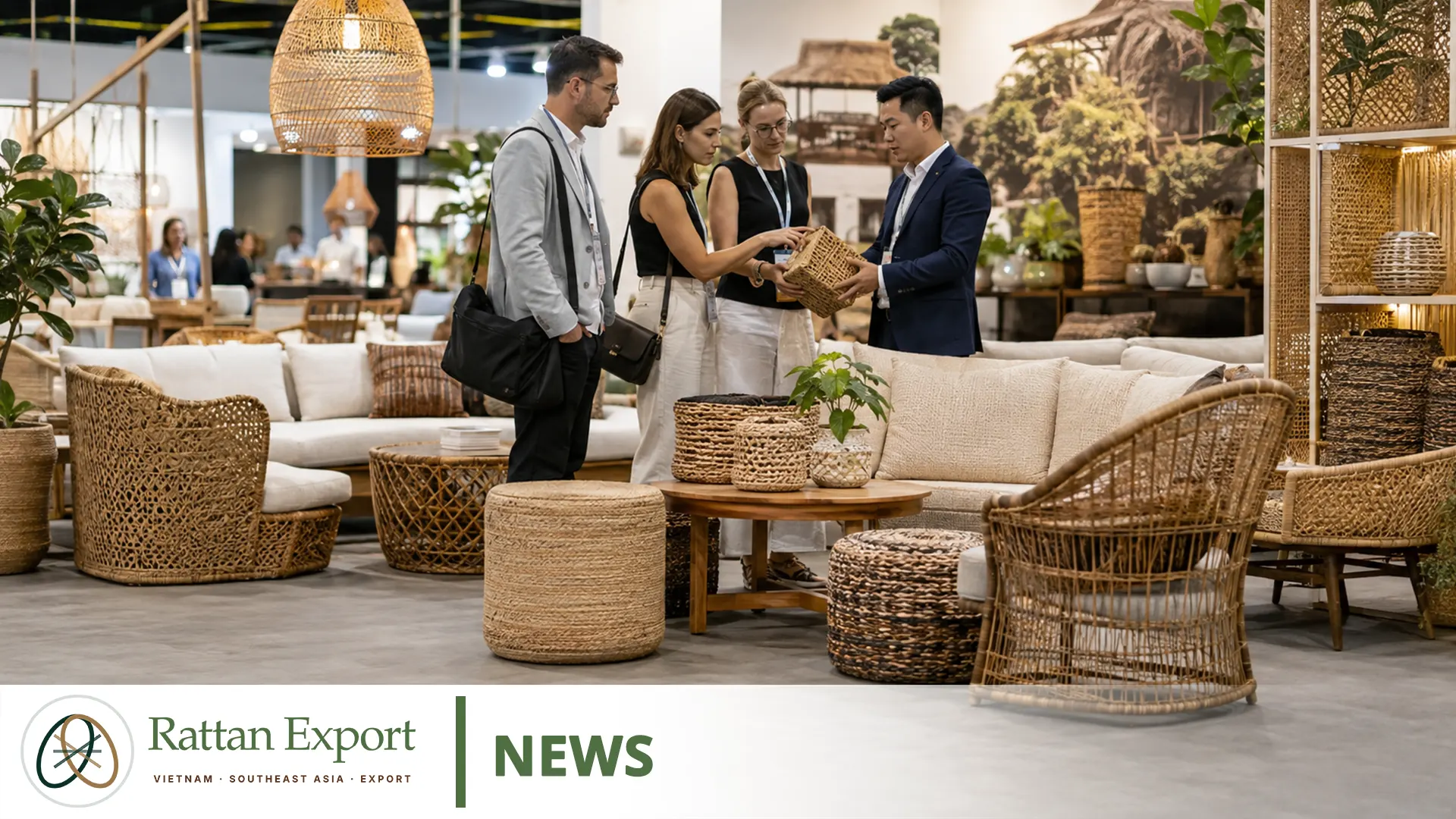
Vietnamese craft villages are increasingly targeting higher-value international markets with rattan and bamboo products as artisans, cooperatives and export businesses move beyond low-cost household goods toward design-led furniture, lighting, décor, hospitality products and branded handicraft collections. The shift does not mean abandoning traditional weaving. Instead, many production communities are trying to preserve manual skills while improving design, quality consistency, material documentation, packaging, branding and connections with professional exporters. For international importers, wholesalers, retailers, hospitality buyers and private-label brands, this evolution is creating a sourcing base where cultural identity and commercial production can increasingly operate together.
Craft Villages Are Moving From Volume Toward Value
Vietnam's rattan and bamboo sector already has a meaningful export foundation. Preliminary full-year statistics from the General Department of Customs recorded approximately US$900.06 million of bamboo and rattan product exports in 2025. The commercial challenge for craft villages is therefore not simply to prove that international demand exists. The more strategic question is how to capture greater value from that demand instead of remaining primarily a low-margin production base for simple goods.
Higher-value positioning can take several forms. A traditional basket can become part of a coordinated interior collection. Bamboo that once served mainly household functions can be developed into lighting, furniture and hospitality décor. Weaving techniques can be applied to cabinet doors, chair backs and sculptural pieces. Products can also gain value through stronger design, documented origin, private-label development, improved packaging or a clear cultural story that distinguishes them from generic mass-produced alternatives.
| Traditional Value Model | Higher-Value Direction | Potential Buyer |
|---|---|---|
| Basic household basket | Designed storage collection with defined colors and sizes | Retail chains and homeware importers |
| Simple bamboo utility item | Lighting, furniture or lifestyle product | Interior and hospitality buyers |
| Anonymous handmade product | Product with craft-village story and documented origin | Premium retail and cultural design brands |
| Single-SKU production | Coordinated OEM/ODM collection | Private-label brands |
| Local packaging | Export-ready carton, labeling and container plan | Importers and distributors |
Phu Vinh Shows How Traditional Skill Can Reach Global Markets
Phu Vinh, one of Hanoi's best-known rattan and bamboo weaving communities, illustrates the scale that a traditional craft ecosystem can achieve. Reporting in June 2026 based on data from the Phu Nghia Commune People's Committee said the craft provides livelihoods for 11,347 people and involves nearly 90% of households in local production and business. Artisans have developed more than 500 types of handicraft products, with products reaching more than 50 countries and territories.
The important lesson is not simply the number of products. Phu Vinh's development demonstrates how the same weaving knowledge can evolve from everyday household goods into decorative and artistic products with stronger aesthetic value. Cultural identity becomes a commercial asset when buyers can recognize a distinctive Vietnamese technique, material language or design story that is difficult to reproduce through anonymous industrial manufacturing.
Nghệ An Is Linking Craft Production With Export Businesses
A different model can be seen in Nghệ An. The province has around 200 craft villages, more than 40 of which are associated with rattan and bamboo weaving. Local reporting in May 2026 described products reaching markets including France, the Netherlands, Germany, Japan and South Korea, with European demand particularly visible for lanterns, table lamps, gift boxes and natural-material décor.
Production is also becoming more organized. Instead of operating only as isolated households, a number of weaving communities work through chain-linked models with purchasing companies. Businesses supply raw materials and design guidance, households perform selected weaving operations, and finished goods return to the business for collection, finishing, packing and export. This structure can preserve rural craft employment while giving overseas buyers a more manageable commercial interface.
Higher-Value Markets Are Buying More Than the Material
Rattan and bamboo alone do not automatically create premium value. International buyers can source similar fibres from several countries. The stronger commercial proposition comes from the combination of material, design, craftsmanship, production reliability and product story.
- Design: proportions, silhouettes, color and functionality need to fit the target market.
- Craftsmanship: weaving quality can provide differentiation that machine-made products cannot easily reproduce.
- Origin: buyers increasingly need to understand where production and important materials originate.
- Branding: a recognizable craft village, artisan tradition or Vietnamese design identity can add commercial meaning.
- Quality consistency: handmade appearance must still stay within agreed tolerances.
- Export readiness: packaging, documentation, labeling and shipping economics need to support professional orders.
Natural Colors and Minimalist Design Are Opening European Opportunities
Nghệ An producers reported that natural colors and minimalist designs were receiving particular interest from foreign customers. This reflects a useful product-development principle: craft villages do not necessarily need to make their products more complicated to reach higher-value markets. In many cases, commercial improvement comes from simplifying forms, refining proportions and finishes and allowing the natural material and handwork to become the visual focus.
This can be especially effective in contemporary interiors where rattan and bamboo are used to introduce warmth and tactile contrast. A carefully proportioned pendant lamp, handwoven chair or simple storage collection can create more perceived value than a heavily decorated product if it better matches the buyer's market and merchandising strategy.
Cultural Identity Can Become Part of Product Differentiation
Some craft communities are also using local patterns and dyeing traditions to create stronger product identity. In Diem village in western Nghệ An, bamboo and rattan products incorporate natural dyes and motifs connected with the Thai ethnic community. This kind of cultural reference can help differentiate a product, but it should be treated responsibly rather than reduced to decorative marketing.
For higher-value B2B sourcing, cultural storytelling works best when it is connected to actual materials, techniques, communities and production processes. Buyers should be able to understand which elements genuinely come from the craft tradition and which parts have been adapted for contemporary commercial requirements.
Design and Technology Are Becoming Part of Craft-Village Policy
The move upmarket is also visible in public policy. Hanoi has more than 1,350 craft villages and villages with crafts, including more than 300 officially recognized craft villages and traditional craft villages. Policies taking effect from the beginning of 2026 support preservation while also encouraging technology, design, digital infrastructure, traceability, training, machinery investment and stronger links to raw-material regions.
The policy direction is significant because craft villages often face a structural gap between excellent manual skill and limited commercial infrastructure. An artisan may produce exceptional weaving but still lack access to industrial design, export documentation, digital product data or capital for finishing and quality-control equipment. Higher-value export development requires both sides of that equation.
Traceability and Origin Matter More in Premium Markets
Vietnam's Ministry of Industry and Trade has also emphasized the role of certificates of origin and compliance with rules of origin in helping handicraft products access more demanding markets and use preferential trade agreements. For a professional buyer, origin is not simply a marketing statement saying “Made in Vietnam.” It can affect tariff treatment, customs risk, buyer due diligence and confidence in the supply chain.
Craft-village exporters therefore need stronger records linking suppliers, raw materials, production locations and commercial shipments. This does not mean every basket requires an expensive digital system, but the exporting organization should be able to explain who produced the product, where significant processing occurred and what documentation is available when a destination market or buyer requires it.
Higher Value Requires Better Quality Control
The more a product moves toward premium retail, hospitality or private-label programmes, the less room there is for uncontrolled production variation. Handmade products can retain natural differences, but buyers still require predictable dimensions, construction and finishing.
- Material grading: control fibre diameter, color, condition and moisture.
- Approved sample: establish the commercial reference for mass production.
- Weave specification: define pattern, density, tension and acceptable variation.
- Structural inspection: verify bamboo, rattan, wood or metal frames beneath the visible weave.
- Finishing control: maintain agreed staining, coating and color ranges.
- Packaging inspection: protect products from deformation, abrasion and moisture.
Packaging and Container Design Can Add or Destroy Value
A beautifully designed product can become commercially unattractive if it ships inefficiently. Rattan and bamboo products are often lightweight relative to their cubic volume, making container utilization a critical part of export development. Baskets that nest efficiently can achieve very different freight economics from rigid products that occupy the same external volume whether empty or full.
| Export Variable | Higher-Value Requirement |
|---|---|
| Carton size | Optimized around product protection and CBM |
| Nesting | Use compatible dimensions where design allows |
| Knock-down construction | Reduce volume for furniture and lighting where practical |
| 20ft / 40ft / 40HQ loading | Calculate before final commercial approval |
| Mixed-SKU planning | Support broader wholesale and retail collections |
For craft villages moving toward larger international programmes, container planning therefore becomes part of product development rather than a task left until shipment.
The Workforce Challenge Could Limit the Move Upmarket
Craft villages also face a serious human-capital challenge. In several communities, younger workers are choosing other careers while experienced artisans age. This matters because higher-value products often require more skill, not less. Intricate weaving, custom prototypes, difficult curves and premium finishing depend on workers who understand the material deeply.
The solution is not simply to preserve every historic product unchanged. Younger workers need reasons to remain in or return to the craft economy. Better design, stronger brands, higher productivity, digital sales and higher-value orders can make traditional skills economically more attractive. Connecting designers, technology specialists, exporters and artisans may therefore be as important as preserving the weaving technique itself.
Higher Value Does Not Automatically Mean Luxury
For international buyers, “higher-value market” should not be interpreted only as expensive luxury goods. Value can increase through better function, more efficient logistics, stronger design, documented origin, improved durability, reliable quality or easier repeat ordering. A well-designed wholesale basket programme can create more value than an artistic one-off piece if it is commercially repeatable and profitable across the supply chain.
The most successful craft-village suppliers will therefore be those capable of matching their distinctive skills to the buyer's actual segment, whether that is premium home décor, mid-market retail, hospitality, private label or project sourcing.
What International Buyers Should Evaluate
- Is the supplier an actual manufacturer, cooperative, exporter or production coordinator?
- Which craft village or production community is involved?
- What exact rattan, bamboo or secondary materials are used?
- Can the supplier reproduce the approved sample at commercial scale?
- How are household or subcontracted production stages controlled?
- What MOQ applies by SKU, finish and color?
- What documentation supports origin and any environmental claims?
- Can products be nested, knocked down or consolidated into mixed containers?
- Does the supplier have experience with the buyer's destination market?
What This Means for Rattan Export Vietnam Buyers
The effort by Vietnamese craft villages to reach higher-value markets is directly relevant to the sourcing model being developed by Rattan Export Vietnam. International buyers need access not only to attractive woven products, but also to clearer supplier identity, material information, production context and commercial data.
Our developing product catalogue is structured around supplier-linked products across rattan, bamboo, seagrass, water hyacinth, jute, wood, metal, fabric, lacquer and mixed-material constructions. Buyers can also review our approach to quality and compliance, learn more about Vietnam sourcing and export, or submit specifications, quantities, destination markets, packaging and container requirements through the wholesale inquiry.
Vietnam's craft villages already possess something difficult to manufacture from scratch: accumulated skill, cultural identity and material knowledge. The next competitive step is to connect those strengths with design, documentation, quality control, branding and export systems capable of serving higher-value international programmes. For buyers, that creates an opportunity to source products that are not only made in Vietnam, but carry a more distinctive and commercially defensible reason for being sourced there.
Sources and Data References
- General Department of Customs of Vietnam, preliminary full-year 2025 export statistics.
- Phu Nghia Commune People's Committee and June 2026 reporting on Phu Vinh rattan and bamboo weaving.
- Nghệ An provincial reporting, May 2026, on rattan and bamboo craft villages and export-market development.
- Government of Vietnam reporting on Hanoi craft-village development policy effective from 2026.
- Vietnam Ministry of Industry and Trade reporting on origin documentation, trade promotion and access to higher-value export markets.