
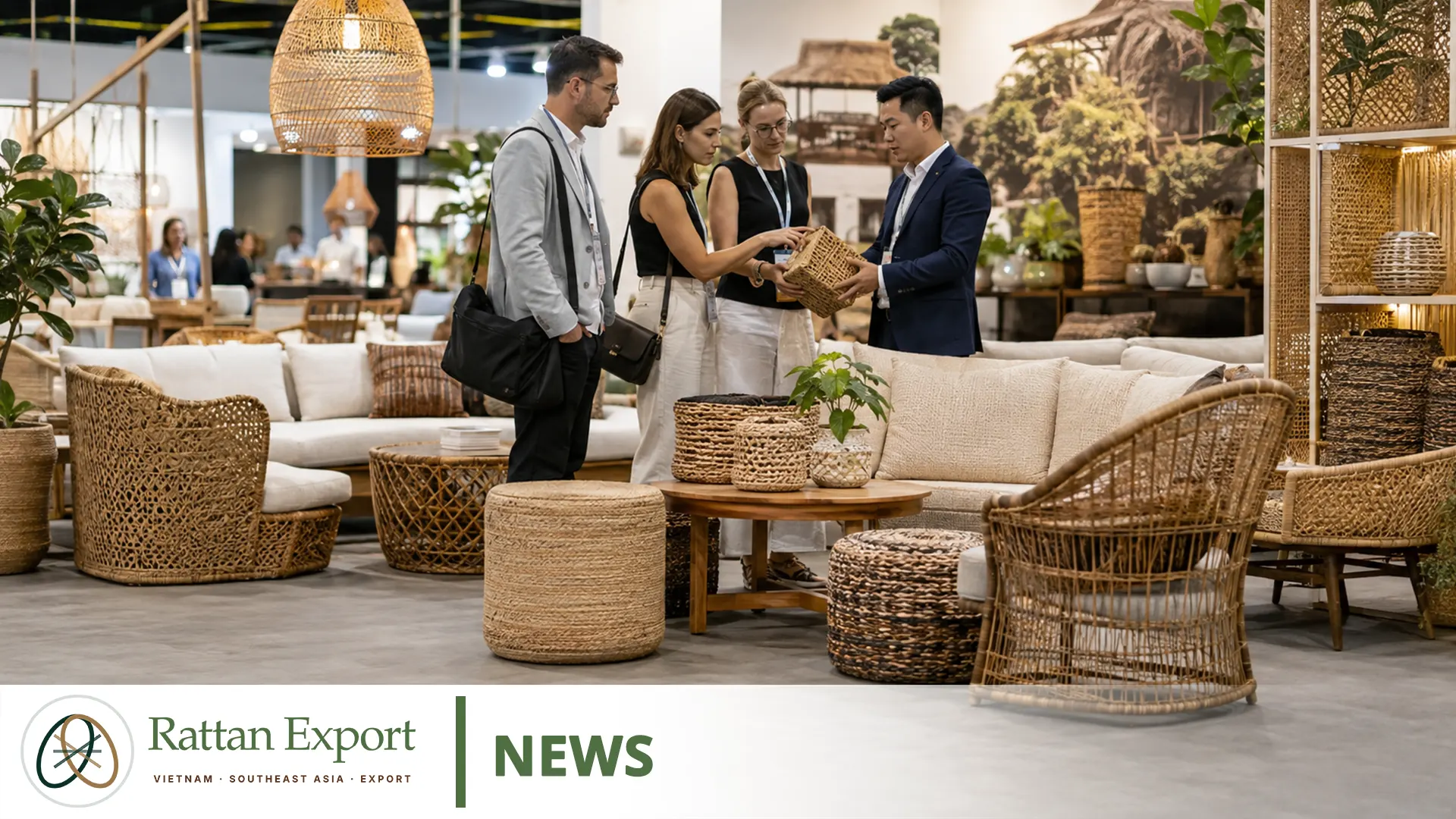
Natural-fibre furniture is gaining greater visibility in 2026 as international buyers look for products that combine tactile texture, recognizable craftsmanship and the potential for lower-impact material strategies. Across Vietnam's furniture and handicraft supply base, rattan, bamboo, seagrass, water hyacinth and other fibres are appearing in chairs, cabinets, benches, lighting, storage, occasional furniture and mixed-material collections rather than remaining confined to traditional baskets and decorative accessories. The trend is being reinforced by changing interior aesthetics, stronger interest in material identity and growing pressure on buyers to understand how products are sourced, manufactured, documented and eventually transported to market.
Texture Is Becoming a Commercial Design Requirement
One of the clearest signals came from the HawaExpo 2026 Furniture Forum. Discussions on contemporary design trends pointed to a shift away from purely minimalist and industrial interiors toward spaces that feel warmer, more human and more tactile. Natural materials, handcrafted details, softer forms and textured surfaces were identified as increasingly important elements in that transition.
For international sourcing teams, texture is not merely a visual trend. It can differentiate products in crowded furniture categories where basic silhouettes are easy to copy. A woven rattan back, seagrass panel, bamboo detail or water-hyacinth surface can give a chair, cabinet or storage product a stronger material identity without requiring the entire SKU to be made from one fibre.
| Buyer Objective | Natural-Fibre Response | Typical Product Application |
|---|---|---|
| More tactile interiors | Visible weave and irregular natural texture | Chair backs, cabinet doors, benches, headboards |
| Warmer visual language | Plant-based fibres combined with wood | Living, dining and hospitality collections |
| Handcrafted differentiation | Manual weaving and artisan details | Lighting, storage, décor and accent furniture |
| Mixed-material design | Fibre paired with metal, timber, ceramic or textile | Contemporary retail and project furniture |
| Lower-impact positioning | Renewable or plant-based material options | Collections where sourcing evidence supports the claim |
Vietnam Has an Existing Commercial Base Behind the Trend
Natural-fibre furniture is not emerging from zero. Preliminary full-year statistics from Vietnam's General Department of Customs recorded approximately US$900.06 million of bamboo and rattan product exports in 2025. The same report recorded approximately US$17.20 billion in wood and wooden-product exports and US$3.83 billion in furniture made from materials other than wood. The customs categories are different and should not be combined as one market figure, but they illustrate the scale of the broader furniture and home-furnishing export ecosystem in which natural fibres operate.
Vietnam's advantages also include established weaving communities, export manufacturers and companies able to combine natural fibres with industrially produced frames and components. This is important because many commercially successful products are hybrid constructions rather than pure rattan or pure bamboo products.
Natural Fibre Is Moving Into Furniture, Not Just Home Accessories
HawaExpo 2026 supplier profiles show how the product mix is broadening. Viet Source Handicraft lists bamboo furniture alongside storage baskets, lamps, rugs and home decorations using bamboo, rattan, seagrass, water hyacinth and palm leaf. Nature Craft combines rattan, seagrass and water hyacinth with lighting, pottery and other home décor categories. Vietnam Housewares operates across wooden furniture, woven handicrafts and ceramic garden décor, creating the manufacturing structure needed for mixed-material programmes.
This matters because international buyers can increasingly use natural fibres as a design language across a collection rather than as a single product category. A coordinated range might contain a timber dining chair with a woven rattan back, a cabinet with cane doors, a water-hyacinth storage basket, a seagrass pendant and an occasional table combining wood and woven detailing.
Each Fibre Creates a Different Design and Sourcing Result
| Material | Typical Character | Common Furniture Role | Buyer Consideration |
|---|---|---|---|
| Rattan | Flexible, fine to substantial weave | Frames, cane panels, chair backs, furniture details | Confirm whether rattan is structural or decorative |
| Bamboo | Linear, rigid or split into woven strips | Frames, furniture components, lamps and shelving | Confirm species, treatment and construction |
| Water hyacinth | Thicker, softer-looking fibre | Woven surfaces, stools, storage and accent pieces | Identify the supporting frame under the weave |
| Seagrass | Tighter natural texture | Panels, baskets, seating details and rugs | Control moisture, color and weave consistency |
These differences affect more than appearance. Fibre thickness influences weave density and labor time. Structural frames influence strength and testing. Material flexibility affects product geometry. Surface characteristics influence staining and finishing. Accurate specifications therefore matter when a design moves from showroom sample to container-level production.
Craftsmanship Is Becoming Part of Product Value
In mass-market sourcing, craftsmanship was sometimes treated as something difficult to standardize. In 2026 it is increasingly being used deliberately as a source of differentiation. A visible handwoven surface can communicate human input in a product category otherwise dominated by machine-produced forms.
That does not mean buyers should accept uncontrolled variation. The commercial challenge is to preserve signs of hand production while defining measurable boundaries for dimensions, weave density, pattern, color range and finish. An approved master sample remains essential because written descriptions such as “natural handmade finish” are too broad to control mass production.
Lower-Impact Materials Require Evidence, Not Assumptions
The growing interest in natural fibres is also connected with buyer demand for products that may support lower-impact material strategies. Plant-based fibres can offer useful design opportunities because they are renewable biological materials and, in some applications, can reduce dependence on more resource-intensive components. However, the environmental performance of a finished product cannot be determined from the word “natural” alone.
HawaExpo's 2026 Green Transition forum made the same distinction at industry level. Experts argued that companies should measure environmental impact first, improve operations, integrate sustainability criteria into management and only then position products or businesses as green. Discussions also highlighted lifecycle assessment, carbon information, material traceability and the risk of superficial greenwashing.
For buyers, a responsible comparison should therefore consider:
- Where and how the fibre was sourced.
- Whether cultivation or harvesting is documented where relevant.
- Drying and processing energy.
- Dyes, coatings, adhesives and treatments.
- Durability and expected product life.
- Amount and type of supporting frame material.
- Packaging and container utilization.
- Potential repair, reuse or end-of-life options.
A Natural-Fibre Chair Is Often a Mixed-Material Product
The material visible in a photograph is frequently only one part of the SKU. A woven dining chair may use a solid-wood frame, rattan or seagrass surfaces, metal fasteners, adhesive and a textile cushion. An outdoor-style lounge chair may combine an aluminium frame, rope or synthetic components and natural detailing. A cabinet may be predominantly engineered board with rattan-cane door panels.
This means sourcing databases and RFQs should distinguish primary material, structural material, secondary material and accessory material. Calling every woven product “rattan furniture” creates errors in costing, product classification, compliance review and supplier matching.
Quality Control Changes When the Material Is Natural
Natural fibres introduce controlled variability. Diameter, color, texture and moisture can change between raw-material batches. Handmade weaving can introduce small dimensional differences. Professional sourcing therefore requires tolerances rather than an unrealistic expectation that every piece will be visually identical.
- Raw-material inspection: confirm fibre identity, condition, moisture and grading.
- Frame inspection: verify the hidden timber or metal construction before weaving.
- First-piece approval: confirm dimensions, weave pattern, tension and finish.
- In-process checks: identify deformation and weaving inconsistencies before large quantities are completed.
- Final appearance standard: define acceptable natural color and texture variation.
- Packaging inspection: protect the product against crushing, abrasion and moisture during ocean transport.
Container Economics Can Decide Whether a Design Is Commercially Viable
Natural-fibre furniture can create attractive margins but also challenging freight economics. A lightweight chair or pendant lamp can occupy a large amount of container space. Nesting, stacking, removable legs and knock-down construction can therefore be as important as unit price.
| Logistics Question | Why It Matters |
|---|---|
| Can products nest? | Can dramatically improve units per container |
| Can the structure ship knock-down? | Reduces CBM for furniture and lighting |
| What is carton CBM? | Allows comparison of freight cost per unit |
| What fits in 20ft / 40ft / 40HQ? | Connects design decisions to landed cost |
| How is moisture controlled? | Natural materials can be sensitive during long ocean transit |
A buyer evaluating two similar natural-fibre chairs should therefore compare not only FOB price but packed dimensions, loading quantity, damage risk and assembly requirements. A more expensive factory price can still produce a better landed result if the product ships efficiently.
The Trend Also Favors ODM and Collection Development
Natural fibres are well suited to ODM because small changes in weave, material combination, proportion and finish can create a visibly different product without reinventing the entire structural platform. A manufacturer may use the same timber chair frame with several woven back options or adapt a storage technique into furniture and lighting.
This allows private-label buyers to create coordinated ranges with a recognizable identity. The strongest development programmes normally combine the supplier's local material knowledge with the buyer's target price, market positioning, dimensions, compliance requirements and merchandising strategy.
What Buyers Should Ask Before Sourcing Natural-Fibre Furniture
- What exact fibre is used and what is its commercial name?
- Which component actually carries the load?
- Which processes are performed in-house and which are subcontracted?
- What natural variation is considered acceptable?
- How are moisture and drying controlled?
- What MOQ applies by SKU, color and finish?
- Can several SKUs be consolidated into one container?
- What are carton dimensions and expected loading quantities?
- What evidence supports environmental or sustainability claims?
- Can the same material and finish be reproduced for repeat orders?
What This Means for Rattan Export Vietnam Buyers
The growing interest in texture, craftsmanship and potentially lower-impact materials is directly relevant to the sourcing model being developed by Rattan Export Vietnam. International buyers need more than a broad “natural furniture” category. They need accurate product identity, supplier linkage, material classification and commercial information that can support RFQs and container planning.
Our developing product catalogue is therefore structured around supplier-linked products and clearer material records across rattan, bamboo, seagrass, water hyacinth, jute, wood, metal, fabric, lacquer and other components. Buyers can also review our approach to quality and compliance, learn more about Vietnam sourcing and export, or submit specifications, quantities, destination markets, packaging requirements and container targets through the wholesale inquiry.
Natural-fibre furniture is gaining ground because it answers several buyer needs at once: stronger tactile identity, visible craftsmanship, material diversity and the possibility of developing products with a more considered environmental profile. But the strongest B2B programmes will be those that move beyond appearance and verify the fibre, construction, environmental claims, production capability, quality controls and logistics behind every SKU.
Sources and Data References
- General Department of Customs of Vietnam, preliminary full-year 2025 export statistics.
- HawaExpo 2026 Furniture Forum: Anticipating Design Trends and Positioning Asian Design Identity.
- HawaExpo 2026 Green Transition forum reporting.
- HawaExpo 2026 Home Accessories and Handicraft supplier profiles, including Viet Source, Nature Craft and Vietnam Housewares.


