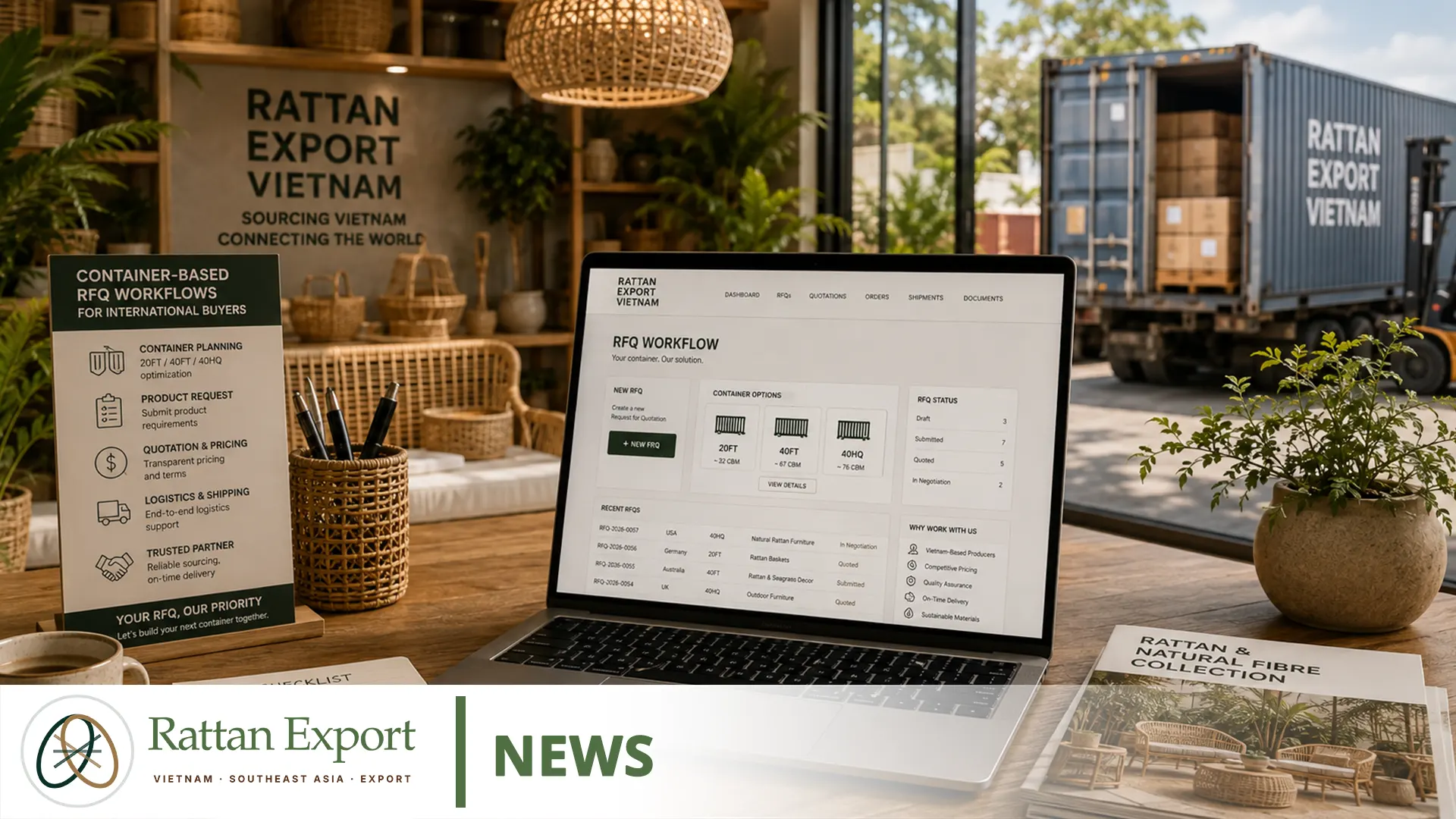
Rattan Export Vietnam has launched a dedicated News and Buyer Intelligence Program designed to help international furniture, handicraft and natural-material buyers follow the commercial developments that can influence sourcing decisions in Vietnam. Introduced in August 2026 as a dedicated editorial layer of the developing B2B platform, the programme goes beyond conventional company news. Its scope includes manufacturing developments, export and logistics conditions, natural-material supply, sustainability and compliance, product and design trends, market changes and updates to Rattan Export Vietnam itself. The objective is to turn fragmented industry information into practical context for importers, wholesalers, distributors, retail groups, hospitality buyers and sourcing teams working with Vietnam.
From Product Catalogue to Buyer Intelligence
A sourcing platform can provide thousands of product references and still leave buyers without answers to some of their most important questions. Is the manufacturing environment changing? Are freight risks rising? Are new European rules likely to affect packaging or product documentation? Are natural materials gaining or losing relevance in design? Is a particular trade event signalling changes in buyer demand?
Rattan Export Vietnam's News and Buyer Intelligence Program has been created to address this information gap. Product discovery remains important, but international B2B purchasing decisions are also shaped by trade policy, manufacturing capacity, logistics, regulation, design direction and material availability.
The programme therefore treats news as part of sourcing infrastructure rather than as a separate media feature.
Seven Editorial Categories Structure the Programme
The editorial framework is organised into seven categories covering the areas most relevant to international buyers sourcing furniture and handicrafts from Vietnam.
| Editorial Category | Primary Buyer Question |
|---|---|
| Industry & Market | What is changing in demand, trade and sourcing conditions? |
| Vietnam Manufacturing | How is Vietnam's production base developing? |
| Rattan, Bamboo & Natural Materials | What is happening in materials, craftsmanship and supply? |
| Export & Logistics | What could affect freight, container planning and shipment risk? |
| Sustainability & Compliance | Which rules, standards and traceability requirements matter to buyers? |
| Design & Product Trends | Which materials, forms and product concepts are influencing new collections? |
| Company & Platform Updates | How is Rattan Export Vietnam's sourcing infrastructure developing? |
The structure is deliberately broader than a traditional furniture-news section. A buyer deciding whether to source a rattan collection may need design information, but the same buyer may also need to understand freight conditions, packaging regulation and supplier documentation.
The Programme Is Built for B2B Buyers, Not General Consumers
Rattan Export Vietnam is not positioning the news section as lifestyle journalism. The editorial perspective is designed around professional procurement.
When a story discusses export growth, the useful question is not simply whether the percentage increased. The analysis should consider what that change may indicate about factory utilisation, buyer competition, shipment planning or Vietnam's position within Asian sourcing networks.
When the topic is new packaging regulation, the article should explain how the rule could affect exporters, importers, packaging specifications and product-development decisions rather than merely repeating legal language.
When a design trend highlights natural textures or weaving, the programme should connect that trend to material selection, manufacturing feasibility, quality control, packing and container economics.
Primary and Official Sources Receive Priority
The programme is being developed around a source-first editorial model. Where possible, reporting and analysis are based on primary or official information from organisations such as Vietnam Customs, Vietnamese government and ministry sources, official trade-fair organisers, European institutions, regulatory texts, shipping carriers and recognised industry bodies.
Secondary reporting can still provide useful context, particularly for rapidly developing trade or logistics events, but the programme aims to distinguish between original data, reported interpretation and Rattan Export Vietnam's own sourcing analysis.
This is especially important in B2B content because inaccurate figures or outdated regulatory information can lead to poor commercial decisions.
Publication Chronology Matters
The News and Buyer Intelligence Program also applies chronology as an editorial control. Each article is prepared according to the information that was available on its publication date rather than silently using facts published weeks or months later.
This is important when reviewing events such as trade fairs, policy announcements, freight disruptions or regulations whose details develop over time. An article dated March should not present a June outcome as though it were already known in March.
Maintaining chronology makes the archive more useful to buyers who want to understand how market conditions developed through 2026 rather than reading a rewritten version of history.
Facts and Sourcing Implications Are Kept Distinct
Buyer intelligence requires interpretation, but interpretation should not be presented as fact. The programme therefore aims to distinguish between what a source actually reports and what that information could mean for a furniture or handicraft buyer.
For example, rising exports may indicate stronger factory activity, but they do not automatically prove that every furniture manufacturer is operating at full capacity. A design fair may highlight growing interest in rattan or tactile materials, but that does not constitute a quantified global sales forecast.
The editorial model is intended to make those distinctions visible so that commercial implications remain useful without becoming exaggerated claims.
Multilingual Publication Supports International Sourcing
The programme has been structured for publication in English, Vietnamese, German, Italian and Spanish. This multilingual model reflects the international buyer base Rattan Export Vietnam aims to serve while preserving Vietnamese-language access for manufacturers and local industry participants.
The language versions are intended to be full editorial translations rather than short summaries of an English article. Technical trade terminology such as B2B, OEM, ODM, MOQ, CBM, FOB, 20ft, 40ft and 40HQ may remain where it is already standard in international sourcing, while the surrounding analysis is localised for natural reading.
Each language version can also be reviewed and made ready independently, preventing an incomplete translation from being treated as a finished public article simply because another language has been completed.
Buyer Intelligence Extends Beyond Breaking News
Not every commercially important development is a breaking-news event. Some of the most useful information comes from slower changes in sourcing conditions.
Manufacturers may expand mixed-material capabilities over several years. Buyers may gradually move from OEM toward stronger ODM cooperation. Traceability requirements can become more important before a legal deadline arrives. Furniture design can shift toward warmer surfaces, organic forms and visible craftsmanship over several seasons.
The programme therefore combines time-sensitive news with analytical articles that explain these longer-term developments.
Manufacturing Intelligence Is a Major Focus
Vietnam's manufacturing base is one of the core subjects of the programme. Articles can examine factory capability, export readiness, material specialisation, craftsmanship, supplier diversification and the growing relationship between industrial furniture production and specialist handicraft manufacturing.
For international buyers, this matters because “made in Vietnam” covers a very wide range of production models. A large wood-furniture manufacturer, a specialist woven-fibre producer and a craft workshop may all be viable suppliers for different programmes.
Buyer intelligence should help explain those differences rather than treating the manufacturing base as one uniform sector.
Natural Materials Receive Dedicated Coverage
Rattan, bamboo, seagrass, water hyacinth, jute and other natural materials are central to the identity of Rattan Export Vietnam and therefore receive a dedicated editorial category.
Coverage can include material applications, weaving and craft techniques, product development, supply issues, design trends, terminology, traceability and the technical differences between natural and synthetic alternatives.
The objective is not to promote every natural material as automatically sustainable or suitable for every application. Buyer intelligence is more useful when it explains both opportunities and limitations.
Export and Logistics Coverage Connects News to Container Decisions
Furniture and handicraft exports are highly sensitive to logistics. Container availability, freight rates, route disruption, fuel costs, port conditions and packaging efficiency can all affect the viability of an order.
The programme's Export & Logistics category therefore connects shipping developments to real B2B sourcing decisions. A route disruption matters differently to a buyer importing a compact basket collection and a buyer importing bulky fully assembled lounge furniture.
Where appropriate, articles can explain how the issue relates to 20ft, 40ft and 40HQ planning, CBM, mixed-SKU loading and shipment timing.
Sustainability Coverage Focuses on Evidence
Sustainability and compliance are becoming increasingly important in international furniture purchasing, but the terminology can easily become vague.
The programme is intended to examine rules and claims through evidence: what regulation actually says, when it applies, who carries the legal obligation and which information an upstream Vietnamese supplier may need to provide to an importer.
Topics can include packaging requirements, product durability, circularity, forest and timber traceability, certification systems and market-specific due-diligence expectations.
Certification is treated as supporting evidence where relevant rather than a substitute for every legal or commercial requirement.
Design Intelligence Is Connected to Production Reality
International design fairs and product launches can offer important signals for suppliers and buyers, but design reporting becomes more useful when it is connected to manufacturing.
If Milan highlights weaving as structure, the buyer implication includes fibre tension, frame interaction and quality control. If softer outdoor forms gain attention, container volume and cushion packaging also matter. If handcrafted details return to premium interiors, repeatability and acceptable natural variation become part of the sourcing discussion.
This approach turns design coverage into product-development intelligence instead of simple trend commentary.
Company Updates Create Transparency Around Platform Development
The seventh category covers Rattan Export Vietnam itself. The company-update stream is intended to document meaningful development steps such as supplier onboarding, RFQ workflow design, product-data infrastructure and buyer tools.
This category also creates an important distinction between work that has been launched, work that is being developed and work that has not yet been completed.
For buyers and suppliers, that transparency is more useful than presenting every planned capability as though it were already operational.
The Initial Editorial Framework Covers 2026 Developments
The programme has been structured around an initial editorial framework covering major developments from the first eight months of 2026. The planned coverage is distributed across the seven editorial categories so that the archive does not become dominated by one subject such as freight or design.
Publication is being developed progressively. The presence of an editorial plan or prepared headline should not be interpreted as meaning every planned article is already publicly available in all five languages.
This staged approach allows research, chronology, translation and source review to be completed before individual language versions are treated as publication-ready.
News Status and Translation Readiness Are Separate Controls
A multilingual B2B news system needs more control than a simple published/draft switch. The platform's editorial structure is designed so that article-level publication and language-level readiness can be managed separately.
An English version may be ready while another translation still requires review. That language should not automatically become public merely because the underlying article has been approved.
This supports a cleaner multilingual archive and reduces the risk of incomplete content entering search results or buyer workflows.
Sources and Data References Remain Part of the Article
Where a news article relies on external data, the editorial format includes a Sources and Data References section. The purpose is not to create academic papers, but to make the factual basis visible.
A buyer should be able to see whether a trade figure came from customs data, whether a regulatory point came from an official legal text or whether a design conclusion came from an exhibition organiser or an independent industry publication.
Visible source context also makes later updates easier if regulations or market conditions change.
Buyer Intelligence Can Improve Product and Supplier Conversations
The programme is also intended to support other parts of Rattan Export Vietnam. A buyer reading about indoor-outdoor living may discover why natural rattan and fully exposed outdoor fibre require different specifications. A buyer following container-planning coverage may ask for packed CBM earlier in the RFQ process. A compliance article may prompt questions about material provenance before sampling begins.
In that sense, the News and Buyer Intelligence Program is connected to the product catalogue, Vietnam sourcing and export, quality and compliance and the wholesale inquiry rather than functioning as an isolated content channel.
A More Informed Route Into Vietnam Sourcing
The launch of the News and Buyer Intelligence Program marks another step in the development of Rattan Export Vietnam as a sourcing platform rather than a simple online catalogue.
Products remain central to the platform, but professional sourcing decisions are made within a wider commercial environment. Trade conditions change. Freight routes change. Regulations evolve. Design preferences move. Suppliers develop new capabilities. Material claims require better evidence.
The purpose of buyer intelligence is to connect those changes to practical sourcing questions. International buyers do not need more industry noise; they need reliable information that helps them understand what may affect specifications, suppliers, containers, compliance, costs and timing. Rattan Export Vietnam's dedicated news programme has been launched to build that layer progressively, with multilingual coverage and a clear B2B sourcing perspective.
Sources and Data References
- Rattan Export Vietnam, News and Buyer Intelligence editorial framework, August 2026.
- Rattan Export Vietnam, seven-category multilingual news structure for EN, VI, DE, IT and ES.
- Rattan Export Vietnam, buyer-focused research, chronology and source-verification editorial workflow.
- Rattan Export Vietnam, product, export, quality-compliance and wholesale-inquiry platform structure.