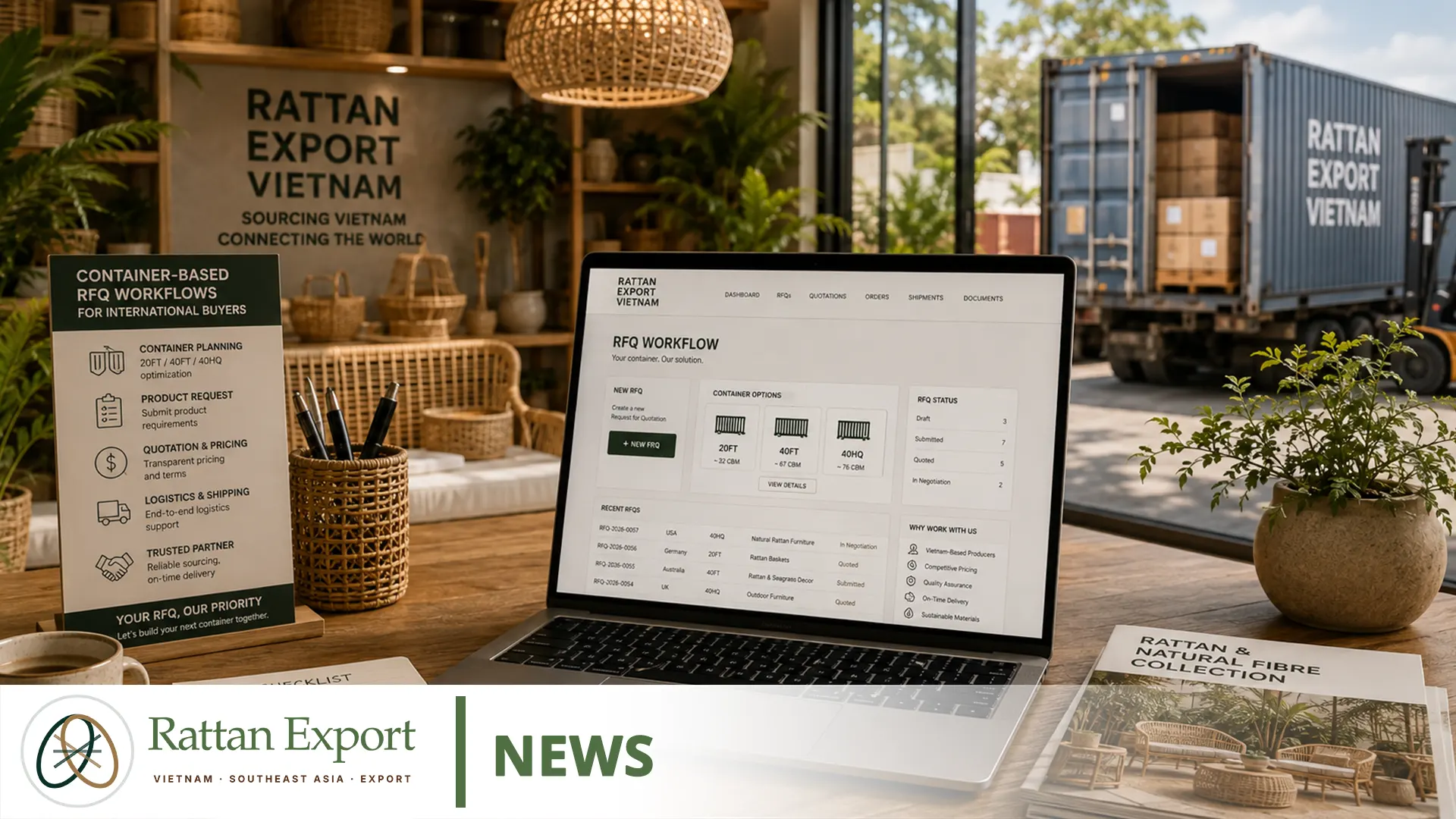
Rattan Export Vietnam is strengthening the product-data and supplier-verification infrastructure behind its developing B2B sourcing platform, with a focus on preserving supplier identity, improving product traceability and creating more reliable information for international furniture and handicraft buyers. The July 2026 work is part of the platform’s infrastructure-development stage rather than a declaration that every supplier, product or material record has already been fully verified. The objective is to establish a data model in which the original supplier, supplier product, platform-level product identity, material information, commercial data and future RFQ activity can remain connected instead of being reduced to disconnected catalogue listings.
Product Data Is Infrastructure, Not Just Catalogue Content
For a conventional product website, a title, photograph, category and short description may be enough to display an item. International B2B sourcing requires substantially more information. A buyer may need to know who originally supplied the product, what supplier code identifies it, which materials are actually used, whether commercial data comes directly from the producer and whether a later modification has changed the product from the version originally shown.
Rattan Export Vietnam is therefore treating product data as sourcing infrastructure rather than only website content. The developing architecture is intended to connect supplier information with individual supplier products and, where appropriate, with a broader platform-level product identity.
This distinction becomes increasingly important as the catalogue expands. Without it, products from different suppliers can appear visually similar while important differences in material, construction, MOQ, packing, lead time or manufacturing capability disappear.
Supplier Product and Master Product Serve Different Purposes
A core principle of the developing data structure is that supplier-specific information should remain attached to the supplier that provided it. The supplier’s original product name, product code, source reference and commercial details should not disappear simply because Rattan Export Vietnam presents the product through a standardised catalogue format.
At the same time, a platform-level product identity can provide a cleaner structure for buyers browsing by product type, category or material.
| Data Layer | Primary Purpose | Example Information |
|---|---|---|
| Supplier | Identify the source company | Company identity, location, contact and capability profile |
| Supplier Product | Preserve source-specific product data | Original title, supplier SKU, source URL, supplier materials and commercial data |
| Master Product | Create a consistent platform catalogue identity | Buyer-facing title, category, product type and structured classification |
| Commercial Data | Support real B2B sourcing | MOQ, FOB information, lead time, packing, CBM and container quantities where available |
| Verification Data | Record what has been checked and from which source | Evidence status, provenance, review notes and later updates |
The benefit of separating these layers is that catalogue presentation can improve without erasing the underlying supplier evidence.
Original Supplier Identity Should Be Preserved
Product images and model names can circulate widely in the furniture and handicraft industry. Once a photograph has been copied between catalogues, marketplaces or social channels, identifying the original producer can become difficult.
Rattan Export Vietnam’s developing infrastructure is intended to preserve the relationship between a product and the supplier from which the data was obtained. Original supplier titles, product codes and source references therefore have value even when a cleaner platform-facing product name is later created.
This supports more transparent communication when a buyer asks for a quotation, sample, modification or repeat order. The sourcing team should be able to trace the enquiry back to the correct supplier record rather than rely only on a public-facing title.
Verification Begins With Provenance
Supplier verification is often discussed as though it were a single yes-or-no decision. In practice, different pieces of information can have different evidence quality.
A company name may be known. A catalogue may have been received directly from a supplier. A product may appear on the supplier’s own website. Material information may be stated on a product page. Commercial data may come from a quotation or direct communication. Each of these represents a different type of source evidence.
The developing system is therefore intended to preserve provenance: what information was received, where it came from and whether it has been reviewed sufficiently for a particular use.
This approach is more useful than treating an entire supplier profile as universally verified simply because one document has been checked.
Verification Does Not Mean Guaranteeing Every Claim
Rattan Export Vietnam’s role is being developed around sourcing coordination, supplier alignment, product-data organisation and export-oriented buyer support. Supplier verification should not be interpreted as a universal guarantee covering every production run, certificate, capacity claim or future commercial performance.
Different orders can require different levels of review. A standard handicraft order may need one set of checks, while a large retail programme, hotel project or destination-specific compliance programme may require additional documentation, samples, inspections or testing.
The purpose of the infrastructure is to make the available evidence clearer and make gaps easier to identify.
Product Identity Needs Stronger Control as the Catalogue Grows
Large catalogues create several identity risks. The same supplier can use similar names for different products. Different suppliers can use identical generic names. Supplier SKUs can contain internal codes that are meaningless to international buyers. Images can be reused across variants.
A stronger product-data system therefore needs to preserve both source identity and a consistent public identity.
Useful controls can include the original supplier title, original supplier SKU, source URL, supplier relationship, platform product identifier and structured variant information. These fields can later support cleaner naming without losing the ability to trace the product back to its source.
Material Data Requires More Than a Single Generic Label
Material classification is especially important for Rattan Export Vietnam because the sourcing scope includes rattan, bamboo, water hyacinth, seagrass, jute, wood, fabric, metal, lacquer and other natural or mixed materials.
A product described casually as a “rattan cabinet” may contain a timber structure, woven rattan doors, metal hardware and a lacquered finish. A basket may combine seagrass with leather handles. A lamp may use bamboo as the main visual material while containing metal or electrical components.
The developing data structure therefore needs to accommodate primary and secondary materials where relevant rather than forcing every product into a single simplistic material label.
| Material Question | Why It Matters |
|---|---|
| What is the primary material? | Supports buyer filtering and core product identity |
| Are significant secondary materials present? | Improves specification accuracy |
| Is the material natural, engineered or synthetic? | Affects performance and buyer expectations |
| Is the material structural or decorative? | Helps explain construction |
| What is the source of the material claim? | Supports traceability and later verification |
Generic Marketing Language Should Not Replace Product-Specific Evidence
A supplier may manufacture many categories and materials across its entire business. That does not mean every material listed on a company website belongs to every product.
For reliable catalogue data, product-specific information should carry more weight than broad company descriptions. The infrastructure is being designed to support that distinction by keeping source references and review status attached to product-level information.
This becomes particularly important with mixed-material collections, where an accessory material, finish or packaging component should not automatically become the product’s primary material classification.
Commercial Data Should Remain Supplier-Specific
MOQ, price, lead time and packing information can change by supplier, product, finish, quantity and date. They should therefore not be treated as universal characteristics of a platform-level product.
Where available, supplier-specific commercial records can include FOB price and currency, MOQ, production lead time, packing method, carton measurements, CBM, estimated container quantities, customisation options and OEM or ODM capability.
The July infrastructure work is focused on creating the structure needed to hold such information reliably. It does not imply that complete commercial data is already available for every product.
Packing and Container Data Can Become Part of the Product Record
For a B2B platform focused on 20ft, 40ft and 40HQ orders, packing information has commercial importance. Two visually similar chairs can have very different container economics if one nests efficiently and the other ships fully assembled.
Keeping carton dimensions, units per carton and CBM close to the supplier-product record can later support more realistic RFQs and loading discussions.
At the same time, estimated loading data should remain distinguishable from supplier-confirmed packing information. The data model should support both without presenting an early estimate as a guaranteed loading quantity.
A Review Layer Helps Separate Raw Data From Public Data
Supplier catalogues, websites and spreadsheets are not always consistent. Product names may vary, dimensions can be missing and materials may be described differently in different documents.
Rattan Export Vietnam is strengthening its infrastructure around the idea that raw supplier information should be preserved while buyer-facing data can be reviewed, cleaned and standardised separately.
This creates a useful staging concept: source data can enter the system, discrepancies can be identified and reviewed information can later be promoted for public or commercial use.
The distinction reduces the pressure to either publish everything immediately or discard useful source information because it is incomplete.
Data Corrections Need an Audit Trail
Product data is rarely static. A supplier may correct a material, update a model code, change dimensions, replace a photograph or clarify that two catalogue items are variants rather than separate products.
A reliable sourcing platform needs to accommodate those changes without losing the earlier source record. Keeping timestamps, source references and review notes can help explain why a classification changed.
This is particularly important when product information has already been used in a quotation or sourcing discussion. Buyers and sourcing teams need to know whether they are looking at the current specification or an earlier version.
Supplier Verification and Product Verification Are Different
A legitimate supplier can still have incomplete product data, and a well-documented product does not automatically establish every aspect of a supplier’s production capability.
The infrastructure is therefore being designed around separate questions. Is the supplier identity sufficiently established? Is the product clearly linked to that supplier? Is the material supported by product-specific information? Is commercial data current? Are manufacturing or certification claims documented?
Separating those questions creates a more realistic verification model than one global “verified” label.
Media Rights Also Belong in the Data Structure
Product photography is valuable sourcing content, but access to an image does not automatically mean unrestricted publication rights. A supplier may provide photographs for review, development, catalogue use or specific commercial purposes under different conditions.
As supplier onboarding expands, media provenance and usage permissions need to remain connected to the supplier relationship. This helps avoid a situation where a useful product record is treated as though every associated image can automatically be published.
Stronger Data Can Improve RFQ Quality
The product-data and verification infrastructure is closely connected to the container-based RFQ workflows being developed by Rattan Export Vietnam. A buyer enquiry becomes more useful when the selected product is already connected to a known supplier, source SKU, material profile and available commercial information.
Instead of sending a generic reference image and asking factories to identify it, an RFQ can eventually carry a much clearer product identity into the quotation process.
This can reduce confusion between visually similar models and make discussions about MOQ, finish, customisation, packing and container quantities more precise.
International Buyers Benefit From Better Data Discipline
The value of the infrastructure is not that every product page becomes more complicated. The buyer-facing experience can remain simple while the underlying records become more disciplined.
A buyer searching for rattan, bamboo or mixed-material products should ideally receive a clean catalogue experience. Behind that experience, however, the platform should retain enough information to answer deeper sourcing questions when the enquiry becomes commercial.
- Who is the source supplier?
- What is the original supplier product code?
- Which materials are confirmed at product level?
- Which commercial data has been provided directly by the supplier?
- What remains unverified or incomplete?
- Has the product data changed since it was first collected?
Suppliers Benefit From Better Attribution
A more structured data model also benefits manufacturers. Suppliers can retain clearer attribution for the products they provide instead of having their catalogue items absorbed into an anonymous marketplace structure.
Original product identity and supplier-product relationships also make technical discussions easier. When a buyer requests a modification, supplier and sourcing team can refer back to the same product reference rather than rely on ambiguous descriptions.
The Goal Is Better Sourcing Decisions, Not More Badges
Verification infrastructure can easily become superficial if it is designed mainly to display badges. Rattan Export Vietnam’s developing approach is more useful when verification improves actual sourcing decisions.
Knowing that a product’s supplier identity is established, its material has a product-specific source and its commercial data was received on a known date can be more valuable than a generic “verified” label with no explanation behind it.
As the platform grows, verification status can become more detailed, but the underlying principle remains the same: claims should be connected to evidence and uncertainty should remain visible where evidence is incomplete.
Building the Data Foundation for a Larger Supplier Network
The July 2026 infrastructure work is part of the broader development of Rattan Export Vietnam. Supplier onboarding, structured product data, material classification, source provenance and RFQ workflows are being designed as connected parts of the same B2B system.
Buyers can follow the developing catalogue through products, learn more about the platform’s Vietnam sourcing and export model, review the developing approach to quality and compliance and submit sourcing requirements through the wholesale inquiry.
The objective is not simply to collect more products. It is to create a catalogue in which each product can carry enough reliable context to support a real commercial conversation. For international buyers, that means clearer supplier identity, better material information and more useful RFQs. For Vietnamese producers, it means a sourcing platform that preserves the connection between their products and the information they actually provide.
Sources and Data References
- Rattan Export Vietnam, product-data architecture and supplier-product relationship planning, July 2026.
- Rattan Export Vietnam, supplier onboarding and source-provenance framework.
- Rattan Export Vietnam, developing material-classification, commercial-data and B2B RFQ infrastructure.