
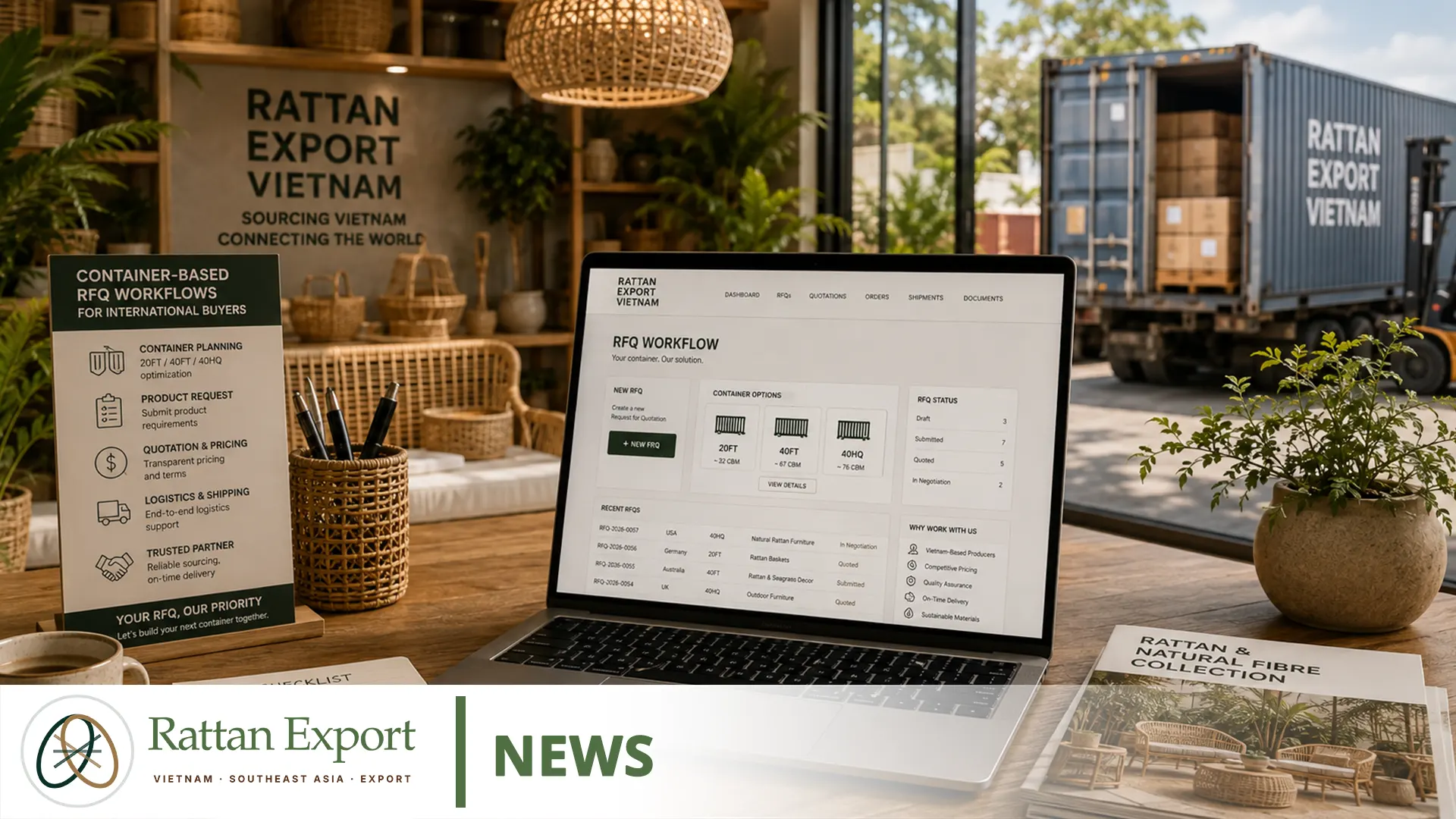
Rattan Export Vietnam is developing container-based RFQ workflows designed around the way international furniture, rattan, bamboo and handicraft orders are actually purchased: by commercial shipment volume rather than by isolated retail units. The May 2026 initiative is part of the platform’s broader B2B development and is intended to make buyer enquiries more useful to manufacturers by connecting product selection, quantities, materials, destination markets and 20ft, 40ft or 40HQ container requirements inside a more structured request-for-quotation process. The workflow remains under development and should not be understood as a completed automated quotation platform. Its purpose at this stage is to define the commercial logic needed for more realistic Vietnam sourcing conversations between international buyers and suppliers.
Furniture RFQs Need More Than a Product and a Quantity
A conventional ecommerce enquiry can be simple: a customer selects a product, enters a quantity and asks for a price. B2B furniture sourcing is different. A buyer may be planning an entire container containing several product families, different carton sizes and several materials sourced from one or more manufacturers.
A request for 200 chairs, for example, does not reveal whether the buyer wants those chairs as a standalone shipment, as part of a mixed 40HQ container or as one component of a hospitality project. The commercially useful RFQ therefore needs to capture more context.
Rattan Export Vietnam is developing its workflow around that reality. The intended process connects product references with shipment planning rather than treating each item as an isolated shopping-cart line.
Container Type Becomes Part of the RFQ
For international furniture sourcing, the difference between a 20ft, 40ft and 40HQ container can materially affect the product mix, quantities, freight economics and supplier quotation strategy.
A buyer may know the exact container type from the beginning. Another may simply have a target order value or product assortment and need the supplier to help estimate the most efficient loading configuration.
| RFQ Input | Why It Matters |
|---|---|
| 20ft / 40ft / 40HQ | Defines the approximate shipment capacity and loading objective |
| Destination market | Affects documentation, packing, route planning and commercial terms |
| Product references | Shows the exact items or design direction requested |
| Target quantities | Helps determine MOQ compatibility and production scale |
| Material preferences | Supports supplier and product matching |
| Mixed or single-SKU load | Changes carton planning and loading efficiency |
| Customisation requirements | Affects development, samples, cost and lead time |
Making container type visible at the enquiry stage can help move discussions faster toward commercially relevant information.
CBM Is Central to Furniture Sourcing
Furniture is frequently constrained by cubic volume before it is constrained by weight. A lightweight rattan lounge chair can occupy more container space than a substantially heavier knock-down table. Large woven lamps may have little gross weight but very poor loading density. Nestable baskets can achieve the opposite result.
This makes cubic metre information a critical part of commercial evaluation. Buyers need to understand not only the price per piece but also the approximate packed volume associated with each piece.
The RFQ structure being developed is intended to support this logic by allowing packed dimensions, carton quantities and expected CBM to become part of later quotation and container-planning discussions when supplier data is available.
A Low Unit Price Can Still Produce a Poor Container
Unit price alone can be misleading in furniture importing. Two chairs with similar FOB prices may produce very different landed economics if one nests efficiently and the other occupies almost twice the container volume.
For that reason, Rattan Export Vietnam’s planned workflow treats loading efficiency as a commercial issue rather than a separate logistics calculation performed after sourcing is complete.
During product development or RFQ review, buyers may need to compare alternative constructions such as assembled versus knock-down frames, removable legs, nested shells, compressed soft components or revised carton dimensions.
Mixed-SKU Containers Require More Structured Enquiries
Many importers do not want an entire container of one product. A distributor may want dining chairs, lounge chairs, baskets, lighting and accessories in the same shipment. A hospitality buyer may need several furniture families for different zones of a project.
Mixed-container RFQs are commercially attractive but more complicated. Product dimensions, carton counts, supplier locations, production schedules and packing dates must be coordinated.
A structured enquiry can therefore include several product lines while preserving quantity and material information for each SKU.
| Product | Example RFQ Information |
|---|---|
| Dining chair | Model reference, quantity, finish and cushion option |
| Lounge chair | Material, packed dimensions and nesting capability |
| Basket set | Set composition, nesting configuration and carton quantity |
| Lighting | Dimensions, electrical component requirements and packaging |
| Occasional table | Frame material, tabletop material and knock-down construction |
The objective is not to turn a complex sourcing order into a simplistic online checkout. It is to make the commercial request organised enough for suppliers to respond meaningfully.
Supplier MOQ Still Matters
Container-based planning does not eliminate manufacturer minimum order requirements. A 40HQ shipment may contain enough total volume but still fail a supplier’s MOQ for a particular finish, product or production process.
A manufacturer may require a minimum number of pieces per model, a minimum quantity per colour or a minimum production value. Handwoven products can also have practical minimums connected to material preparation and labour allocation.
The developing RFQ workflow therefore needs to preserve SKU-level quantities even when the buyer is planning the order at container level.
Container Planning Can Begin Before Final Prices Are Known
In many sourcing projects, exact prices are not available when the buyer begins selecting products. Approximate container planning can still be useful.
A buyer can identify preferred products, target quantities and container type first. Suppliers can then provide actual packing data and quotations. The order can be adjusted once the relationship between FOB price, CBM and loading quantity becomes clearer.
This iterative approach reflects how real furniture sourcing often works. Product selection, price negotiation and loading optimisation influence each other rather than occurring as three completely separate stages.
RFQs Need to Preserve Original Supplier Product Identity
As Rattan Export Vietnam develops its supplier network, product enquiries need to remain connected to the manufacturer or supplier behind each item. This is particularly important when similar products appear in several catalogues.
An RFQ should therefore preserve supplier references, original product codes and relevant product identity data internally so that the correct manufacturer receives the request and quotation discussions do not become detached from the source product.
This approach also supports later sample requests, specification revisions and repeat orders.
Material Selection Can Change the Quotation
For natural-material furniture, the product image alone does not always define the final specification. A chair may be available in natural rattan, synthetic outdoor fibre or rope. A cabinet may combine timber with cane, metal or lacquered components. A basket may be produced in seagrass or water hyacinth with different costs and production characteristics.
The RFQ therefore needs space for buyers to identify required materials or to indicate that equivalent supplier proposals may be considered.
This is especially important for custom development. Changing a structural material can affect price, weight, performance, lead time and packaging.
Indoor and Outdoor Use Should Be Declared Early
Products with similar visual language can require very different materials depending on use conditions. Natural rattan may be suitable for interior or covered environments, while fully exposed outdoor applications may require another construction.
Including intended use in the RFQ helps suppliers avoid quoting the wrong specification. A hotel lobby chair, covered veranda chair and poolside chair may look related but require different frames, weaving materials, fabrics and finishes.
Destination Market Is More Than a Shipping Address
The destination country or region can influence several elements of the quotation. Buyers may have different packaging expectations, documentation requirements, labelling needs or compliance considerations depending on where products will be imported.
Rattan Export Vietnam is therefore developing the RFQ logic so destination market is captured early rather than added only after the commercial negotiation.
The platform does not assume that a destination field automatically determines every regulatory requirement. It provides context that suppliers and buyers can use when deciding what additional information or verification is necessary.
Incoterms Need to Be Explicit
A quotation is difficult to compare if commercial terms are unclear. Furniture buyers may request FOB Vietnam, while another project may require different arrangements.
The RFQ workflow is being designed to support the commercial term requested by the buyer rather than allowing unit prices to appear without context.
For FOB quotations, the nominated Vietnamese port can also matter. Buyers should understand what is included in the supplier quotation and which freight, destination and import costs remain outside it.
Samples and Mass Production Are Separate Stages
A container-level enquiry does not mean a buyer should move directly to mass production. New products, custom finishes and ODM development may require samples or pre-production approval first.
A useful RFQ can identify whether the buyer is requesting an existing product, a modified catalogue item or a fully custom concept. The supplier can then respond with relevant development requirements rather than quoting mass production as though no sample work is required.
Handicraft Products Require Flexible Quantity Logic
Handicraft sourcing can be especially complex because large container orders may include many smaller products. Baskets, trays, planters, lampshades and decorative accessories can often be nested or packed in sets, producing very different CBM behaviour from furniture.
At the same time, handmade products may have material and labour constraints that make extremely fragmented SKU quantities inefficient.
The RFQ process therefore needs enough flexibility to support both furniture-scale lines and smaller natural-fibre products without assuming every supplier operates under the same MOQ model.
What a Container-Based RFQ Can Eventually Include
- Buyer company and destination market.
- 20ft, 40ft, 40HQ or container type not yet decided.
- Product references and supplier references.
- Quantity required for each SKU.
- Material and finish preferences.
- Indoor, covered outdoor or full outdoor application.
- OEM, ODM or standard catalogue requirement.
- Target commercial terms such as FOB.
- Required packaging or private-label information.
- Target shipment period.
- Known carton dimensions and CBM where available.
- Sample or development requirements.
- Notes for mixed-container loading.
Not every field must be available at the first buyer contact. The purpose of the workflow is to progressively turn an initial sourcing request into a quotation-ready commercial brief.
The Workflow Is Intended to Reduce Repeated Back-and-Forth
Poorly structured enquiries often generate long email chains because basic information is missing. Supplier asks quantity. Buyer answers. Supplier then asks destination. Buyer replies. Material is clarified later, followed by packing, MOQ and shipping terms.
A more structured RFQ can collect much of this information earlier and identify what remains unknown. This should not remove human negotiation. Furniture sourcing still requires discussion, especially for custom products. The goal is to make that discussion more productive.
Container Planning Should Not Produce False Precision
Another important principle is avoiding unrealistic loading claims before accurate supplier packing information exists. Product dimensions shown in a catalogue are not the same as packed dimensions, and theoretical CBM does not always equal actual container loading.
Carton shape, nesting, protection, pallet use, fragile components and loading practice can all change final quantities.
Rattan Export Vietnam’s developing workflow is therefore intended to distinguish estimates from supplier-confirmed loading information. Early container planning can guide sourcing, but final quantities should depend on validated packing data.
Why This Matters to International Buyers
For importers and wholesalers, a container-based RFQ creates a more natural way to think about purchasing. Buyers can compare product value, container utilisation and assortment strategy together instead of negotiating unit prices first and discovering logistics problems afterward.
For hospitality and project buyers, the workflow can support multiple product families and custom specifications under one commercial sourcing request.
For suppliers, better structured RFQs can reduce enquiries that are impossible to quote because essential commercial information is missing.
Building the RFQ Foundation at Rattan Export Vietnam
The container-based RFQ workflow being developed in May 2026 is part of the broader B2B infrastructure of Rattan Export Vietnam. It is intended to connect product discovery, supplier information and realistic export-order planning rather than recreate a retail shopping cart for industrial sourcing.
Buyers can explore the developing product catalogue, learn more about Vietnam sourcing and export, review the platform’s approach to quality and compliance and use the wholesale inquiry to communicate sourcing requirements.
The longer-term objective is straightforward: make it easier for international buyers to describe what they actually intend to import and easier for Vietnamese suppliers to understand what they are being asked to quote. For furniture, rattan, bamboo and natural-fibre products, that means treating container capacity, CBM, SKU mix, material specification and commercial terms as connected parts of the same sourcing decision.
Sources and Data References
- Rattan Export Vietnam, B2B RFQ workflow development notes, May 2026.
- Rattan Export Vietnam, container-based sourcing model for 20ft, 40ft and 40HQ buyer enquiries.
- Rattan Export Vietnam, developing supplier-product and export-order data structure.


