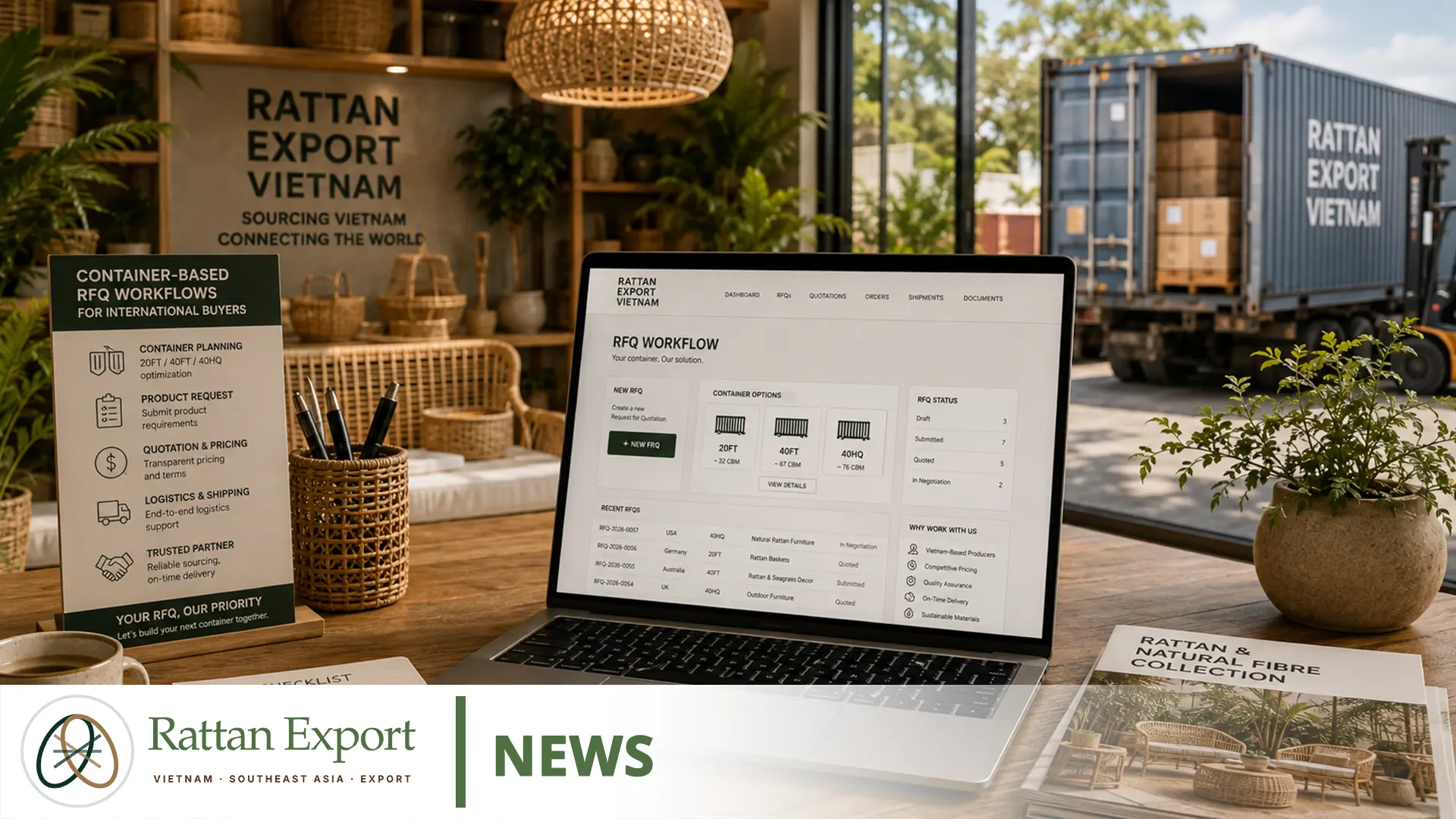
Rattan Export Vietnam is expanding its supplier onboarding programme for Vietnam-based furniture, handicraft and natural-material producers as the platform develops a broader B2B sourcing network for international buyers. The initiative is designed to create a more structured way for manufacturers to present their production capabilities, product categories, materials, export experience and commercial requirements while allowing buyers to understand more clearly who makes a product and what type of factory or workshop stands behind it. The March 2026 expansion remains part of the platform-building stage. Supplier onboarding does not automatically mean commercial approval, public publication or a guaranteed buyer relationship. Instead, it creates the information foundation required for more transparent sourcing as Rattan Export Vietnam develops its supplier and product infrastructure.
Supplier Onboarding Is Becoming a Core Part of the Platform
Rattan Export Vietnam is being developed as a B2B sourcing and export platform rather than a retail marketplace. Its intended users include importers, wholesalers, distributors, retail chains, hospitality buyers, project buyers and brands sourcing from Vietnam. For that model to work effectively, supplier information needs to be organised as carefully as product information.
A buyer looking at a rattan chair, bamboo lamp, seagrass basket or mixed-material cabinet needs more than a photograph and a price indication. The buyer may also need to understand the producer's location, manufacturing specialisation, export experience, available materials, order scale, production capacity, custom-development capability and the relationship between the supplier and the specific product being offered.
The expanded onboarding programme is intended to begin capturing those relationships in a more systematic way.
The Focus Is on Vietnam-Based Producers
Vietnam has a diverse manufacturing base that ranges from large export-oriented furniture factories to specialised workshops and handicraft producers. Different suppliers can have very different strengths even when their catalogues appear to overlap.
One producer may specialise in solid-wood furniture. Another may combine wood and metal. A handicraft manufacturer may work primarily with rattan, bamboo, seagrass or water hyacinth. Other suppliers may focus on baskets, lighting, storage, decorative accessories, lacquer, ceramics or mixed-material collections.
Rattan Export Vietnam's supplier onboarding process is therefore being structured around actual production capability rather than placing every manufacturer into one broad “furniture supplier” category.
| Supplier Area | Examples of Information to Capture | Why Buyers Need It |
|---|---|---|
| Company identity | Legal or trading name, location and contact details | Establishes who the producer is |
| Production focus | Furniture, baskets, lighting, home décor, accessories | Helps buyers identify relevant suppliers |
| Materials | Rattan, bamboo, seagrass, water hyacinth, wood, metal, fabric and others | Supports material-specific sourcing |
| Manufacturing capability | Weaving, woodworking, metalwork, upholstery, finishing | Shows which processes can be handled |
| Commercial model | OEM, ODM, custom development, catalogue supply | Clarifies how a buyer can work with the supplier |
| Export readiness | Markets served, documentation capability and shipment experience | Supports realistic B2B qualification |
Onboarding Is Not the Same as Automatic Approval
A central principle of the developing system is that supplier onboarding and supplier approval should not be treated as the same event. A manufacturer may enter the onboarding process so its capabilities and products can be reviewed, but that does not automatically mean every product will be published, every commercial claim will be accepted or every item will be presented to international buyers without further checks.
This distinction is important for both manufacturers and buyers. Suppliers need a clear route into the platform without the onboarding process becoming unnecessarily difficult. Buyers, however, need confidence that the information they eventually receive is structured and traceable to an identifiable source.
The objective is therefore to build a progressive process: collect supplier information first, organise product and material data, review what can be supported and only then determine which information is appropriate for buyer-facing use.
Supplier Identity Should Remain Connected to the Product
Rattan Export Vietnam is being built around a transparent intermediary model. That makes supplier-product relationships especially important. When a product originates from a particular manufacturer, the internal sourcing structure should preserve that relationship rather than separating the item from its source.
This helps avoid a common sourcing problem in which photographs circulate across multiple websites and buyers can no longer tell who actually manufactures the item. Maintaining supplier identity also makes later discussions about samples, specifications, modifications, production lead times and commercial terms easier to manage.
For the developing platform, supplier onboarding therefore includes not only a company profile but also the concept of connecting individual supplier products to their original supplier information.
Product Data Needs to Start at the Supplier Level
Many supplier catalogues are designed primarily for visual presentation. They may contain attractive images and product codes but limited structured data. International sourcing often requires more detail.
Useful product-level information can include the supplier's original product name, supplier SKU, materials, dimensions, finish, colour options, packing method, carton measurements, gross and net weight, minimum order expectations and whether the product is available as a standard catalogue item or requires custom development.
Not every supplier will have all of this information available during initial onboarding. The purpose of the process is to establish a framework in which missing information can be identified rather than silently assumed.
Material Classification Is Particularly Important for Vietnam
Vietnam's furniture and handicraft industry uses a wide range of natural and industrial materials, and product descriptions can become inaccurate if material terminology is too general.
A woven chair may use natural rattan over a wooden frame. Another may use synthetic fibre over steel. A basket marketed as a “natural basket” may be made from seagrass, water hyacinth, bamboo or a combination. A cabinet may combine wood, metal, fabric and woven fibre.
Supplier onboarding therefore benefits from identifying the actual materials used in each product rather than relying only on catalogue category names.
- Rattan should be distinguished from synthetic rattan-style fibre.
- Bamboo should be recorded separately from timber.
- Seagrass and water hyacinth should not be merged into a generic “natural fibre” field where precise information is available.
- Structural materials should be distinguished from decorative or secondary materials.
- Mixed-material products should preserve more than one material where relevant.
More precise material information can later support sourcing, quality discussions, customs classification, buyer specifications and compliance work.
OEM and ODM Capability Matter to International Buyers
International buyers do not all source in the same way. Some want to select an existing supplier model and change only the colour or finish. Others provide drawings, measurements or reference images and expect OEM manufacturing. Design-led buyers may want ODM support in which the supplier helps turn a concept into a production-ready item.
The onboarding programme therefore needs to capture how each producer prefers to work. A small handicraft workshop may be excellent at material adaptation and hand weaving but unsuitable for a large industrial furniture programme. A larger factory may be highly efficient at container-scale production but less flexible for small experimental development.
Neither profile is automatically better. The value comes from matching the right production model to the right buyer requirement.
Container-Based Orders Change Supplier Qualification
Rattan Export Vietnam is focused on B2B sourcing rather than retail quantities. This means supplier onboarding has to consider how a manufacturer operates at commercial shipment scale.
For furniture and handicrafts, container economics can significantly influence whether a product is commercially viable. A lightweight woven chair may occupy substantial cubic volume. A basket may nest efficiently. A knock-down table may load far better than an assembled version. A large decorative lamp may have low weight but poor container utilisation.
For buyers considering 20ft, 40ft or 40HQ orders, useful supplier data can eventually include packed dimensions, units per carton, loading quantities and packaging structure. The March onboarding expansion begins with creating the supplier relationships and data discipline required to support that deeper commercial information over time.
Handicraft Producers Need a Different Onboarding Approach From Large Factories
Vietnam's handicraft sector includes producers whose strengths come from skilled labour, weaving communities and specialised local materials rather than highly automated production lines. Their onboarding requirements can therefore differ from those of large industrial factories.
A handicraft supplier may need to explain how work is distributed, how material preparation is controlled, how handmade variation is managed and how production capacity changes with order volume. Lead times may also depend on weaving labour and seasonal material availability.
For professional buyers, these are not weaknesses when they are understood and managed correctly. Hand production can provide product differentiation that industrial production cannot easily reproduce. The important requirement is clarity about what can be standardised and what natural or handmade variation should be expected.
Supplier Documentation Should Support, Not Replace, Commercial Review
Onboarding can collect catalogues, company documents, available certifications, production information and export records, but documents alone do not prove that a supplier is suitable for every order.
Different buyers may have different requirements relating to material origin, testing, packaging, social compliance, factory standards or destination-market regulation. A supplier that is appropriate for one programme may require additional evidence for another.
Rattan Export Vietnam therefore does not treat a single certificate, brochure or factory claim as a universal guarantee. The role of structured onboarding is to make available evidence easier to understand and identify where further verification may be required.
Photography and Catalogue Permission Need Clear Boundaries
Supplier onboarding also involves intellectual-property and content considerations. Manufacturers may provide catalogues, product photography, specification sheets or brand information for review. Permission to inspect that material does not automatically mean it can be publicly republished, commercially reused or automatically synchronised to another platform.
A more responsible onboarding process separates supplier information from usage rights. Product data can be reviewed internally while image publication, catalogue use or other commercial content rights remain subject to the permissions actually granted by the supplier.
This protects both manufacturers and the integrity of the platform as the supplier network grows.
Why Buyers Benefit From Structured Supplier Onboarding
From the buyer's perspective, the advantage of supplier onboarding is not the number of factories listed. A large list of unstructured manufacturers can actually make sourcing more difficult.
The value comes from being able to filter suppliers according to meaningful commercial characteristics: what they make, what materials they use, what production processes they control and what type of order they are suited to handle.
| Buyer Requirement | Useful Supplier Information |
|---|---|
| Rattan dining programme | Natural-fibre weaving capability, frame construction and order scale |
| Bamboo lighting range | Bamboo processing, weaving, electrical-component coordination and packaging |
| Mixed-material furniture | Wood, metal, upholstery and subcontractor coordination |
| Private-label collection | OEM/ODM capability, packaging and branding options |
| Hotel project | Repeatability, custom dimensions, replacement capability and lead time |
| Full-container import | Commercial capacity, packing efficiency and export documentation |
Supplier Onboarding Can Improve RFQ Quality Later
A stronger supplier information base can eventually improve the quality of buyer enquiries. Instead of sending a broad request to every manufacturer, sourcing teams can direct an RFQ toward suppliers whose material, production and commercial profile fits the requirement.
For example, a buyer requesting a natural-rattan lounge collection may need a different producer from a buyer requesting weather-resistant synthetic weaving over aluminium frames. A hotel project requiring customised timber and woven furniture may need a factory network with more complex production coordination.
The March 2026 onboarding expansion is therefore an early infrastructure step. It does not mean a fully automated RFQ matching system is already complete. It creates the supplier data foundation that can support more precise sourcing workflows as the platform develops.
What Vietnam-Based Producers Can Prepare
Manufacturers and handicraft suppliers interested in international B2B sourcing can make onboarding easier by preparing clear, structured information about their operations.
- Company and factory or workshop information.
- Primary product categories.
- Materials and manufacturing processes.
- Original product catalogue and supplier SKUs.
- Standard dimensions and available customisation.
- OEM and ODM capability.
- Indicative MOQ or order-scale expectations.
- Export markets and experience where applicable.
- Available certificates and supporting documents.
- Packaging information and available shipment data.
- Clear permission boundaries for catalogue images and product information.
- A contact person responsible for commercial and technical communication.
Complete information is useful, but the process can also identify gaps and allow suppliers to improve their export documentation progressively.
What International Buyers Should Expect
For international buyers, expanded supplier onboarding should create more transparency rather than an impression that every manufacturer has already been fully approved for every possible order.
Buyers should still evaluate product suitability, samples, specifications, commercial terms, production capacity and any destination-specific compliance requirements relevant to their own programme.
The role of Rattan Export Vietnam is to make the sourcing structure clearer: connect products to identifiable suppliers, organise available information and create a more practical route from initial product discovery toward direct B2B sourcing discussions.
Building a More Transparent Vietnam Sourcing Network
The supplier onboarding expansion is an important step in the development of Rattan Export Vietnam, but it remains part of a wider platform-building process. The objective is not to create the largest possible supplier directory. It is to build a useful B2B sourcing network in which supplier identity, product information and material data remain connected.
As the platform develops, buyers will be able to explore relevant categories through the product catalogue, understand the broader Vietnam sourcing and export model, review the platform's developing approach to quality and compliance and communicate specific product or sourcing requirements through the wholesale inquiry.
For Vietnam-based manufacturers and handicraft producers, structured onboarding creates an opportunity to present capabilities to international buyers in a more professional context. For buyers, it creates the foundation for sourcing decisions based not simply on attractive product images but on a clearer understanding of the manufacturer, material, production process and commercial fit behind each product.
Sources and Data References
- Rattan Export Vietnam, supplier onboarding programme and platform development roadmap, March 2026.
- Rattan Export Vietnam, B2B sourcing model for Vietnam-based furniture and handicraft manufacturers.
- Rattan Export Vietnam, developing supplier-product and material data structure.