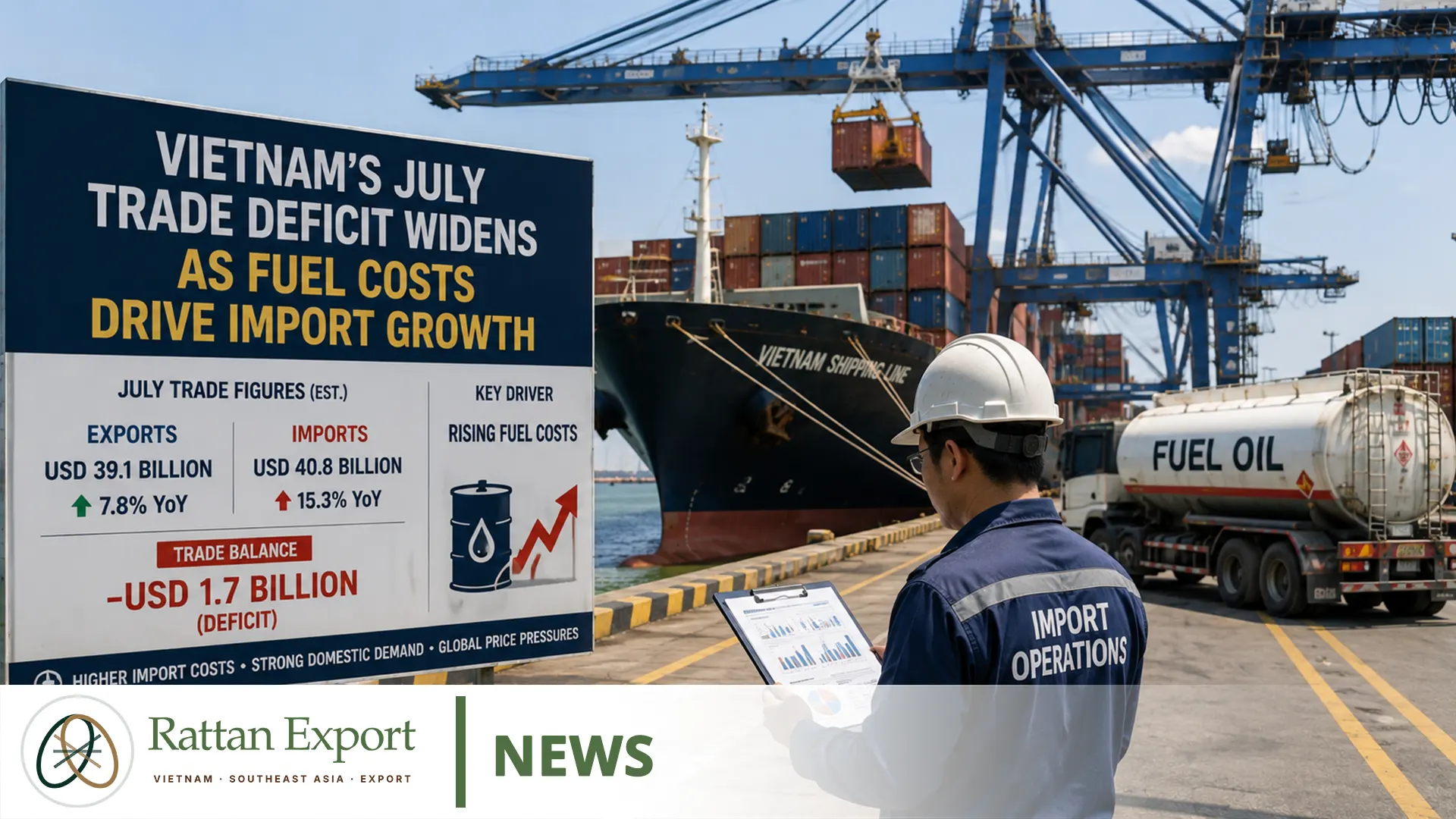
Vietnam’s merchandise trade deficit widened again in July 2026 as rapidly rising import costs, particularly for crude oil and refined fuels, outpaced another strong month of export growth. Government data released on 3 August showed a July trade deficit of US$3.587 billion, compared with US$2.64 billion in June. Exports still performed strongly, rising 25% year on year to approximately US$53 billion, but imports increased much faster, climbing 41% to about US$56.67 billion. For international buyers sourcing furniture, rattan, bamboo, handicrafts and other manufactured goods from Vietnam, the figures do not indicate collapsing export demand. Instead, they highlight how energy prices, imported production inputs and logistics costs can change the commercial environment even while factories continue to expand output and overseas sales.
July’s Deficit Widened Even as Exports Grew 25%
The central point in Vietnam’s July trade data is that the deficit did not emerge because exports were weak. Merchandise exports rose by one quarter from a year earlier. The problem was that imports expanded even faster. At approximately US$56.67 billion, July imports exceeded exports sufficiently to produce a US$3.587 billion monthly deficit.
This distinction matters for B2B sourcing. A country can simultaneously record strong export manufacturing growth and a widening trade deficit if its factories, transport network and energy system require increasingly expensive imported inputs. Vietnam’s 2026 trade pattern is therefore partly a story of strong manufacturing activity being accompanied by a much larger import bill.
| Trade Indicator | July / Jan-Jul 2026 | Year-on-Year Change |
|---|---|---|
| July exports | Approx. US$53 billion | +25% |
| July imports | Approx. US$56.67 billion | +41% |
| July trade balance | US$3.587 billion deficit | Wider than June |
| Jan-Jul exports | Approx. US$320 billion | +21.7% |
| Jan-Jul imports | Approx. US$340 billion | +34.8% |
| Jan-Jul trade balance | US$20.5 billion deficit | Above Vietnam’s previous annual deficit record |
The Seven-Month Deficit Has Become Historically Large
For January through July, Vietnam exported approximately US$320 billion of goods and imported around US$340 billion. The cumulative trade deficit reached US$20.5 billion, exceeding the country’s previous full-year record deficit of roughly US$18 billion recorded in 2008.
The comparison should be interpreted carefully because Vietnam’s economy, manufacturing base and total trade turnover are now much larger than they were in 2008. Nevertheless, the figure demonstrates the unusual scale of the 2026 reversal for an economy that has frequently generated merchandise trade surpluses in recent years.
For manufacturers and overseas buyers, the immediate question is not whether a national trade deficit is inherently negative. The more useful question is what is driving it and whether those drivers affect individual product costs, production lead times, freight rates or supplier capacity.
Fuel Costs Are a Major Part of the Import Story
The strongest evidence comes from the difference between import volumes and import values. In the first seven months of 2026, Vietnam’s crude-oil import volume fell 11.9% from a year earlier, but the value of those imports increased 18%. Refined-fuel imports increased only 6% in physical volume while their value surged 67.6%.
Those figures show that the import bill was being driven significantly by price rather than simply by larger physical quantities. As a rough illustration, the published volume and value changes imply that average import value per unit rose by around one-third for crude oil and by more than one-half for refined fuels, although changes in product mix and sourcing routes mean this should not be treated as an exact commodity-price calculation.
| Energy Import | Volume Change | Value Change | Commercial Meaning |
|---|---|---|---|
| Crude oil | -11.9% | +18% | Vietnam paid substantially more despite importing less volume |
| Refined fuels | +6% | +67.6% | Import spending rose far faster than physical demand |
Why Vietnam Remains Exposed to Imported Energy
Vietnam produces crude oil domestically and operates two major refineries, but domestic refining does not fully cover the country’s fuel needs. Earlier in 2026, supply disruption associated with the Middle East conflict forced Vietnam to diversify crude and refined-product sourcing. The country’s largest refinery had historically depended heavily on Kuwaiti crude, while additional refined fuels, including aviation fuel and other petroleum products, continued to be imported to meet domestic demand.
That dependence creates a channel through which global geopolitical events can affect Vietnamese manufacturing even when the goods being exported have no direct connection with the energy sector. Higher imported fuel costs can influence domestic trucking, industrial energy expenses, supplier transport, packaging-material production and ultimately the operating environment surrounding export manufacturing.
A Trade Deficit Does Not Mean Vietnam’s Factories Are Slowing
Other July indicators continued to show strong domestic activity. Industrial production expanded 14.5% from a year earlier, while retail sales also increased 14.5%. Foreign direct investment inflows in the first seven months rose 11.8% to approximately US$15.2 billion.
These figures help explain why import demand remains high. An expanding manufacturing economy imports machinery, components, chemicals, fabrics, metals, electronics and other production inputs in addition to energy. Some imported goods are consumed domestically; others become part of products that are subsequently exported.
For a professional buyer, rising imports can therefore have two very different meanings. They may indicate cost pressure from expensive fuel, but they can also reflect factory investment and expanding production. Supplier-level evaluation is necessary to distinguish between the two.
Furniture and Handicraft Buyers Should Focus on Input Exposure
Rattan, bamboo and natural-material products can appear highly local because the visible fibre may originate in Vietnam. Yet the finished SKU can depend on imported components. Upholstery fabrics, hardware, coatings, adhesives, electrical components, packaging materials or specialised machinery can be sourced internationally.
A buyer evaluating a Vietnamese supplier should therefore ask which cost elements are genuinely local and which are linked to global input prices. A chair with a Vietnamese timber frame and woven rattan back may still use imported fabric or metal hardware. A bamboo pendant lamp may depend on imported electrical fittings. A natural-fibre cabinet may use engineered board, hinges or finishing chemicals whose prices react differently from the raw fibre itself.
Energy Costs Can Reach the Buyer Through Logistics
Fuel-price pressure can also move through the logistics chain. Factory pickup, container positioning, trucking to port, terminal handling and international freight all contain energy-sensitive components. Carriers and transport companies may adjust fuel-related charges when energy markets move sharply.
This does not mean every FOB quotation will immediately rise when crude prices increase. Contract terms, carrier hedging, route structure and competition all affect how quickly cost changes are passed through. Buyers should therefore avoid applying a simple fuel-price percentage directly to product cost. The correct approach is to request updated transport assumptions and identify which cost components are fixed and which remain variable.
Landed Cost Is More Important Than Factory Price
For bulky furniture and natural-fibre products, the combination of energy and freight pressure makes container efficiency even more important. A product that uses 15% less container volume can sometimes offset a meaningful increase in freight or inland transport costs.
| Cost Variable | Buyer Control | Useful Action |
|---|---|---|
| Factory unit price | Medium to high | Negotiate specifications and volume |
| Carton CBM | High during development | Improve nesting, stacking or knock-down design |
| Ocean freight | Low | Compare current carrier and route options |
| Fuel-related surcharges | Low | Clarify validity period and responsibility |
| Damage rate | Medium | Balance packaging protection against excessive volume |
| Units per container | High | Build a loading plan before final order approval |
Natural-Material Products Need Particular Cost Discipline
Natural fibres introduce characteristics that can complicate cost control. Rattan, bamboo, seagrass and water hyacinth vary in dimensions and moisture, and many production stages remain labor-intensive. Packaging must protect woven surfaces against crushing and abrasion while also avoiding unnecessary container volume.
If energy and freight costs are rising at the same time, inefficient packaging becomes more expensive. Buyers should therefore request actual packed dimensions rather than calculate landed cost from finished-product dimensions alone.
Currency and Inflation Deserve Monitoring, but Not Simplistic Assumptions
Vietnam’s annual consumer inflation eased to 4.45% in July from 4.69% in June, remaining close to the government’s 2026 target of 4.5%. The easing is important, but it does not remove the cost pressure visible in imported energy.
For sourcing teams, inflation should be monitored together with exchange rates, wage costs, fuel prices and supplier-specific input exposure. A national inflation number cannot by itself predict whether a rattan chair, bamboo lamp or woven basket will become more expensive. Individual BOM structure remains more useful.
Buyers Should Avoid Overreacting to the Headline Deficit
A US$20.5 billion cumulative deficit is notable, but it does not mean Vietnam has suddenly become an unattractive sourcing base. Exports were still growing above 20% during the first seven months, industrial production remained strong and foreign investment continued to rise.
The data instead signals a more expensive operating environment and a higher level of external-input exposure. Buyers that rely on old freight assumptions or quotations with very long validity periods may therefore face more surprises than buyers that update costs regularly.
What International Buyers Should Ask Vietnamese Suppliers
- How long is the FOB quotation valid? Identify inputs that can trigger revision.
- Which important materials or components are imported? Understand exposure to global prices.
- What are the final carton dimensions? Calculate real freight rather than estimated freight.
- How many units fit in 20ft, 40ft and 40HQ containers? Compare landed cost per unit.
- Can packaging or construction be redesigned? Reduce CBM without creating quality risk.
- What inland transport assumptions are included? Fuel-sensitive charges may change.
- Is the supplier able to hold pricing for repeat orders? Ask which BOM components are volatile.
- Are multiple SKUs suitable for consolidation? Better container utilisation can reduce freight exposure.
What This Means for Rattan Export Vietnam Buyers
Vietnam’s widening trade deficit reinforces why Rattan Export Vietnam is being developed around supplier-linked product data rather than simple catalogue browsing. International buyers need to understand the material structure, supplier, packed dimensions, order quantity and container economics behind each SKU before comparing commercial offers.
Our developing product catalogue is structured around clearer material information for rattan, bamboo, seagrass, water hyacinth, jute, wood, metal, fabric, lacquer and mixed-material products. Buyers can also review our approach to quality and compliance, learn more about Vietnam sourcing and export, or send SKUs, quantities, destination market, packaging specifications and container requirements through the wholesale inquiry.
July’s trade deficit is therefore less a warning that Vietnamese exports are failing than a reminder that strong manufacturing growth is taking place in a more expensive energy and import environment. For B2B buyers, the practical response is not to abandon Vietnam sourcing. It is to improve cost visibility, verify supplier input exposure, optimise container utilisation and calculate landed economics with current rather than historical assumptions.
Sources and Data References
- National Statistics Office of Vietnam, July and January-July 2026 trade, inflation, industrial-production, retail-sales and foreign-investment data.
- Reuters, Vietnam July trade deficit and fuel-import cost reporting, 3 August 2026.
- Reuters, Vietnam crude-oil and refined-fuel supply analysis, 13 May 2026.
- Vietnam Customs data referenced in 2026 energy-supply reporting.