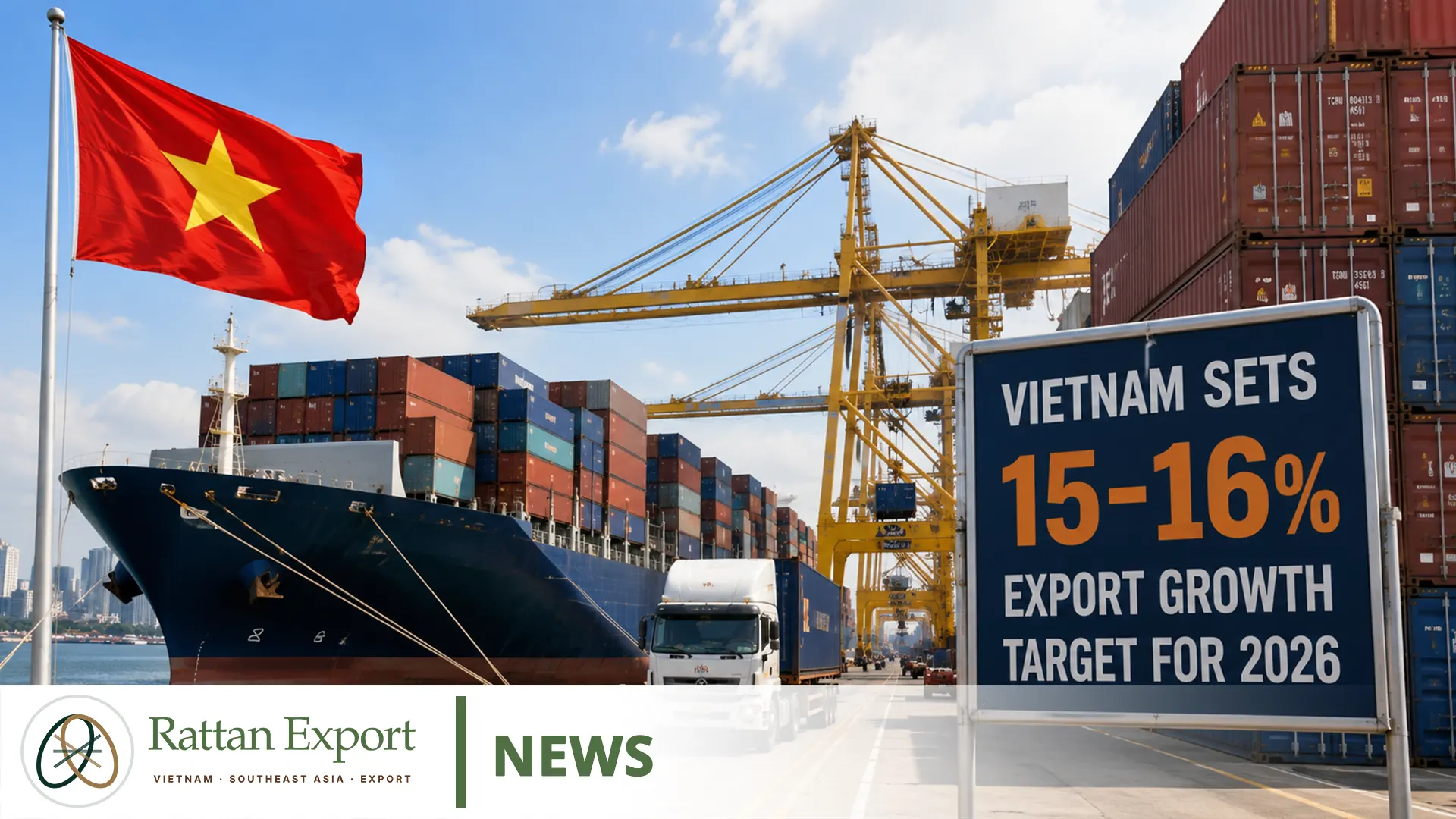
Vietnam has set an ambitious target of 15–16% export growth for 2026, equivalent to approximately US$546–550 billion in merchandise exports, as the government seeks to convert strong manufacturing momentum into broader and more resilient international trade growth. The target, reiterated by the Ministry of Industry and Trade in March, comes after Vietnam exported about US$475.06 billion of goods in 2025, up 17% year on year. Early 2026 data show that exports were initially running ahead of the annual target, but the policy challenge is considerably more complex than maintaining a headline growth rate. Vietnam must expand markets, manage trade-policy risk, improve domestic value creation, strengthen compliance and traceability, and help exporters compete on reliability and product capability rather than price alone.
A 15–16% Target Means Roughly US$546–550 Billion in Exports
At a March trade-promotion briefing involving the Ministry of Industry and Trade, Vietnam's overseas trade offices, business associations and local authorities, officials described the 15–16% target as one of the central trade objectives for 2026. The corresponding export value was placed at approximately US$546–550 billion.
The target follows an already strong 2025. Preliminary Vietnam Customs data show merchandise exports reaching around US$475.06 billion, an increase of 17% from the previous year. Repeating another year of growth in the mid-teens therefore requires a large absolute increase in export value rather than merely recovering from a weak base.
| Indicator | Value | Why It Matters |
|---|---|---|
| 2025 merchandise exports | Approx. US$475.06 billion | Creates a high base for 2026 |
| 2026 export-growth target | 15–16% | Requires another year of strong expansion |
| Indicative 2026 export target | Approx. US$546–550 billion | Shows the scale of additional international demand required |
| Jan–Feb 2026 exports | Approx. US$76.36 billion | Early-year exports were growing faster than the annual target |
| Jan–Feb export growth | 18.3% year on year | Provides initial momentum, not a full-year guarantee |
Early 2026 Trade Data Show Strong Momentum but Also Pressure
Vietnam's National Statistics Office estimated first-two-month merchandise exports at approximately US$76.36 billion, up 18.3% from the same period of 2025. Manufactured products generated about US$68.55 billion and accounted for 89.8% of exports, reinforcing the central role of processing and manufacturing in Vietnam's trade model.
The same data also show why the export target should not be interpreted in isolation. Imports increased 26.3% year on year to approximately US$79.34 billion, leaving a trade deficit of about US$2.98 billion for January and February. Capital goods represented the overwhelming majority of imports, reflecting strong production and investment demand but also highlighting the extent to which export manufacturing can depend on imported machinery, components and industrial inputs.
The foreign-invested sector accounted for approximately 79.1% of exports in the first two months, with export value of about US$60.4 billion. This demonstrates Vietnam's strength as a manufacturing platform but also reinforces a long-term policy objective: increasing the domestic value captured inside export supply chains.
The Target Is a Policy Objective, Not an Export Guarantee
A national growth target cannot ensure that every sector, supplier or market will expand by 15–16%. Electronics, machinery, textiles, footwear, agriculture, furniture and handicrafts face different demand cycles, tariff structures and competitive conditions. The target should therefore be understood as a national policy direction supported by trade promotion, market development, industrial policy and regulatory coordination.
For B2B buyers, this distinction matters. Rapid national export growth can expand supplier capacity and infrastructure, but it can also tighten production schedules, labor availability, container space and raw-material demand in successful sectors. Buyers still need supplier-level due diligence rather than assuming that macroeconomic growth automatically means reliable execution.
Market Diversification Is Central to the 2026 Strategy
The Ministry of Industry and Trade has emphasized both traditional export markets and new growth markets. Vietnam's overseas trade-office network is expected to play a stronger role in identifying opportunities, connecting companies with buyers and communicating policy or technical changes back to exporters.
Officials have even proposed market-specific performance indicators for overseas trade offices. The logic is straightforward: achieving another large increase in export value requires more active market development rather than waiting for existing buyers to increase orders automatically.
The United States remained Vietnam's largest export market during the first two months of 2026, with approximately US$23.8 billion of Vietnamese goods shipped there. Heavy dependence on major markets can generate scale, but diversification helps reduce exposure to tariff changes, demand shocks and geopolitical risk.
Vietnam Plans to Use Its FTA Network More Intensively
Vietnam's 2026 trade plan also emphasizes more effective use of its network of 17 signed free trade agreements while continuing work on additional agreements and market-access initiatives. For manufacturers, the commercial value of an FTA depends on much more than the existence of a lower tariff. Products must satisfy the applicable rules of origin and documentation requirements.
This creates a practical procurement issue for international buyers. A product made in Vietnam does not automatically qualify for every preferential tariff available under a Vietnamese trade agreement. Material origin, processing operations, HS classification and supporting certificates can determine eligibility.
Furniture and natural-material products are particularly diverse in construction. A single SKU may combine Vietnamese rattan or bamboo with imported hardware, fabric, coatings or other components. Buyers should therefore assess origin at the actual product level instead of relying only on the final manufacturing country.
Trade Promotion Is Becoming More Data-Driven
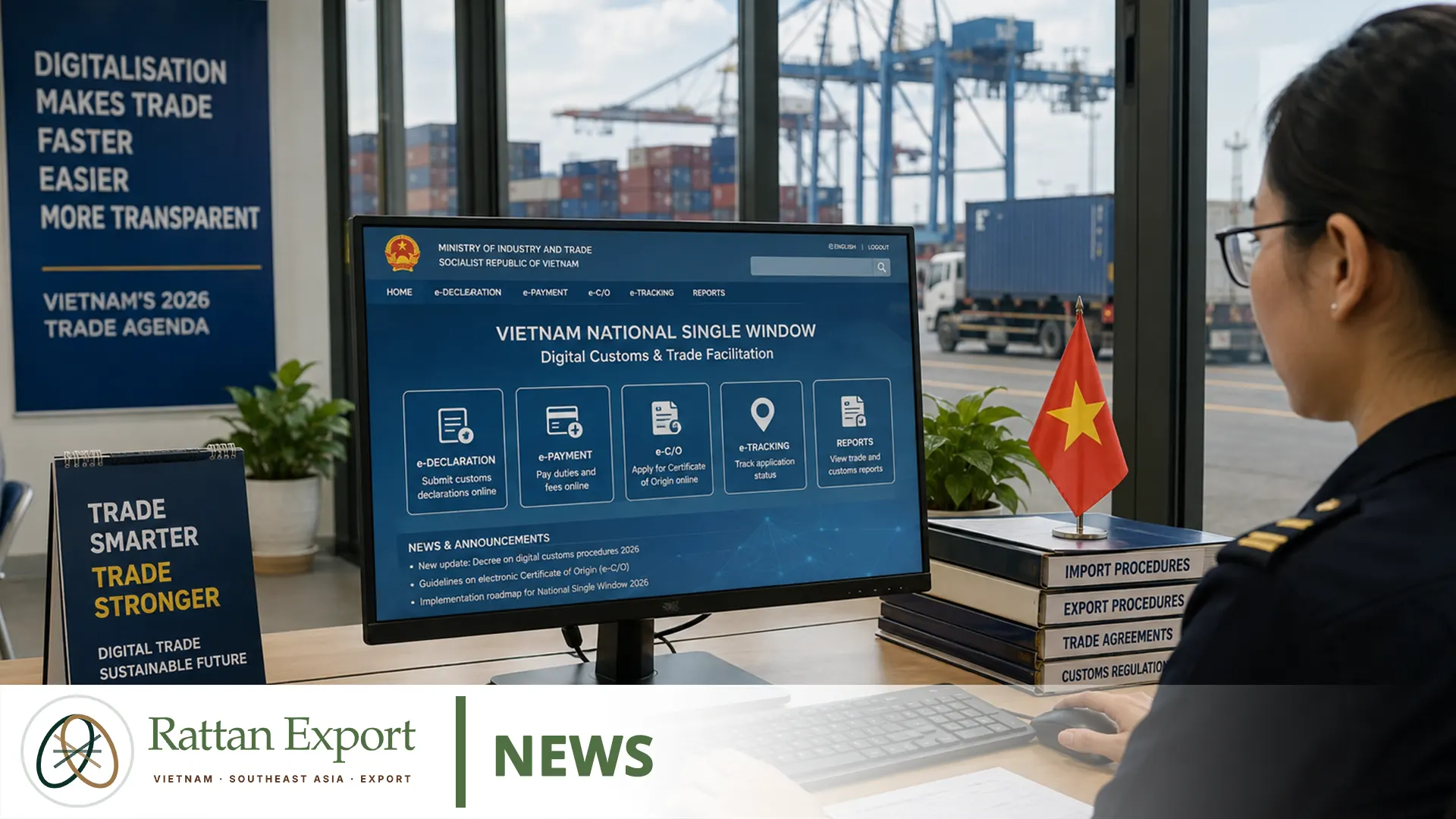
On March 12, the Ministry of Industry and Trade launched a Digital Platform for Overseas Market Development. The initiative is intended to consolidate information from international markets, including economic developments, trade and investment policies, promotion programmes and commercial opportunities.
For exporters, access to timely market intelligence can be as important as factory capability. A technically strong manufacturer can still lose business if it reacts too slowly to a new product rule, labeling requirement, tariff measure or buyer trend. Faster information flows between Vietnam's overseas trade offices, associations and companies are therefore part of the infrastructure supporting the export-growth target.
Growth Must Come With Better Export Readiness
Additional export turnover is most valuable when it is commercially sustainable. International buyers increasingly expect documentation, traceability, quality systems, reliable lead times and accurate product information alongside competitive pricing.
| Export Capability | Buyer Expectation |
|---|---|
| Product data | Accurate materials, dimensions, specifications and HS information |
| Quality control | Approved samples, inspection criteria and repeatable production |
| Origin | Documentation supporting country and preferential-origin claims |
| Compliance | Awareness of destination-market technical and regulatory requirements |
| Packaging | Protection, labeling and commercially efficient carton design |
| Logistics | Realistic cargo-ready dates and container-loading information |
| Supplier capacity | Verified available capacity rather than theoretical maximum output |
What the 15–16% Target Means for Furniture and Handicraft Exporters
Vietnam's furniture, rattan, bamboo and handicraft suppliers operate inside the broader manufacturing and export ecosystem, but their commercial economics differ from electronics or garments. Furniture and homeware can be highly sensitive to freight cost, container utilization, housing demand, retail inventory cycles and discretionary consumer spending.
Natural-material products introduce additional variables such as manual weaving capacity, moisture control, natural color variation and distributed craft-village production. Growing national exports will not remove these operational realities. Suppliers seeking higher-value international orders will need to combine Vietnamese craftsmanship with stronger commercial systems.
Higher Export Growth Does Not Mean Competing Only on Low Cost
Vietnam's long-term opportunity is not simply to ship more units at lower prices. Stronger domestic design, engineering, branding, component production and supplier capability can increase the value retained in Vietnam for every dollar exported.
For furniture and handicrafts, this can mean moving from basic OEM production toward more ODM development, offering coordinated collections instead of isolated SKUs, documenting Vietnamese materials more clearly and helping buyers optimize packaging and container economics.
A US$1 increase in factory price can be commercially justified if it delivers better durability, more efficient packing, lower damage rates or stronger retail differentiation. Higher-value exports are therefore compatible with the national growth target even when unit volumes do not rise at exactly the same rate.
International Buyers Should Watch Capacity as Well as Growth
When an exporting economy expands quickly, supplier capacity deserves more attention. A factory may accept more orders than its actual production window can support, or subcontract additional work to outside workshops. This does not automatically create a quality problem, but buyers should know how production is organized.
- Confirm available monthly capacity for the requested production period.
- Separate factory-owned production from subcontracted stages.
- Check whether critical raw materials have long replenishment times.
- Agree on realistic sample, production and inspection schedules.
- Verify the cargo-ready date before committing to a vessel booking.
- Maintain an approved specification and master sample for repeat orders.
Import Growth Is Also a Signal for Buyers
Vietnam's imports grew faster than exports in the first two months of 2026. This is partly consistent with a manufacturing economy importing machinery, components and production inputs, but it also means buyers should understand how dependent a specific supplier is on foreign materials.
A furniture producer relying mainly on local wood, rattan or bamboo may have a different supply-risk profile from a product dependent on imported upholstery, specialized hardware or machinery components. Supplier qualification should therefore include key upstream dependencies rather than evaluating only the final assembly factory.
What International Buyers Should Ask in 2026
- Where does the supplier's real capacity sit? Factory, craft village, subcontractor or a combination?
- Which materials are local and which are imported? This affects lead time, origin and risk.
- Can the supplier support repeat orders? Rapid growth can expose inconsistency.
- Which destination markets does the supplier already serve? Market experience can reduce execution risk.
- What documentation supports origin and compliance? FTA eligibility should never be assumed.
- What are the packed dimensions? Export growth is irrelevant if freight economics make the SKU uncompetitive.
- What happens if demand increases? Buyers should understand the supplier's capacity-expansion plan.
What This Means for Rattan Export Vietnam Buyers
Vietnam's 15–16% export-growth target reinforces the country's ambition to deepen its role in global supply chains, but for Rattan Export Vietnam the practical objective remains supplier-level clarity rather than macroeconomic promotion alone.
Our developing product catalogue is structured around supplier-linked products, clearer material classification and commercial information relevant to international sourcing. Buyers can review our approach to quality and compliance, learn more about Vietnam sourcing and export, or submit product specifications, quantities, destination markets, packaging and container requirements through the wholesale inquiry.
If Vietnam reaches its 2026 export target, it would mark another major expansion of an already large trading economy. For international furniture and natural-material buyers, however, the most useful consequence is not the headline percentage itself. It is the continued development of supplier capability, market intelligence, production infrastructure and export systems that can make Vietnam a more effective sourcing base. The best procurement decisions will still depend on identifying the right supplier, verifying the right product and understanding the real commercial structure behind each order.
Sources and Data References
- Vietnam Ministry of Industry and Trade, March 2026 trade-promotion briefing and export-growth programme.
- Vietnam Ministry of Industry and Trade, implementation measures for 2026 production and export objectives.
- National Statistics Office of Vietnam, socio-economic performance for February and the first two months of 2026.
- Vietnam Customs, preliminary full-year 2025 international merchandise trade statistics.
- Vietnam Ministry of Industry and Trade, Digital Platform for Overseas Market Development launch, March 2026.