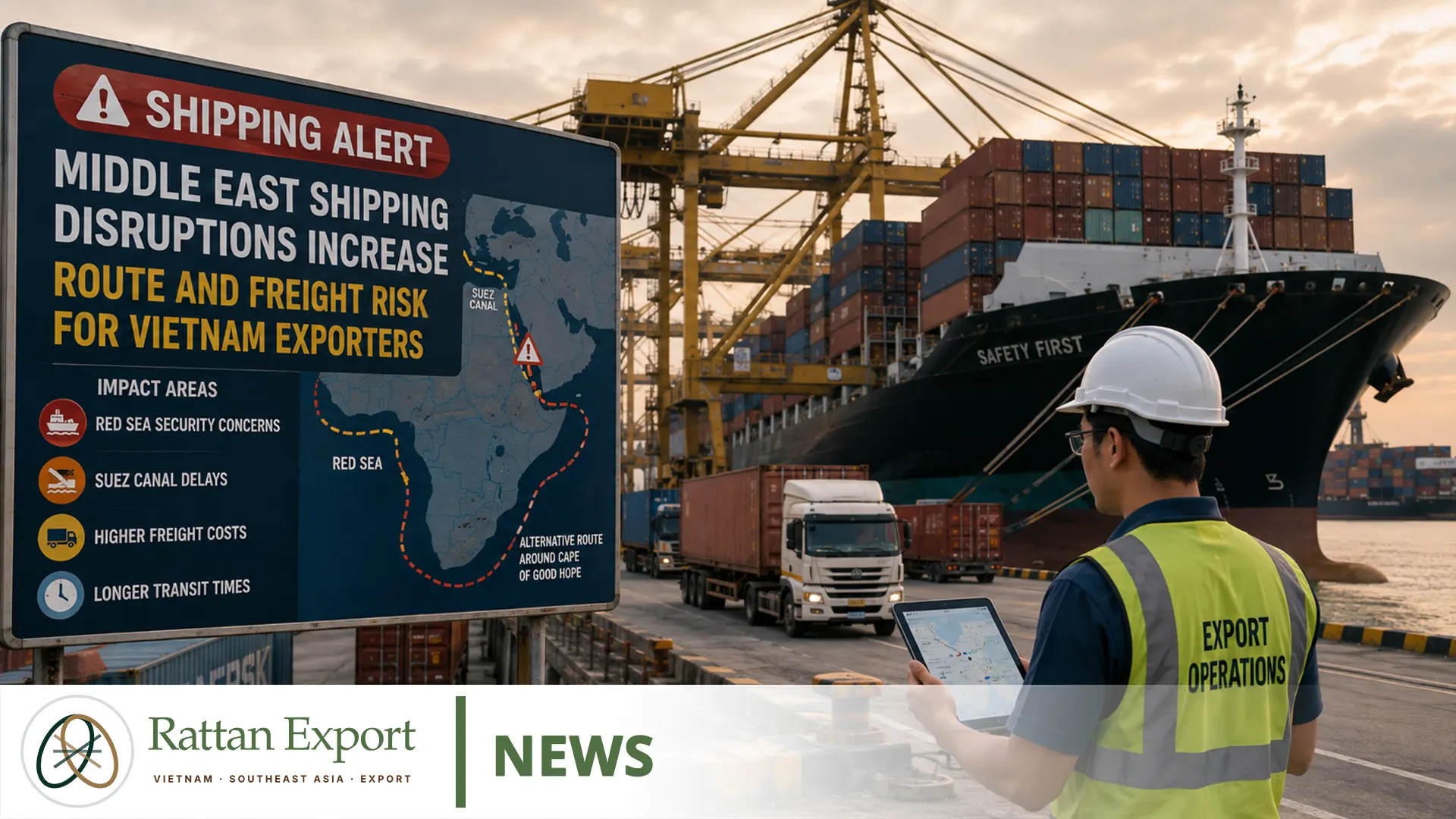
Middle East shipping disruptions are increasing route, freight and delivery risk for Vietnamese exporters in 2026, forcing manufacturers and international buyers to treat logistics as a variable part of the commercial order rather than a fixed service added after production. By late June, disruption around the Strait of Hormuz, continuing instability affecting Red Sea and Suez routings, higher energy costs and repeated carrier-network adjustments were creating a more complicated environment for cargo moving from Vietnam to the Gulf, Europe and other international markets. For furniture, rattan, bamboo, handicraft and homeware exporters, the challenge is particularly important because products are often container-volume intensive and a relatively small change in routing, storage or surcharge structure can materially alter landed cost.
By Late June, Middle East Disruption Was Still an Operational Issue
The shipping problem was no longer a short-lived event by 25 June 2026. Maersk's Asia-Pacific market update in May said instability across the Red Sea and Gulf continued to affect global networks and that the carrier had reversed its gradual return to Suez Canal transits on affected trade lanes, maintaining Cape of Good Hope routing where required. Its early-June European update likewise said conditions around the Strait of Hormuz had not shown significant improvement.
By 16 June, Maersk was still operating an extensive Middle East contingency structure involving booking restrictions, alternative gateways, temporary storage, landbridge movements and emergency freight charges. This is significant for Vietnamese exporters because it demonstrates that a normal sailing schedule or freight quotation cannot automatically be assumed to remain valid through the life of an order.
Hormuz and Suez Are Different Risks
Exporters need to distinguish the region's two major route problems. The Strait of Hormuz controls access to the Persian Gulf and therefore directly affects cargo for markets such as the UAE, Qatar, Bahrain, Kuwait, Iraq and eastern Saudi Arabia. The Red Sea, Bab el-Mandeb and Suez Canal corridor is the shorter maritime route between Asia and Europe.
A container moving from Vietnam to Northern Europe through Suez does not normally need to pass through Hormuz. A shipment from Vietnam to an Upper Gulf destination may be heavily dependent on Hormuz but not continue through Suez. The risks nevertheless interact because the same regional conflict affects fuel markets, insurance availability, fleet deployment, feeder services, transshipment hubs and carrier network planning.
| Risk Area | Primary Exposure | Possible Effect on Vietnam Cargo |
|---|---|---|
| Strait of Hormuz | Upper Gulf trade | Booking restrictions, storage, landbridge and alternative-port routing |
| Red Sea / Bab el-Mandeb | Asia-Europe maritime route | Cape rerouting, longer transit and lower effective vessel capacity |
| Energy market | Global transport network | Fuel-related surcharges and higher inland cost |
| Insurance | War-risk areas | More limited cover or higher risk pricing |
| Network disruption | Global carrier operations | Equipment and vessel capacity can shift between routes |
Emergency Freight Shows How Quickly Landed Cost Can Change
Maersk's 16 June Middle East operational update illustrates the scale of potential additional cost. For cargo loading from or destined to specified markets including Iraq, Kuwait, Bahrain, Qatar, the UAE, parts of Saudi Arabia and Oman, the carrier published a Strait of Hormuz Emergency Freight rate of US$1,800 for a 20-foot dry container, US$3,000 for a 40-foot dry container and US$3,800 for reefer, special and dangerous-goods containers, subject to applicable regulatory approvals.
The charge was linked to alternative routing, temporary storage, additional charters and eventual onward transport when conditions permitted. The published structure included 14 days of storage in transit; after that point, storage could be charged at US$25 per TEU per day, with additional reefer monitoring and plug-in costs where applicable.
This type of cost is very different from a normal predictable ocean rate. It can emerge after the product has already been manufactured or even after cargo has entered the transport network. Exporters and buyers therefore need to decide in advance who carries additional freight, storage and change-of-destination exposure under the sale contract and agreed shipping terms.
Alternative Routes Are Becoming Part of Normal Contingency Planning
The disruption has also changed the physical architecture of some Gulf shipments. Maersk's June update described cargo for Kuwait, Iraq, Qatar, Bahrain and the UAE being routed through Salalah and Khor Fakkan and then connected through landbridge and intra-Gulf feeder solutions. Saudi cargo continued to use Jeddah, including landbridge movements toward Riyadh and Dammam.
Separate June arrangements also gave customers additional detention flexibility for containers moving through ports such as Jeddah, Salalah and Jebel Ali. These measures show that freight risk is not simply a question of whether a ship sails. Cargo may require an alternative port, additional truck movement, storage, a feeder connection or a completely different final-delivery structure.
Vietnam Is Managing This Risk While Trade Volumes Continue to Grow
The logistics uncertainty is occurring during strong trade growth. Vietnam's National Statistics Office estimated merchandise exports at approximately US$215.66 billion in the first five months of 2026, up 19.5% year on year. Manufactured products represented about US$193.71 billion, or 89.8% of exports.
Imports reached approximately US$229.46 billion over the same period, up 30.8%. The scale of these flows means Vietnam depends not only on factories and ports but also on predictable access to international vessel capacity, container equipment, transshipment hubs and destination-market logistics.
High export growth can therefore coexist with high logistics risk. A manufacturer may have full order books and efficient production while still facing a commercial problem if the final transport corridor changes suddenly.
Furniture and Natural-Material Products Are Especially Sensitive to Freight Changes
For Rattan Export Vietnam's target sectors, freight economics are particularly important. Rattan chairs, bamboo furniture, woven storage, natural-fibre lighting and home décor can be lightweight but consume significant container volume. Freight is therefore often spread over relatively few units compared with dense cargo.
A US$3,000 emergency cost on a 40-foot container does not affect every product equally. If a container carries a high-value, efficiently packed collection, the additional cost per unit may remain manageable. If it carries large non-nesting chairs or oversized decorative pieces, the same charge can materially change the buyer's landed-cost calculation.
| Product Type | Container Risk | Useful Mitigation |
|---|---|---|
| Rattan chairs | High cubic volume | Stacking or knock-down construction |
| Woven baskets | Potentially inefficient if non-nesting | Develop nesting sets |
| Bamboo furniture | Rigid frames consume CBM | Removable components where structurally appropriate |
| Pendant lighting | Large volume, low weight | Stackable or modular shades |
| Mixed homeware | Many carton sizes complicate loading | Container plan before final assortment approval |
Freight Risk Extends Beyond Cargo Destined for the Middle East
A Vietnamese exporter selling directly to Dubai, Doha, Kuwait or other Gulf markets obviously faces the most direct exposure. But businesses shipping to Europe or other regions can also experience indirect effects.
When carriers reroute ships around the Cape of Good Hope, the round voyage takes longer and each vessel can complete fewer cycles in the same period. Equipment may remain tied up longer. Fuel consumption rises. Scheduled arrival patterns change. At the same time, energy-market pressure can move into trucking, rail, port and inland charges far from the Middle East.
On 23 June, for example, Maersk announced a temporary Emergency Inland Fuel/Energy Surcharge for several Nordic markets, explicitly linking the measure to Middle East energy-supply pressure. For a Vietnamese exporter selling under a commercial structure that includes destination inland transport, this type of cost can matter even though the container itself never enters the Gulf.
Insurance Needs to Be Checked, Not Assumed
Carrier advisories during the disruption have also warned that some insurers have reduced or withdrawn vessel-related cover in parts of the Red Sea, Gulf of Oman and Persian Gulf. Cargo insurance conditions vary by policy, route and insurer, so exporters should not assume that a standard policy automatically covers every war-risk scenario or rerouted movement.
The practical action is straightforward: verify cargo-insurance coverage before loading and again if the route changes materially. Buyers should also understand whether additional war-risk premium, storage or change-of-destination cost is covered, excluded or subject to specific approval.
FOB Price Alone Is Becoming Less Useful for Procurement Decisions
In an unstable freight environment, comparing suppliers only on FOB unit price can produce the wrong result. Buyers should compare landed economics: packed CBM, loading quantity, ocean freight, surcharges, potential storage, destination handling and inland movement.
A supplier that quotes a chair US$2 cheaper may not be commercially better if the chair occupies 20% more container space. A basket programme with slightly higher unit cost can produce a lower landed cost if the products nest efficiently. Logistics therefore needs to be part of product design and sourcing, not only a purchasing department's final shipping task.
Booking Timing Has Become More Important
Route instability also changes the value of a confirmed booking. Exporters should distinguish between a freight indication, a quotation and actual confirmed space. Cargo-ready dates need to align with vessel cut-offs, and production teams should avoid promising delivery dates before the logistics team has checked the current operating situation.
Where disruption is severe, an earlier booking can provide more planning visibility but still does not guarantee that the original vessel, port rotation or routing will remain unchanged. Contingency time should therefore be included in customer commitments for sensitive routes.
Container Planning Is a Direct Risk-Control Tool
Vietnamese exporters cannot control geopolitical events, but they can reduce the amount of freight exposure attached to each saleable unit. Container optimisation is one of the most practical tools available.
- Calculate packed CBM before final product approval.
- Develop nesting, stacking or knock-down options where product integrity allows.
- Model 20ft, 40ft and 40HQ loading quantities separately.
- Review mixed-SKU loading before confirming the purchase order.
- Keep carton dimensions accurate in the RFQ and production record.
- Plan moisture protection for natural materials during longer transit or storage.
- Leave commercial room for route and surcharge changes on volatile corridors.
Natural Materials Create an Additional Storage Risk
Rattan, bamboo, seagrass, water hyacinth and other plant-based fibres require particular attention if a container is unexpectedly stored or transit time becomes much longer. The issue is not simply the number of days in transport. Humidity, ventilation, material moisture at packing and packaging design can influence mold, odor, staining and deformation risk.
Exporters should therefore avoid treating moisture protection as an optional packaging extra. Products should be properly dried before packing, packaging specifications should suit the material and route, and the buyer and supplier should understand what happens if cargo is held at a transit location significantly longer than planned.
A Better RFQ Should Include Logistics Risk Data
For 2026 sourcing, the RFQ for furniture and natural-material products should include more than product specification and FOB price. It should capture the information required to test whether the order remains viable under different freight scenarios.
| RFQ Field | Commercial Purpose |
|---|---|
| Carton dimensions | Calculate real CBM |
| Units per carton | Measure packing efficiency |
| 20ft / 40ft / 40HQ quantity | Compare freight per unit |
| Port of loading | Identify origin routing options |
| Destination port | Assess route and regional risk |
| Cargo-ready date | Match production to booking window |
| Incoterm / freight responsibility | Clarify commercial allocation of transport cost |
| Alternative destination acceptable? | Support contingency planning |
| Moisture-protection specification | Reduce natural-material storage risk |
What This Means for Rattan Export Vietnam Buyers
Middle East shipping disruption reinforces why Rattan Export Vietnam is being developed around more than product discovery. International buyers sourcing rattan, bamboo and other natural-material products need supplier identity, product data, packing information and container requirements to be connected before an order is commercially evaluated.
Our developing product catalogue links products to suppliers and structured material information, while buyers can review our approach to quality and compliance, learn more about Vietnam sourcing and export, or send product quantities, destination markets, packaging requirements and container targets through the wholesale inquiry.
The Middle East situation cannot be solved by Vietnamese manufacturers or international buyers. What can be controlled is exposure. Products can be designed for better container utilisation, quotations can state realistic logistics assumptions, contracts can clarify freight responsibility and buyers can maintain alternative routing scenarios. In a volatile shipping environment, that preparation can be as commercially important as negotiating the factory price.
Sources and Data References
- Maersk, Middle East Operational Update 36, 16 June 2026.
- Maersk, Strait of Hormuz disruption and temporary line-detention arrangements, 9 June 2026.
- Maersk Asia Pacific Quarterly Market Update, Q2 2026.
- Maersk, Emergency Inland Fuel/Energy Surcharge announcement, 23 June 2026.
- National Statistics Office of Vietnam, trade performance for May and the first five months of 2026.
- Vietnam Ministry of Industry and Trade, energy-security guidance related to the Middle East crisis.