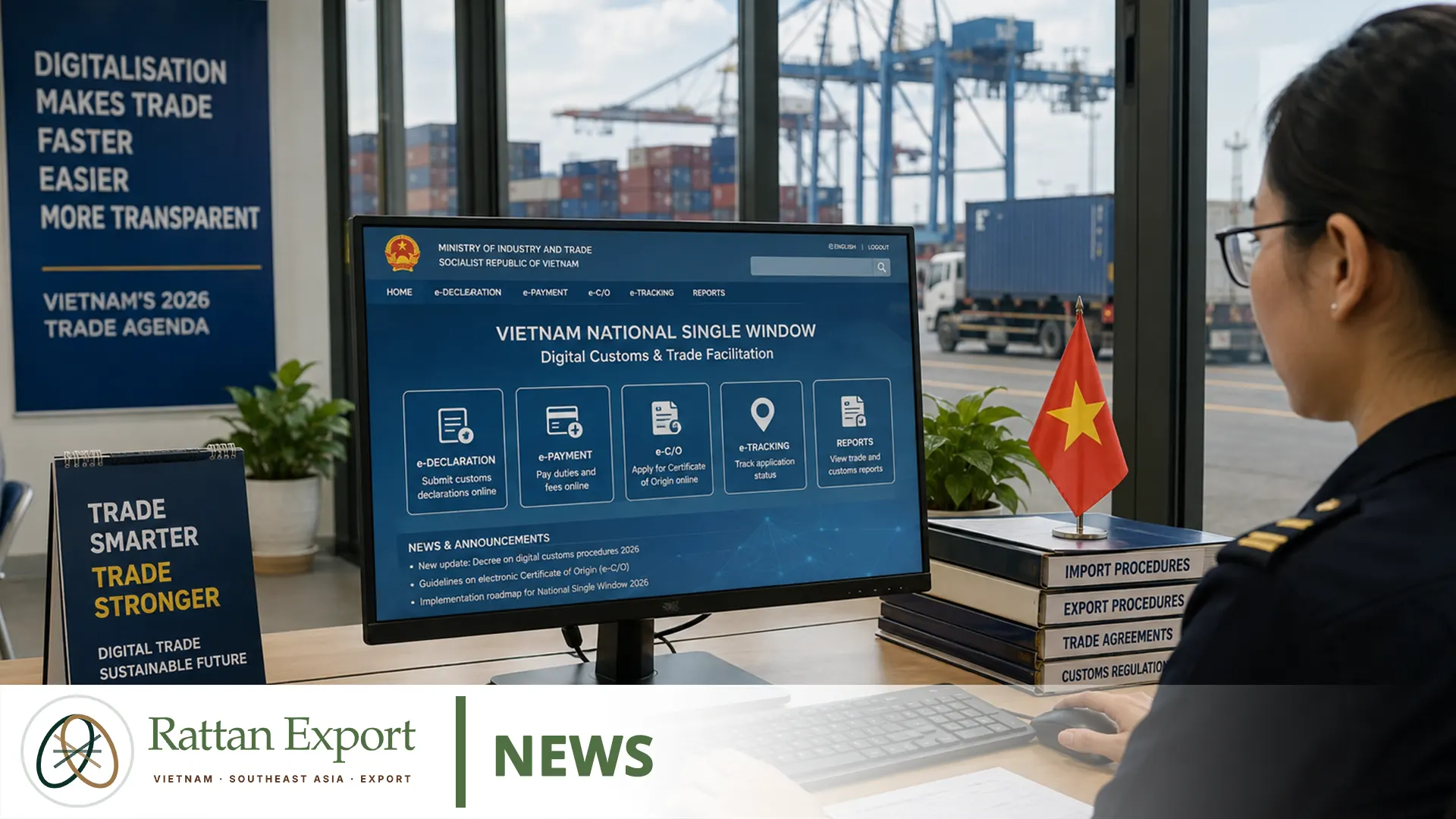
Digitalisation of import-export procedures is moving higher on Vietnam’s 2026 trade agenda as the country shifts from electronic customs toward a broader digital and smart-customs model built around interconnected data, automated processing and more streamlined interaction between businesses and government agencies. The direction is commercially important for an economy that depends heavily on international trade. For exporters, importers and global sourcing teams, faster customs processing is only one part of the potential benefit. More consistent electronic records, better integration between agencies, clearer regulatory information and more reusable trade data can also reduce administrative friction across product classification, origin documentation, specialised inspection, cargo release and post-clearance compliance.
Vietnam Is Moving Beyond Electronic Customs
Vietnam has used electronic customs procedures for years, but the 2026 policy direction goes further than replacing paper declarations with online forms. The Ministry of Finance has described the next stage as a transition from “electronic customs” toward “digital customs”, with businesses positioned as a central user of the system rather than simply as entities submitting declarations.
The distinction matters. An electronic process can still require companies to enter similar information into several systems, upload documents repeatedly or wait for separate government agencies to process related procedures independently. A more mature digital customs model aims to make data reusable, interoperable and increasingly suitable for automated risk management and decision-making.
| Earlier Digitalisation | 2026 Direction | Potential Business Effect |
|---|---|---|
| Electronic submission of declarations | Integrated digital workflow | Less duplication between stages |
| Separate agency systems | Greater data connectivity | Fewer fragmented procedures |
| Document-centred processing | Data-centred processing | More reusable information |
| Manual administrative checks | More risk-based and automated processing | Resources focused on higher-risk shipments |
| Reactive information search | Structured digital trade information | Better regulatory predictability |
The Digital Customs IT System Is a Core 2026 Project
A central part of the modernisation programme is the project to build an information-technology system for Digital Customs. The Ministry of Finance approved the investment policy for the project under Decision No. 2819/QĐ-BTC dated 14 August 2025, and implementation preparation carried into 2026.
The project is intended to support a more comprehensive digital operating environment rather than simply add another application beside existing customs software. The broader objective is to modernise customs management according to international standards and support the longer-term development of a digital and smart customs framework toward 2030.
For businesses, the significance lies in system architecture. Customs information touches declarations, valuation, classification, taxation, risk management, inspection, cargo supervision and post-clearance activities. If these functions rely on better-connected data, exporters and importers should ultimately face fewer inconsistencies between different stages of the same shipment.
Decision 422 Places Digital Transformation High on the 2026 Work Programme
On 23 March 2026, the Customs Department issued Decision No. 422/QĐ-CHQ with its plan for science, technology, innovation, digital transformation and related work during the year. The plan reinforces 2026 as an implementation year for customs modernisation rather than simply a period of policy discussion.
Priorities include work on the Digital Customs IT system, continued development of the National Single Window and ASEAN Single Window, data integration and preparation for new clearance models. This matters because improvements to border procedures increasingly depend on how well information moves between agencies, not only on what happens inside the Customs Department itself.
The National Single Window Remains a Key Piece of Trade Facilitation
Vietnam’s National Single Window is designed to allow traders to submit information for import, export and transit procedures through a more integrated government interface. The principle is straightforward: when several authorities need information about the same shipment, the trader should not have to recreate the same administrative file for each authority wherever data can legally and technically be shared.
The Ministry of Finance has linked the next phase of National Single Window and ASEAN Single Window development to Decision No. 3748/QĐ-BTC dated 6 November 2025. The programme remains a significant part of the 2026 customs digitalisation agenda.
This is particularly relevant to products subject to specialised management. Depending on the product, a shipment can involve customs together with technical, safety, quarantine, quality or other regulatory procedures. Digital integration can potentially reduce the time lost between those separate administrative steps, although the exact requirement continues to depend on the product and applicable law.
ASEAN Connectivity Adds a Cross-Border Dimension
Digitalisation is not limited to Vietnam’s domestic procedures. Vietnam also participates in the ASEAN Single Window framework, which enables member states to exchange selected trade and customs data electronically. By 2025, all ten ASEAN members had officially implemented the exchange of ASEAN Customs Declaration Data, adding to existing regional electronic-document initiatives.
For companies operating regional supply chains, this direction is important because customs digitalisation becomes more valuable when data can move beyond one national border. Electronic certificates, origin data and customs information can help reduce the reliance on separate physical documents and repeated manual verification, subject to the rules governing each document and transaction.
Trade Information Is Also Being Digitalised
Processing a declaration is only one part of an exporter’s administrative burden. Companies must first understand what procedure applies, which documents are required, what standards affect the product and whether specialised inspection is necessary.
The Vietnam Trade Information Portal serves as an official source of regulatory information for traders seeking to import into or export from Vietnam. It provides information organised around goods and HS codes, legal documents, procedures, forms, measures, standards and other requirements. The portal’s stated objective includes improving the predictability and transparency of trade rules while supporting the simplification and modernisation of procedures.
For smaller manufacturers and new exporters, this type of digital information infrastructure can be almost as important as the customs declaration system itself. A delay caused by using an incorrect HS code, missing a certificate or misunderstanding a specialised requirement can exceed the time saved by faster electronic clearance.
Digitalisation Does Not Remove the Need for Accurate Product Data
More automated procedures can actually increase the importance of structured and accurate product data. If customs and regulatory systems increasingly use electronic information for risk analysis, classification and cross-checking, inconsistent descriptions or incomplete material records can create problems more quickly.
| Product Data Field | Why It Matters |
|---|---|
| Commercial description | Should accurately identify what the product is |
| HS classification | Affects tariff treatment and regulatory procedures |
| Material composition | Can influence classification, origin and compliance |
| Country of origin | Relevant to customs treatment and FTA claims |
| Supplier / manufacturer | Supports traceability and commercial records |
| Quantity and unit | Must remain consistent across commercial documents |
| Value | Relevant to customs valuation and taxation |
| Certificates / permits | May be necessary for regulated products |
Furniture and Natural-Material Products Need Precise Descriptions
The issue is particularly relevant to furniture, handicrafts and natural-material products because a single SKU can contain several meaningful materials. A cabinet marketed as “rattan” may have a timber or engineered-wood body, rattan-cane panels and metal hardware. A basket may combine water hyacinth with a metal frame and fabric liner. A lamp may use bamboo together with electrical components.
In a more data-driven trade environment, generic descriptions such as “handicraft”, “wicker product” or “natural furniture” may not provide enough information for reliable commercial and customs records. Buyers and suppliers benefit from maintaining a clear distinction between primary material, structural material and significant secondary materials.
Digitalisation Can Support Origin and FTA Administration
Vietnam’s extensive free-trade-agreement network makes origin documentation commercially important. Preferential tariffs depend on the rules of the relevant agreement, not simply on the fact that the final product was assembled in Vietnam.
Better digital records can help manufacturers maintain information about materials, suppliers, production and supporting certificates. This does not automatically make a product eligible for preferential origin, but it can make it easier to demonstrate the production history required for an origin assessment.
For B2B buyers, that means product data and supplier documentation should be collected during sourcing rather than reconstructed only when the shipment is ready to leave the factory.
Risk Management Is Likely to Become More Data-Driven
One of the long-term advantages of digital customs is the ability to use data more systematically for risk management. A customs authority does not need to inspect every low-risk shipment with the same intensity if reliable information and compliance history allow resources to be focused on higher-risk transactions.
For compliant exporters, the commercial incentive is therefore greater than simply avoiding penalties. Consistent declarations, accurate documentation and a stable compliance history can become operational assets in a system that increasingly relies on risk analysis.
Digitalisation should not be interpreted as the disappearance of inspection. Physical inspection, documentary verification and post-clearance controls remain important tools. The change is the potential for those controls to become better targeted.
Centralised Clearance Is Part of the Modernisation Discussion
Vietnam Customs has also been preparing a more centralised clearance model. By late March 2026, customs authorities were planning a pilot at Customs Sub-department Region III, with implementation expected later in the year subject to the required preparations and approvals.
The concept is significant because decentralised processing can create variation in how similar declarations are interpreted. A more centralised digital workflow could improve consistency in classification, valuation and document handling while concentrating specialist expertise.
For businesses, however, the success of such a model depends on system reliability. Import-export activity operates continuously, and digital transformation cannot create a new bottleneck by making traders dependent on unstable infrastructure. Continuity, cybersecurity, data quality and technical support are therefore as important as automation itself.
Digital Customs Does Not Mean Zero Administrative Work
Businesses should avoid assuming that government digitalisation will automatically eliminate their internal documentation workload. In many cases, it shifts the nature of the work. Less time may be spent moving paper, while more attention is required for structured data, electronic records and consistency between systems.
- Product descriptions must be standardised.
- HS codes should be reviewed rather than copied blindly from previous shipments.
- Invoices, packing lists and declarations should use consistent quantities and units.
- Origin documents should match the actual production structure.
- Supplier records should be maintained before shipment.
- Electronic files should be stored in a controlled and retrievable manner.
- Staff should know which procedures are completed through customs and which involve other authorities.
Digital Procedures Can Reduce Friction in Container-Based Trade
For containerised exports, customs delays affect more than administrative time. A missed document can cause cargo to lose a planned vessel, extend storage, create rebooking costs or disrupt delivery dates. Furniture and natural-material products are particularly sensitive because a full 40ft or 40HQ programme can represent months of coordinated manufacturing across many SKUs.
A more predictable digital process can therefore support logistics planning as well as customs clearance. If documents, origin data, packing information and supplier records are prepared earlier, the export team can identify inconsistencies before the container reaches the port.
What International Buyers Should Ask Their Vietnamese Suppliers
- Who is responsible for customs documentation? Manufacturer, exporter, forwarder or customs agent?
- Is the HS classification established for every SKU? Similar-looking products can fall under different classifications.
- Are materials recorded accurately? This is especially important for mixed-material furniture.
- What origin documents are expected? Preferential treatment should not be assumed.
- Are any specialised permits or inspections required? Confirm this before production finishes.
- Do invoice, packing-list and declaration data match? Quantity and product descriptions should be consistent.
- How long are records retained? Post-clearance verification may require historical documentation.
- Who monitors regulatory changes? Digital systems change quickly, but legal responsibility still matters.
What This Means for Rattan Export Vietnam Buyers
The digitalisation of Vietnam’s import-export procedures is directly relevant to the sourcing model being developed by Rattan Export Vietnam. A B2B sourcing platform cannot treat customs and export documentation as something completely separate from product data. Accurate supplier identity, material classification, dimensions, quantities, origin information and packaging records all contribute to a cleaner export workflow.
Our developing product catalogue is structured around supplier-linked products and clearer material information across rattan, bamboo, water hyacinth, seagrass, jute, wood, metal, fabric, lacquer and mixed-material constructions. Buyers can also review our approach to quality and compliance, learn more about Vietnam sourcing and export, or submit products, quantities, destination markets, packaging and container requirements through the wholesale inquiry.
Vietnam’s 2026 digitalisation agenda should ultimately be judged not by the number of new online systems but by whether trade becomes more predictable, transparent and efficient. For international buyers, the practical response is to build better data into the sourcing process now. Digital customs works best when the commercial information entering the system is already accurate, structured and traceable.
Sources and Data References
- Vietnam Ministry of Finance, Digital and Smart Customs development programme and 2026 digital-transformation reporting.
- Vietnam Customs Department, Decision No. 422/QĐ-CHQ dated 23 March 2026.
- Ministry of Finance Decision No. 2819/QĐ-BTC on the Digital Customs IT System project.
- Ministry of Finance Decision No. 3748/QĐ-BTC on National Single Window and ASEAN Single Window development.
- Vietnam Trade Information Portal, official import-export regulatory and procedural information.
- Vietnam Customs reporting on ASEAN Single Window connectivity and regional customs-data exchange.