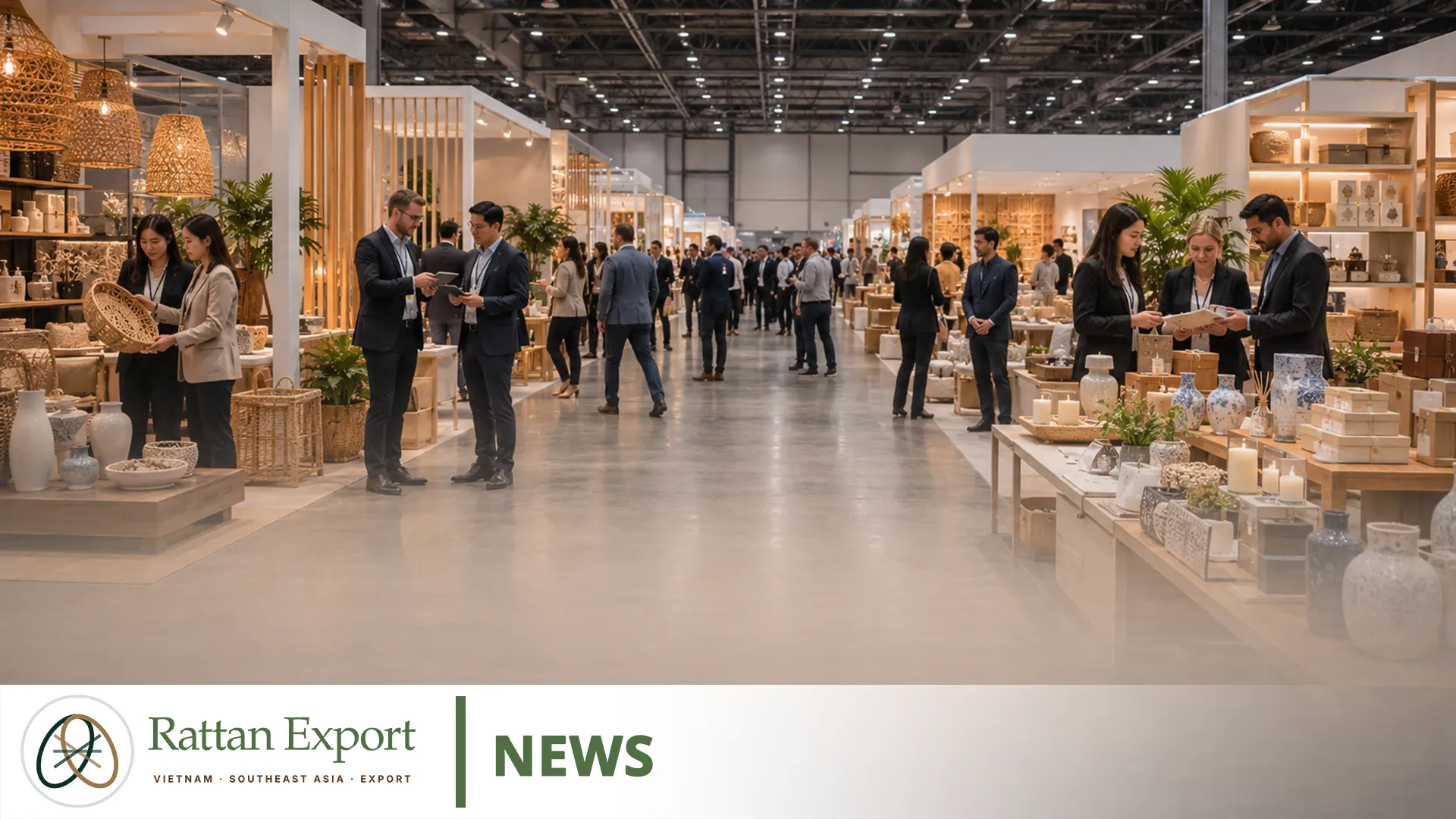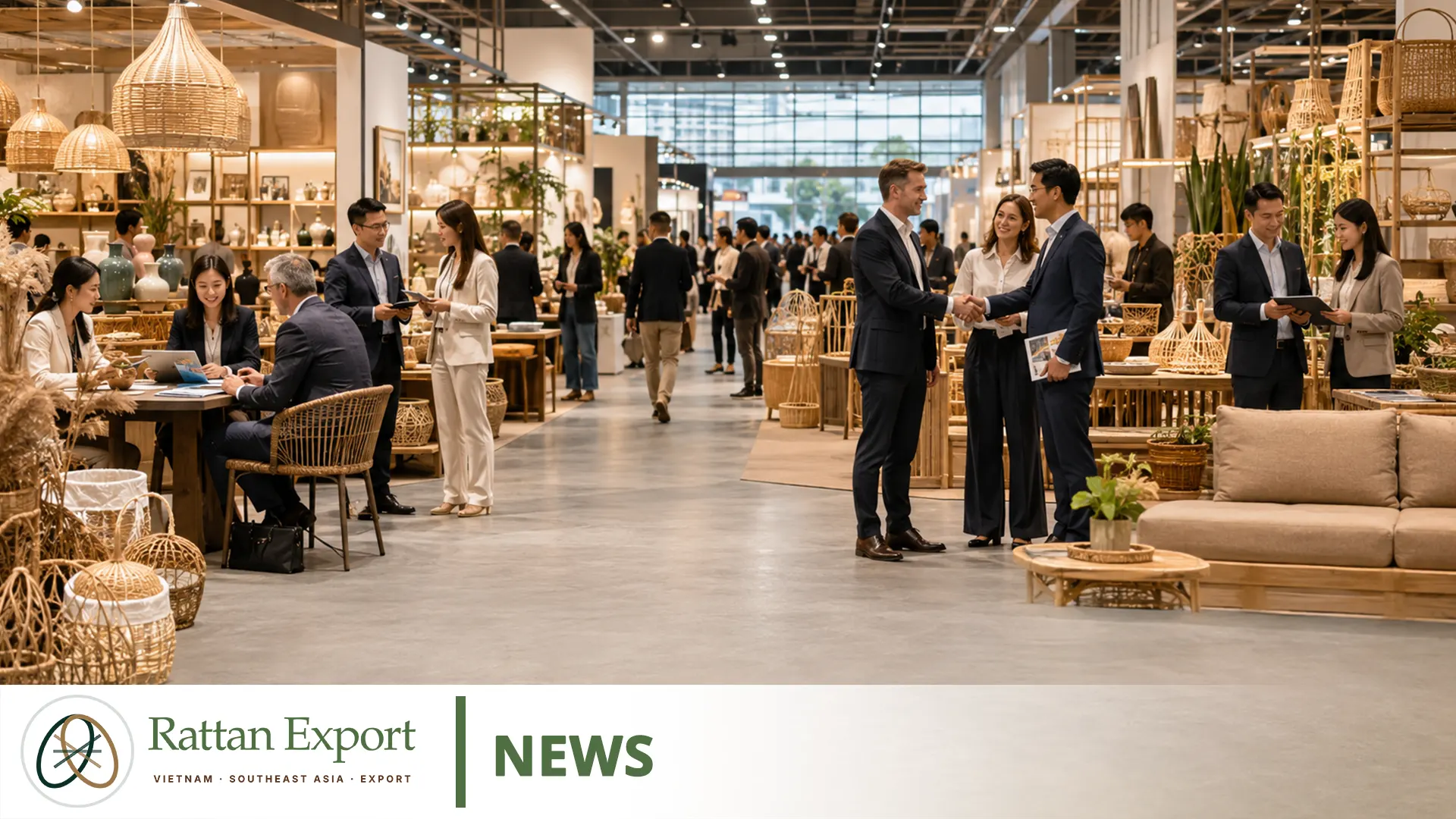
Vietnam International Sourcing 2026 is preparing to bring international buyers, importers, distributors and global retail groups to Ho Chi Minh City for three days of direct supplier discovery, B2B business matching and supply-chain development. Scheduled for September 3–5, 2026 at the Saigon Exhibition and Convention Center (SECC), the Ministry of Industry and Trade-led programme comes at a time when global procurement teams are looking beyond simple price comparisons and building more diversified, resilient and transparent sourcing networks. For buyers of furniture, homeware, handicrafts and natural-material products, the event offers an opportunity to evaluate Vietnamese manufacturers within a wider ecosystem that also includes logistics, raw materials, machinery, certification, finance and other export-support services.
Vietnam International Sourcing 2026 at a Glance
The Ministry of Industry and Trade approved the 2026 programme as one of Vietnam's important trade-promotion activities for the year, with the objective of connecting domestic enterprises more directly with international distributors, importers and commercial partners. The event is scheduled to take place from September 3 to 5, 2026 at SECC in Ho Chi Minh City. Preparations indicate an exhibition footprint of approximately 13,000 square metres, with a multi-sector format designed to give buyers access not only to finished products but also to supporting supply-chain capabilities.
| VIS 2026 Element | Current Plan | Relevance for International Buyers |
|---|---|---|
| Dates | September 3–5, 2026 | Three concentrated days for supplier discovery and meetings |
| Location | SECC, Ho Chi Minh City | Access to Vietnam's major southern commercial and manufacturing region |
| Expected exhibition scale | Approx. 13,000 m² | Multi-sector sourcing in a single venue |
| Home & Houseware | Furniture, indoor and outdoor décor, construction materials, handicrafts | Direct relevance to furniture and natural-material buyers |
| Export Supply Chain | Logistics, e-commerce, machinery, raw materials and services | Allows buyers to evaluate more than the finished product |
| B2B programme | Scheduled buyer-supplier meetings | Supports targeted commercial discussions rather than passive browsing |
A Trade Fair Designed Around Supply Chains, Not Only Products
VIS 2026 is being positioned as a “one-stop, multi-sector” sourcing platform. The official event structure currently groups four major exhibitions under one roof: Home & Houseware, Food & Beverage, Lifestyle & Personal Care and Export Supply Chain. This structure is important because international sourcing rarely stops at finding a product. A buyer also needs packaging, logistics, raw materials, quality management, production technology, financing and reliable documentation before an attractive sample can become a repeatable commercial programme.
For furniture and home-product buyers, the Home & Houseware section is particularly relevant. It covers furniture, interior and exterior décor, construction-related materials and handicrafts. These categories overlap closely with Vietnam's existing manufacturing strengths in wood, rattan, bamboo, seagrass, water hyacinth, ceramics, textiles, lacquer, metal and mixed-material production.
- Furniture buyers can identify manufacturers for indoor, outdoor, contract and hospitality programmes.
- Home décor importers can compare woven products, decorative accessories, baskets, lighting and storage collections.
- Private-label brands can discuss OEM and ODM development, customization, packaging and branding.
- Retail groups can evaluate suppliers against volume, consistency, compliance and delivery requirements.
- Project buyers can search for factories capable of customized dimensions, finishes and repeat production.
VIS 2025 Provides a Useful Benchmark for 2026
The scale achieved by the previous edition helps explain why international buyer recruitment for 2026 matters. According to Vietnam's Ministry of Industry and Trade, Vietnam International Sourcing 2025 attracted 450 foreign purchasing delegations from 60 countries and territories. More than 400 Vietnamese enterprises presented approximately 12,000 export products across 10,000 square metres. Organizers arranged around 3,000 pre-scheduled B2B meetings, while thousands of additional commercial exchanges took place throughout the exhibition.
| VIS 2025 Benchmark | Reported Result | What It Suggests for Buyers |
|---|---|---|
| Foreign purchasing delegations | 450 | Strong international procurement participation |
| Countries and territories | 60 | Diverse geographic buyer base |
| Vietnamese exhibitors | 400+ | Broad supplier comparison |
| Products displayed | Approx. 12,000 | Large commercial product pool |
| Exhibition area | 10,000 m² | Substantial physical sourcing platform |
| Pre-arranged B2B meetings | Approx. 3,000 | Structured buyer-supplier interaction |
The 2025 programme also attracted representatives and sourcing activity connected with major international distribution systems. That history is important because VIS is developing as more than a conventional exhibition. Its value proposition is increasingly based on converting buyer requirements into direct meetings with suppliers that may actually fit those requirements.
Large Retail Buyers Are Already Part of the 2026 Story
Preparations for September have included international buyer outreach through Vietnam's network of overseas Trade Offices. In the United States, Vietnamese trade officials promoted VIS 2026 directly to business leaders and companies interested in diversifying sourcing and developing relationships with Vietnamese manufacturers. Similar promotion has taken place in Europe, Latin America, Africa and Asia.
Two particularly significant buyers have already been publicly linked to the 2026 event. Reliance Retail of India and Pagoda of China have confirmed participation according to information published through Ho Chi Minh City's trade and investment promotion system citing the Ministry of Industry and Trade. Reliance Retail is seeking supply across categories that include wooden furniture, household appliances, textiles, footwear, food products and consumer goods. Pagoda is focused primarily on agricultural sourcing, but its participation illustrates the broader scale of global retail interest in direct Vietnamese supply.
Central Retail is also continuing its partnership with the Ministry of Industry and Trade in organizing VIS 2026. The group has stated that it will participate in business matching, identify new sources of supply and support Vietnamese products seeking entry into its distribution systems and international markets.
Business Matching Can Reduce the Cost of Supplier Discovery
A buyer can spend several days walking through hundreds of booths and still leave a trade show without a qualified supplier. Structured B2B matching is intended to reduce that problem. VIS combines product exhibition with meetings organized around buyer requirements, enabling procurement teams to communicate what they are actually seeking before commercial discussions begin.
A professional furniture or homeware buyer preparing for VIS 2026 should ideally define the following before meeting suppliers:
- Product category and reference images or technical drawings.
- Target dimensions, materials, finish and construction requirements.
- Estimated opening order and annual purchasing volume.
- Required MOQ per SKU, color or finish.
- Destination country and target sales channel.
- Required certifications, testing or compliance documentation.
- Packaging, barcode, labeling and private-label requirements.
- Preferred Incoterm and Vietnamese loading port.
- Required sample and production lead time.
- Whether purchasing will use single-SKU, mixed-SKU, 20ft, 40ft or 40HQ container programmes.
When buyers arrive with this information, supplier meetings become substantially more productive. Instead of asking “What products do you sell?”, the conversation can move directly toward capability, commercial fit and quotation.
Natural-Material Products Need More Than a Visual Inspection
This is especially important for buyers sourcing rattan, bamboo and other natural materials. Product appearance does not always reveal actual material composition. A basket presented as “rattan” may use a bamboo frame, seagrass weaving, water hyacinth panels, paper cord or metal reinforcement. A chair may combine wood, rattan cane, fabric and steel. A decorative lamp can include bamboo, paper, textile and electrical components.
| Buyer Question | Why It Matters |
|---|---|
| What is the primary material? | Determines the main technical and commercial identity of the product |
| Which materials are structural? | Affects durability, weight and specifications |
| Which materials are secondary or decorative? | Important for costing, labeling and compliance |
| Where do the materials originate? | Can affect traceability and destination-market requirements |
| Can the material specification be repeated? | Critical for repeat orders and collection consistency |
For a B2B buyer, this information should be confirmed before quotation approval rather than after production begins. Accurate material data can influence HS classification, compliance reviews, sustainability documentation, packaging decisions and final landed cost.
Supplier Qualification Should Continue Beyond the Exhibition
Meeting a supplier at VIS 2026 can accelerate discovery, but a trade-show meeting should not replace commercial due diligence. Buyers should verify whether the company displaying a product is the manufacturer, exporter, trading company or a combination of these roles. Factory location, production capacity, subcontracting, quality-control processes and export history should be clarified.
Factory tours are therefore an important part of the wider VIS model. Vietnam's overseas Trade Offices have promoted the 2026 programme as including product showcases, B2B connections, business matching and factory visits. A buyer who identifies a promising supplier at SECC may be able to use the trip to inspect production conditions and discuss capability in greater depth.
- Verify manufacturing identity. Determine where production actually occurs.
- Review capacity. Compare stated monthly output with the intended order programme.
- Inspect quality systems. Understand incoming-material, in-process and final inspection.
- Confirm subcontracting. Identify which stages are performed outside the main factory.
- Compare samples with production standards. Exhibition samples may represent best-case quality.
- Document commercial assumptions. MOQ, lead time, packaging and pricing should be written into the RFQ.
Container Planning Is Part of Supplier Selection
Furniture, baskets, lighting and natural-material décor are often highly sensitive to volume. A supplier with a lower unit price can still create a higher landed cost if packaging is inefficient or products use container space poorly. Buyers should therefore discuss packaging dimensions and loading assumptions during sourcing rather than after an order has been negotiated.
For example, nesting baskets can significantly improve container utilization. Knock-down furniture may lower CBM but increase assembly complexity. Large decorative lamps can require protective empty space that reduces loading quantities. Mixed-SKU programmes can improve assortment flexibility but require careful synchronization of production and packing.
| Commercial Data to Collect | Use in Sourcing Decision |
|---|---|
| Unit dimensions | Product and packaging planning |
| Carton dimensions | CBM calculation |
| Units per carton | Loading and inventory planning |
| 20ft loading quantity | Trial or smaller wholesale programmes |
| 40ft / 40HQ loading quantity | Full-scale container economics |
| Mixed-SKU rules | Collection and assortment planning |
Why Ho Chi Minh City Matters
The SECC location gives visiting buyers access to more than a conference venue. Ho Chi Minh City sits at the commercial center of southern Vietnam and connects closely with major manufacturing and logistics areas. For sourcing teams, that can make it practical to combine trade-show meetings with supplier visits, logistics discussions and factory inspections during the same trip.
This is particularly valuable for furniture and home-product buyers because Vietnam's supplier ecosystem is geographically diverse. Different factories specialize in wood furniture, upholstery, metal, ceramics, handicrafts or natural fibres. A concentrated sourcing event can create the shortlist; follow-up field visits can determine which suppliers deserve further commercial evaluation.
What VIS 2026 Means for Rattan Export Vietnam Buyers
Vietnam International Sourcing 2026 supports the same broader shift that is shaping the development of Rattan Export Vietnam: global buyers need easier access to Vietnamese manufacturing, but they also need better information after they discover a product.
A large trade event can introduce hundreds of manufacturers and thousands of products. The buyer's next challenge is organizing that information into a usable sourcing system: which supplier owns the product, what materials are actually used, what quantities are viable, how the product will be packed, whether it fits a mixed container, what documentation exists and how the supplier should be compared with alternatives.
Rattan Export Vietnam is being developed around those B2B requirements rather than consumer retail. Importers, wholesalers, distributors, retail chains, hospitality procurement teams and private-label brands can explore the developing product catalogue, review information on Vietnam sourcing and export, understand our approach to quality and compliance, or submit product, quantity, packaging and destination requirements through the wholesale inquiry.
VIS 2026 is preparing to bring global demand and Vietnamese supply into the same room. The commercial opportunity for buyers will depend on what happens next: disciplined supplier qualification, accurate product data, realistic container planning and a procurement process capable of turning a promising meeting in Ho Chi Minh City into a reliable long-term supply relationship.
Sources and Data References
- Vietnam Ministry of Industry and Trade, Decision No. 1049/QD-BCT and official VIS 2026 programme information.
- Vietnam International Sourcing official 2026 exhibition information.
- Vietnam Ministry of Industry and Trade, international buyer promotion and business-matching updates.
- Ho Chi Minh City Investment and Trade Promotion Centre, 2026 international retail buyer participation reporting.
- Ministry of Industry and Trade Go Global platform, official results of Vietnam International Sourcing 2025.