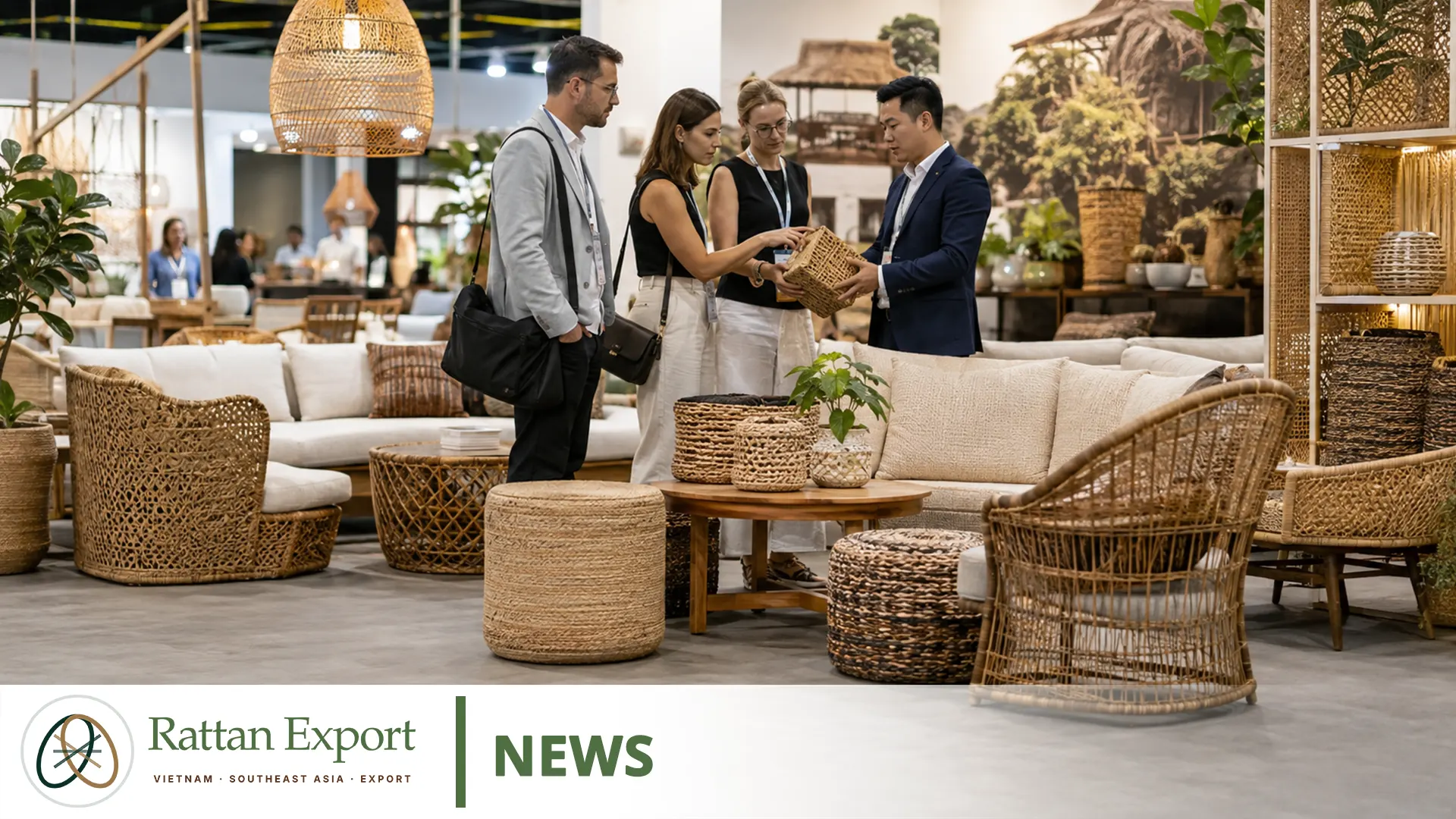
Traditional weaving and natural materials have taken a prominent place at HawaExpo 2026, showing international furniture and home-furnishing buyers that Vietnam's export proposition extends beyond industrial wood manufacturing into a deeply rooted ecosystem of bamboo, rattan, seagrass, water hyacinth and other handcrafted materials. As the Ho Chi Minh City Export Furniture Fair continues at the Saigon Exhibition and Convention Center from March 4–7, natural fibres are appearing not only as finished baskets and decorative accessories, but across furniture, lighting, storage, mixed-material collections and hands-on demonstrations of Vietnamese craft. For international importers, wholesalers, retail chains, hospitality groups and private-label brands, the fair provides a useful view of how traditional techniques are being connected with contemporary design and commercially organized export production.
Traditional Weaving Became Part of the Buyer Experience
One of the clearest expressions of this connection took place on March 5 through the official workshop The Art of Vietnamese Handicrafts & Weaving. Organized by HAWA and Vietnam Housewares, the workshop ran from 09:00 to 16:00 in the Workshop Area at Tent C1 inside SECC. Rather than displaying weaving only behind a finished product, the organizers invited buyers, designers, architects and visitors to sit with Vietnamese artisans and experience the process directly.
Participants could create a basket, tray or mat using cỏ năng tượng and water hyacinth sourced from the Mekong Delta. The activity linked the physical qualities of the raw material with the rhythm and skill of hand weaving and presented craftsmanship as part of Vietnam's design and sourcing identity rather than simply as decoration. Vietnam Housewares was identified by the organizer as an exporter working with these fibres and other natural materials for markets including the United States, Australia and Japan.
Why a Weaving Workshop Matters to Professional Buyers
For a B2B buyer, physically seeing how a woven product is made can answer questions that photographs cannot. The flexibility and thickness of the fibre, the way strands are tensioned, the construction of corners and edges and the relationship between a woven surface and its supporting frame all influence the finished product.
The workshop also highlights an important sourcing distinction: traditional craftsmanship and commercial manufacturing are not opposites. Export-ready production can preserve manual weaving while adding controlled specifications, approved samples, quality inspection, packaging standards and container planning around the handmade process.
| Craft Element | What the Buyer Sees | Commercial Question |
|---|---|---|
| Raw fibre | Natural variation in thickness, color and texture | How are fibres selected, dried and graded? |
| Hand weaving | Manual tension and pattern construction | What tolerances define acceptable production? |
| Frame | Structure beneath or around the weave | Is it rattan, timber, bamboo or metal? |
| Finishing | Natural, stained or coated surface | How is color consistency managed? |
| Finished piece | Handcrafted visual character | Can the design be repeated across commercial quantities? |
Natural Materials Are Visible Across the Exhibition Floor
HawaExpo's dedicated Home Accessories and Handicraft presentation brings together ceramics, bamboo, rattan, lacquerware and woven products. Supplier profiles published for the 2026 exhibition show natural materials appearing across several product groups rather than within one isolated handicraft category.
Haprosimex Saigon, for example, presents woven homeware, laundry baskets and storage products using materials including rattan, seagrass, bamboo, rope, wood and metal. Vietnam Housewares operates separate production for wooden furniture, woven handicrafts and ceramic garden décor and works with a broad material library including rattan, seagrass and bamboo. Viet Source Handicraft focuses on natural fibres across bamboo furniture, baskets, lighting and rugs using bamboo, rattan, seagrass, palm leaf and water hyacinth.
Nature Craft's official exhibitor profile describes woven storage baskets, home décor and table, floor and pendant lighting made with materials including water hyacinth, rattan, seagrass and palm leaf. Duy Thanh Art Export lists handwoven baskets, lanterns, mirrors, trays, tableware and home décor using seagrass, water hyacinth, bamboo, rattan and palm leaf. Together, these examples demonstrate the commercial breadth behind the phrase “Vietnamese handicraft.”
Natural Fibre Is No Longer Limited to the Basket Category
International sourcing discussions sometimes treat natural fibres mainly as basket materials. HawaExpo 2026 demonstrates a much broader application. Rattan cane can become a cabinet panel or chair back. Bamboo can form furniture structures or pendant lighting. Water hyacinth can be woven around storage frames. Seagrass can appear in baskets, décor, furniture panels or flooring-related products. Natural fibres can also be combined with ceramics, timber and metal in coordinated collections.
| Material | Applications Visible in the Supply Base | Potential B2B Category |
|---|---|---|
| Rattan | Furniture, chair backs, cabinet panels, baskets, lighting | Furniture, décor, hospitality and retail |
| Bamboo | Furniture, baskets, lighting, accessories | Homeware, furniture and lifestyle collections |
| Water hyacinth | Storage, baskets, décor and woven surfaces | Organization, home décor and natural-texture collections |
| Seagrass | Baskets, décor, rugs and furniture components | Home accessories and mixed-material programmes |
| Palm leaf | Decorative and woven accessories | Gift, décor and lifestyle products |
Traditional Technique Is Being Connected With Contemporary Design
The importance of traditional weaving at a furniture export fair is not nostalgia. Vietnamese suppliers are increasingly adapting inherited techniques to forms and styles that fit contemporary retail and interior design. A weaving pattern traditionally used for household objects can be translated into cabinet fronts, lighting or modern storage. Natural fibre can soften the visual appearance of metal furniture or introduce tactile contrast to a wooden product.
This creates additional design options for buyers developing coastal, tropical, organic-modern, Scandinavian-influenced, resort or handcrafted collections. The underlying technique can remain recognizably Vietnamese while product dimensions, color palettes and mixed-material construction are adapted for international markets.
Handcrafted Does Not Mean Small-Scale Only
Another important sourcing lesson from HawaExpo is that natural-material handicrafts can exist within organized export manufacturing. The exhibitor information published by HawaExpo includes suppliers reporting factory facilities, container-level production capacity, formal MOQ structures and established export markets.
Nature Craft reports a 12,000-square-metre facility, 100 employees, production capacity of around 50 containers per month and an MOQ of 100 items. Duy Thanh Art Export reports a 2,000-square-metre facility, capacity of up to 50 40HQ containers per month and an MOQ of 300 pieces. Viet Source reports a 10,000-square-metre facility, approximately 10 containers per month and an MOQ of 200. These are supplier-reported figures and should be verified for a specific order, but they show that handwoven categories can sit inside commercially structured export operations.
The Exhibition Connects Craft With Industrial Manufacturing
HawaExpo's broader significance comes from putting these handicraft suppliers inside the same sourcing environment as large furniture manufacturers, material companies, designers and production specialists. The official opening described the fair as a trade-promotion platform for manufacturers to demonstrate production capability, products and technologies and connect with domestic and international partners.
On March 6, the organizer reported more than 2,500 booths at the exhibition while announcing its Top Best Booth Awards. Because the event remains in progress through March 7, final attendance and exhibitor results should not yet be treated as completed figures. The available information nevertheless shows the breadth of products and manufacturing models being presented under one roof.
Material Identification Remains Critical for Buyers
Traditional weaving can create visual similarity between different fibres, making accurate material identification important. A woven item that appears to be rattan in a photograph may actually be seagrass or water hyacinth. “Wicker” describes a type of woven construction rather than one botanical material. Synthetic wicker can look similar again while having a completely different supply chain and performance profile.
Professional product data should therefore distinguish:
- Primary material: the material that principally defines the product.
- Structural material: the frame or load-bearing component.
- Secondary materials: additional meaningful materials used in the SKU.
- Accessory materials: handles, hardware, liners and other fittings.
- Natural or synthetic identity: particularly important when the commercial description uses “rattan” or “wicker.”
Quality Control Must Respect Natural Variation Without Losing Consistency
A natural-material product will not behave exactly like an injection-molded or fully machined product. Fibre color, thickness and surface texture can vary naturally. Handmade weaving can also create minor dimensional differences. Buyers should not attempt to eliminate every natural variation, but they should define the limits within which the product remains commercially acceptable.
- Approve the exact material and construction using a master sample.
- Define permissible natural color variation.
- Specify dimension tolerances for handmade items.
- Confirm drying, moisture and storage procedures.
- Define weaving pattern, density and tension requirements.
- Inspect hidden frames as well as visible woven surfaces.
- Confirm finishing, dyes and coatings where used.
- Verify packaging against deformation and moisture risk during shipping.
Container Planning Matters Even for Lightweight Products
Natural-fibre products can be lightweight but highly volumetric. This creates a different commercial challenge from dense furniture. Nestable baskets can use container space very efficiently, while large woven lamps or rigid decorative items may consume significant CBM despite low weight.
Furniture and homeware buyers should therefore request carton dimensions and estimated loading quantities during product development. A design adjustment that allows products to nest, fold or ship knock-down can have a larger effect on landed cost than a small reduction in factory unit price.
| Logistics Field | Buyer Requirement |
|---|---|
| Carton dimensions | Required for accurate CBM calculation |
| Units per carton | Shows packaging efficiency |
| Nesting ratio | Important for baskets and storage products |
| Knock-down structure | Can reduce furniture and lighting volume |
| 20ft / 40ft / 40HQ quantity | Allows realistic landed-cost comparison |
| Moisture protection | Important for natural fibres during ocean transit |
Traditional Craft Can Support OEM and ODM Development
For OEM buyers, Vietnamese weaving expertise can be applied to a defined drawing, dimensions and material specification. For ODM buyers, the supplier's knowledge of local fibres and production techniques can become part of product development. A factory may propose a different weave, replace one fibre with another to achieve a target texture or cost, or translate a basket-making technique into furniture or lighting.
The strongest development process combines creative flexibility with documentation. Buyer and supplier should agree on materials, dimensions, weave, finish, packaging and acceptable variation before mass production rather than relying on a broad description such as “handmade natural product.”
What HawaExpo 2026 Means for Rattan Export Vietnam Buyers
The prominence of weaving and natural materials at HawaExpo 2026 closely reflects the sourcing model being developed by Rattan Export Vietnam. Natural-material sourcing requires more than searching thousands of attractive product photographs. Buyers need to know what a product is actually made from, which manufacturer is linked to it and whether the commercial production structure matches the intended order.
Our developing product catalogue is therefore structured around supplier-linked products and clearer material classification across rattan, bamboo, seagrass, water hyacinth, jute, wood, metal, fabric, lacquer and other components. International buyers can also review our approach to quality and compliance, learn more about Vietnam sourcing and export, or submit specifications, quantities, destination markets, packaging and container requirements through the wholesale inquiry.
HawaExpo 2026 is demonstrating that Vietnam's traditional weaving heritage is not separate from its modern export industry. The same skills that turn Mekong Delta fibres into handmade baskets can also support furniture, lighting, storage and mixed-material collections built for international commerce. For global buyers, the opportunity lies in preserving the authenticity of the craft while applying the material control, specifications, quality systems and logistics planning required to make that craft commercially repeatable.
Sources and Data References
- HawaExpo, The Art of Vietnamese Handicrafts & Weaving workshop, 5 March 2026.
- HawaExpo, Official Opening of the Ho Chi Minh City Export Furniture Fair 2026.
- HawaExpo, Vietnam Home Accessories Exhibition 2026.
- HawaExpo 2026 exhibitor profiles for Nature Craft, Viet Source Handicraft, Vietnam Housewares, Haprosimex Saigon and Duy Thanh Art Export.
- HawaExpo, Top Best Booth Awards announcement, 6 March 2026.