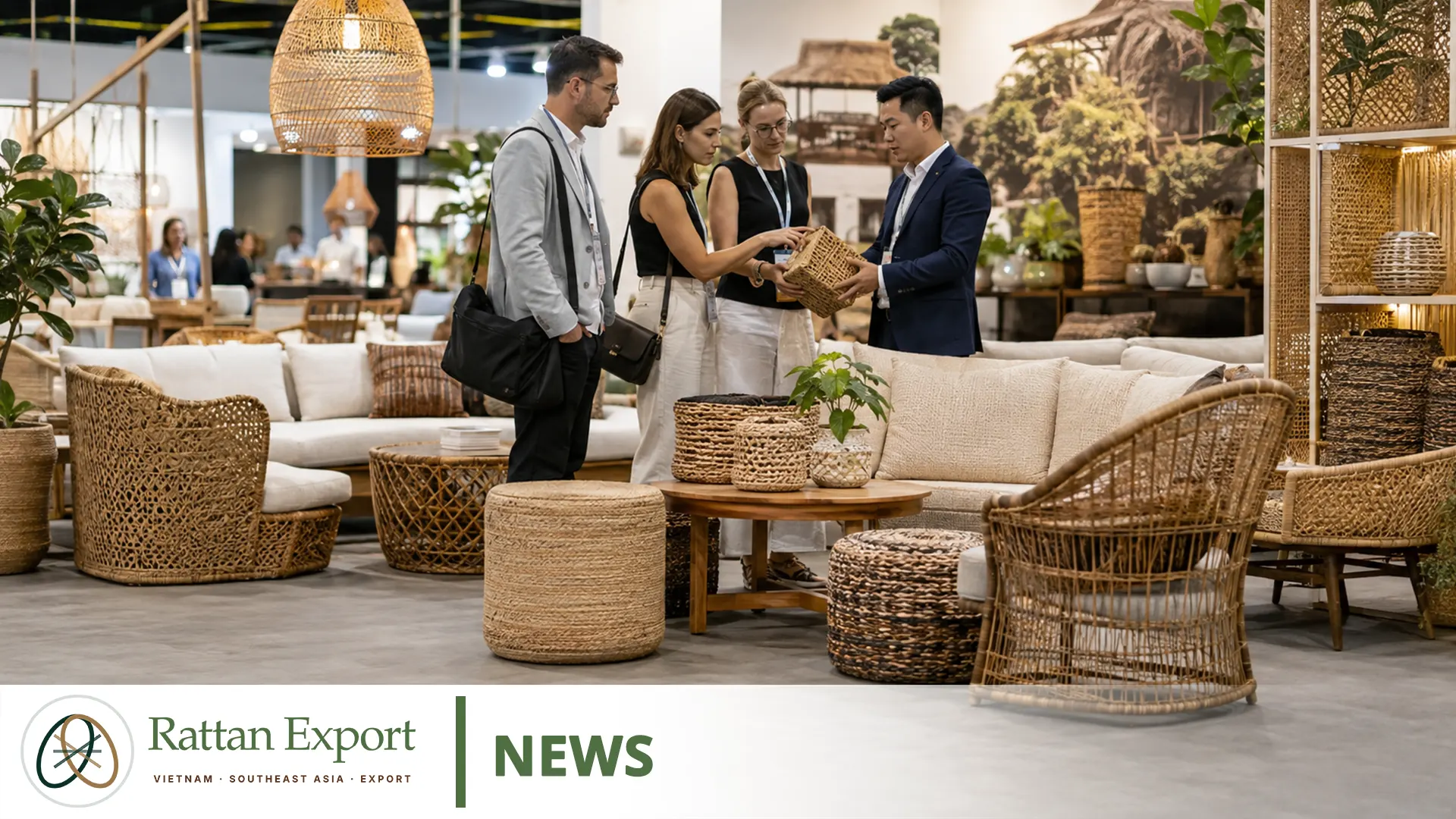
Vietnamese suppliers are bringing bamboo, rattan and natural-fibre collections into the 2026 sourcing season with a broader mix of furniture, storage, lighting, home décor and lifestyle products designed for international retail, wholesale and project buyers. The development is not simply a continuation of traditional basket weaving. Export-oriented manufacturers are increasingly presenting natural fibres as part of coordinated commercial collections that combine craftsmanship with standardized dimensions, mixed materials, contemporary styling, packaging requirements and international order structures. For importers, wholesalers, retail chains, hospitality buyers and private-label brands, the result is a wider sourcing opportunity across bamboo furniture, rattan details, woven storage, water-hyacinth products, seagrass accessories, lighting, rugs and mixed-material home furnishings.
Natural-Fibre Products Enter 2026 as an Established Export Category
Vietnam enters 2026 with a substantial existing export base in these materials. Preliminary full-year statistics from the General Department of Customs show approximately US$900.06 million of bamboo and rattan product exports during 2025. The same customs report recorded approximately US$17.20 billion in exports of wood and wooden products. These categories are not directly comparable or additive, but together they demonstrate the broader commercial ecosystem surrounding furniture, handicrafts and home furnishings in Vietnam.
The natural-fibre market also extends beyond what the customs heading “bamboo and rattan products” can describe. Vietnamese suppliers work with seagrass, water hyacinth, palm leaf, rope and other fibres, often combining them with wood, metal, ceramic, fabric or paper. Buyers should therefore avoid using a single customs category as a market-size estimate for every natural fibre. The commercial reality is a diversified material base spread across multiple product classifications.
2026 Supplier Profiles Show a Broader Product Mix
Pre-show supplier information for HawaExpo 2026 illustrates how wide this product range has become. Viet Source Handicraft lists bamboo furniture for indoor and outdoor use, baskets and storage, lamps and lanterns, rugs, carpets and home decorations. Its stated natural-material range includes bamboo, rattan, seagrass, palm leaf and water hyacinth. Nature Craft focuses on woven storage baskets, home décor, table, floor and pendant lighting and handmade pottery, combining rattan, seagrass, water hyacinth, palm leaf and other materials. Haprosimex Saigon describes four principal categories: handwoven handicrafts, bamboo furniture, wooden kitchenware and planters and pots.
| Collection Area | Typical Materials | Potential Buyer Use |
|---|---|---|
| Bamboo furniture | Bamboo, rattan, wood, rope | Indoor, outdoor, resort and lifestyle collections |
| Woven storage | Water hyacinth, seagrass, rattan, metal frames | Retail storage, organization and home décor |
| Lighting | Bamboo, rattan, seagrass, fibre, metal | Pendant, floor and table-lighting programmes |
| Decorative accessories | Palm leaf, natural fibres, ceramic, wood | Seasonal and permanent home-accessory ranges |
| Rugs and soft-form products | Seagrass, fibre, woven natural materials | Natural-texture interior collections |
| Mixed-material products | Natural fibre + wood, metal or ceramic | Higher-differentiation retail and hospitality ranges |
Rattan Is Moving Beyond the Fully Woven Product
Rattan remains one of Vietnam's most recognizable handicraft materials, but its role in contemporary collections is broader than an entirely woven chair or basket. Suppliers can use rattan cane in cabinet fronts, chair backs and decorative panels while wood or metal provides the main structure. Thicker rattan can become part of frames, while thinner material can provide texture and visual identity.
This gives international buyers greater flexibility. A retailer can develop a coordinated collection in which a dining chair, cabinet, bench and lighting product share the same rattan language without every SKU having the same construction. It also means buyers need accurate material data. Calling an item “rattan furniture” is insufficient if most of the structural product is wood, metal or engineered board.
Bamboo Supports Both Furniture and Smaller Homeware
Bamboo offers another type of flexibility. Depending on processing and construction, it can be used as a structural element, split into strips, formed into decorative components or woven into baskets and accessories. Supplier profiles entering the 2026 season show bamboo appearing across furniture, storage and home-decoration ranges rather than being confined to traditional handicrafts.
For buyers building a category rather than sourcing a single item, this is commercially useful. A bamboo-oriented programme can potentially extend from larger furniture into lanterns, baskets, trays and smaller accessories, creating a more coherent merchandising story. The important sourcing question is whether the supplier actually has consistent capability across those categories or is coordinating different production partners.
Water Hyacinth and Seagrass Strengthen the Woven Collection
Water hyacinth and seagrass remain important because their visual and physical characteristics differ from rattan and bamboo. Dried water hyacinth produces a thicker, softer-looking weave that is widely suited to baskets, storage and decorative surfaces. Seagrass can produce tighter woven textures for baskets, rugs, furniture panels and home accessories.
Nature Craft's 2026 supplier profile, for example, combines water hyacinth, rattan, seagrass and palm leaf across woven storage, home décor and lighting. Viet Source similarly describes a material library covering bamboo, rattan, seagrass, palm leaf and water hyacinth. This ability to work across fibres allows manufacturers to create collections based on color, texture and price positioning rather than forcing every SKU into one material.
The Commercial Collection Is Increasingly Mixed-Material
One of the strongest sourcing themes entering 2026 is that natural-fibre products do not need to be single-material products. A woven basket may require an iron frame. A pendant light may combine bamboo or seagrass with metal electrical fittings. A cabinet may combine timber, engineered board, rattan cane and hardware. A planter programme can combine woven fibre with ceramic or metal containers.
| Product | Possible Material Structure | Buyer Verification |
|---|---|---|
| Storage basket | Water hyacinth or seagrass + metal frame | Fibre identity, frame gauge, dimensions and coating |
| Rattan cabinet | Wood/MDF + rattan cane + metal hardware | Primary and structural materials must be separated |
| Bamboo pendant | Bamboo weave + metal fitting + electrical components | Lighting and destination-market requirements |
| Natural-fibre chair | Wood/metal frame + woven rattan or seagrass | Load-bearing construction and weave specification |
| Decorative planter | Natural fibre + inner pot/frame | Moisture exposure and inner construction |
For procurement teams, this makes precise product records more important. The visible fibre should not automatically be treated as the primary structural material. Costing, testing, labeling, customs treatment, packaging and repeat-order consistency can depend on the complete material composition.
Export Suppliers Are Offering Different Scales and MOQs
The 2026 supplier profiles also demonstrate that the natural-material segment is not limited to small craft workshops. Viet Source reports a 10,000-square-metre production facility, capacity of approximately 10 containers per month and an MOQ of 200. Nature Craft reports a 12,000-square-metre facility, around 50 containers per month and an MOQ of 100 items. Haprosimex lists a 5,000-square-metre facility and an MOQ of 300 pieces or sets while serving export markets across the United States, Europe, Japan, Australia and the Middle East.
These figures are supplier-reported capacities and should be verified during actual procurement, but they show an important point: natural-fibre sourcing in Vietnam can include commercially organized manufacturers with container-level export programmes. Buyers should still check available rather than theoretical capacity, particularly during peak production periods.
Design Capability Is Becoming Part of the Offer
International buyers increasingly need suppliers that can do more than reproduce an existing basket. The HawaExpo supplier descriptions point to in-house design resources, customization and coordinated collections. Nature Craft describes an in-house design and production team, while Haprosimex emphasizes customizable solutions and its own creative design capability.
This matters for OEM and ODM sourcing. A buyer with finished drawings may need precise execution and material consistency. Another buyer may arrive with only a target market, price point, visual direction and required collection size. A manufacturer with stronger design capability can adapt existing products, propose new fibre combinations, adjust dimensions or develop a coordinated assortment.
Natural Texture Does Not Remove the Need for Quality Control
Handmade and natural products inevitably contain visual variation. That does not eliminate the need for specifications. Professional buyers should define what variation is acceptable and which differences are defects. Natural fibre diameter, moisture, color, weave tension and finishing can affect the appearance and durability of mass production.
- Material identity: specify rattan, bamboo, seagrass, water hyacinth or other fibre accurately.
- Moisture control: confirm drying and storage procedures before ocean shipment.
- Weaving tolerance: establish acceptable gaps, tension and pattern consistency.
- Dimensions: define tolerances for handmade products rather than expecting perfect mathematical uniformity.
- Color range: approve the acceptable natural or stained color window.
- Frame quality: inspect wood or metal structures hidden beneath the weave.
- Packaging: consider crushing, deformation, mold risk and abrasion during container transport.
Container Economics Can Favor Some Natural-Fibre Products and Penalize Others
Natural-fibre collections require careful logistics planning. Baskets can often be nested, dramatically improving container utilization. Knock-down bamboo furniture can also reduce CBM. By contrast, large rigid woven lamps, decorative chairs or non-nesting storage pieces can consume significant cubic volume despite relatively low unit weight.
For B2B buyers, the commercial comparison should therefore include carton dimensions and loading quantities before a final SKU is approved. A slightly more expensive basket that nests efficiently can produce a lower landed cost than a cheaper design that wastes container space.
What Buyers Should Ask Before Approving a 2026 Collection
- Which exact fibres are used in each SKU? Avoid generic “natural fibre” descriptions.
- Which material is structural? Separate visible weaving from the load-bearing frame.
- Who performs the weaving? Understand factory, workshop and household production stages.
- What is the MOQ? Confirm it by SKU, color, finish and total programme.
- Can SKUs be consolidated? Mixed-container flexibility can strongly affect wholesale economics.
- What is the real loading quantity? Obtain carton CBM and 20ft/40ft/40HQ estimates.
- What sample defines production? Keep an approved master sample and written specification.
- How are repeat orders controlled? Confirm material, color and weaving consistency over time.
A Collection Strategy Can Be More Valuable Than Sourcing Individual Products
The diversity of Vietnamese natural-material suppliers creates an opportunity for buyers to source coordinated product families rather than isolated SKUs. A retailer might combine woven storage, lamps, planters, occasional furniture and decorative accessories around a consistent palette of rattan, bamboo, water hyacinth and seagrass. A hospitality buyer might use related textures across guest rooms, restaurants and public areas.
The commercial benefit is stronger merchandising and potentially better container utilization, but collection sourcing also requires tighter supplier coordination. Dimensions, colors, finishes, packaging and delivery schedules need to remain compatible across multiple products and sometimes multiple production lines.
What This Means for Rattan Export Vietnam Buyers
The natural-fibre collections entering 2026 are directly relevant to the sourcing model being developed by Rattan Export Vietnam. Buyers need more than a generic category called “rattan products.” They need to distinguish bamboo, rattan, seagrass, water hyacinth and mixed-material constructions and understand which supplier is actually responsible for each SKU.
Our developing product catalogue is structured around supplier-linked products and clearer material classification across natural fibres, wood, metal, fabric, lacquer and other components. International importers, wholesalers, distributors, retailers and hospitality buyers can also review our approach to quality and compliance, learn more about Vietnam sourcing and export, or submit product specifications, quantities, destination markets, packaging requirements and container targets through the wholesale inquiry.
Vietnamese suppliers are entering 2026 with a natural-fibre offer that is broader than traditional handicrafts alone. Bamboo furniture, rattan detailing, water-hyacinth storage, seagrass décor, lighting and mixed-material collections are increasingly part of the same B2B sourcing conversation. For buyers, the opportunity lies not simply in choosing a natural material, but in selecting the right supplier, construction, quality standard and container strategy for a commercially repeatable collection.
Sources and Data References
- General Department of Customs of Vietnam, preliminary full-year 2025 export statistics.
- HawaExpo, Vietnam Home Accessories Exhibition at HawaExpo 2026, published 30 January 2026.
- HawaExpo 2026 exhibitor profiles for Viet Source Handicraft, Nature Craft and Haprosimex Saigon.
- HawaExpo, Handcrafted in Vietnam Furniture & Gifts, published 8 February 2026.