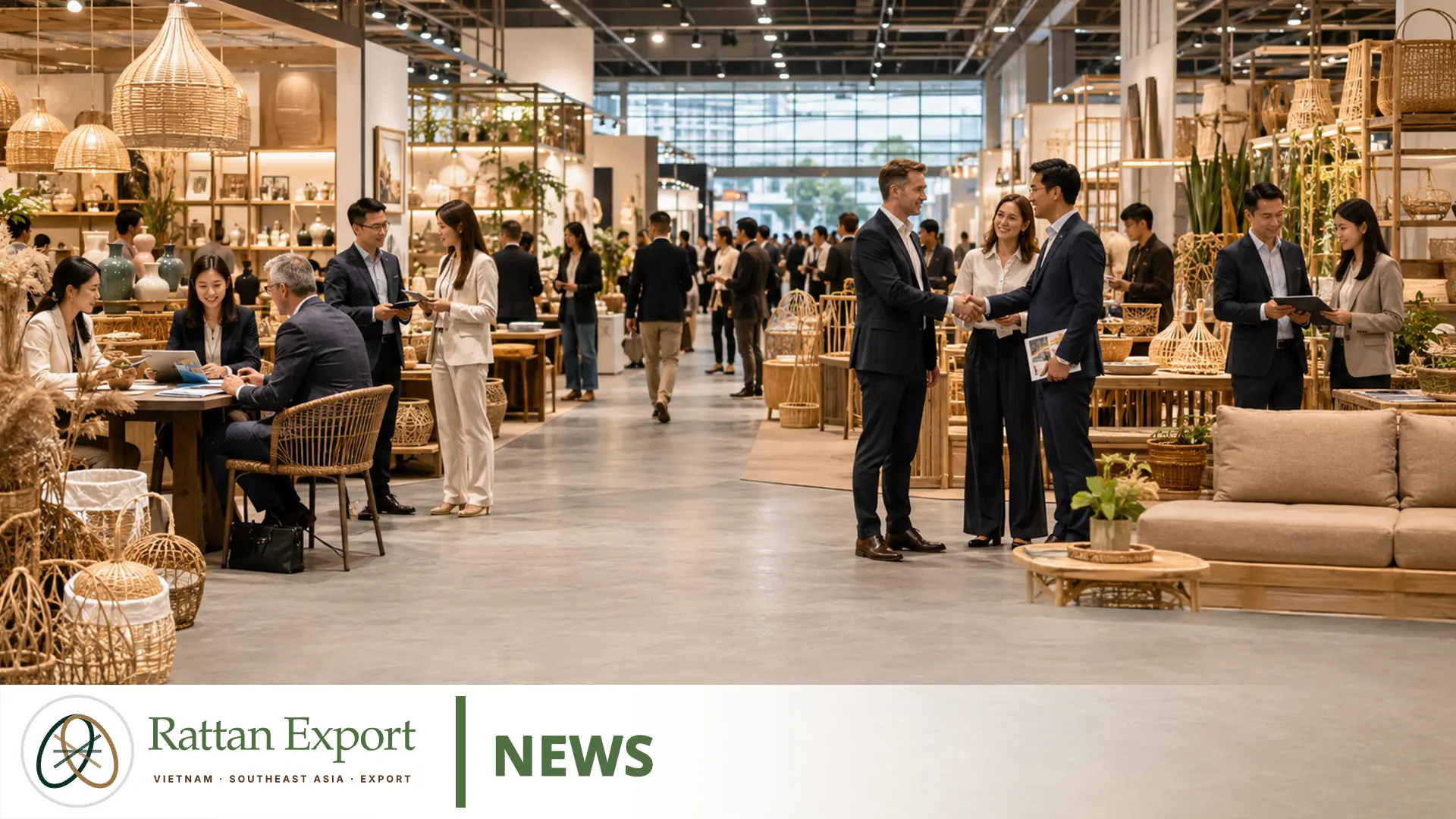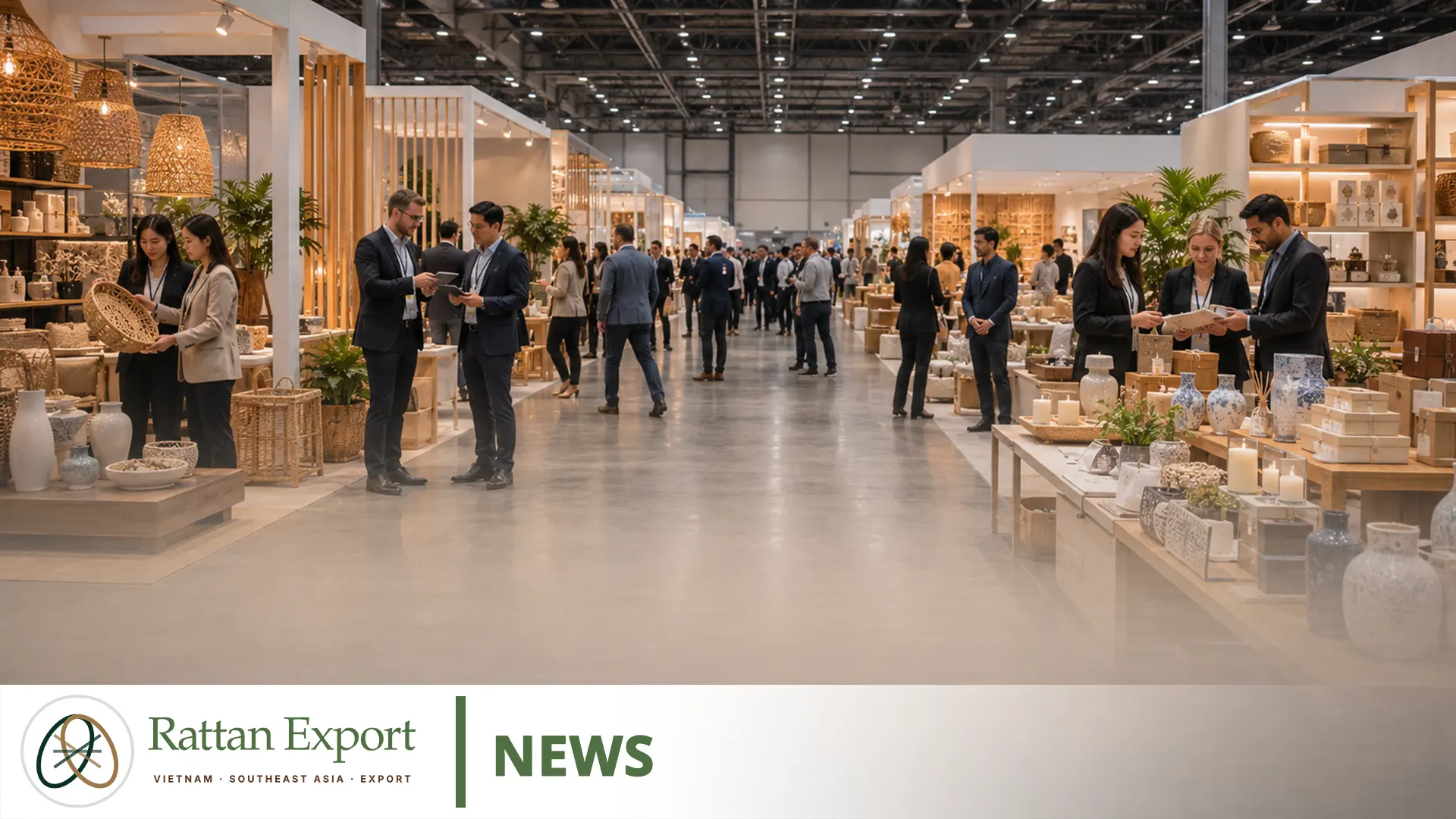
Vietnam entered 2026 with stronger export momentum, an ambitious national growth agenda and a clear policy direction toward deeper participation in regional and global supply chains. For international buyers, importers and sourcing teams, the significance goes beyond headline trade figures. Vietnam is increasingly positioning itself not simply as a low-cost manufacturing alternative, but as a diversified sourcing base where furniture, home décor, natural materials, consumer goods and industrial products can be connected to a large export infrastructure, an expanding network of trade agreements and a manufacturing economy accustomed to serving global markets.
Vietnam Starts 2026 From a Much Larger Export Base
Official Vietnam Customs data show that merchandise exports reached approximately US$475.06 billion in 2025, an increase of 17% year-on-year. Before the final customs figures were available, the Ministry of Industry and Trade had already described the 2020–2025 period as a major expansion phase for Vietnamese trade, with average annual export growth of around 10%. Government reporting also noted that Vietnam had joined the group of the world's 20 largest exporting economies from 2023 and was moving toward the top tier of global trading nations.
| Indicator | 2025 Position | Why It Matters for Global Buyers |
|---|---|---|
| Merchandise exports | Approx. US$475.06 billion | Shows the scale of Vietnam's export-oriented manufacturing system |
| Annual export growth | Approx. 17% | Signals strong overseas demand despite trade uncertainty |
| GDP growth | 8.02% | Provides a strong economic base entering 2026 |
| Processing and manufacturing growth | Approx. 10.5% | Highlights continued industrial expansion |
| Signed free trade agreements referenced in the 2026 Government program | 17 FTAs | Supports access to a broad range of international markets |
Exports were again a central growth engine. Government reporting citing UOB noted that full-year exports rose approximately 17%, while Vietnam's processing and manufacturing sector expanded around 10.5% in 2025. GDP grew 8.02%, giving the country a strong starting position for 2026 even as trade policy uncertainty, tariffs and geopolitical risks remain significant.
2026 Policy Moves Beyond Export Volume Alone
Vietnam's 2026 economic program suggests that policy makers are not looking only at how many more goods the country can ship. Resolution No. 01 identifies investment, consumption and exports as traditional growth drivers that need to be accelerated and renewed. It also calls for stronger trade promotion, market diversification, higher product quality and deeper participation in regional and international supply chains.
The Government specifically directs more effective use of Vietnam's network of 17 signed free trade agreements, continued efforts to maintain a trade surplus and broader trade promotion programs during the 2026–2030 period. It also identifies potential agreements with Mercosur and the Gulf Cooperation Council among future market-expansion priorities. For exporters and sourcing businesses, this points toward a more diversified commercial map rather than dependence on only a small group of destinations.
- More market diversification: exporters are being encouraged to expand beyond established destinations and develop new commercial channels.
- Deeper supply-chain participation: the policy direction explicitly calls for stronger integration into regional and international production networks.
- Higher product quality: export growth is increasingly tied to standards, value creation and competitiveness rather than volume alone.
- Trade promotion: exhibitions, overseas trade networks and business matching remain important tools for connecting Vietnamese producers with foreign buyers.
- Green and digital transition: circular economy, green growth, digital transformation and technology adoption are positioned as new growth drivers.
Global Sourcing Is Shifting, but Not in a Simplistic Way
The phrase “supply-chain diversification” is sometimes reduced to the idea that factories are simply leaving one country and moving to another. Actual procurement decisions are more complex. Large buyers increasingly build multi-country sourcing networks to reduce concentration risk, improve lead-time resilience, access different manufacturing capabilities and manage tariffs or regulatory exposure. Vietnam benefits from this shift because it combines a substantial manufacturing base with established export ports, international supplier experience and proximity to the wider Asian production ecosystem.
AMRO's January 2026 regional outlook highlighted Vietnam's increasingly prominent role in regional supply chains and the contribution of foreign investment in manufacturing, technology and export-oriented services. AMRO projected 7.6% economic growth for Vietnam in 2026 at the time, the highest forecast among the ASEAN+3 economies covered in its update. Forecasts can change, but the underlying message for procurement teams is important: Vietnam is being evaluated as a strategic production and sourcing location, not only as an opportunistic alternative.
What the Shift Means for Furniture and Natural-Material Buyers
For buyers of rattan furniture, bamboo products, woven baskets, seagrass products, water-hyacinth goods, natural-fibre home décor, lighting and handcrafted accessories, macro-level export growth does not automatically guarantee a good sourcing result. The buyer still has to qualify factories, confirm material composition, establish commercial quantities, review specifications, understand packaging and calculate realistic container utilization.
| Macro Sourcing Opportunity | Buyer-Level Requirement |
|---|---|
| Large manufacturing ecosystem | Identify the actual manufacturer behind each product |
| Growing export infrastructure | Confirm FOB point, lead time, packaging and shipping assumptions |
| Broad material availability | Separate primary materials from secondary and accessory materials |
| FTA network | Check product-specific origin rules and destination-market requirements |
| Supply-chain diversification | Build qualified supplier alternatives instead of relying on a single source |
| Expanding product range | Plan mixed-product and container programs around commercial volumes |
This is particularly important in natural-material products, where descriptions are often inconsistent. A product marketed as a “rattan basket” may include bamboo structure, seagrass weaving, water hyacinth, paper cord, fabric lining, metal reinforcement or leather accessories. For a consumer browsing photographs this may seem minor. For an importer calculating price, tariff classification, labeling, compliance and repeat orders, it matters.
More Exports Also Mean More Competition Between Suppliers
Vietnam's stronger export ambitions are an opportunity for buyers, but they can also create pressure on factory capacity. When export orders rise, experienced manufacturers may allocate production to established customers, minimum order quantities can become less flexible and lead times can lengthen during peak periods. Buyers therefore need to move beyond sending generic messages asking for “best price.” A serious sourcing request should establish product references, target quantity, destination, packaging expectations, required certifications, commercial terms and intended shipment format.
For container buyers, sourcing strategy also becomes a logistics problem. A factory with an attractive unit price may not be the most competitive option if products use container volume inefficiently, packaging is unsuitable for export, minimum quantities prevent consolidation or production schedules cannot be synchronized. This is why container planning needs to be considered during sourcing rather than after purchasing decisions have already been made.
Free Trade Agreements Expand Access but Do Not Remove Due Diligence
Vietnam's trade-agreement network is another important part of the 2026 export strategy. In January, the Government also approved an implementation plan for the Vietnam–Israel Free Trade Agreement, including stronger market intelligence, trade promotion, regulatory guidance and support for businesses entering the Israeli market. The wider policy is consistent with Vietnam's efforts to diversify destinations and connect domestic enterprises more deeply with international production networks.
However, an FTA should never be interpreted as automatic preferential treatment for every shipment. Importers must still consider rules of origin, HS classification, documentary requirements and product-specific regulations in the destination market. Furniture and natural-material products can also face requirements relating to timber legality, chemical substances, packaging, fumigation, labeling, sustainability claims and material traceability depending on the product and market. Commercial sourcing and compliance therefore need to develop together.
What International Buyers Should Ask in 2026
As Vietnam expands its role in global supply chains, the quality of buyer questions becomes increasingly important. Instead of asking only whether a supplier “can make” a product, procurement teams should establish whether the manufacturer can make it repeatedly, at the required scale, with consistent materials and documentation.
- Who is the actual manufacturer and where is production carried out?
- What are the primary, secondary and accessory materials?
- What is the realistic MOQ for export production?
- Can several SKUs be consolidated into one 20ft, 40ft or 40HQ container?
- What packaging specifications are used for international shipping?
- Which Incoterms and Vietnamese port are used for the quotation?
- What production lead time applies after order confirmation?
- Which compliance documents or test reports can the supplier provide?
- Can specifications and quality be repeated across future orders?
Vietnam's Opportunity Is Also a Data Challenge
The next stage of sourcing from Vietnam is likely to require better information rather than simply more supplier listings. Thousands of manufacturers and products already exist, but international buyers need structured ways to identify, compare and qualify them. Product identity, supplier attribution, material classification, technical specifications, commercial terms and logistics data need to work together.
That is the environment in which Rattan Export Vietnam is being developed. The platform focuses on B2B buyers seeking Vietnamese manufacturers and export-ready natural-material products, with supplier-linked product records, multilingual information and a sourcing model designed around commercial quantities and container purchasing rather than consumer retail.
Importers, wholesalers, distributors, retail groups, hospitality buyers and brands evaluating Vietnam can explore the developing product catalogue, review Vietnam sourcing capabilities through the export and sourcing section, or submit project requirements through the wholesale inquiry channel. In a market moving toward greater scale and deeper global integration, the advantage will increasingly belong to buyers who combine product discovery with supplier qualification, accurate data and disciplined procurement.
Sources and Data References
- Vietnam Customs, preliminary assessment of Vietnam's international merchandise trade performance in 2025.
- Government of Vietnam, Resolution No. 01 on major tasks and solutions for implementation of the 2026 socio-economic development plan.
- Government News, Vietnam 2025 trade and economic performance reporting.
- ASEAN+3 Macroeconomic Research Office regional outlook update, January 2026.
- Government of Vietnam, implementation plan for the Vietnam–Israel Free Trade Agreement.