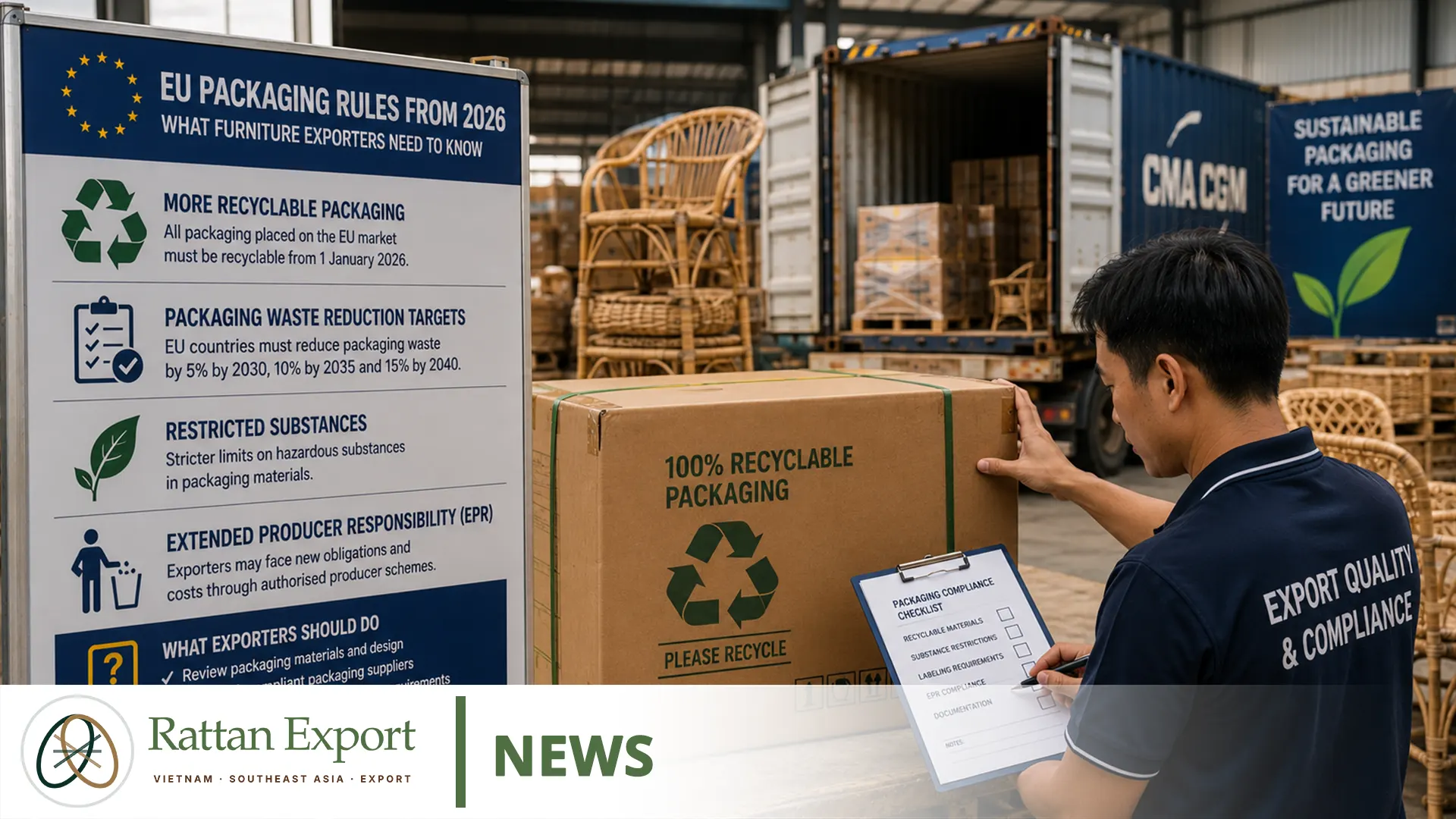
New European Union packaging rules are creating a fresh compliance planning issue for furniture exporters in 2026, as Regulation (EU) 2025/40 on packaging and packaging waste moves toward its general application date of 12 August 2026. The Packaging and Packaging Waste Regulation, widely known as the PPWR, applies to packaging regardless of the material used or its origin. For Vietnamese manufacturers exporting furniture, rattan, bamboo, lighting, baskets and homeware to Europe, that means packaging can no longer be treated only as a logistics question involving carton strength, damage prevention and container utilisation. The regulatory identity, composition, documentation, recyclability and future minimisation of packaging are increasingly becoming part of the commercial compliance discussion between supplier, importer and buyer.
The Regulation Applies From August 2026, but Not Every Target Starts Then
The PPWR entered into force on 11 February 2025 and will generally apply from 12 August 2026, replacing the existing Packaging and Packaging Waste Directive while retaining certain transitional provisions. This date is important, but exporters should avoid the common mistake of assuming that every numerical target in the Regulation becomes mandatory on the same day.
The PPWR establishes a long implementation calendar. Major design-for-recycling criteria are linked to 2030. Minimum recycled-content requirements for many plastic packaging formats are also primarily 2030 requirements. Harmonised material-composition labelling will apply later, from 2028 or according to the timing of the relevant implementing acts. Packaging minimisation and excessive-empty-space requirements also develop through later deadlines.
| PPWR Milestone | General Timing | Furniture Export Relevance |
|---|---|---|
| Regulation entered into force | 11 February 2025 | Businesses begin implementation planning |
| General application | 12 August 2026 | Core PPWR framework begins applying |
| Harmonised packaging labels | From 2028, subject to implementing-act timing | Material labelling systems need preparation |
| Packaging minimisation | By 1 January 2030 | Weight and volume must be reduced to what is necessary |
| Design-for-recycling requirements | 2030 or later depending on delegated acts | Cartons, plastics and components need recycling-compatible design |
| Plastic recycled-content targets | Primarily from 2030 | Relevant to plastic film, bags and other plastic packaging formats |
| Transport-packaging reuse targets | From 1 January 2030 | Relevant to pallets, boxes, trays, wrapping and straps in covered situations |
Furniture Packaging Falls Inside the Regulation
The Regulation defines packaging broadly as items intended for containment, protection, handling, delivery or presentation of products. It covers sales packaging, grouped packaging and transport packaging. Transport packaging includes packaging used to facilitate handling and transport and to protect goods against damage, although road, rail, ship and air freight containers themselves are excluded from that definition.
For a furniture exporter, the regulated packaging system can therefore include far more than the outer carton. Depending on the design, it may include cardboard boxes, paper protection, plastic bags, foam or other cushioning, edge protectors, plastic film, pallet wrapping, straps, pallets and other packaging components.
This distinction matters because a factory might accurately describe the furniture product while having little structured information about the packaging materials surrounding it. Under the new European framework, that gap becomes increasingly difficult to ignore.
Packaging Compliance and Product Compliance Are Separate Questions
A rattan chair can comply with the buyer's furniture specification while its packaging creates a separate regulatory issue. Likewise, a cabinet can meet strength and finishing requirements while the packaging supplier has not provided sufficient information about material composition or conformity.
International buyers should therefore treat the finished SKU as two connected compliance systems:
- The product: furniture construction, materials, performance, chemicals, labeling and destination-market requirements applicable to the actual product.
- The packaging: cartons, wraps, cushioning, pallets and other materials used to contain, protect and transport that product.
The PPWR does not convert every furniture exporter into the same type of legal operator. Responsibilities depend on how packaging and packaged products are manufactured, branded and placed on the EU market. In conventional B2B imports, an EU-established importer has specific responsibilities for packaging arriving from a third country. Direct selling structures can create different roles. Commercial contracts should therefore identify who controls packaging specifications, who holds supporting documentation and who performs the relevant EU compliance tasks.
Importer Responsibilities Make Supplier Documentation More Important
The PPWR requires EU importers to place only compliant packaging on the market. Before doing so, importers must verify relevant conformity steps, required technical documentation, applicable labelling and accompanying documents.
For Vietnamese exporters, this creates an indirect but commercially powerful requirement. Even when the European buyer or importer carries the formal EU importer obligation, it will need information from the factory and packaging supply chain in order to perform that obligation.
Furniture suppliers should expect professional European customers to ask more questions about:
- Packaging material composition.
- Who manufactured or supplied each packaging format.
- Whether packaging contains multiple inseparable materials.
- Plastic types and quantities.
- Coatings, laminates and adhesives.
- Whether technical documentation is available.
- How packaging design will adapt to future recycling criteria.
- Whether repeated orders use the same packaging specification.
Recyclability Becomes a Central Design Principle
The PPWR establishes the principle that packaging placed on the market must be recyclable. More detailed design-for-recycling criteria and recyclability-performance methodologies are scheduled to develop toward the 2030 phase of implementation, with later requirements concerning recycling at scale.
This is particularly important for furniture packaging because protection systems can involve several materials. A corrugated carton may be relatively straightforward, while a packaging system containing laminated cardboard, difficult-to-separate plastic, foam, adhesives and composite protective pieces can present a more complicated recycling profile.
The direction of travel is clear even where detailed technical criteria are still being developed: packaging should be designed with its waste stream in mind rather than only with factory packing speed and transport protection in mind.
Packaging Minimisation Will Affect Furniture Logistics
By 1 January 2030, manufacturers or importers must ensure that packaging weight and volume are reduced to the minimum necessary to maintain packaging functionality, taking account of the shape and material of the packaging. The Regulation also targets packaging characteristics that merely increase perceived volume without a functional reason.
For furniture exporters, this creates an unusual alignment between environmental compliance and logistics economics. Reducing unnecessary packaging volume can both support PPWR objectives and improve container utilisation.
| Packaging Decision | Compliance Direction | Logistics Effect |
|---|---|---|
| Oversized carton | Increasingly difficult to justify without protective need | Higher CBM and freight cost |
| Excess void filling | Target of future reduction requirements | Ships unnecessary volume |
| Knock-down furniture | Can support lower packaging volume where safe | More units per container |
| Nesting products | Can reduce packaging required per unit | Improves loading efficiency |
| Right-sized cartons | Supports packaging minimisation | Improves landed cost |
The 50% Empty-Space Rule Is a Future Issue, Not an August 2026 Requirement
The Regulation includes a maximum 50% empty-space ratio for grouped, transport and e-commerce packaging. However, this obligation is linked to 1 January 2030 or three years after the relevant calculation methodology enters into force, whichever is later.
This timing matters. A furniture exporter should not tell an EU buyer that every transport carton must already meet a 50% limit in August 2026. The correct commercial response in 2026 is to begin measuring packaging efficiency so that future redesign is based on real data.
The Regulation also recognises that packaging may require space for legitimate protection, particularly for products of irregular shape or goods that could be damaged. Furniture exporters therefore should not remove cushioning simply to minimise volume. Packaging still needs to perform its protective function.
Plastic Packaging Deserves Particular Attention
Plastic often appears in furniture exports even when the product itself is overwhelmingly natural. A rattan chair may use polyethylene bags, plastic wrapping and foam protection. A bamboo cabinet may be wrapped in film and stabilised using plastic straps. Upholstered furniture may rely heavily on protective plastic packaging.
The PPWR establishes minimum recycled-content percentages for plastic packaging from the 2030 phase, subject to specific packaging categories, exemptions and implementing methodologies. This makes it useful for furniture exporters to start recording plastic packaging now rather than waiting until the compliance deadline.
A practical packaging bill of materials can record:
- Plastic polymer where known.
- Weight per packaging unit.
- Whether it is film, bag, strap, foam or another format.
- Recycled-content information supplied by the packaging manufacturer.
- Supplier and specification reference.
- Whether different materials are manually separable.
Transport Packaging and Reuse Become More Important From 2030
The PPWR contains future re-use requirements for certain transport and sales packaging used for transporting products within the Union. Covered formats include pallets, boxes, trays, plastic crates, intermediate bulk containers, drums and certain pallet wrapping and straps, subject to the detailed rules, situations and exemptions in the Regulation.
These 2030 provisions should not be incorrectly presented as a blanket 2026 requirement for every Vietnamese export pallet. Their immediate relevance is strategic: European importers and distribution groups may redesign their logistics networks before the legal deadline and may begin asking overseas suppliers to use packaging compatible with those systems.
Labelling Will Become More Harmonised, but the Main Change Comes Later
The PPWR provides for harmonised labels showing packaging material composition to make sorting easier. The general material-composition labelling requirement is scheduled to apply from 12 August 2028 or 24 months after the relevant implementing acts take effect, whichever is later.
This provides exporters with transition time. A Vietnamese supplier should therefore avoid inventing its own claim that a 2026 shipment already carries an official future PPWR harmonised label unless the applicable system actually exists and is legally usable.
The better preparation is to maintain accurate packaging material data so that correct labels can later be generated when the harmonised specifications are finalised.
Technical Documentation Changes the Buyer-Supplier Relationship
The Regulation places substantial emphasis on conformity and technical documentation. Packaging suppliers are required to provide manufacturers with information and documentation necessary to demonstrate conformity. Manufacturers also face documentation and declaration obligations under the regulatory framework.
This means packaging purchasing may become more formal. Buying an unrecorded carton or plastic bag because it is locally available and inexpensive may become less attractive for export programmes if the supplier cannot support the documentation required farther down the chain.
Furniture exporters should therefore begin treating packaging suppliers more like controlled production suppliers:
- Create an approved packaging specification for every export SKU or SKU family.
- Identify the packaging supplier and material type.
- Record carton dimensions and weight.
- Record meaningful plastic and composite components.
- Request technical information from packaging suppliers.
- Control packaging substitutions during mass production.
- Keep version history when packaging specifications change.
A Packaging Change Can Become a Compliance Change
Factories frequently change packaging for practical reasons. A different carton supplier may be cheaper, a foam type may become unavailable or an export order may require additional corner protection. Under a more structured regulatory framework, substitutions need greater control.
A seemingly minor change can alter packaging weight, material composition, recyclability, plastic content or labelling information. Supplier approval should therefore include packaging changes rather than treating them as invisible factory decisions.
Natural-Material Furniture Presents a Packaging Trade-Off
Rattan, bamboo, seagrass and water-hyacinth products often need strong moisture, abrasion and deformation protection during long ocean shipments. Eliminating packaging indiscriminately could increase product damage and create more waste rather than less.
The commercial objective is therefore not “use the least packaging possible” in isolation. It is to use the minimum packaging necessary to perform the required functions. A carton that prevents a large chair from arriving damaged has a legitimate protective purpose. The challenge is to remove unnecessary layers and void space without compromising product condition.
Container Planning and PPWR Can Support the Same Goal
For bulky furniture, packaging optimisation already has a financial incentive. Smaller cartons, better nesting and knock-down design increase units per container. The PPWR adds a regulatory reason to examine those same variables.
| Data to Record | PPWR Value | Commercial Value |
|---|---|---|
| Carton dimensions | Supports packaging-volume assessment | Calculates CBM |
| Packaging weight | Supports minimisation and material records | Improves gross-weight planning |
| Material breakdown | Supports compliance and future recycling analysis | Improves supplier transparency |
| Plastic packaging weight | Relevant to future recycled-content requirements | Highlights cost exposure |
| Units per carton | Shows packaging efficiency | Improves container loading |
| Packaging supplier | Supports traceability | Improves quality-control accountability |
What EU Furniture Buyers Should Ask Vietnamese Suppliers in 2026
- What packaging materials are used for each SKU?
- What are the weight and dimensions of each packaging component?
- Who supplies the carton, film, foam, straps and pallets?
- Can the supplier provide technical information for the packaging materials?
- Are packaging substitutions controlled and documented?
- Which packaging components contain plastic?
- Can the packaging be separated into identifiable material streams?
- Can carton volume be reduced without increasing damage?
- Is the packaging specification consistent across repeat orders?
- Who will be responsible for EU PPWR conformity and importer documentation?
What This Means for Rattan Export Vietnam Buyers
The PPWR reinforces why packaging information needs to become part of structured B2B sourcing rather than remain an invisible detail at the factory. For Rattan Export Vietnam, a product record is most useful when buyers can eventually connect the SKU not only to its supplier and material composition, but also to its commercial packing and container requirements.
Our developing product catalogue is structured around supplier-linked products and clearer information for rattan, bamboo, seagrass, water hyacinth, jute, wood, metal, fabric, lacquer and mixed-material products. Buyers can also review our approach to quality and compliance, learn more about Vietnam sourcing and export, or submit product quantities, destination markets, packaging specifications and container requirements through the wholesale inquiry.
The main lesson for 2026 is not that every furniture carton must be redesigned immediately. It is that packaging has become a more formal part of EU market access. Exporters that begin collecting packaging data, controlling suppliers and reducing unnecessary volume now will be better positioned for the Regulation's later recyclability, minimisation, recycled-content, labelling and reuse milestones. For international buyers, that preparation also creates something valuable beyond regulatory readiness: better packaging consistency, better container economics and clearer supplier accountability.
Sources and Data References
- Regulation (EU) 2025/40 of the European Parliament and of the Council on packaging and packaging waste.
- European Commission, New Rules for a More Sustainable and Competitive Packaging Economy, 11 February 2025.
- Council of the European Union, Sustainable Packaging: Council Signs Off on New Rules, 16 December 2024.
- EUR-Lex, Packaging and Packaging Waste Regulation provisions on recyclability, minimisation, labelling, importer obligations and transport packaging.