Green transition moved to the center of Vietnam’s wood and furniture industry agenda at HawaExpo 2026, as manufacturers, sustainability specialists, certification organisations and industry representatives focused on a new competitive reality: international buyers increasingly want measurable environmental performance, traceable materials and credible data rather than broad claims that a product or factory is simply “green”. The issue received dedicated attention during the HawaExpo forum “Green Transition: A Prerequisite for Vietnam’s Wood Industry to Break Through in the Global Value Chain”, held on 6 March in Ho Chi Minh City and reported by the organiser on 11 March. The discussion linked sustainability with export competitiveness, carbon measurement, ESG management, circular production, digital traceability, international certification and access to higher-value markets.
Green Transition Is Becoming a Commercial Requirement
The central message from HawaExpo was that sustainability is moving from corporate communication into operational management. Vietnamese furniture suppliers can no longer rely only on competitive labour costs, manufacturing speed or attractive design when major customers are increasingly examining origin, emissions, material efficiency and social responsibility.
For international procurement teams, this changes the sourcing conversation. A supplier claiming to use sustainable wood may now be asked which forest or supplier supplied it, which certificate applies, whether the certificate covers the specific material and product, how much certified material enters production and what documentation supports the claim. A factory promoting low-carbon production may increasingly need energy and emissions data rather than marketing language.
| Traditional Supplier Claim | Emerging Buyer Question |
|---|---|
| “We are a green factory.” | What emissions have been measured and over what boundary? |
| “We use sustainable wood.” | Which material, supplier, origin and certification claim? |
| “Our products are eco-friendly.” | Which lifecycle or material evidence supports the claim? |
| “We reduce waste.” | What waste streams are measured, reused or recovered? |
| “We comply with international standards.” | Which standards apply to this SKU and destination market? |
HawaExpo Proposed a Measurement-First Roadmap
One of the most practical messages presented at the forum was a four-stage green-transition roadmap. Vu Linh Quang of the Ho Chi Minh City Green Business Association argued that companies should begin with measurement, then move to optimisation, integrate ESG principles into management systems and only then use sustainability as part of their market positioning.
The sequence is important because it reverses a common greenwashing risk. A company should not first describe itself as environmentally responsible and only later search for numbers that support the claim. It should understand energy use, emissions, waste and material flows first; improve the weak points; create repeatable management controls; and communicate only what can be substantiated.
- Measure: establish reliable baselines for energy, emissions, waste and important material flows.
- Optimise: improve energy efficiency, process yield, material use and waste reduction.
- Integrate: make ESG and environmental controls part of normal management rather than a separate marketing activity.
- Position: communicate environmental performance after evidence and systems are established.
Carbon Data Is Moving Closer to the Furniture Buying Decision
HawaExpo speakers also highlighted the increasing role of carbon information in architecture, construction and project sourcing. Life Cycle Assessment tools allow architects, consultants and developers to compare environmental impacts across products and buildings. Environmental Product Declarations can provide structured lifecycle information and carbon-related data for specified products.
This has particular significance for contract furniture, hotels, resorts, offices and other project markets. Product design and price remain important, but a manufacturer that can provide structured environmental information may be easier for an architect or procurement consultant to evaluate for a project with sustainability targets.
For Vietnamese suppliers, carbon accounting therefore has a potential commercial function. It can help identify energy-intensive processes, compare improvement projects and answer customer requests more consistently. It should not, however, be confused with a universal legal requirement applying identically to every furniture exporter or SKU.
EUDR Makes Traceability Especially Relevant to Wood Products
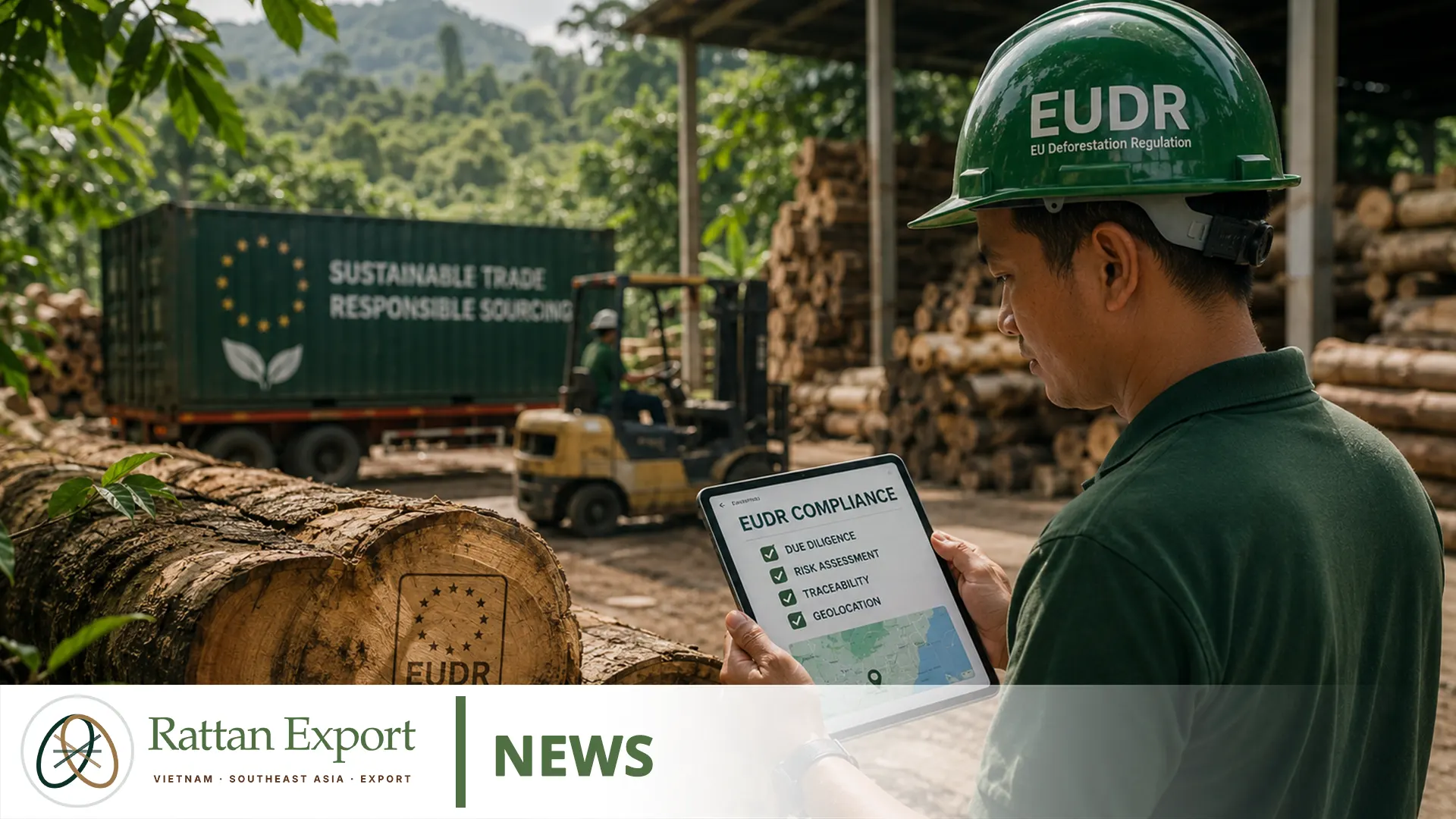
The European Union Deforestation Regulation is one of the clearest regulatory reasons for wood-product traceability to receive more attention in 2026. Following the amendment adopted in December 2025, the principal application timeline moved to 30 December 2026 for the main categories of operators covered by the amended framework.
For relevant wood and wood-derived products, EUDR due diligence can require information reaching far upstream in the supply chain. This makes supplier identity, species, origin and geographic production information increasingly important to European customers.
A Vietnamese furniture factory may not always be the EU operator carrying the formal legal obligation, but it can still become an essential source of upstream information. A European importer cannot reliably reconstruct forest-origin data at destination if the Vietnamese manufacturer and its timber suppliers never collected it.
CBAM Should Not Be Confused With a Furniture Carbon Tax
Carbon Border Adjustment Mechanism discussions also appeared in the broader green-transition debate at HawaExpo. Buyers and suppliers should nevertheless distinguish the general direction of carbon-related trade policy from the actual legal scope of CBAM.
As of March 2026, the EU mechanism covers selected goods in carbon-intensive sectors including cement, iron and steel, aluminium, fertilisers, electricity and hydrogen. Furniture and wood are not generally CBAM product sectors. A furniture exporter should therefore not describe CBAM as a direct carbon tariff on ordinary wooden or rattan furniture.
The wider lesson remains relevant: carbon measurement is becoming more important across global supply chains, and furniture companies that use energy-intensive processes or significant metal and other industrial inputs may increasingly encounter carbon-data requests from customers even where the finished furniture SKU itself falls outside CBAM.
CSRD Can Influence Suppliers Indirectly Through Their Customers
Corporate sustainability reporting requirements create another form of pressure. Where large European customers are required to report environmental, social and governance information, they may request more structured data from companies in their value chains. Vietnamese furniture manufacturers may therefore experience sustainability reporting as a customer-data request even when the Vietnamese supplier itself is not directly subject to European corporate reporting law.
This is one reason a repeatable supplier data system matters. If different buyers request timber origin, energy use, certifications, waste information and emissions data in different formats, a factory that has already organised those records can respond more efficiently than one starting from zero for every RFQ.
Green and Digital Transition Are Increasingly Connected
The HawaExpo forum also promoted the idea of a “twin transition”: environmental improvement and digital transformation developing together. Circular production becomes difficult to manage if companies cannot track the materials entering, moving through and leaving the factory.
Digital records can connect raw-material purchasing, production lots, scrap, reuse, supplier information and finished SKUs. Advanced analytics may later help factories identify waste patterns or optimise material cutting, but the foundation is much simpler: accurate structured data.
| Data to Track | Green-Transition Use | Buyer Value |
|---|---|---|
| Material and supplier | Traceability and responsible sourcing | Clearer origin evidence |
| Production lot | Material-flow control | Better quality investigation |
| Energy consumption | Carbon and efficiency measurement | Environmental-performance data |
| Wood or fibre waste | Circularity and yield improvement | Evidence of resource efficiency |
| Finished SKU | Connect impact data to products | More defensible product claims |
Circular Economy Means Looking at Waste as Material
Another theme at the forum was the circular economy. For furniture manufacturing, this can involve improving cutting yield, recovering wood residues, separating waste streams, redesigning components for longer life and finding productive uses for material that would otherwise be discarded.
The commercial opportunity is not limited to environmental reporting. Better material yield can reduce cost. Recovered wood or by-products may create secondary value streams. Durable products can strengthen quality positioning. Design for disassembly or repair can become increasingly relevant as international buyers place more emphasis on product life and circularity.
Not every waste stream can automatically be recycled into another product, and environmental claims should be supported by evidence. The useful principle is to measure first and identify technically and economically credible recovery opportunities.
Certification Is Becoming Part of a Product’s “Green Passport”
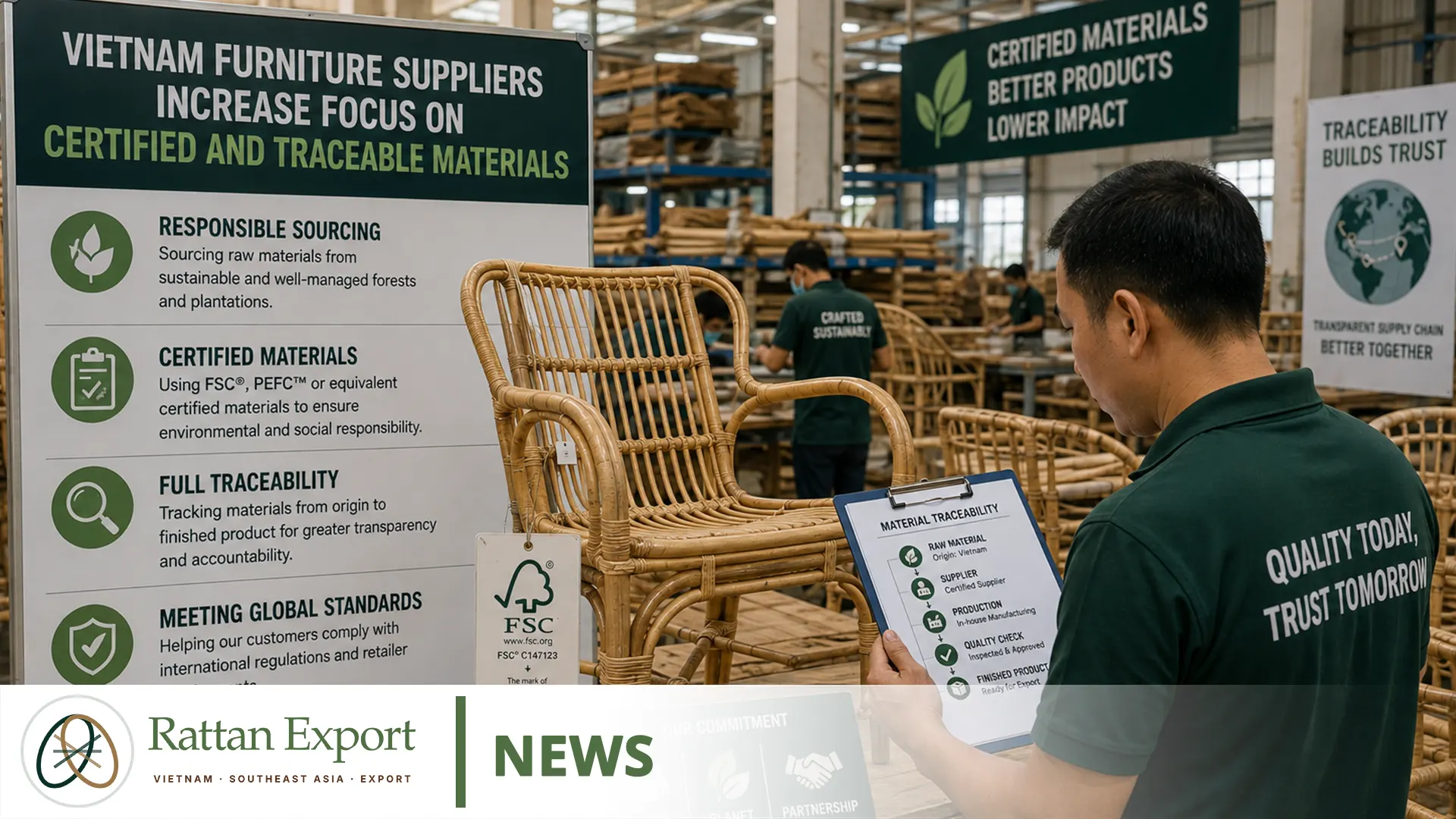
Forest Stewardship Council representatives at the HawaExpo forum highlighted the growing importance of transparency and certification in modern supply chains. FSC and other recognised systems can support evidence about forest management and chain of custody when the exact certificate scope and product claim are valid.
Certification should nevertheless be handled precisely. A supplier holding an FSC certificate does not automatically make every product it sells FSC-certified. Buyers should verify certificate validity, scope, material claim and sales documentation for the actual product being purchased.
The same caution applies to natural fibres. Rattan, bamboo, seagrass and water hyacinth may be renewable biological materials, but “natural” does not automatically mean certified, traceable, low-carbon or sustainable. Claims should match the evidence available for the specific material and supply chain.
Natural Materials Can Be an Advantage, but Evidence Still Matters
Vietnam has a strong design and manufacturing base using wood, rattan, bamboo and other natural materials. HawaExpo's 2026 sourcing materials placed plantation woods such as acacia and rubberwood, certified sourcing, legal timber and material transparency prominently in the buyer conversation.
For international buyers, natural-material products can offer texture, craftsmanship and strong design differentiation. But the commercial value becomes stronger when a supplier can answer basic sourcing questions: what exactly is the material, who supplied it, where did it originate, what treatment was used and which certification or legality evidence applies?
Green Transition Is Also a Production-Efficiency Project
Environmental improvement does not need to begin with an expensive certification programme. For many small and medium-sized furniture manufacturers, useful first steps can include standardising environmental records, measuring electricity and fuel, monitoring waste, identifying formaldehyde or chemical requirements relevant to export markets and improving purchasing documentation.
These actions can provide a baseline for later investments in efficient machinery, renewable energy, dust collection, waste recovery, certification or product-level environmental assessment. A phased strategy is often more credible than attempting to present a fully transformed “green factory” overnight.
What International Buyers Should Ask
- What exactly has been measured? Ask for the boundary and period behind energy or emissions claims.
- Which materials are certified? Verify the exact component, certificate and claim.
- Can origin be traced upstream? Especially for timber and products potentially affected by EUDR.
- How are material substitutions controlled? A new supplier can change traceability and environmental evidence.
- What happens to production waste? Separate measured recovery from broad “zero waste” marketing.
- Does the factory maintain product-level data? SKU-linked records are more useful than general company statements.
- Are carbon or lifecycle figures independently verified? Understand the methodology behind environmental claims.
- Which requirements actually apply to the destination market? Avoid confusing EUDR, CBAM, CSRD and voluntary certification.
What Green Transition Means for Rattan Export Vietnam Buyers
The discussion at HawaExpo 2026 reinforces the sourcing direction being developed by Rattan Export Vietnam. Sustainability becomes commercially useful when it is connected to real products, real suppliers and verifiable information rather than generic marketing claims.
Our developing product catalogue is structured around supplier-linked products and clearer material classification across rattan, bamboo, seagrass, water hyacinth, jute, wood, metal, fabric, lacquer and mixed-material constructions. Buyers can also review our approach to quality and compliance, learn more about Vietnam sourcing and export, or provide product, certification, destination, quantity and container requirements through the wholesale inquiry.
The most important message from HawaExpo is that Vietnam's green transition should not be reduced to a collection of sustainability labels. For suppliers, the durable path begins with measurement, material traceability, production efficiency and transparent governance. For buyers, the opportunity is to source from manufacturers capable of turning environmental responsibility into reliable product data, better resource management and stronger long-term supply-chain performance.
Sources and Data References
- HawaExpo, “Many Proposals to Support Businesses in Green Transition at HawaExpo 2026”, published 11 March 2026.
- HawaExpo, official opening coverage of the Ho Chi Minh City Export Furniture Fair 2026.
- HawaExpo, “Vietnamese Furniture Wood: A Guide to Sustainable Materials”, February 2026.
- Regulation (EU) 2023/1115 as amended by Regulation (EU) 2025/2650 regarding deforestation-free supply chains.
- European Commission, official Carbon Border Adjustment Mechanism sector information.