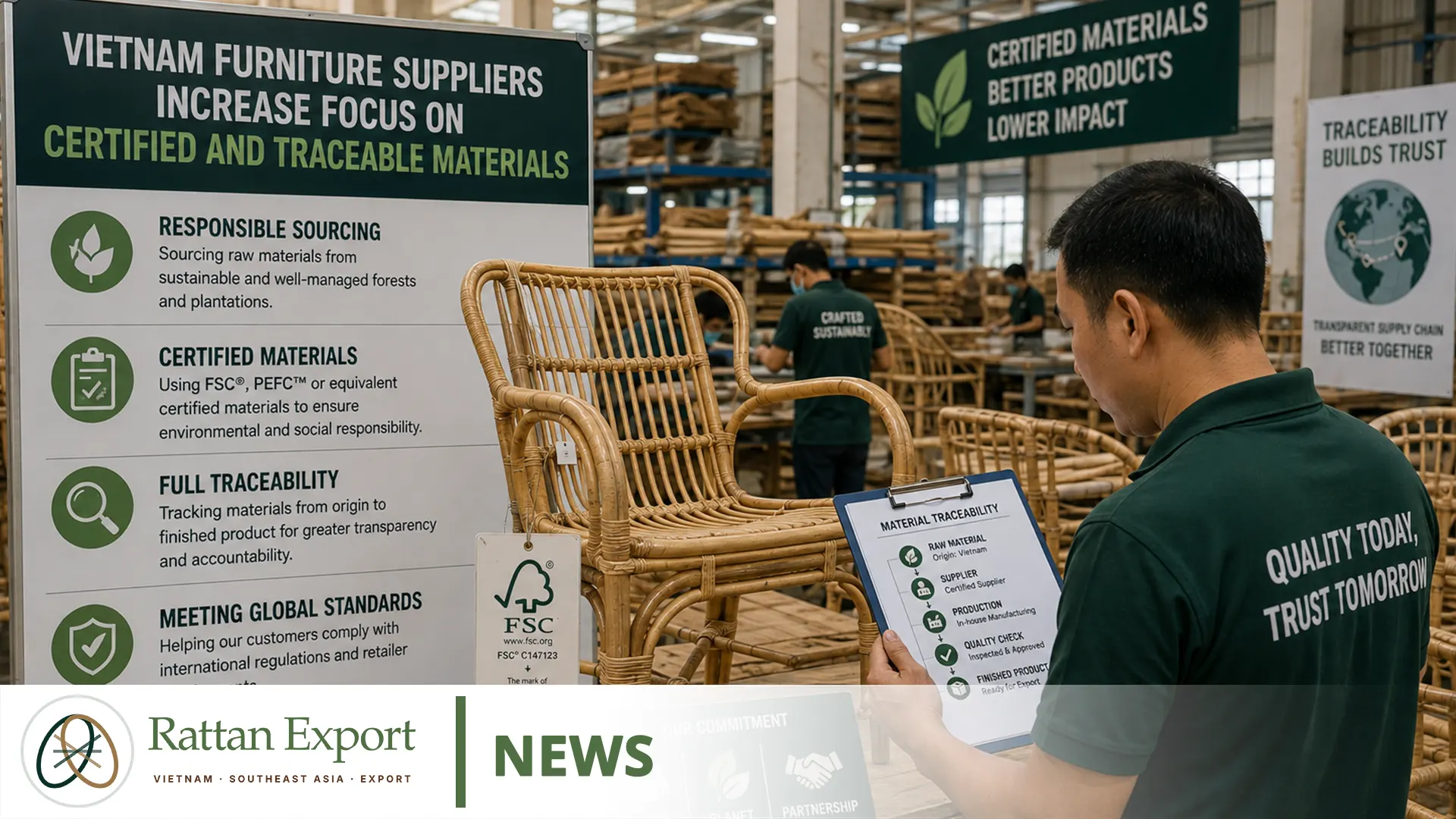
Vietnamese furniture suppliers are increasing their focus on certified and traceable materials as international buyers ask for stronger evidence about where timber, bamboo, rattan and other natural inputs come from and how those materials move through the supply chain. For Vietnam's export-oriented furniture industry, the issue is developing beyond a simple sustainability claim. Buyers increasingly need material identity, supplier records, origin documentation, chain-of-custody information and evidence that the quantity of certified or legally sourced material entering a factory is consistent with the products leaving it. The change is particularly relevant in 2026 as European deforestation rules move closer to implementation, major buyers strengthen responsible-sourcing programmes and trade scrutiny makes product origin increasingly important.
Certification Is Moving From Marketing Claim to Procurement Data
For many years, furniture suppliers could present an FSC certificate or a statement about legal timber as a general sustainability credential. Professional procurement is becoming more detailed. Buyers increasingly want to know which specific SKU contains certified material, which component is covered, which supplier provided it and whether the certification claim remains valid throughout the production chain.
This distinction is important because a furniture product may contain several materials. A dining chair could combine certified wood with rattan cane, metal hardware, foam and fabric. A cabinet may use solid timber, plywood, veneer, lacquer and imported hinges. A woven product may use rattan or bamboo together with a timber or metal structural frame. A single certificate therefore cannot automatically describe every material in the finished product.
| Buyer Question | Weak Answer | Stronger Traceability Answer |
|---|---|---|
| What material is certified? | “The product is FSC.” | Identify the exact wood component and applicable claim |
| Where did it come from? | “Vietnam.” | Supplier, forest or plantation source and country/region where required |
| Who supplied it? | Not recorded | Approved supplier and purchase record |
| Is the certificate valid? | Old PDF on file | Current certificate scope and licence verification |
| Can quantities be reconciled? | No material balance | Incoming, production and outgoing quantities can be checked |
Vietnam Already Has a Legal-Timber Traceability Framework
Vietnam's timber sector does not begin from zero. The Vietnam Timber Legality Assurance System, established under Decree No. 102/2020/ND-CP and subsequently amended, provides a national framework for timber legality covering import and export as well as links to harvesting, transport, processing and trade. The system forms part of Vietnam's broader effort to control illegal timber and strengthen documentation across the wood supply chain.
For a furniture supplier, legal timber documentation and voluntary sustainability certification serve related but different purposes. Legal compliance establishes whether timber can lawfully enter and move through the supply chain. Certification systems such as FSC can add independently audited requirements for forest management and chain of custody. Buyers should avoid treating one as an automatic substitute for the other.
Vietnamese Research Shows Why Traceability Is Operational, Not Theoretical
A research programme led by the Vietnamese Academy of Forest Sciences examined seven plantation-timber value chains, including interior and exterior furniture, with a focus on economic performance, timber legality and sustainable forest management. The researchers found that value chains using forest certification generally performed better economically than the comparison group without forest certificates in the study.
For interior furniture, total net profit in the certified-chain group was reported at VND 1.191 million on the study's standardised input basis, compared with VND 878,000 in the non-certified group. For exterior furniture, the respective figures were VND 1.474 million and VND 940,000. These findings should not be interpreted as proof that certification alone creates the additional profit. Certified chains may also differ in market access, management, scale and product mix. The result nevertheless illustrates that certification and traceability can form part of a commercially stronger value chain rather than being only a compliance cost.
Smallholder Timber Remains One of the Harder Traceability Areas
The same Vietnamese research identified supply-chain management and traceability difficulties where plantation timber originates from household forest owners. Timber from organised afforestation entities was generally supported by more complete origin documentation and was easier to manage in processing and trade.
This matters because Vietnam has a large smallholder forestry base. A furniture factory may purchase through traders, sawmills or aggregators rather than directly from the forest owner. Every additional commercial step creates another point where species, quantity, origin or certification information can become separated from the physical material.
Improved traceability therefore requires more than collecting a certificate at the factory gate. It requires a documented chain linking forest or plantation, harvesting, transport, primary processing, secondary processing and the final furniture manufacturer.
Digital Traceability Is Being Tested in Plantation Wood Chains
The Vietnamese Academy of Forest Sciences also developed and piloted the iTwood system to improve management and traceability of legally planted forest timber. Four pilot models across the Northeast, North Central, South Central and Southeast regions registered 7,530.8 hectares of planted forest.
The pilots involved 2,040 households registering directly and another 1,005 households participating through authorisation. They also included 226 logging and transport facilities and 107 wood-processing establishments. The significance is not the software name itself. It demonstrates the direction of the industry: traceability increasingly requires structured records shared across multiple supply-chain actors rather than isolated paper files at the export factory.
FSC Chain of Custody Adds Another Layer of Control
Forest certification can only remain credible if material claims survive the journey from forest to finished product. FSC Chain of Custody certification is designed to control certified material through processing and trading organisations, including rules for purchasing, identification, material accounting, sales documentation and claims.
For furniture buyers, a valid Chain of Custody certificate should still be checked carefully. The certificate holder's scope matters. The product group matters. The claim on the sales document matters. A company being FSC-certified does not mean every product it manufactures is automatically an FSC-certified product.
Vietnam's FSC Transaction Verification Shows Why Volume Integrity Matters
FSC and Assurance Services International completed a significant transaction-verification exercise in Vietnam in 2025. The work examined transaction data from 56 Forest Management certificate holders and 368 Chain of Custody certificate holders and covered more than 241,600 hectares of certified forest.
The investigation was initially focused heavily on wood-pellet supply chains but also intersected with other wood-product chains because furniture, construction materials and household-product production can generate wood residues used by pellet manufacturers. The verification work identified volume mismatches and other integrity risks and led to further investigation and certification actions.
The lesson for furniture sourcing is important: certification credibility depends not only on possession of a certificate but also on whether transaction volumes make sense. A supplier cannot legitimately sell unlimited quantities of certified furniture if its certified material purchases and approved accounting system do not support those sales.
Certification Does Not Replace Buyer Due Diligence
Certification can significantly strengthen evidence, but professional buyers should not treat it as a legal guarantee. Even FSC emphasises that certification can support regulatory due diligence but does not replace the responsibilities imposed on operators by law.
A buyer should therefore verify the certificate, check its scope, identify the certified material in the SKU and retain the supporting commercial documentation. Where regulations require additional origin or geolocation information, those data still need to be collected even when the supplier is certified.
EUDR Is Increasing Demand for Upstream Data
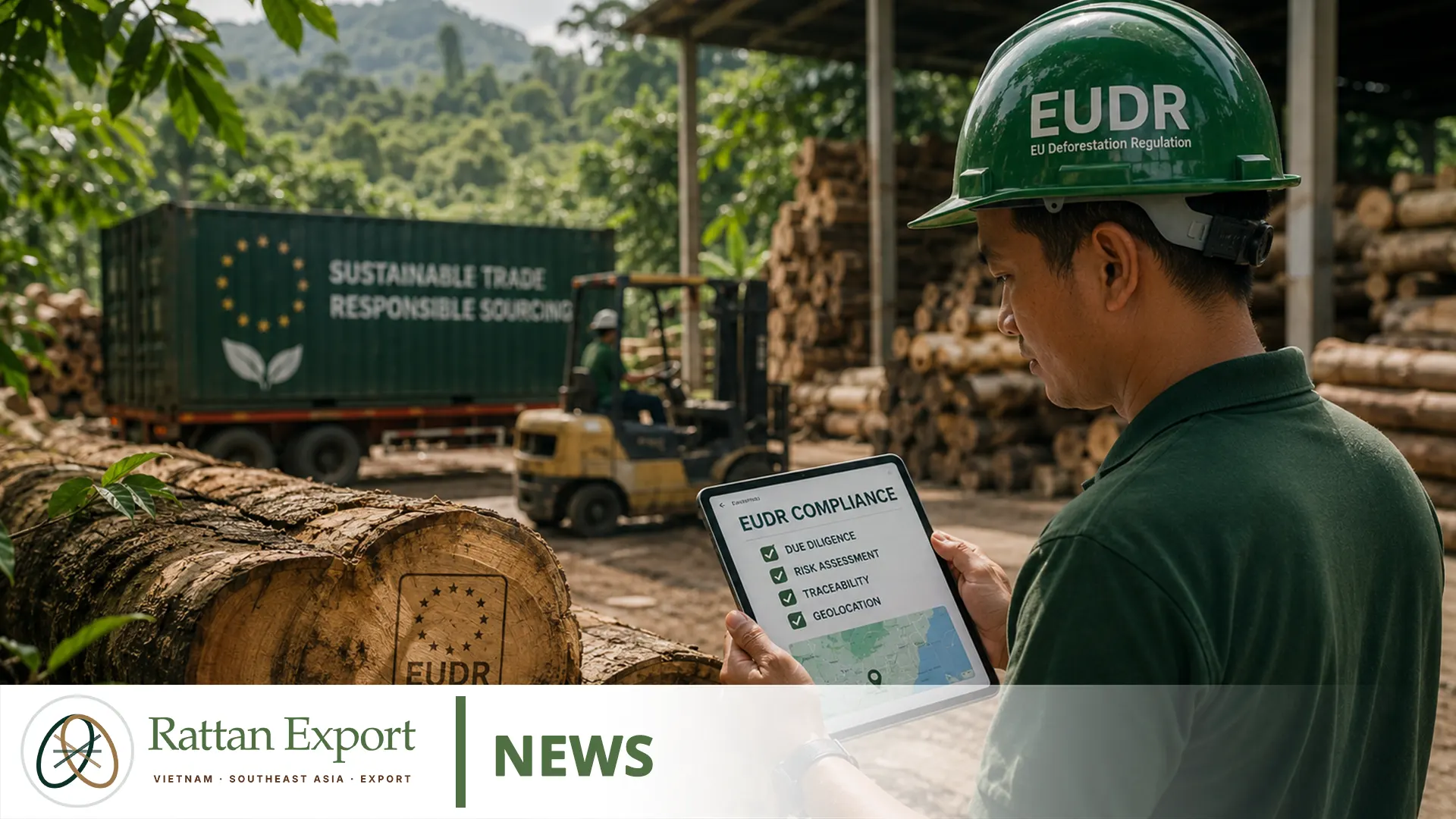
The European Union's Regulation on Deforestation-free Products is one of the clearest reasons traceability has moved higher on the furniture sourcing agenda. Following amendments adopted in December 2025, the principal obligations are scheduled to apply from 30 December 2026 for large and medium operators and for certain micro and small operators already covered by the previous EU Timber Regulation, with a later date for most other micro and small operators.
The regulation concerns specified commodities and products, including wood and relevant wood-derived products. Its due-diligence structure requires information that can reach far upstream, including product information and geographic data connected to the land where relevant commodities were produced.
A Vietnamese manufacturer may not itself be the EU operator carrying the formal due-diligence obligation. Nevertheless, an EU importer cannot create reliable upstream information after the container arrives in Europe if the factory and its suppliers did not collect that information earlier. As a result, European buyers have a commercial reason to push traceability requirements deeper into their Vietnamese supplier networks before the legal application date.
Traceability Is Also Becoming Important for Trade-Origin Risk
Material origin is not only an environmental issue. Vietnam's furniture sector operates in a trade environment where major markets scrutinise country of origin, transshipment and the use of imported inputs. HAWA has warned that although Vietnamese wood businesses have made substantial progress in legal-timber traceability, stronger end-to-end supply-chain controls are increasingly necessary to manage origin-related risk.
For manufacturers using imported timber, the relevant question is therefore more detailed than “Was this product made in Vietnam?” Buyers may need to know the species, country of harvest, importer, processing history and documentation associated with the wood entering the Vietnamese factory.
Certified Wood Is Only One Part of a Mixed-Material Furniture Programme
Rattan Export Vietnam's product universe extends beyond wood. Rattan, bamboo, seagrass, water hyacinth and other natural fibres need traceability as well, but the certification landscape is not identical for every material.
FSC's smallholder standards in Vietnam can cover timber and certain non-timber forest products where they fall within the applicable certificate scope. FSC has also documented Vietnamese community forests where bamboo species are certified. This does not mean Vietnamese bamboo or rattan should generally be described as FSC-certified. Certification must always be verified for the exact forest, material, organisation and product claim involved.
Where a natural fibre is not covered by a recognised certification programme, meaningful traceability can still include the supplier, production community, material name, harvesting or cultivation region, purchase lot and processing facility.
“Natural” Is Not the Same as “Certified” or “Sustainable”
One of the most important sourcing distinctions is between material identity and sustainability evidence. Rattan, bamboo or water hyacinth may be renewable biological materials, but calling them natural does not by itself prove responsible harvesting, legal origin, good labour conditions, low environmental impact or full traceability.
Likewise, a certified timber component does not automatically make the entire finished piece “sustainable”. Furniture can contain adhesives, finishes, metals, fabrics, foams and packaging with their own environmental and regulatory profiles. Buyers need claims that match the evidence rather than broad marketing language.
What a Traceable Furniture Material Record Should Contain
| Data Field | Purpose |
|---|---|
| Exact material | Distinguish oak, acacia, rattan, bamboo, seagrass and other inputs |
| Role in product | Identify primary, structural and secondary materials |
| Supplier | Link material to approved commercial source |
| Country / region of origin | Support origin and risk analysis |
| Species where relevant | Improve timber and botanical identification |
| Certificate scheme | Identify FSC or another applicable programme |
| Certificate / licence code | Enable independent verification |
| Claim or percentage | Avoid implying more certified content than supported |
| Purchase lot | Connect incoming material to production |
| Finished SKU | Connect traceability evidence to the buyer's actual product |
Supplier Substitution Needs Better Control
Traceability systems can fail during ordinary production changes. A factory may approve a sample using one timber supplier and then purchase from another source during mass production because the price is lower or material is available faster. The finished product may look identical, but its origin evidence can be completely different.
Professional export programmes should therefore treat significant material-source changes as controlled substitutions. The factory should know whether the new supplier provides the same species, legality documentation, certification status and quality specification before the material enters production.
Material Traceability Can Improve Quality Control Too
Traceability is often discussed as a sustainability requirement, but it also improves traditional quality management. If a buyer discovers cracking, colour inconsistency, moisture problems or weaving defects, a lot-based record can help identify which supplier and material batch produced the issue.
This is particularly useful for natural materials where performance can vary by harvest, drying method, fibre grade or region. Better traceability can therefore support corrective action and repeat-order consistency in addition to environmental due diligence.
What International Furniture Buyers Should Ask in 2026
- Which exact components are certified and which are not?
- Is the supplier's certificate current and does its scope cover the relevant product or material?
- Can certified purchasing volumes support the quantity being offered?
- Where was the timber harvested or the natural fibre sourced?
- Which materials are imported into Vietnam before manufacturing?
- Are species and supplier details recorded for every production lot?
- Can the factory connect incoming material lots to finished SKUs?
- How are subcontractors and secondary processors controlled?
- What happens when a material supplier changes?
- Which sustainability claims are supported by independent evidence and which are only descriptive?
What This Means for Rattan Export Vietnam Buyers
The growing emphasis on certified and traceable materials closely matches the sourcing structure being developed by Rattan Export Vietnam. An international buyer should be able to understand more than the visible appearance of a product. Supplier identity, exact materials, primary and secondary material roles and available verification evidence are increasingly important parts of an export-ready product record.
Our developing product catalogue is structured around supplier-linked products and clearer material classification across rattan, bamboo, seagrass, water hyacinth, jute, wood, metal, fabric, lacquer and mixed-material constructions. Buyers can also review our approach to quality and compliance, learn more about Vietnam sourcing and export, or submit product, quantity, certification, destination and container requirements through the wholesale inquiry.
Certification should not be treated as a decorative logo and traceability should not begin when a buyer asks for a document. The more durable model is to build origin and material records into sourcing from the beginning. For Vietnamese furniture suppliers, that can improve market access, reduce origin risk, support quality control and make sustainability claims more defensible. For international buyers, it creates something equally important: a clearer understanding of what they are actually buying and the supply chain behind it.
Sources and Data References
- Vietnamese Academy of Forest Sciences, research on plantation-timber value chains, legal timber and the iTwood traceability system.
- Forest Stewardship Council and Assurance Services International, Vietnam Forest Management Transaction Verification findings.
- Forest Stewardship Council, Asia-Pacific Regional Forest Stewardship Standard for smallholders in Vietnam.
- Vietnam Timber Legality Assurance System under Decree No. 102/2020/ND-CP and subsequent amendments.
- Regulation (EU) 2023/1115 as amended in December 2025 regarding deforestation-free supply chains.
- Handicraft and Wood Industry Association of Ho Chi Minh City reporting on supply-chain and origin risks in Vietnam's furniture exports.