Preparations for the European Union Deforestation Regulation are intensifying across furniture and wood-product supply chains as the main 30 December 2026 application date moves closer, pushing European importers and their overseas suppliers to convert timber-origin information into structured, verifiable and shipment-ready data. For Vietnamese furniture manufacturers, the commercial impact reaches beyond the legal question of which company formally acts as the EU operator. European customers sourcing relevant wooden furniture increasingly need accurate species information, supplier identity, country of production, evidence of legal production and geolocation data connected to the land where the wood was produced. Vietnam’s low-risk classification under the EU benchmarking system can simplify part of the due-diligence process, but it does not remove the underlying information and traceability requirements.
The Main Application Date Is 30 December 2026, but Company Size Still Matters
Regulation (EU) 2023/1115, as amended most recently by Regulation (EU) 2025/2650, establishes the principal application date of 30 December 2026 for large and medium-sized operators and for certain micro and small operators already covered by the previous EU Timber Regulation. Most other micro and small operators receive a further transition until 30 June 2027.
This distinction matters for suppliers because different European customers may therefore enter full compliance at different times. A Vietnamese manufacturer should not assume that every EU customer has exactly the same deadline or operational role. The practical approach is to ask the buyer who will act as the EUDR operator, what information it requires from the factory and when that information must be available before shipment.
EUDR Does Not Automatically Cover Every Furniture Product
The Regulation applies only to relevant commodities and relevant products listed in Annex I. For the wood commodity, the list includes a broad range of timber, panels and wood products and also specified furniture headings. These include seats of wood under ex 9401 and specified wooden-furniture headings under 9403, including 9403 30, 9403 40, 9403 50, 9403 60 and 9403 91.
This is particularly important for Vietnam’s mixed-material furniture industry. A product marketed as rattan furniture may have a timber frame. Another product may be predominantly bamboo or metal with only limited wooden components. Whether the finished SKU is within EUDR scope depends on the relevant CN/HS classification and the Annex I wording, not simply on the marketing description “natural furniture”.
| Product Situation | EUDR Question | Buyer Action |
|---|---|---|
| Wooden chair | Potentially within listed wood furniture scope | Confirm CN/HS code and wood origin data |
| Wooden cabinet | Specified 9403 categories may be covered | Check exact tariff classification |
| Rattan chair with timber frame | Scope depends on classification and construction | Do not rely only on product name |
| Pure bamboo or rattan product | Not automatically covered as a wood product | Verify Annex I and tariff code |
| Mixed wood, metal and fabric furniture | Wood may still make the relevant SKU subject to EUDR | Map materials to final customs classification |
Three Conditions Sit at the Core of EUDR Compliance
Relevant products may be placed on or exported from the EU market only when the applicable EUDR requirements are satisfied. In practical terms, the system is built around three fundamental conditions: the relevant commodity must be deforestation-free, it must have been produced in accordance with the relevant legislation of the country of production, and the relevant product must be covered by the required due-diligence documentation.
For wood, the environmental test also addresses forest degradation. The Regulation uses 31 December 2020 as its cut-off date. Operators must therefore be able to establish that relevant commodities were not produced on land affected by prohibited deforestation after that date and, for wood, that harvesting did not result in prohibited forest degradation.
Vietnam’s Low-Risk Classification Is Helpful, but It Is Not an Exemption
The European Commission’s initial country benchmarking classifies Viet Nam as low risk. This is commercially positive because eligible operators sourcing relevant products entirely from low-risk countries may use simplified due diligence if the conditions in the Regulation are satisfied.
However, “simplified” does not mean “no traceability”. For ordinary operators, the fundamental Article 9 information still has to be collected. The simplification generally removes the need to perform the full risk-assessment and risk-mitigation stages when the operator has established that the relevant commodities and products come entirely from low-risk locations and there is no relevant risk of circumvention or mixing with material of unknown, standard-risk or high-risk origin.
If low-risk Vietnamese timber is mixed with material whose origin cannot be demonstrated, the advantage can disappear. The commercial value of Vietnam’s classification therefore depends on maintaining separation and reliable records through the supply chain.
Geolocation Is One of the Biggest Practical Changes
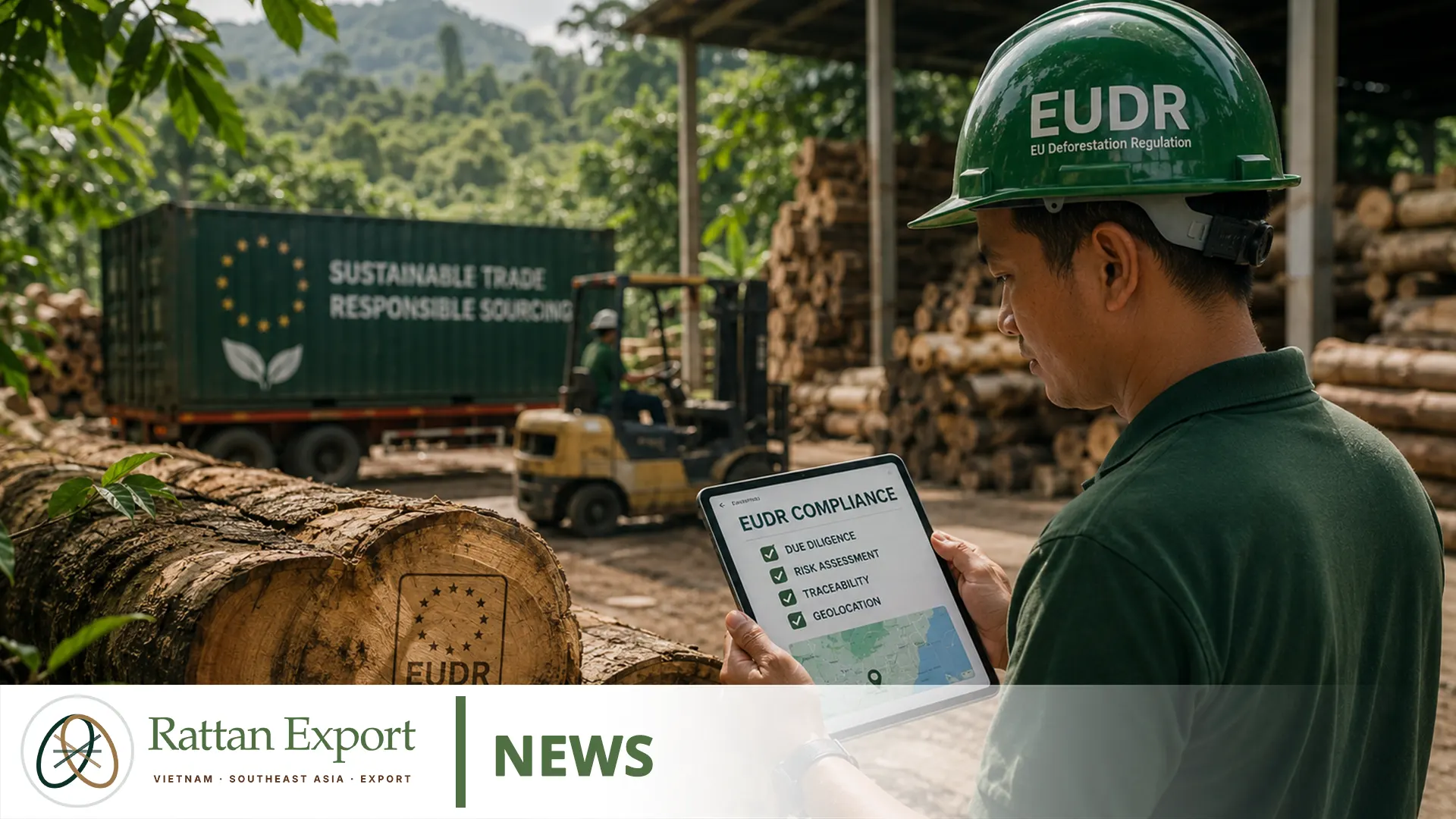
Traditional furniture documentation often stops at the timber trader, sawmill or supplier. EUDR pushes information considerably further upstream. For relevant commodities, operators generally need the geolocation of all plots of land where the commodity used in the relevant product was produced.
For plots larger than four hectares, geolocation must generally be represented by polygons describing the perimeter of the plot. For plots below four hectares, a polygon or a single latitude-and-longitude point can be used. Coordinates are provided with at least six decimal digits.
This creates a very different data requirement for factories buying plantation timber through several intermediaries. An invoice stating “acacia wood, Vietnam” is not equivalent to plot-level traceability. The exporter may need its supplier network to preserve the connection between a timber batch and the plantation plots from which the wood originated.
Every Relevant Plot Contributing to the Product Matters
If timber contained in a relevant product originates from several plots, all relevant plots must be included. The operator cannot simply provide the coordinates of one representative plantation or draw a large polygon around a wider district containing both contributing and non-contributing land.
This makes batch segregation increasingly important. If a sawmill mixes timber from dozens of plantations into one undifferentiated stockpile without preserving the underlying records, downstream furniture manufacturers may find it difficult to provide their EU buyers with defensible information.
The practical objective is not necessarily to physically keep every log separate throughout the factory. It is to preserve a credible documentary relationship between incoming material, approved origin data and the production batches for which that material is used.
Wood Species Information Must Become More Precise
For relevant products containing or made using wood, Article 9 information includes the common name of the species and its full scientific name. Generic descriptions such as “hardwood”, “mixed wood”, “plantation wood” or even “acacia” may therefore be inadequate where they do not identify the species sufficiently.
Vietnamese furniture companies that purchase material through traders should review whether their purchasing documents preserve the species identity supplied by the upstream source. A supplier substitution during mass production can become an EUDR data change as well as a quality-control change.
Legality Covers More Than a Timber Purchase Invoice
EUDR also requires relevant commodities to have been produced in accordance with relevant legislation in the country of production. The exact evidence depends on the applicable national legal framework and supply-chain circumstances. For timber, buyers may therefore ask for records relating to legal harvesting, land-use rights, trade documentation and other applicable requirements.
The formal legal assessment remains the responsibility of the relevant operator, but Vietnamese suppliers have a strong commercial reason to organise supporting documents before the buyer asks for them. Reconstructing upstream documentation only after the container is packed can create delays that product quality inspection cannot solve.
The Due-Diligence Statement Connects Compliance to Customs
Before a relevant product is placed on the EU market or exported from the EU, the responsible operator must complete the required due diligence and submit a Due Diligence Statement, or another applicable declaration under the amended framework, through the EUDR Information System.
For imported relevant products, the relevant DDS reference number or applicable declaration identifier must be available for the customs declaration. This moves EUDR from a sustainability report into the physical trade process. Missing information can therefore become a customs-readiness problem rather than merely a documentation issue discussed after delivery.
The Commission’s EUDR Information System has been available for registration and testing well before the main application date. It allows operators to submit product information, quantities, origin data and geolocation records and to manage the resulting due-diligence references.
The EU Importer Holds the Legal Duty, but the Factory Holds Much of the Data
In a conventional B2B shipment from Vietnam, the European importing entity will often be the operator responsible for the first placing of the relevant product on the EU market. That does not make the Vietnamese manufacturer irrelevant to compliance. The importer frequently depends on upstream information that only the manufacturer, timber processor, sawmill or forest supplier can provide.
This produces a commercial division of responsibilities:
| EU Operator / Buyer | Vietnamese Supplier |
|---|---|
| Determine legal EUDR role | Identify products and materials accurately |
| Conduct required due diligence | Provide supplier and origin records |
| Assess risk where required | Provide reliable supporting evidence |
| Submit DDS where required | Provide geolocation data through the supply chain |
| Maintain compliance records | Maintain material-lot and supplier records |
| Decide whether product may enter EU market | Control substitutions that could change origin evidence |
Certification Can Support Evidence but Does Not Replace EUDR
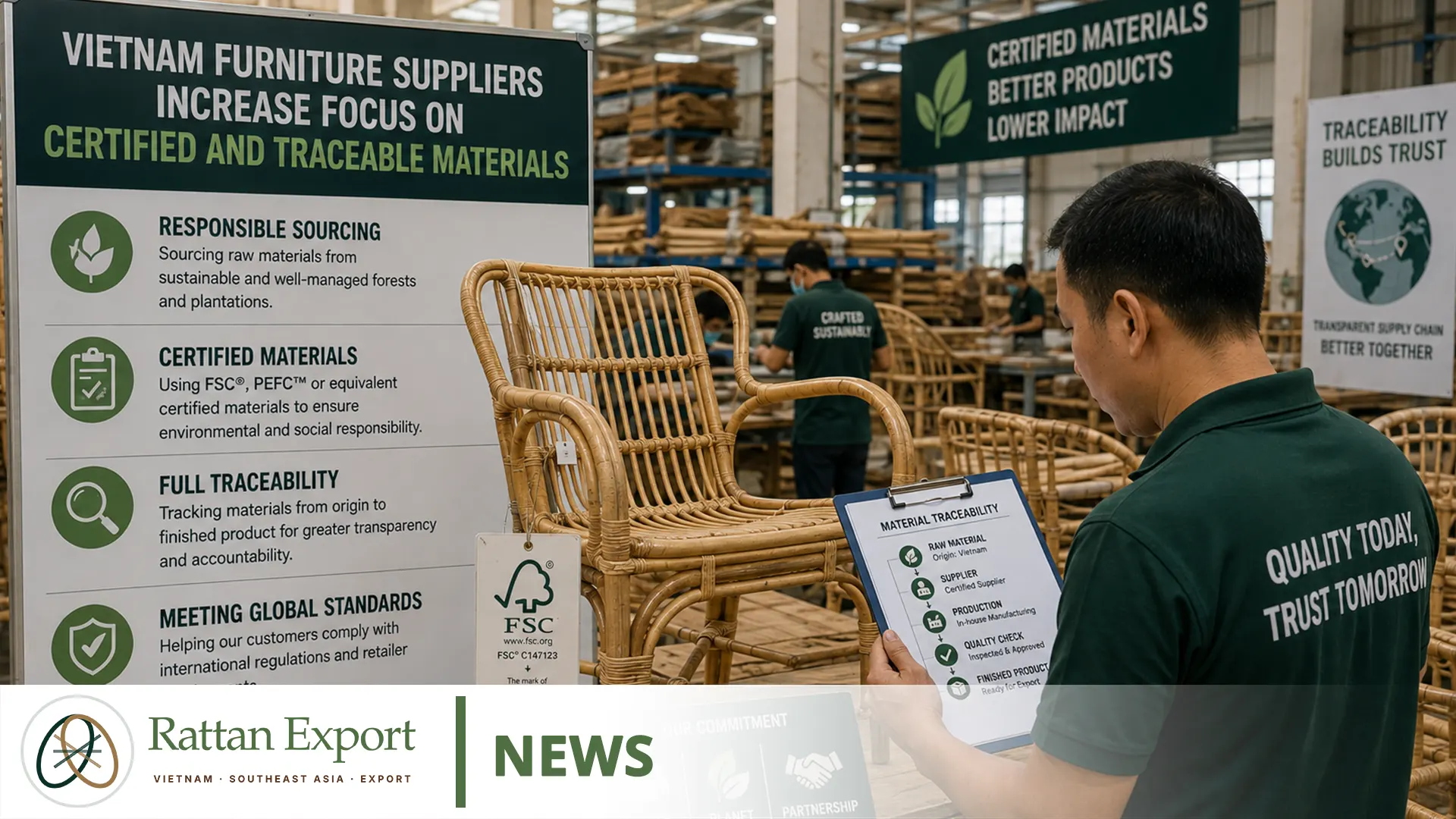
Forest certification and chain-of-custody systems can help companies organise supplier information, material accounting and origin controls. They can therefore be valuable supporting evidence within an EUDR preparation programme.
They do not, however, automatically replace the operator’s regulatory responsibility. An FSC-certified supplier is not an automatic EUDR clearance route, and a certificate cannot substitute for required geolocation or other information where the Regulation demands it. Buyers should verify the exact certificate scope and then assess how that evidence contributes to the broader due-diligence file.
Mixed-Material Furniture Needs SKU-Level Assessment
Vietnam’s furniture sector increasingly combines wood with rattan, bamboo, seagrass, water hyacinth, metal, fabric, leather, ceramic, lacquer and engineered panels. The EUDR relevance of a finished product should therefore be established at SKU and customs-classification level rather than at catalogue-category level.
A collection called “Rattan Living” may contain one chair with a solid-wood frame, another with a metal frame and a third made entirely from woven plant fibre. The three products can have different EUDR implications even though the marketing category is identical.
Structured product data becomes essential because the compliance team needs to know not just that a product contains natural materials, but exactly which relevant commodity is present, where it appears in the construction and which tariff code applies to the final product.
Supplier Changes Can Break an Otherwise Good Traceability Chain
One of the most practical risks occurs after sample approval. A prototype may use timber from an approved plantation source, but the production factory later buys the same species from another trader because of price or availability. Visually, the finished furniture may be identical. Legally and administratively, the origin file can be completely different.
Factories preparing for EUDR should therefore include material-source changes in their change-control systems. Significant substitutions should trigger review of species, supplier identity, origin, geolocation records and supporting legality documents before the new material is used for an EU-bound order.
Smallholder Supply Chains Need Earlier Preparation
Vietnam’s plantation timber supply can involve many small forest owners, traders, logging operators and primary processors. These supply chains can be commercially efficient but data-intensive under plot-level traceability requirements.
Waiting until final assembly to collect plantation coordinates is likely to be inefficient. The stronger model is to move the data requirement upstream: approved timber suppliers should know which information must accompany each material lot before it reaches the furniture factory.
Vietnam’s low-risk classification reduces part of the regulatory burden for eligible EU operators, but reliable upstream data is what allows that advantage to be used in practice.
A Practical EUDR-Ready Furniture Record
| Data Field | Why It Matters |
|---|---|
| Final SKU | Connects compliance to the actual buyer product |
| CN/HS code | Determines whether the product is in Annex I scope |
| Wood component | Identifies where the relevant commodity is used |
| Common species name | Required wood identification information |
| Scientific species name | Supports precise Article 9 identification |
| Supplier | Provides commercial traceability |
| Country of production | Links to benchmarking and legality |
| Plot geolocation | Supports deforestation-free verification |
| Production / purchase lot | Connects origin data to manufacturing |
| Supporting legality evidence | Supports the operator’s due-diligence file |
What Vietnamese Furniture Suppliers Should Do Before December
- Map the EU catalogue against Annex I. Do not assume every furniture SKU is covered or excluded.
- Confirm CN/HS classifications. Product scope begins with the correct tariff code.
- Build exact wood-species records. Include common and scientific names where relevant.
- Identify upstream timber suppliers. Know who can provide origin and geolocation data.
- Test geolocation collection now. Do not wait for a December shipment.
- Link purchase lots to production lots. Preserve traceability through the factory.
- Control supplier substitutions. An origin change can invalidate an existing data package.
- Ask EU buyers what format they need. Commercial systems should be compatible before the purchase order is finalised.
- Separate low-risk material from unknown-origin material. Mixing can remove simplified-due-diligence advantages.
- Retain supporting documentation systematically. EUDR preparation should be a repeatable process rather than a one-off document search.
What International Buyers Should Ask Vietnamese Suppliers
- Is this exact SKU within the EUDR Annex I scope?
- What CN/HS code is being used?
- Which wood species are contained in the product?
- What are their full scientific names?
- Where was the wood produced?
- Can every contributing plot be identified?
- Are coordinates available as points or polygons in the required format?
- Can material lots be linked to the finished purchase order?
- Has any timber supplier changed since sample approval?
- Is any unknown, standard-risk or high-risk material mixed into the supply chain?
- What legality and certification evidence is available?
- Who on the EU side will submit and manage the EUDR declaration?
What This Means for Rattan Export Vietnam Buyers
EUDR preparation reinforces the importance of product-level data in the sourcing structure being developed by Rattan Export Vietnam. For products containing wood, it is increasingly useful to connect the finished SKU not only to its visible material description but also to its supplier, precise material classification and available origin evidence.
Our developing product catalogue is structured around supplier-linked products and clearer classification across rattan, bamboo, seagrass, water hyacinth, jute, wood, metal, fabric, lacquer and mixed-material constructions. Buyers can also review our approach to quality and compliance, learn more about Vietnam sourcing and export, or submit product, material, certification, destination, quantity and container requirements through the wholesale inquiry.
Vietnam’s low-risk status is commercially useful, but the strongest sourcing advantage will come from suppliers that can turn that favourable classification into reliable data. By December 2026, the most valuable question may no longer be simply whether a factory uses legal or certified timber. It will be whether the supplier can connect the exact product, wood species, production lot and origin information in a form that allows the European operator to complete its due diligence without delaying the shipment.
Sources and Data References
- Regulation (EU) 2023/1115 on deforestation-free products, including Annex I product scope.
- Regulation (EU) 2025/2650 amending EUDR obligations and application dates.
- European Commission, EUDR Frequently Asked Questions, fifth iteration, April 2026.
- European Commission, EUDR Guidance Document, May 2026.
- Commission Implementing Regulation (EU) 2025/1093 establishing the initial EUDR country benchmarking.
- European Commission Green Forum, EUDR Information System, due-diligence and country-classification guidance.