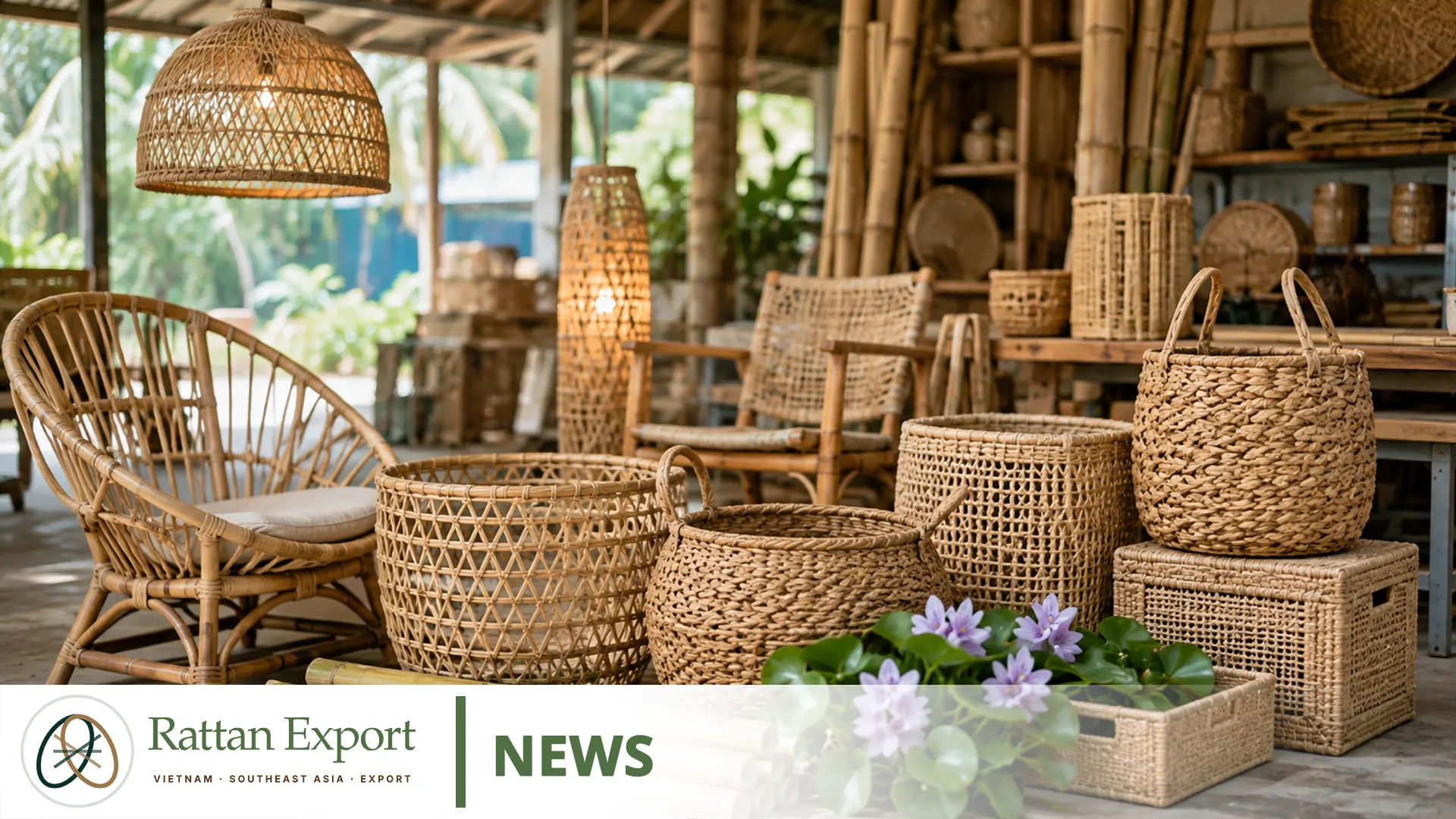
Rattan, bamboo and water hyacinth remain core materials in Vietnam's handicraft supply as the country enters 2026 with a deeply established network of craft villages, export manufacturers and rural weaving communities serving international furniture, home décor and household-goods buyers. These materials are often grouped together under the broad language of natural fibres or wicker products, but they perform different structural, decorative and commercial roles. Understanding those differences is increasingly important for importers, wholesalers, retail chains, hospitality buyers and private-label brands seeking reliable products rather than simply attractive photographs.
Vietnam Entered 2026 With a Significant Natural-Material Export Base
Preliminary full-year data from the General Department of Customs show that Vietnam exported approximately US$900.06 million of bamboo and rattan products in 2025. This official customs category sits alongside a much larger wood and wooden-products industry, which reached approximately US$17.20 billion during the same year. The figures demonstrate that woven and natural-material products are not a marginal craft activity isolated from Vietnam's export economy. They form part of a commercially established furniture, homeware and handicraft supply base.
Water hyacinth is also highly visible within Vietnam's handicraft production, although buyers should note that the headline customs table does not provide a separate full-year 2025 export total specifically for water-hyacinth products. It appears in the product mix of handicraft manufacturers, traditional craft villages and export businesses alongside rattan, bamboo, seagrass and other fibres. For professional sourcing, this distinction matters: broad export statistics should not be used to claim a material-specific market size that the underlying customs category does not actually provide.
| Material | Common Commercial Role | Typical Product Applications | Key Buyer Question |
|---|---|---|---|
| Rattan | Flexible structural and weaving material | Furniture, chair backs, baskets, cabinets, lighting, décor | Is it structural rattan, rattan cane or only a decorative component? |
| Bamboo | Rigid structure, strips, slats and woven components | Furniture, baskets, trays, lamps, shelving, accessories | What species, construction and treatment are used? |
| Water hyacinth | Soft, thick dried fibre mainly used for weaving | Baskets, storage, trays, planters, bags and occasional furniture | What frame supports the woven fibre? |
Rattan Remains Important Because It Can Perform Several Jobs
Rattan is particularly versatile because different parts and preparations of the material can serve different functions. Larger rattan canes can contribute to frames and structural elements, while thinner strips and rattan cane can be woven into chair backs, cabinet panels, baskets and decorative surfaces. This allows manufacturers to use rattan in products ranging from almost entirely rattan constructions to mixed-material furniture where only a small visible section is woven.
For buyers, the word “rattan” should therefore never be treated as a complete specification. A chair advertised as rattan may have a timber frame and a rattan-cane back. A cabinet may be predominantly engineered wood with rattan door panels. A basket might use rattan for the rim while another fibre forms the body. Each construction has different implications for price, strength, customs classification, packaging and quality control.
Bamboo Combines Craft Tradition With Broader Product Engineering
Bamboo remains another central material because it can be split, woven, bent, laminated, shaped or used in more rigid structural applications. Traditional baskets and household goods remain part of the market, but Vietnamese producers also use bamboo in lighting, furniture components, storage, decorative products and contemporary home accessories.
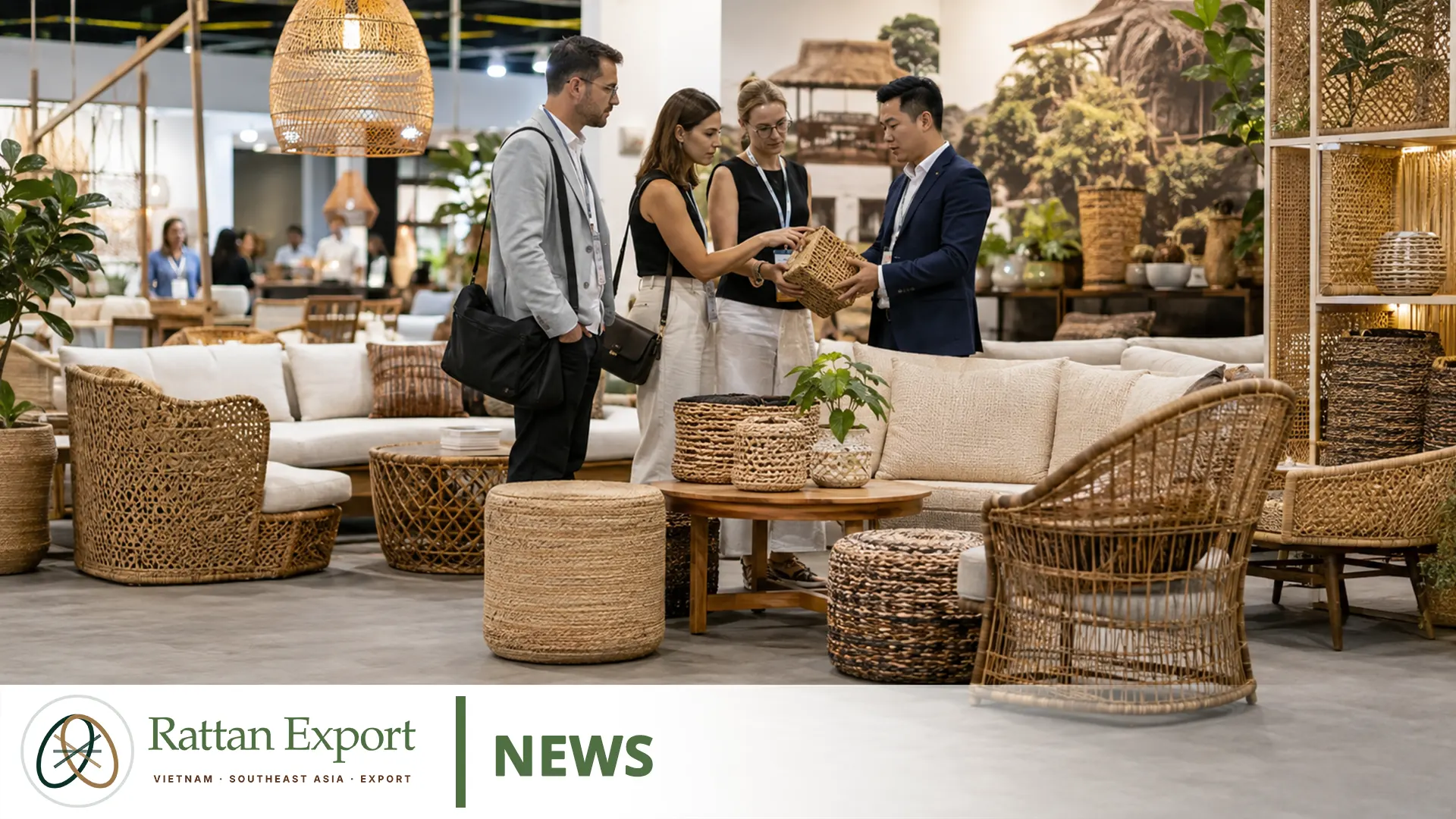
Vietnam's participation at international exhibitions during 2025 showed bamboo and rattan products being promoted together with furniture, interior décor and handicrafts rather than only as traditional souvenirs. At High Point Market 2025 in the United States, Vietnam's national pavilion brought together more than 20 exporters across furniture, wooden products, handicrafts, bamboo and rattan and interior décor. At Mega Show Hong Kong 2025, a Hanoi-supported delegation showcased rattan and bamboo crafts alongside other home and gift categories to professional international buyers.
This development is important because commercial growth increasingly depends on translating traditional material knowledge into products that fit contemporary international assortments. A buyer may still value the handwoven appearance, but also expects dimensional consistency, predictable packaging, repeatable colors, clear specifications and the ability to reorder the same collection.
Water Hyacinth Connects Export Production With Rural Livelihoods
Water hyacinth provides a particularly clear example of the relationship between Vietnam's handicraft exports and rural production networks. In waterways where the plant is abundant, stems can be harvested, dried and prepared for weaving. The dried fibre is then used for products including baskets, trays, mats, handbags, planters and storage items.
A December 2025 report from Ba Sao commune in Dong Thap described more than 1,000 local women participating in water-hyacinth weaving. A common production model involves households receiving dried material and prepared frames from workshops or companies, weaving products according to required patterns and returning them for collection. This distributed model allows rural labor to participate in production while export-oriented businesses coordinate designs, raw materials, consolidation, finishing, inspection and commercial orders.
The system also explains why a buyer should distinguish between the exporting company and every physical stage of production. Hand weaving may take place across households or cooperative groups even when specification control, final finishing, quality inspection, packing and export documentation are managed centrally.
One Product Can Contain Several Natural Materials
International buyers sometimes search for “rattan products,” “bamboo products” or “water-hyacinth products” as if each category were chemically or structurally pure. Vietnamese handicraft production is often more complex. Craftspeople routinely combine fibres with each other or with timber, metal, leather, textile, paper cord, ceramic and other components.
| Commercial Product | Possible Construction | Why Specification Matters |
|---|---|---|
| Rattan cabinet | Wood or engineered-wood body + rattan-cane panels + metal hardware | Rattan may not be the primary structural material |
| Water-hyacinth basket | Water-hyacinth weaving + iron frame | Frame specification affects strength and classification |
| Bamboo lamp | Bamboo structure + paper/textile shade + electrical components | Electrical requirements extend beyond the natural material |
| Natural-fibre chair | Wood frame + rattan/seagrass weave + fabric cushion | Several materials influence cost and compliance |
| Storage basket | Seagrass or water hyacinth + rattan rim + fabric liner | Visible fibre alone does not describe the full SKU |
“Wicker” Describes a Construction Technique, Not One Material
This distinction is especially useful for overseas buyers. Wicker generally refers to a weaving technique or woven construction rather than one botanical material. A wicker product can therefore be made from rattan, bamboo, seagrass, water hyacinth, synthetic fibre or combinations of several materials. Product sourcing becomes more accurate when buyers ask for the exact fibre instead of relying only on the word “wicker.”
For catalogues, RFQs and customs documentation, clear material naming reduces confusion between natural rattan and synthetic rattan, between bamboo and rattan, and between water hyacinth and seagrass. These products can look similar in photographs while behaving very differently in production and use.
Quality Starts With Drying, Moisture and Material Selection
Natural fibres introduce variations that do not exist in completely synthetic materials. Diameter, color, texture, moisture and flexibility can vary from batch to batch. That natural variation is part of the visual appeal of handcrafted products, but export manufacturing still requires controlled tolerances.
Buyers should understand how suppliers select, dry, store and prepare materials before weaving. Excess moisture can create quality problems during storage and shipping. Inconsistent fibre size can affect appearance and dimensions. Weak or brittle material can influence durability. Surface finishing and coloring also need to remain sufficiently repeatable across production batches.
- Confirm the exact fibre. Do not accept “natural material” as the complete specification.
- Identify the structural frame. The visible weave may not carry the product load.
- Define acceptable color variation. Handmade natural products cannot always be visually identical.
- Review drying and moisture control. This is especially important for export storage and ocean transport.
- Approve a master sample. Production should be evaluated against a physical reference.
- Specify finishing and treatment. Confirm coatings, dyes or other processes used on the material.
Craftsmanship Must Be Converted Into Repeatable Export Production
Traditional craft knowledge is one of Vietnam's strengths, but international B2B sourcing requires a bridge between artisan skill and commercial repeatability. A retailer ordering several containers does not only need beautiful hand weaving. It needs hundreds or thousands of pieces that remain within agreed dimensions, color ranges, construction methods and packaging standards.
This is where export manufacturers and production coordinators add value. They can provide design standards, templates and frames to weaving communities, consolidate production, perform finishing and inspection and organize export packing. The challenge is maintaining the handmade character while controlling the variables that affect a buyer's commercial programme.
International Trade Promotion Shows Continued Buyer Interest
Vietnam continued promoting natural-material handicrafts internationally throughout 2025. At Mega Show Hong Kong, Vietnamese companies presented environmentally oriented products made from rattan, bamboo, sedge and water hyacinth that were sourced and produced through traditional craft villages. Participating exporters reported connections with customers from the United States and Europe while seeking additional opportunities in the Middle East, India and other Asian markets.
That international exposure reinforces the commercial position of Vietnam's natural-material supply, but participation at a trade show is only the beginning of supplier qualification. Buyers still need to verify capacity, product ownership, manufacturing structure, material specifications, quality systems and export experience before placing commercial orders.
Natural Does Not Automatically Mean Sustainable
Rattan, bamboo and water hyacinth are frequently positioned as environmentally preferable materials, and their plant-based character creates genuine opportunities for lower-impact product development. However, professional buyers should avoid treating the word “natural” as an automatic sustainability certification.
Commercial sustainability depends on more than the fibre itself. Material sourcing, harvesting, processing, drying, dyes, coatings, adhesives, durability, packaging, transport and end-of-life all influence the environmental profile of a product. A durable natural-fibre product with transparent sourcing may support a strong sustainability story, but those claims should be based on supplier evidence rather than marketing language alone.
What International Buyers Should Put in an RFQ
| RFQ Field | Required Detail |
|---|---|
| Product material | Exact primary, structural and secondary materials |
| Dimensions | Finished-product dimensions and acceptable tolerance |
| Color / finish | Natural, stained, painted or coated specification |
| Construction | Frame, weave pattern, joints and reinforcement |
| MOQ | Per SKU, finish and total order |
| Packaging | Carton dimensions, units/carton and protection method |
| Container loading | Estimated units per 20ft, 40ft and 40HQ |
| Quality control | Master sample, inspection points and acceptance criteria |
| Destination | Country and buyer-specific compliance requirements |
What This Means for Rattan Export Vietnam Buyers
Rattan, bamboo and water hyacinth are central to the sourcing model being developed by Rattan Export Vietnam, but the objective is not to place every woven product under a generic “rattan” label. Effective B2B sourcing requires more precise product and material information.
Our developing product catalogue is structured around supplier-linked products and clearer identification of primary and secondary materials across rattan, bamboo, water hyacinth, seagrass, jute, wood, metal, fabric, lacquer and other categories. Buyers can also review our approach to quality and compliance, learn more about Vietnam sourcing and export, or submit product specifications, quantities, destination markets, packaging and container requirements through the wholesale inquiry.
Vietnam's natural-material advantage is not based on a single fibre. It comes from the combination of available materials, weaving knowledge, craft-village networks, export manufacturers and the ability to turn handmade techniques into commercially repeatable products. For international buyers entering 2026, the opportunity is substantial, but the strongest sourcing decisions will come from understanding exactly what each product is made from, who actually produces it and how consistently that production can be scaled.
Sources and Data References
- General Department of Customs of Vietnam, preliminary full-year 2025 export statistics.
- Vietnam Ministry of Industry and Trade, Vietnam National Pavilion at High Point Market 2025.
- Ho Chi Minh City Investment and Trade Promotion Centre and Vietnam News Agency reporting on Vietnamese handicrafts at Mega Show Hong Kong 2025.
- Dong Thap local reporting, December 2025, on water-hyacinth weaving and rural production networks in Ba Sao commune.