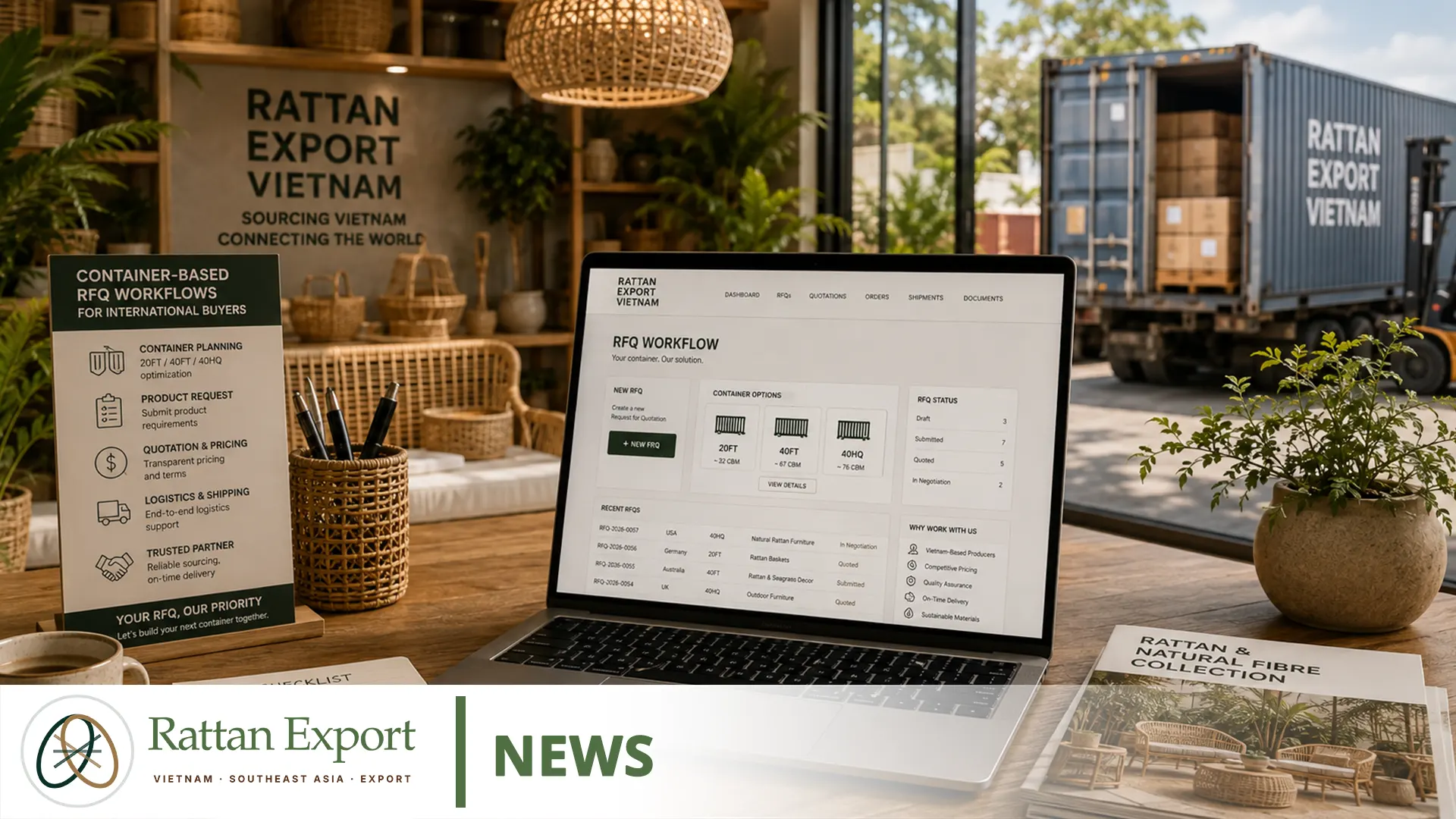
Rattan Export Vietnam has begun building a multilingual B2B sourcing platform designed to connect international buyers with export-ready manufacturers, products and natural-material supply capabilities in Vietnam. The project is being developed for importers, wholesalers, distributors, retail chains, hospitality buyers, project procurement teams and private-label brands that need more than a visual catalogue. Its objective is to turn fragmented supplier information into structured sourcing data that can support product discovery, supplier evaluation, quotation requests, container planning and export discussions across five languages: English, Vietnamese, German, Italian and Spanish.
Why Build a Dedicated Vietnam Sourcing Platform Now?
Vietnam already operates at the scale of a major export economy, while furniture, wood products, bamboo, rattan and handicrafts occupy an important position within its manufacturing base. Preliminary data from the General Department of Customs show that Vietnam recorded approximately US$475.06 billion in total exports in 2025. Within that total, bamboo and rattan products reached about US$900.06 million, while wood and wooden products reached about US$17.20 billion. Natural-material sourcing is therefore part of a large export ecosystem serving global markets.
| 2025 Vietnam Export Indicator | Reported Value | Buyer Relevance |
|---|---|---|
| Total merchandise exports | Approx. US$475.06 billion | Shows the scale of Vietnam's export infrastructure |
| Bamboo and rattan products | Approx. US$900.06 million | Confirms established international demand |
| Wood and wooden products | Approx. US$17.20 billion | Highlights depth in furniture and wood-processing supply chains |
The Ministry of Industry and Trade also reported that forestry-product exports exceeded US$8.2 billion in the first half of 2025, with wood and wood products accounting for about 67.3% of that value. The United States represented roughly 55.6% of Vietnam's wood and wood-product export value during the period. Vietnam's international visibility is also growing: at High Point Market 2025 in the United States, the national pavilion brought together more than 20 Vietnamese exporters in furniture, wooden products, handicrafts, bamboo, rattan and interior décor.
The Real Problem Is Product Qualification
Global buyers can already find thousands of product images through supplier websites and trade portals. The difficult work starts after discovery. A professional buyer needs to know who manufactures an item, its primary and secondary materials, whether specifications are consistent, what order quantity is commercially realistic, how products can be consolidated into a container and whether the supplier can support repeat production. Rattan Export Vietnam is being built around these procurement questions rather than retail-style browsing.
- Supplier transparency: products remain linked to their actual supplier or manufacturer instead of anonymous inventory.
- Structured material data: rattan, bamboo, seagrass, water hyacinth, jute, wood, lacquer, fabric, metal and other materials can be classified more precisely.
- Multilingual product intelligence: buyers can review localized information in EN, VI, DE, IT and ES while the underlying product identity stays consistent.
- Container-oriented sourcing: the platform is designed for wholesale quantities, including 20ft, 40ft and 40HQ container programs, not single-piece retail orders.
- RFQ workflow: buyers can move from discovery toward specification, quantity, packaging, destination and quotation discussions in a structured way.
Five Languages, One Product Identity
Multilingual sourcing is more complicated than translating a title. Measurements, material names, packaging terms, commercial conditions and compliance language must remain consistent. The platform is therefore being developed around a shared product record with localized content layers. An importer reading a product in German and a supplier-side team reviewing the same item in Vietnamese should still be discussing the same supplier reference and technical identity.
| Buyer Need | Platform Direction |
|---|---|
| Search by product type or material | Normalized categories, collections and material classifications |
| Know who makes the product | Supplier-linked records and manufacturer attribution |
| Compare information across languages | Five-language content tied to one master product identity |
| Plan commercial quantities | Container-based sourcing and RFQ workflow |
| Prepare compliance discussions | Structured supplier, material and product records |
Natural Materials Need Better Data
The natural-material sector is vulnerable to vague descriptions. A basket described simply as “rattan” may actually combine rattan, bamboo, seagrass, water hyacinth, paper cord, metal framing, fabric lining or leather accessories. That distinction can affect costing, durability, specifications, customs classification and regulatory review. The platform is being developed to separate primary materials from secondary or accessory materials instead of treating every material mentioned on a supplier page as equally important.
This also reflects the wider shift toward traceability and sustainability. Vietnam's Ministry of Industry and Trade has described bamboo and rattan as abundant domestic resources with growing appeal in European markets. For product groups containing wood or other regulated commodities, European buyers are also preparing for stricter due-diligence requirements under the EU Deforestation Regulation. The European Commission states that the EUDR covers wood and certain derived products and requires relevant operators to demonstrate that covered goods are deforestation-free and legally produced. A sourcing platform cannot replace legal due diligence, but structured supplier and material data can make that process more efficient.
Built for Importers, Wholesalers and Project Buyers
Rattan Export Vietnam is not being designed as a consumer marketplace. Its focus is B2B sourcing for buyers that need repeatable supply, factory communication, export packaging, mixed-product planning, private-label discussions or container purchasing. This includes furniture importers, home-decor distributors, retailers, hotel and resort procurement teams, architects, project buyers and brands developing natural-material collections.
Development is being approached in phases: product and supplier records first; multilingual content, category and material normalization next; sourcing tools, RFQ handling and buyer workflows on top. This is deliberately different from publishing a large catalogue first and repairing product identities later. For professional procurement, data quality is part of the product.
From Product Search to a Commercial Sourcing Brief
The goal is to help buyers move from a broad question such as “Who can manufacture this in Vietnam?” toward a usable sourcing brief covering product type, material composition, target quantity, container strategy, packaging requirement, destination market, supplier capability and quotation scope. That reduces unnecessary back-and-forth and helps buyers and manufacturers focus on commercially viable opportunities.
Companies evaluating Vietnam for rattan furniture sourcing, bamboo products, woven baskets, natural-fibre home décor, lighting, accessories or mixed-container programs can explore the developing product catalogue or send a structured request through the wholesale inquiry channel.
Sources and Data References
- General Department of Customs of Vietnam, preliminary 2025 export statistics published 7 January 2026.
- Vietnam Ministry of Industry and Trade, 2025 wood-industry export and market reporting.
- Vietnam Ministry of Industry and Trade, Vietnam National Pavilion at High Point Market 2025.
- European Commission, Regulation on Deforestation-free Products.