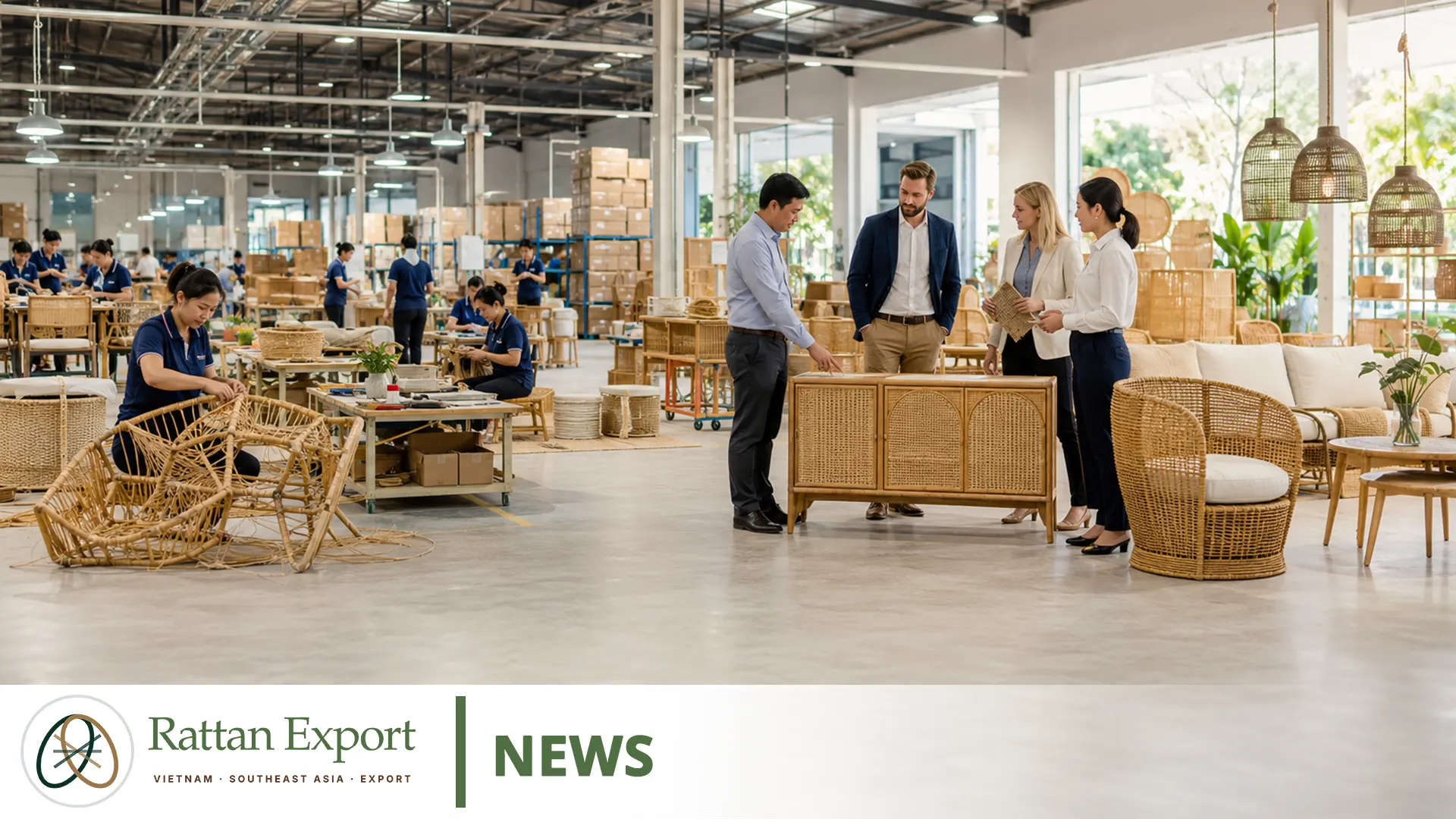
Vietnam’s furniture manufacturing sector is accelerating a strategic shift from pure OEM production toward more design-led ODM capabilities in 2026, giving international buyers access not only to factories that can manufacture a specification, but increasingly to suppliers that can help create the product itself. The change does not mean that Original Equipment Manufacturing is disappearing. OEM remains a major strength of Vietnam’s export furniture industry. What is changing is the value proposition offered by a growing group of manufacturers: in-house design teams, ready-developed collections, material engineering, prototype development, customization and product concepts that buyers can adapt for their own markets. For importers, wholesalers, retail chains, hospitality groups and private-label brands, this development can reduce product-development time while opening a different type of supplier relationship.
From “Made in Vietnam” to “Made by Vietnam”
The direction was visible throughout HawaExpo 2026 in Ho Chi Minh City. Official HawaExpo materials described the furniture industry’s evolution from OEM toward design-led ODM, while the event’s post-show report identified a broader strategic ambition to elevate the sector from “Made in Vietnam” to “Made by Vietnam.” The distinction is commercially important. Under a traditional OEM relationship, the buyer generally owns the product concept and provides drawings, specifications or reference products. The factory’s primary responsibility is manufacturing them accurately, efficiently and at the required scale. Under ODM, the supplier contributes substantially more to the development process, potentially creating the design, engineering the construction, selecting materials, producing prototypes and preparing a product or collection that can later be customized for the buyer.
| Capability | Traditional OEM | Design-Led ODM |
|---|---|---|
| Product concept | Primarily supplied by buyer | Supplier can originate or co-develop concept |
| Design resources | Buyer-led | In-house or supplier-supported design team |
| Engineering | Manufacture to provided specifications | Design adapted for manufacturability, cost and logistics |
| Material selection | Usually buyer specified | Supplier can recommend alternatives and combinations |
| Prototype development | Based on buyer design | Can begin from supplier concept or buyer brief |
| Time to market | Depends heavily on buyer R&D | Can be shortened using existing supplier collections |
| Buyer differentiation | Created mainly by buyer | Can be co-created with supplier |
Why Vietnam’s Manufacturers Want to Move Up the Value Chain
The commercial logic behind the shift is straightforward. Manufacturing only to another company’s drawing captures a narrower part of the final product value. Design, engineering, collection development, intellectual property, merchandising and branding sit further up the value chain. Vietnamese manufacturers that develop these capabilities can compete on more than labour, production capacity and FOB price.
This matters in an industry already operating at significant export scale. HawaExpo’s official 2026 report cited approximately US$17.2 billion in Vietnamese exports of wood and wood products during 2025. At HawaExpo 2026 itself, 16,449 buyers and visitors were recorded, including 3,284 international buyers from 83 countries and territories. The event also dedicated significant programming to design, including the Furniture Forum 2026 under the theme “Asia Rising – Design Leading,” the “Asia Design, Global Voice” design programme and a technical session focused on standardizing design, production and management processes.
These are useful indicators of where the industry wants to compete next. Production scale remains essential, but manufacturers increasingly need to demonstrate that they can interpret market trends, develop products, manage mixed materials and create collections suitable for North American, European, Australian, Asian and hospitality markets.
ODM Does Not Mean One Standard Business Model
For buyers, it is important not to treat “ODM” as a certification. Two suppliers can both describe themselves as ODM manufacturers while offering very different capabilities. One may maintain a substantial internal design and engineering department capable of developing complete collections. Another may simply modify existing models, change dimensions or select a different finish. Both can be useful, but they are not commercially equivalent.
- Basic customization: changing dimensions, colors, fabrics, finishes or hardware on an existing product.
- Adapted ODM: modifying an existing supplier-developed design for a particular retailer or market.
- Co-development: buyer and manufacturer jointly develop the product from a brief, target price and design direction.
- Full ODM: supplier develops the concept, design, engineering, prototype and manufacturing package before presenting the collection to buyers.
- Private-label ODM: an existing or modified supplier-developed collection is produced under the buyer’s brand.
A professional sourcing team therefore needs to understand exactly where the supplier’s design contribution begins and ends.
ODM Can Shorten Product Development for International Buyers
The strongest commercial argument for ODM is speed. A retailer starting from an empty page may need to brief designers, develop CAD files, engineer joints, source materials, create prototypes, test packaging and complete multiple sample rounds before a product is ready for production. A capable ODM manufacturer may already have commercially viable concepts and engineering solutions that can be adapted rather than developed from zero.
This can be especially useful for buyers managing large assortments. A home-furnishing distributor might need twenty dining SKUs, twelve living-room pieces and several accent products for a seasonal launch. Developing every item independently can consume significant design and sourcing resources. An ODM supplier can potentially present coordinated collections that the buyer then adjusts according to dimensions, finish, upholstery, target price and market positioning.
| Buyer Challenge | Potential ODM Advantage |
|---|---|
| Long product-development cycle | Existing concepts can shorten initial R&D |
| Limited internal furniture engineering | Supplier engineering team can support manufacturability |
| Large seasonal assortment | Coordinated collections can reduce development workload |
| Target price pressure | Design can be engineered around cost from an early stage |
| Container inefficiency | Supplier can integrate nesting or knock-down considerations into design |
| Material substitution | Factory can propose materials available within its supply network |
Design Is Increasingly Connected to Manufacturing Engineering
The most valuable ODM suppliers are not simply styling studios attached to a factory. Furniture intended for international trade must be designed around manufacturing reality. Joint construction, tolerances, moisture movement, structural strength, surface finishing, upholstery, hardware, packing dimensions and assembly all influence whether a concept can become a commercially repeatable product.
Container economics are particularly important. A beautiful chair that cannot stack, nest or ship efficiently can become commercially unattractive even if its factory price is competitive. A table redesigned into a knock-down format may reduce CBM significantly. A woven basket collection can sometimes be engineered so that several sizes nest together. ODM creates an opportunity to include these logistics considerations during design rather than attempting to repair them after the product has already been approved.
Natural Materials Create a Strong Opportunity for Vietnamese ODM
Vietnam has another potential advantage in furniture and décor made from natural and mixed materials. Manufacturers and artisan networks work with combinations that can include rattan, bamboo, seagrass, water hyacinth, jute, wood, lacquer, ceramic, metal, rope, leather and textiles. These materials give designers a larger vocabulary than conventional single-material manufacturing.
A dining chair, for example, might combine an acacia or rubberwood structure with woven rattan cane. A cabinet might use a timber carcass with natural-fibre doors. A lighting collection could combine bamboo frames with woven seagrass or paper. A hospitality collection might use wood, metal, rope and upholstery within the same design language. The commercial opportunity is not merely to substitute one material for another, but to develop distinctive products that use Vietnamese material knowledge and craftsmanship as part of the design identity.
However, mixed-material ODM also requires stronger data discipline. A product marketed visually as “rattan furniture” may contain significant wood, metal or textile components. Buyers need accurate primary and secondary material descriptions for costing, labeling, customs classification, sustainability assessment and repeat-order consistency.
ODM Makes Intellectual Property More Important
Moving from OEM to ODM creates new questions that buyers should resolve before placing orders. If the supplier created the design, who owns the intellectual property? Is the model available to multiple retailers? Can the buyer obtain territorial exclusivity? Is exclusivity tied to a minimum annual purchase? Can the supplier make a visually similar product for another customer? Who owns tooling, drawings and modifications paid for by the buyer?
| ODM Commercial Question | What the Buyer Should Clarify |
|---|---|
| Design ownership | Supplier, buyer or jointly owned? |
| Exclusivity | Global, country-specific, channel-specific or none? |
| Minimum volume | Is exclusivity conditional on annual purchasing? |
| Tooling | Who pays for and owns molds, jigs or special tooling? |
| Design modification | Who owns the modified version? |
| Catalog availability | Can the same base product be offered to other buyers? |
These questions should be addressed commercially and contractually rather than assumed. A strong ODM relationship can create differentiation for the buyer, but only when the rules around designs and market access are clear.
What International Buyers Should Verify Before Selecting an ODM Partner
- Ask to meet the design team. Determine whether design is genuinely performed internally or outsourced only when needed.
- Review development history. Compare sketches, CAD files, prototypes and final commercial products.
- Understand engineering capability. Confirm how designs are converted into repeatable manufacturing specifications.
- Check material knowledge. The supplier should be able to distinguish structural, primary, secondary and decorative materials accurately.
- Discuss target costing. Good ODM development should consider the buyer’s target price from the beginning.
- Review packaging engineering. The design team should understand carton dimensions and container efficiency.
- Clarify IP and exclusivity. Put ownership and market restrictions in writing.
- Evaluate production capacity. Strong design without reliable mass production is not enough.
- Verify compliance capability. Product design must account for requirements of the intended destination market.
OEM Will Remain Important
The move toward ODM should not be interpreted as an abandonment of OEM. Many of the world’s largest furniture buyers deliberately control design themselves and require factories to execute detailed specifications without changing them. For those companies, Vietnam’s OEM capability remains extremely valuable. In fact, many strong manufacturers will operate both models simultaneously: OEM for customers with established product-development departments and ODM for buyers that want greater supplier participation.
The more meaningful change in 2026 is therefore not “OEM versus ODM.” It is that buyers have a wider choice of partnership models. A Vietnamese manufacturer may now be able to receive a finished drawing, modify an existing collection, co-develop a concept or originate an entirely new product depending on the buyer’s requirements.
A New Sourcing Question: Who Can Help Create the Product?
For many years, one of the central sourcing questions in Vietnam was simply, “Who can manufacture this product?” As ODM capability expands, another question becomes relevant: “Which manufacturer can help us develop the right product for our market?”
That changes supplier evaluation. Factory size and FOB price remain important, but design talent, material knowledge, engineering, sample speed, communication, intellectual-property discipline, packaging capability and understanding of the buyer’s target market become part of the sourcing decision.
What This Means for Rattan Export Vietnam Buyers
The transition toward more design-led manufacturing is especially relevant to the sourcing model being developed by Rattan Export Vietnam. Our buyers are not limited to companies searching for a specific existing SKU. Importers, wholesalers, distributors, hospitality groups and private-label brands may also need factories capable of modifying products, developing collections, combining natural materials or creating exclusive programmes.
That is why effective B2B sourcing requires more than a product photograph. Buyers need to understand which products and collections already exist, which supplier actually manufactures them, what materials are used, whether customization is available, what quantities are commercially realistic and whether the manufacturer operates primarily as OEM, ODM or both. They also need to evaluate quality and compliance alongside design capability and understand how the proposed product will move through Vietnam’s export supply chain.
Companies developing rattan furniture, bamboo products, woven collections, natural-material home décor, lighting, furniture or mixed-material programmes can submit a structured brief through the wholesale inquiry. As Vietnam moves further from manufacturing capacity alone toward design-led value creation, the strongest sourcing relationships will increasingly be those in which buyer and manufacturer understand not only how to make a product, but how to make the right product commercially viable.
Sources and Data References
- HawaExpo 2026 Official Post Show Report.
- HawaExpo 2026 official furniture-manufacturing, design and ODM industry materials.
- HawaExpo Furniture Forum 2026: Asia Rising – Design Leading.
- Vietnam Ministry of Industry and Trade, HawaExpo 2026 international business-matching and furniture-industry cooperation reporting.