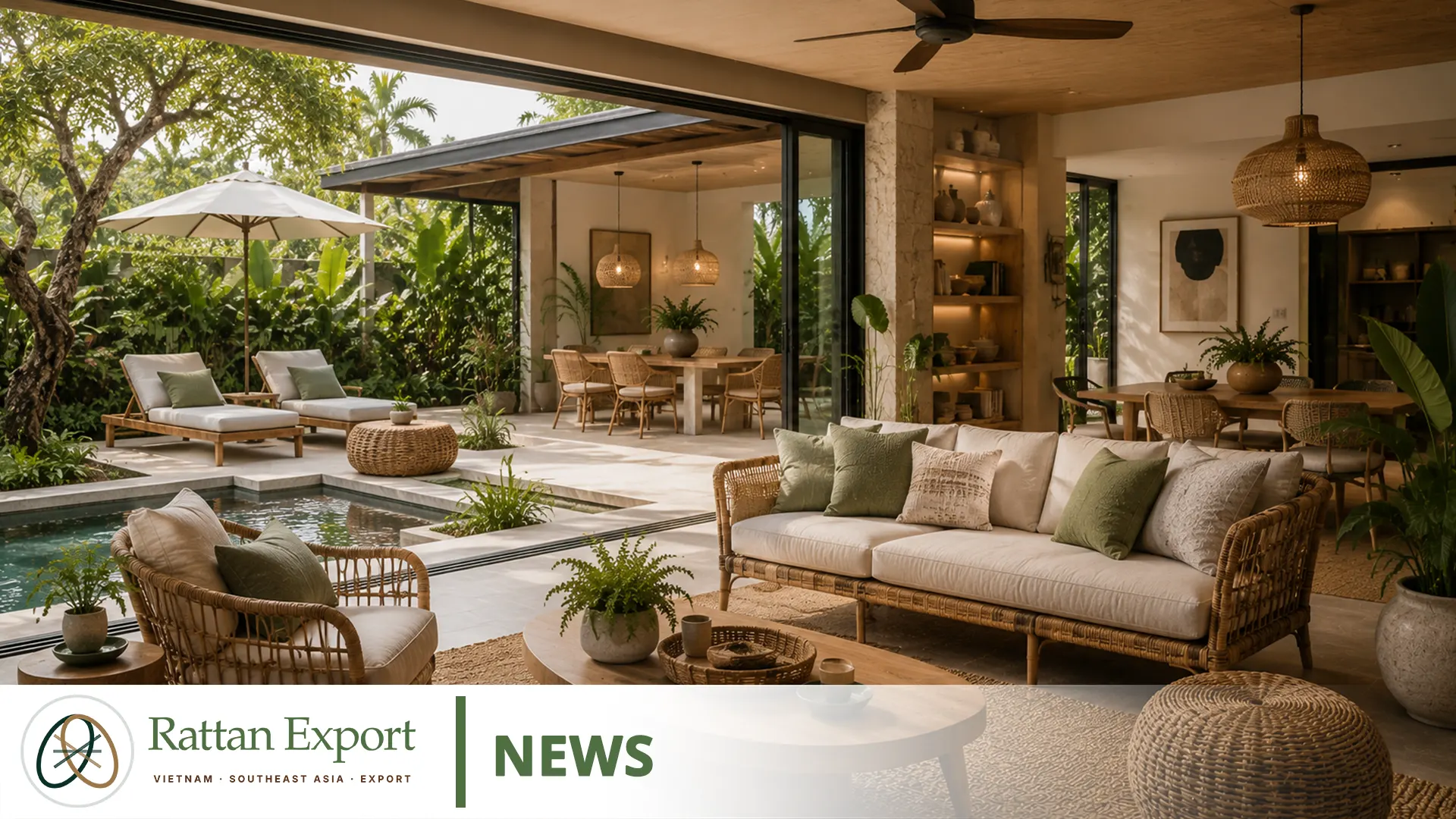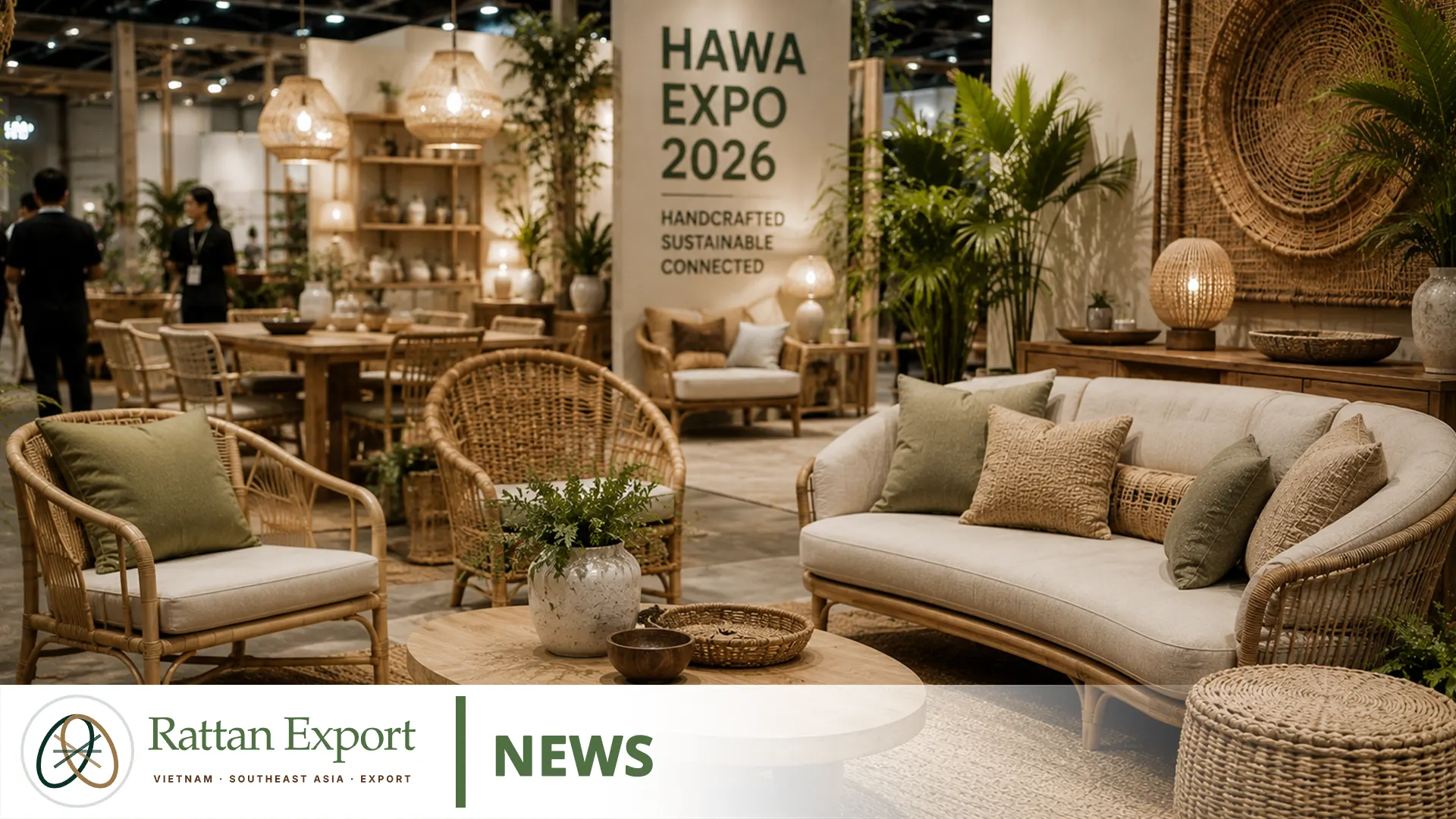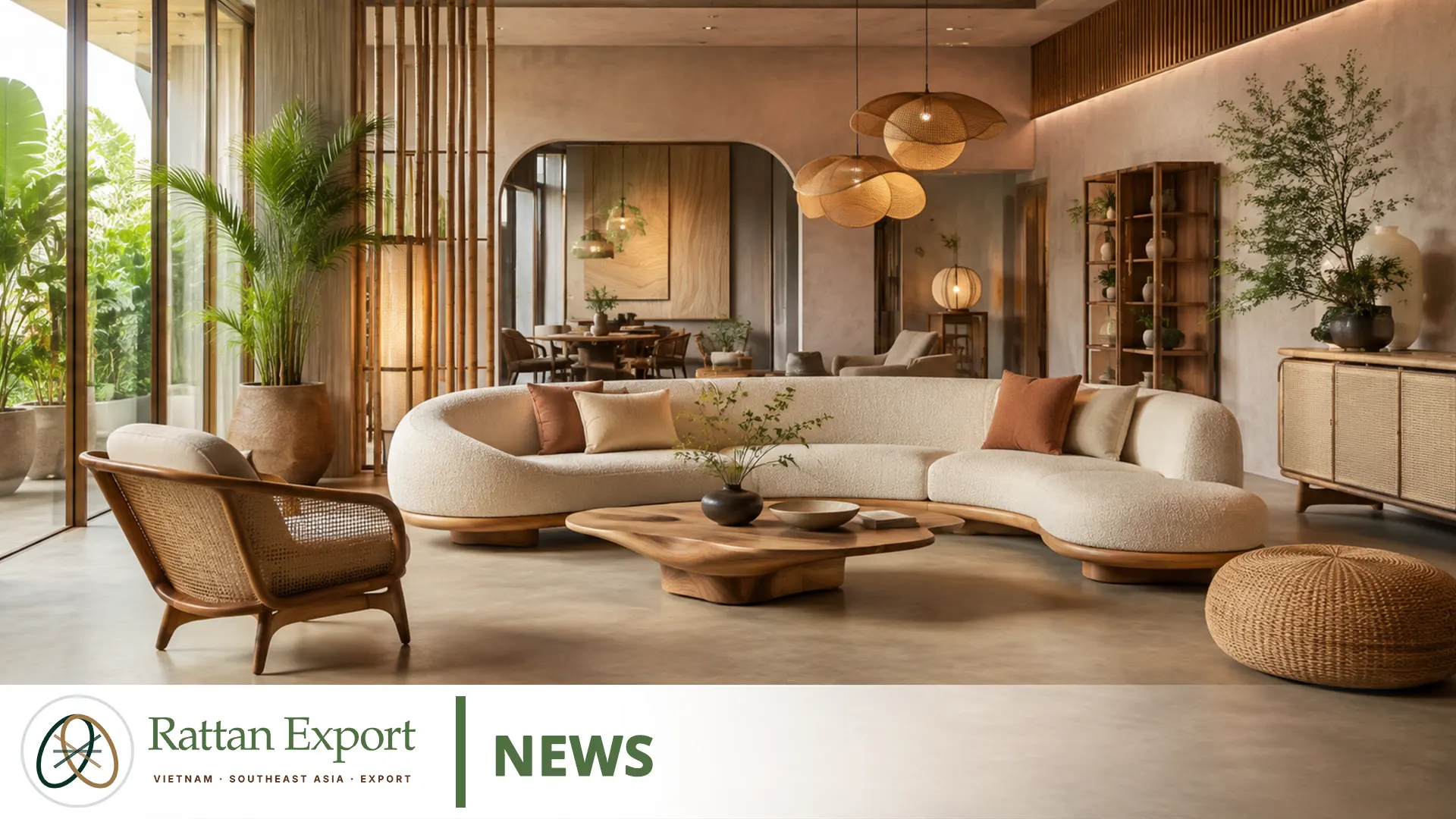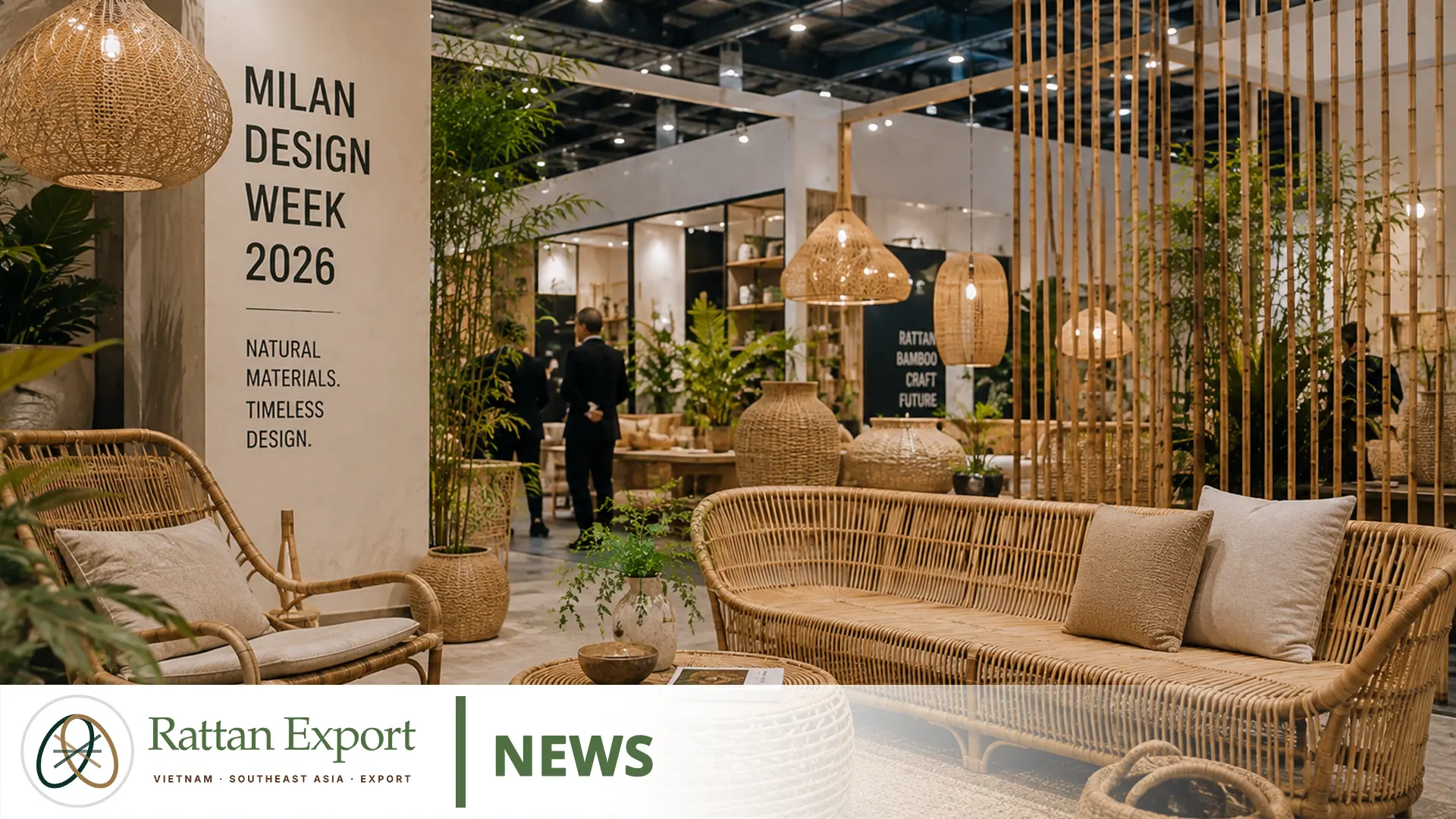
Milan Design Week 2026 brought weaving, rattan and bamboo back into the international design spotlight, but not as a simple revival of rustic furniture or nostalgic craft. Across Salone del Mobile and the wider city programme, weaving appeared increasingly as structure, material logic and contemporary design language. Rattan and cane moved from familiar veranda associations into refined indoor furniture, while bamboo appeared in lighting, installations and material experimentation. The shift matters for Vietnam because the country already combines industrial furniture manufacturing with long-established skills in rattan, bamboo and natural-fibre craftsmanship. For international buyers, Milan's message is therefore less about copying a particular Italian trend and more about recognising a wider opportunity: traditional material knowledge can be translated into contemporary, scalable and commercially relevant furniture.
Weaving Moved From Decoration Toward Structure
One of the clearest post-show observations from Milan Design Week was the growing use of weaving as more than surface decoration. Architectural Digest's global editors described weaving as a structural design approach capable of combining softness with support, openness with enclosure and different materials through visible systems of connection.
Loro Piana explored traditional textile and weaving knowledge through its “Studies, Chapter I: On the Plaid” presentation. Edra's Dilly lamp by Jacopo Foggini created another form of interlacing using hand-shaped polycarbonate, while projects at Alcova used rope, textile and lightweight structural elements in furniture. The important point was not that every object was made from rattan. Rather, the logic of weaving itself became part of how products and spaces were constructed.
This distinction is highly relevant to natural-fibre furniture. A woven surface can be decorative, semi-structural or genuinely load-bearing. Those three uses require different engineering, quality-control and material specifications.
| Use of Weaving | Typical Function | Buyer Consideration |
|---|---|---|
| Decorative | Cabinet panels, screens, accents | Appearance, colour, pattern consistency |
| Semi-structural | Chair backs, headboards, side panels | Tension, fixing method and repeated loading |
| Structural | Seat surfaces, shells or supporting elements | Strength, elongation, frame interaction and testing |
| Spatial | Partitions, installations and architectural elements | Fire, stability, fixing and project requirements |
Rattan and Cane Are Moving Beyond the Veranda
Milan also showed a notable change in where woven natural-material aesthetics are being used. Rattan and cane have long been associated with terraces, conservatories, resorts and informal 1970s furniture. In 2026, designers brought that language deeper into polished residential interiors.
Architectural Digest highlighted Minotti's Elas family with a wicker shell, Gervasoni's use of rattan in both the reissued R 513 armchair and the new Santé chair, and Poliform's Auguste chair combining metal with straw rope. B&B Italia reinterpreted the visual language of the garden cane chair using woven cork, demonstrating that the weaving idea can travel across materials as well as product categories.
The commercial implication is important. Buyers may increasingly request the warmth and visual permeability associated with rattan without necessarily asking for an entirely traditional rattan product. A timber cabinet can use cane doors. A metal chair can use a woven back. A contemporary headboard can introduce a fibre panel. Natural material becomes one element of a broader product architecture.
Bamboo Reappeared in Lighting, Surfaces and Installations
Bamboo also gained visibility during the week. Some projects used the actual material, while others translated the visual or structural memory of bamboo weaving into different media.
Dior Maison provided one of the clearest examples. For Salone del Mobile 2026, the house presented lighting that celebrated basketry and the traditional weaving of plant fibres. One model was made from madake bamboo and handmade by master artisans in Kyoto. Individual canes were split and refined into regular strips before being woven into a structured pattern.
Dior's Milan environment also included a scenography by Thai artists Korakot Aromdee and Vasana Saima that used rattan and bamboo to reinterpret the gardens associated with Christian Dior's childhood home. Elsewhere during Design Week, bamboo appeared in lighting concepts and as inspiration for ceramic and surface patterns.
For manufacturers, this shows how bamboo can move beyond the familiar idea of a simple bamboo chair. The material can enter lighting, screens, decorative structures, accessory collections and mixed-material interiors while its weaving logic can influence products made from completely different materials.
Craftsmanship Was One of SaloneSatellite's Central Messages
The wider return to making by hand was not limited to established luxury brands. SaloneSatellite 2026 explicitly placed craftsmanship back at the centre of its programme. The platform presented more than 700 young designers under 35 together with students selected through 22 international design schools and universities representing 39 countries.
The organisers described a hybrid form of craftsmanship capable of working with technology and entering high-end production without losing expressive power. This is commercially important because it moves the craft conversation away from a false choice between handmade and industrial production.
For Vietnam, that is particularly relevant. International B2B orders require repeatability, lead-time control and scalable output, but buyers can still value visible handwork. The objective is not to transform every woven product into a one-off art piece. It is to create systems in which craftsmanship adds material identity while production management protects consistency.
The New Weaving Trend Is Not Simply a Return to Rustic Design
A mistake for suppliers would be to read Milan as a signal that traditional rustic rattan furniture is automatically back in fashion. The more important development is refinement. Woven materials are being combined with precise metal frames, controlled upholstery, sculptural geometry, sophisticated timber finishes and highly considered interiors.
The 2026 trend therefore rewards suppliers capable of translating craft into contemporary proportions. Heavy ornamental weaving may be replaced by lighter panels. A traditional basket pattern may become the logic for a cabinet door. Bamboo construction may be reduced to a carefully engineered lighting structure. Rattan can be paired with dark wood, brushed metal or neutral textile rather than used as the only material in the product.
This creates strong ODM potential because manufacturers can start with existing material knowledge and reinterpret it for a different visual market.
Rattan, Cane and Wicker Should Not Be Used as Interchangeable Material Names
As woven aesthetics become more commercially important, accurate terminology becomes more important too. Rattan is a climbing palm and can be used in different forms, including structural poles, peeled material and core. Cane commonly refers to the peeled outer layer of rattan used in finer weaving. “Wicker” describes a weaving technique or woven product rather than a single botanical material.
A wicker chair may therefore be made from rattan, willow, synthetic fibre or another flexible material. A catalogue that lists every woven product simply as “rattan” can create problems for pricing, customs information, care instructions and buyer expectations.
Vietnamese suppliers serving professional buyers should identify both the actual material and its role within the product.
Vietnam Has a Natural Manufacturing Advantage in This Direction
Vietnam's advantage comes from the coexistence of several production ecosystems. Furniture factories work with timber, metal, upholstery and engineered panels, while craft villages and specialised manufacturers retain expertise in rattan, bamboo, seagrass, water hyacinth, lacquer and hand weaving.
That combination makes mixed-material development particularly interesting. A furniture factory does not need to become a traditional basket workshop, and a weaving producer does not need to manufacture every structural component. A coordinated supplier network can combine specialised capabilities inside one export programme.
Examples can include a powder-coated steel frame with a woven rattan back, a plantation-wood cabinet with cane doors, a bamboo lighting collection paired with ceramic components, or a hospitality programme combining timber furniture with woven accessories and screens.
Weaving as Structure Requires Better Engineering
When woven material becomes functional rather than decorative, engineering becomes critical. A seat made from woven fibre must manage human load, long-term elongation and repeated movement. A backrest needs enough controlled flexibility for comfort without losing shape. The frame must distribute tension without cutting or damaging the fibre.
Manufacturers therefore need to define fibre dimensions, spacing, weave pattern, pre-tension, fixing method and allowable deflection. The same visual pattern can perform very differently when executed with another species, thickness or moisture level.
Traditional artisan knowledge remains valuable here because experienced weavers understand how fibres behave under tension. For international mass production, however, that tacit knowledge needs to be translated into repeatable specifications.
Moisture Control Is Essential for Natural Fibre
Rattan, bamboo, seagrass and other biological materials respond to humidity. Excess moisture can contribute to mould, staining or dimensional change, while excessive drying can make some fibres brittle. Export shipments add another challenge because products may remain inside containers for weeks while temperature and humidity conditions change dramatically.
Professional sourcing should therefore consider material drying, storage conditions, finishing, carton moisture, desiccant strategy and container loading conditions together. A product that looks perfect during factory inspection can still arrive with problems if moisture management was poor before shipment.
Natural-material sourcing cannot be reduced to appearance alone.
Handmade Variation Must Be Defined Before Mass Production
Weaving inherently contains a degree of variation. Fibre colour, diameter and curvature may differ naturally. Hand tension can create small differences in spacing. Those characteristics can contribute to the product's appeal, but unlimited variation is not acceptable in a commercial order.
| Characteristic | Acceptable Natural Variation | Potential Defect |
|---|---|---|
| Fibre tone | Variation within approved colour range | Strong uncontrolled mismatch |
| Spacing | Minor handmade difference | Visible distortion or inconsistent pattern |
| Tension | Small tactile variation | Loose seat or sagging backrest |
| Fibre surface | Natural texture | Splits, sharp ends or broken fibres |
| Frame interface | Controlled handcrafted fitting | Movement, abrasion or exposed fixing |
Golden samples, weaving diagrams, dimensional checkpoints and approved tolerance ranges make it possible to preserve hand character while maintaining B2B consistency.
Bamboo Requires Its Own Product Logic
Bamboo should also not be treated simply as another version of timber. Culm diameter, wall thickness, maturity, node position, drying and treatment influence how the material performs. Splitting bamboo into strips for weaving creates a different technical material from using full or laminated bamboo components.
The Dior basketry example is useful precisely because the making process was part of the design: bamboo was selected for flexibility, split and refined before weaving. That sequence illustrates how material preparation can be inseparable from final appearance.
Vietnamese manufacturers developing bamboo products should therefore document not only “bamboo” as a material name but also the form of bamboo being used and its function within the SKU.
Natural Does Not Automatically Mean Sustainable
Milan's renewed enthusiasm for rattan, bamboo and craft should not encourage vague environmental claims. A biological material can be renewable while still presenting sourcing, treatment, transport or durability questions. A synthetic material can sometimes offer longer service life in a demanding outdoor application.
Buyers should ask where materials come from, how they are processed, what treatments are used, how durable the finished product is and what evidence supports environmental claims. Certification and traceability should be evaluated according to the actual material and destination market.
The strongest commercial position is accurate material transparency rather than assuming that a woven or plant-based appearance proves sustainability.
Indoor and Outdoor Applications Need Different Material Decisions
Milan also highlighted the movement of outdoor aesthetics into indoor furniture. That does not mean natural rattan and synthetic outdoor weaving are interchangeable.
Natural rattan can perform beautifully indoors and in appropriate covered environments, but permanent exposure to rain, strong ultraviolet radiation and large humidity changes can require a different material strategy. Synthetic outdoor fibres over aluminium or other suitable frames may be preferable for some fully exposed applications.
Suppliers should therefore describe products according to intended use instead of relying on a broad “indoor/outdoor” label without supporting specifications.
Woven Forms Can Create Container-Loading Challenges
Curved woven shells and fully assembled fibre furniture can consume significant CBM because they often leave unused space inside cartons. At the same time, excessive pressure during nesting can deform weaving or mark natural fibres.
Design and logistics therefore need to be developed together. Removable legs, separate bases, stackable frame geometries or protected nesting can improve 20ft, 40ft and 40HQ loading without compromising the visual quality of the product.
Bamboo lighting and fragile woven accessories introduce different challenges: they may be lightweight but occupy substantial volume and require protection against crushing.
Hospitality Can Be a Strong Market for Contemporary Weaving
Hotels, resorts, restaurants and project interiors offer a natural commercial environment for this design direction because texture and material identity can contribute strongly to the guest experience. Woven headboards, screens, lounge-chair backs, lighting and decorative panels can create warmth without requiring an entire room to be designed in a traditional style.
Hospitality buyers should nevertheless evaluate repairability, cleaning, replacement components and repeat-order consistency. A woven chair used hundreds of times per week needs a different technical specification from a decorative chair in a residential bedroom.
For project work, craftsmanship must be supported by contract-level performance.
What International Buyers Should Ask Suppliers
- What is the exact woven material: rattan, cane, bamboo, seagrass, rope or synthetic fibre?
- Is the woven element decorative, semi-structural or load-bearing?
- How is fibre diameter and quality graded?
- How is moisture controlled before packing?
- What treatments or coatings are applied?
- How is weave tension defined and inspected?
- Can a damaged woven panel be replaced independently?
- What natural colour variation is acceptable?
- Is the product intended for indoor, covered outdoor or fully exposed use?
- How are woven components protected during ocean shipment?
- What are the final packed dimensions and CBM?
- Can the design be nested or partially knocked down without deforming the weave?
- Can the supplier reproduce the same weave and material character for repeat orders?
- Which environmental or certification claims can actually be documented?
What This Means for Rattan Export Vietnam Buyers
Milan Design Week 2026 reinforces a direction that is highly relevant to the sourcing model being developed by Rattan Export Vietnam. Rattan, bamboo and other natural fibres are becoming more useful to international design programmes when they are treated not simply as catalogue categories but as materials with specific structural, decorative and manufacturing roles.
Our developing product catalogue is structured around supplier-linked products and clearer classification across rattan, bamboo, seagrass, water hyacinth, jute, wood, metal, fabric, lacquer and mixed-material construction. Buyers can also review our approach to quality and compliance, learn more about Vietnam sourcing and export, or submit references, materials, quantities, destination markets and 20ft, 40ft or 40HQ requirements through the wholesale inquiry.
The important lesson from Milan is not that designers have suddenly rediscovered a forgotten material. Rattan, bamboo and weaving never disappeared. What changed in 2026 is their position within contemporary design: weaving is being considered as structure, craft is being integrated with high-end production and materials once strongly associated with informal or outdoor settings are entering more refined interiors. For Vietnamese suppliers, the opportunity is to translate established craft knowledge into controlled, contemporary and export-ready products. For buyers, the challenge is to evaluate that craftsmanship with the same technical discipline applied to any other engineered furniture component.
Sources and Data References
- Salone del Mobile.Milano, official 2026 exhibition programme, 21–26 April 2026.
- Architectural Digest, “Milan Design Week 2026: 9 Design Trends Spotted by Global AD Editors”, 28 April 2026.
- Dior Maison, official Salone del Mobile 2026 presentation and bamboo basketry documentation.
- Salone del Mobile.Milano, “SaloneSatellite 2026: craftsmanship at the heart of the 27th edition”.
- AD Middle East, Milan Design Week 2026 outdoor furniture review, 21 April 2026.