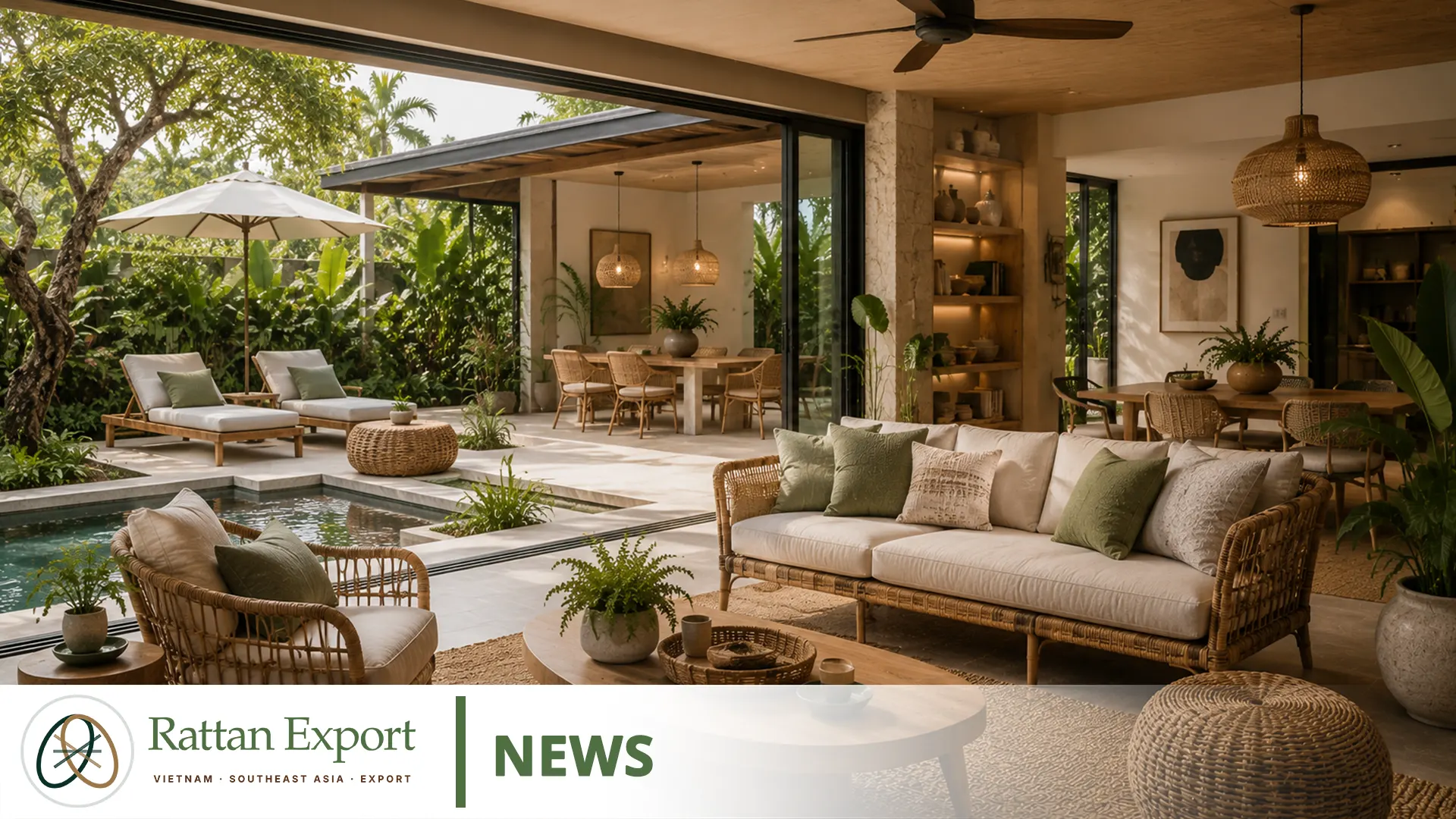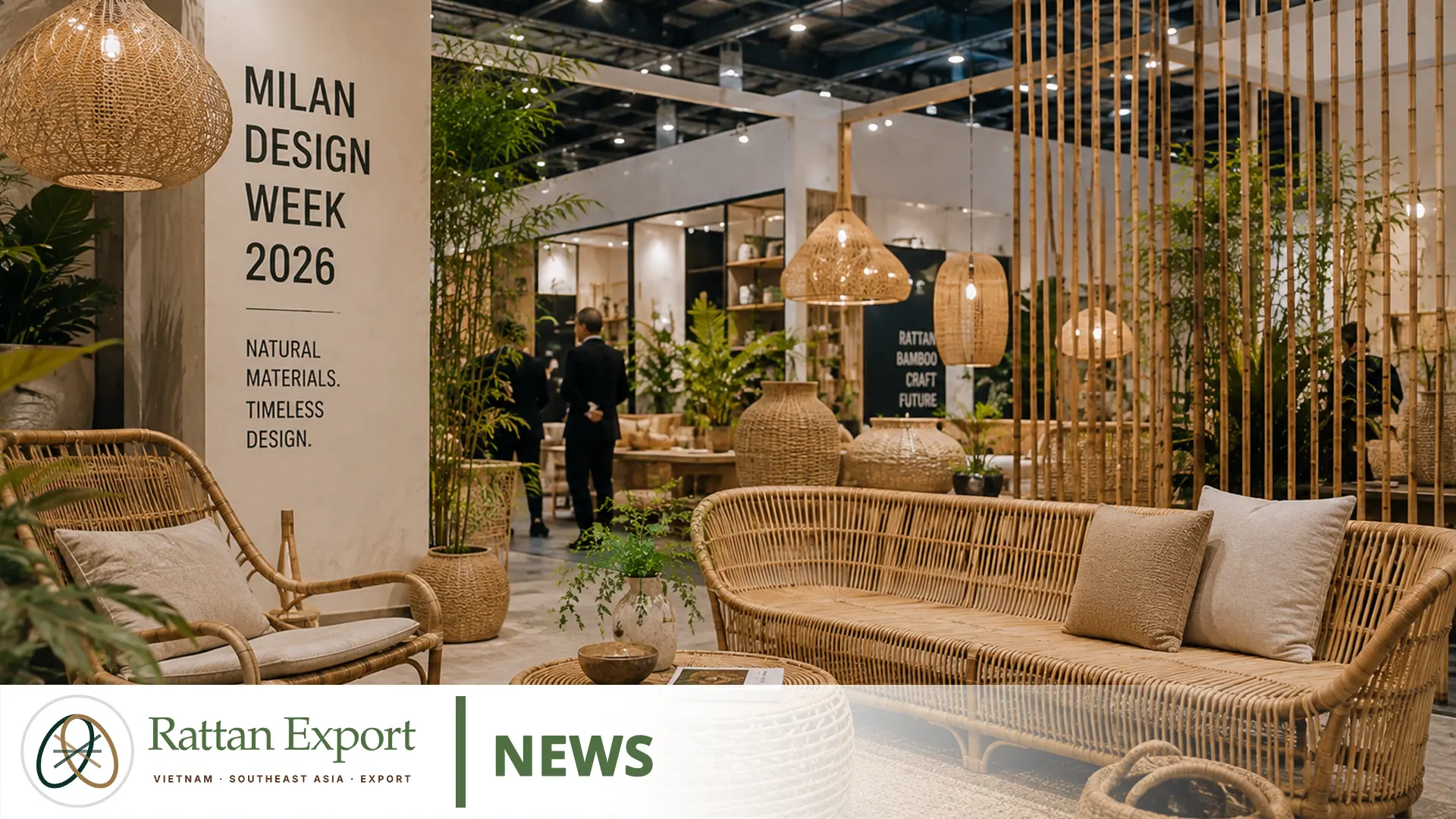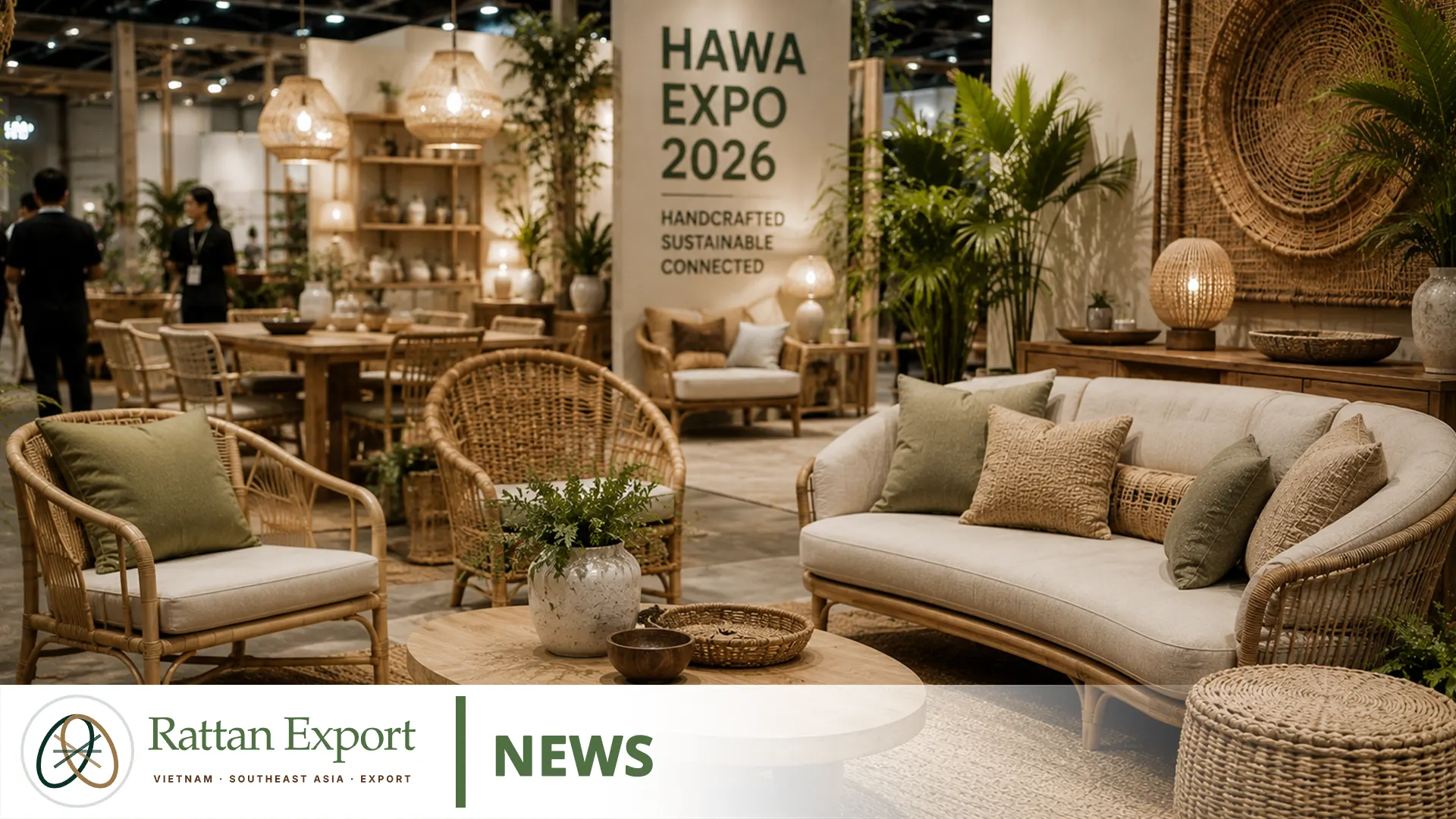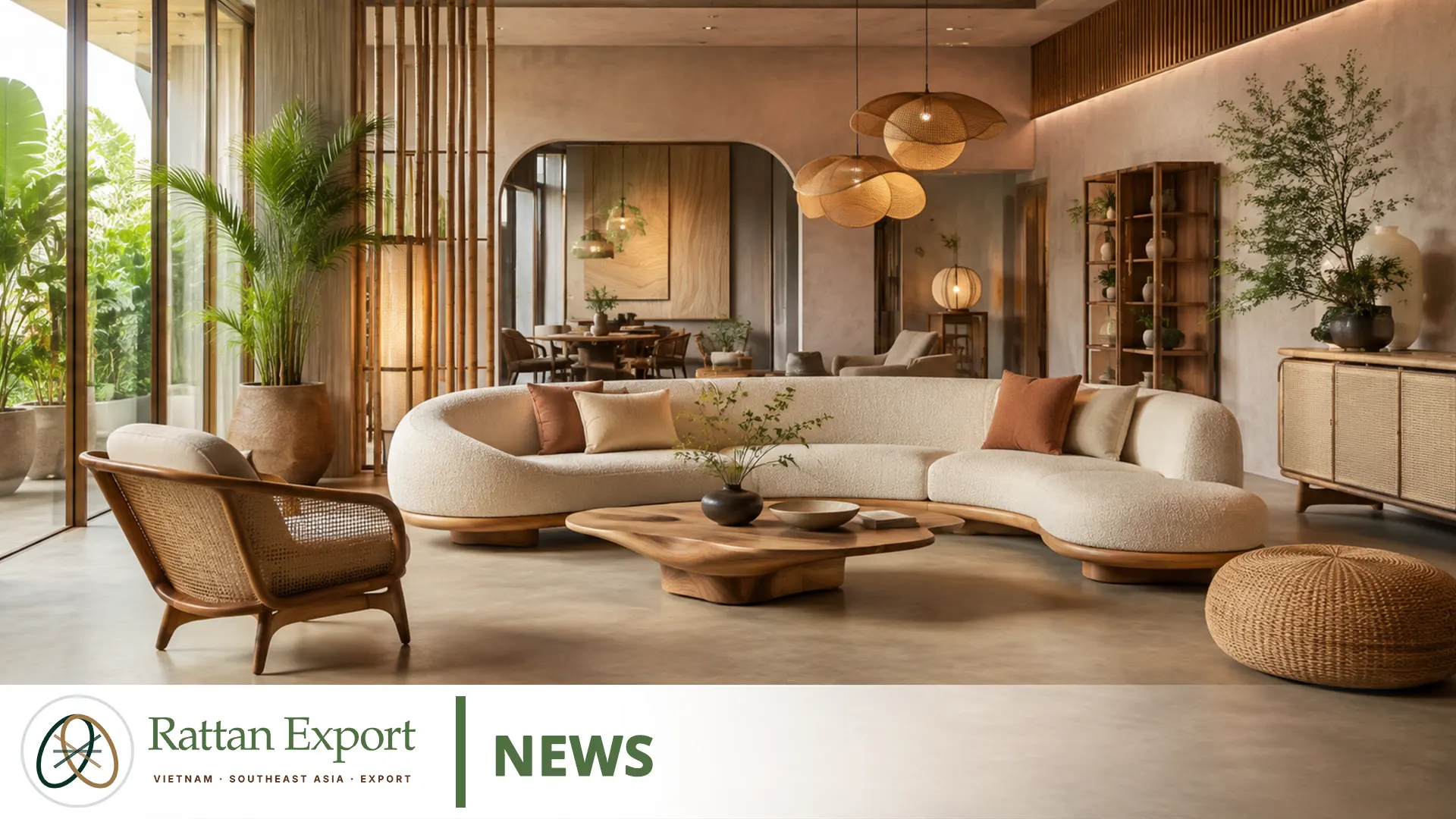
Organic modernism is emerging as an influential design direction for Vietnam’s furniture industry in 2026, bringing together cleaner contemporary forms, softer curves, natural materials, tactile surfaces and increasingly sophisticated mixed-material construction. The direction is particularly relevant as Vietnamese manufacturers move beyond conventional OEM production toward more design-led ODM collections for international buyers. Ahead of HawaExpo 2026, the organiser identified organic modernism as a key bedroom-furniture direction, describing a move away from sharp edges toward softer curved lines, rounded solid-wood forms and combinations of oak or walnut with bouclé and linen upholstery. At the same time, Vietnamese suppliers are expanding combinations of rattan, cane, plantation wood, metal, ceramics, natural fibres and engineered materials, giving the country a manufacturing base particularly well suited to this warmer form of modern design.
Organic Modernism Is Modern Design With More Warmth
Organic modernism should not be understood as the rejection of modern furniture. It is better understood as a softer version of it. The visual discipline of contemporary design remains: relatively clean silhouettes, controlled proportions, limited ornamentation and functional construction. What changes is the emotional and material character. Hard rectangular geometry is softened by curves. Perfectly uniform surfaces are balanced by wood grain, woven fibre, stone texture or visible hand finishing. Neutral spaces gain depth through material rather than excessive decoration.
For product development, the result can be a cabinet with a restrained rectangular body but rounded corners and a rattan-cane door panel; a timber bed with an upholstered curved headboard; a dining table with a simple plantation-wood top carried by sculptural legs; or a lounge chair combining a clean wood frame with woven natural fibre and textured upholstery.
Vietnam’s 2026 Furniture Pipeline Already Shows the Direction
HawaExpo’s 25 February preview of Vietnamese bedroom suppliers explicitly identifies organic modernism among the design shifts expected in 2026. It points to softer and curved bed frames and nightstands, rounded corners in solid woods such as oak and walnut, and combinations with bouclé or linen. The same preview highlights mixed-media furniture combining natural rattan or cane webbing with darker wood finishes and metal accents.
This matters because the trend is appearing within an export-production context rather than only in interior-design imagery. Vietnamese factories represented in the HawaExpo sourcing programme include manufacturers with wood, metal and upholstery capabilities under the same production organisation, making complex mixed-material collections commercially feasible at scale.
Natural Materials Give Vietnam a Strong Starting Position
Vietnam already works with many of the materials that fit naturally into this design language. Plantation woods such as acacia and rubberwood are important to the country’s export manufacturing base. Other suppliers work with oak, ash and walnut for higher-value collections, while engineered materials including plywood and MDF support consistent production and efficient construction.
Beyond wood, Vietnam has deep manufacturing and craft capabilities in rattan, bamboo, seagrass, water hyacinth, rope, ceramics and lacquer. HawaExpo’s home-accessories and handicraft previews for 2026 show suppliers combining these materials rather than keeping them inside isolated craft categories. Natural fibres are being used with lighting and ceramics; wooden production is being connected with woven handicrafts; traditional lacquer is being applied to contemporary furniture and decorative objects.
That material diversity gives Vietnamese suppliers an advantage when a buyer wants a collection that feels natural without looking rustic or traditional.
Craftsmanship Is Being Reframed Rather Than Removed
Organic modernism fits Vietnam particularly well because the aesthetic does not require craftsmanship to disappear behind industrial uniformity. Instead, handwoven surfaces, subtle irregularity and material texture can become part of the design value.
HawaExpo’s pre-show coverage describes traditional Vietnamese weaving, lacquer work and joinery being translated into modern export products. Bamboo and rattan weaving can appear in Scandinavian-influenced or contemporary collections. Lacquer techniques can move from heritage objects into modern tabletops and small furniture. Traditional material knowledge can therefore remain visible while proportions, colour and construction are adapted to international markets.
The commercial opportunity lies in avoiding two extremes: furniture should neither look like an untouched traditional artefact nor lose every sign of Vietnamese material culture through excessive industrial standardisation.
Curved Forms Are One of the Clearest Visual Signals
One of the easiest characteristics of the 2026 direction to recognise is the reduction of aggressive corners. Beds, headboards, cabinets, nightstands, lounge chairs and tables are increasingly using rounded edges, radius corners, arches and more continuous silhouettes.
This direction is also visible in the wider international design market. January 2026 presentations around Maison&Objet highlighted enveloping curves, sculptural furniture and combinations of natural materials. That global context matters to Vietnamese exporters because international buyers do not develop collections in isolation. Mood boards sent to Vietnamese ODM suppliers are influenced by the same trade fairs, design studios, retail concepts and hospitality interiors.
Curves, however, must be engineered rather than added cosmetically. A rounded solid-wood edge affects machining. A curved upholstered headboard changes pattern cutting and foam construction. A radius cabinet door changes hardware tolerances. A bent metal frame introduces welding and dimensional-control requirements. Design softness can therefore increase production complexity.
Texture Is Replacing Excess Decoration
Organic-modern furniture often creates visual interest through surface contrast instead of heavy ornamentation. Wood grain, woven cane, linen, bouclé, rope, ceramic glaze and matte finishes provide depth without requiring carved decoration or complicated patterns.
This is commercially useful for Vietnam because several of these textures already belong to established local supply chains. A simple cabinet can gain identity from a woven rattan panel. A clean bed frame can gain softness from linen upholstery. A side table can combine timber with ceramic or lacquer. The design remains relatively restrained while the material selection creates differentiation.
For buyers, however, tactile design makes material accuracy more important. A catalogue should distinguish natural rattan from synthetic fibre, solid timber from veneer, linen from linen-look fabric and genuine ceramic or stone from composite alternatives. Appearance alone is not sufficient for professional sourcing.
Mixed Materials Are Moving From Accent to Product Architecture
The 2026 direction is not simply about adding a metal handle to a wooden cabinet. Materials are increasingly performing different structural and visual roles inside the same SKU.
| Material | Possible Role | Organic-Modern Effect |
|---|---|---|
| Plantation wood | Frame, casework, legs, tabletop | Warmth and visible natural grain |
| Rattan / cane | Door panel, headboard, chair back | Lightness, craft texture and permeability |
| Metal | Frame, base, hardware, accent | Thin modern structure and contrast |
| Linen / bouclé | Headboards, seating and cushions | Softness and tactile comfort |
| Ceramic / stone-like material | Tabletop or accent component | Mineral texture and visual weight |
| Lacquer | Surface treatment and accent | Controlled colour and refined craft finish |
This creates stronger design possibilities but also demands more precise engineering. Expansion rates, tolerances, fixing methods and finish compatibility differ between wood, metal, fibre and upholstery. The interface between two materials can become the most important quality point in the entire product.
Neutral Does Not Have to Mean Visually Flat
Organic modernism usually works best with warm, controlled palettes: natural timber, off-white, sand, beige, taupe, muted brown, charcoal accents and other earth-influenced tones. The objective is not simply to make everything beige. It is to allow shape, grain and texture to become more visible because colour is not competing aggressively for attention.
For Vietnamese manufacturers, finish development becomes especially important. Buyers may request light natural oak effects, washed plantation wood, smoked tones, dark-stained timber, matte lacquer or combinations of natural wood and blackened metal. Repeatability across production runs is essential because subtle colours often reveal variation more easily than highly opaque finishes.
Organic Modernism Can Increase the Value of ODM Capability
This design direction is particularly relevant to Vietnam’s transition from pure OEM manufacturing toward ODM and collaborative product development. In an OEM model, a factory may receive complete drawings and simply manufacture to specification. In ODM development, the buyer may instead provide references, target pricing, dimensions and an aesthetic direction such as “warm minimal”, “organic modern” or “natural contemporary”.
The supplier must then translate that idea into actual construction: which wood species should be used, whether a curved panel should be solid wood or engineered board, whether rattan webbing needs reinforcement, how a metal base will attach to timber and how the item will be packed for container export.
Factories with several in-house capabilities or reliable networks across wood, metal, upholstery and weaving can therefore contribute substantially more value than a factory limited to a single production process.
Natural-Looking Design Still Requires Precise Material Records
A warmer design language can make a product appear inherently sustainable, but buyers should avoid confusing appearance with environmental evidence. Wood grain, rattan and neutral colours do not automatically prove responsible sourcing or low environmental impact.
Professional B2B sourcing should still record exact materials, supplier identity, relevant certifications, finishes and significant secondary components. If a cabinet contains acacia, MDF, rattan webbing, steel fittings and lacquer, those materials should be understood individually rather than reducing the product to a broad description such as “natural cabinet”.
This distinction will become increasingly important as international buyers face stronger traceability, sustainability and product-information requirements.
Natural Variation Needs to Be Managed Rather Than Eliminated
Organic-modern design often depends on the visual character of natural materials, which means some variation is desirable. The difficulty is deciding where acceptable natural variation ends and quality inconsistency begins.
Wood can vary in grain and colour. Rattan and seagrass fibres can vary in diameter and tone. Handwoven panels can vary slightly in spacing. Ceramic glaze can contain controlled variation. Buyers and factories should agree reference samples and acceptable ranges before mass production rather than attempting to judge every difference after the goods are complete.
For high-volume retail programmes, this is particularly important. The collection should retain natural character without creating uncontrolled differences between products displayed next to each other.
Soft Forms Have Packaging and Container Consequences
Rounded furniture can be visually attractive but inefficient to ship if logistics are ignored during development. Curved headboards, sculptural lounge chairs and wide-radius tables may create unused space inside cartons. The cost impact becomes significant when orders are based on 20ft, 40ft or 40HQ containers.
| Design Choice | Potential Benefit | Export Challenge |
|---|---|---|
| Rounded bed frame | Softer visual identity | Larger protective carton |
| Curved lounge chair | Sculptural silhouette | Poor nesting and high CBM |
| Rattan cabinet door | Natural texture | Needs surface and moisture protection |
| Stone or ceramic accent | Material richness | Additional weight and breakage risk |
| Removable legs | Cleaner product proportions | Requires reliable assembly hardware |
| Knock-down construction | Lower shipping volume | Must preserve durability and appearance |
Good ODM development therefore considers silhouette and container economics at the same time. A beautiful product that loads poorly can become commercially uncompetitive once freight is included.
Hospitality and Project Buyers Can Use the Style Without Making Every Space Residential
Organic modernism can work particularly well in hospitality environments because it combines contemporary restraint with warmth. Resorts, boutique hotels, restaurants and serviced apartments can use timber, woven fibre, textured upholstery and softer forms to create spaces that feel relaxed without becoming visually rustic.
Project buyers, however, should evaluate performance as carefully as appearance. Woven panels may need replacement strategies. Upholstery must suit cleaning cycles. Rounded edges must still withstand repeated impact. Natural finishes should remain maintainable in commercial environments.
The strongest project collections therefore combine the visual language of organic modernism with the engineering discipline of contract furniture.
Vietnam’s Craft Materials Can Differentiate Global Collections
Many global manufacturers can produce a clean wooden cabinet or upholstered bed. Vietnam’s more distinctive opportunity lies in combining industrial furniture manufacturing with established craft-material capabilities. Rattan, bamboo, water hyacinth, seagrass, lacquer and ceramics can provide collection identity when used selectively and with contemporary proportions.
A buyer does not need every item in a range to contain natural fibre. A coherent collection may use a timber bed, cane-front nightstands, a woven bench, ceramic lighting and lacquered accessories. The visual connection can come from colour, proportion and texture rather than identical construction.
This allows Vietnamese suppliers to move from manufacturing isolated SKUs toward helping buyers build complete visual programmes.
What International Buyers Should Ask Suppliers
- Which parts of the design are structural and which are decorative?
- What exact wood species, fibres, metals and textiles are being proposed?
- Are rattan or cane elements natural, engineered or synthetic?
- How are curved components manufactured and controlled for dimensional consistency?
- What natural colour and grain variation should be expected?
- Can finish standards be reproduced across repeat orders?
- How are woven panels attached and can they be replaced?
- Can mixed-material joints tolerate transport and normal product movement?
- What are the final packed dimensions and CBM?
- Can the item nest or knock down without damaging the intended silhouette?
- Which components require separate testing or specialised QC?
- Can the supplier develop coordinated products across furniture, handicraft and accessories?
What This Means for Rattan Export Vietnam Buyers
The organic-modern direction fits closely with the sourcing structure being developed by Rattan Export Vietnam because the trend depends on understanding products at material and supplier level rather than treating “rattan”, “wood” or “furniture” as isolated categories.
Our developing product catalogue is structured around supplier-linked products and clearer classification of primary and secondary materials across rattan, bamboo, seagrass, water hyacinth, jute, wood, metal, fabric, lacquer and mixed-material construction. Buyers can also review our approach to quality and compliance, learn more about Vietnam sourcing and export, or submit references, quantities, materials, destination markets and container requirements through the wholesale inquiry.
Organic modernism should not be treated as a short-lived label applied to every Vietnamese product. Its more important commercial message is that global furniture design is rewarding a combination Vietnam is increasingly capable of delivering: clean contemporary form, softer geometry, visible natural materials, craft texture and scalable manufacturing. Suppliers that can translate that language into controlled specifications, repeatable quality and efficient container packing will be better positioned to compete for design-led international programmes in 2026.
Sources and Data References
- HawaExpo, “Top Manufacturers of Furniture Made in Vietnam for Bedrooms at HawaExpo”, 25 February 2026.
- HawaExpo, “Traditional Vietnamese Furniture Styles & Craft”, 25 February 2026.
- HawaExpo, “Vietnamese Furniture Wood: A Guide to Sustainable Materials”, 13 February 2026.
- HawaExpo, “Handcrafted in Vietnam Furniture & Gifts”, 8 February 2026.
- HawaExpo, “Vietnam Home Accessories Exhibition”, 30 January 2026.
- HawaExpo, “Antique Vietnamese Furniture to Modern Craft”, 30 January 2026.
- Maison&Objet, January 2026 presentations covering sculptural forms, curved furniture and combinations of wood, natural stone and metal.